
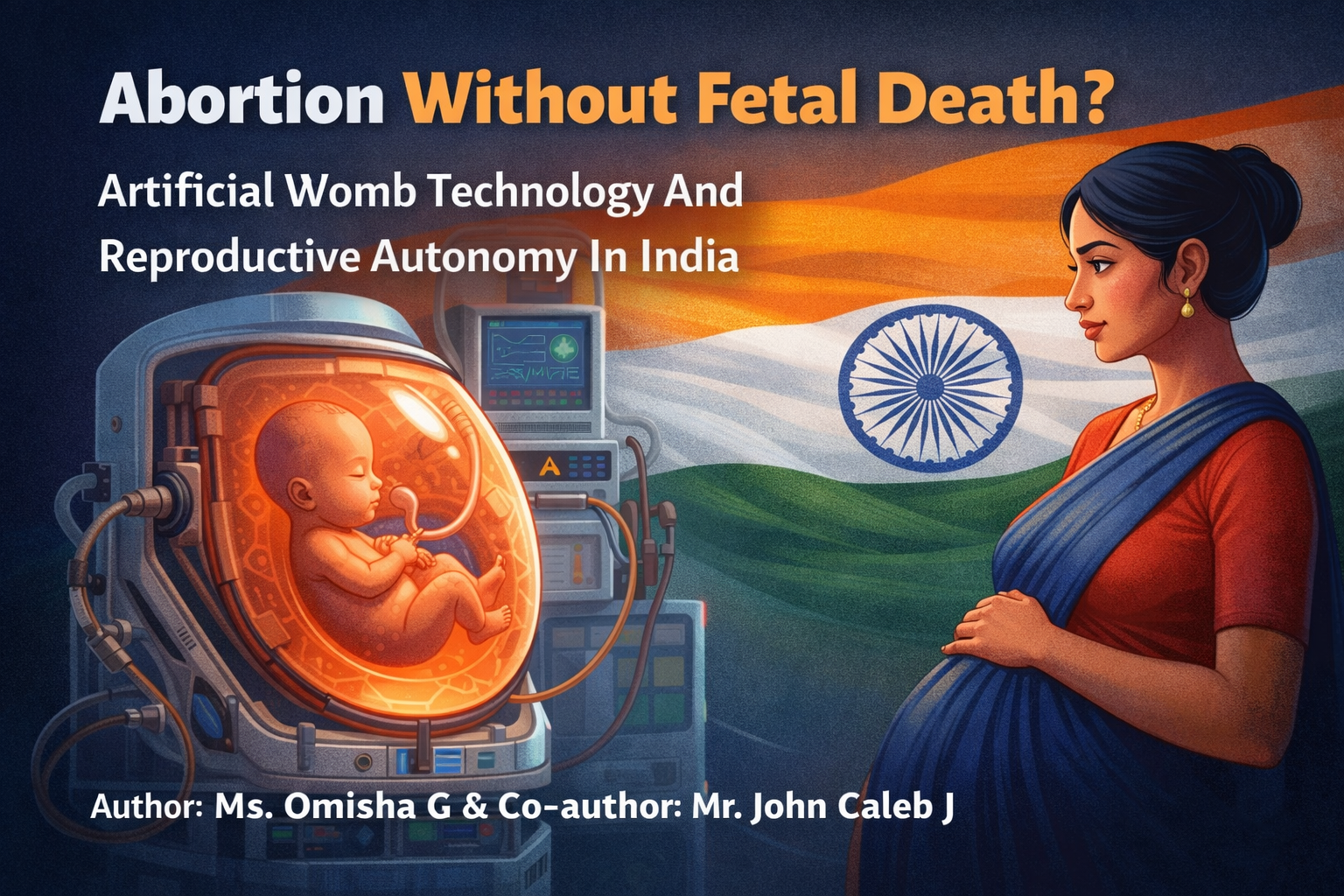
Abstract
Artificial womb technology (AWT), or ectogenesis, represents a profound biomedical development capable of sustaining fetal gestation outside the human body.[1] While originally conceived as a neonatal intervention for extremely premature infants, the technology carries significant implications for abortion jurisprudence. This paper examines whether the possibility of ending pregnancy without ending fetal life fundamentally alters the legal meaning of abortion. Using the Indian constitutional framework as its primary context, the study analyzes the Medical Termination of Pregnancy Act, 1971 (as amended in 2021)[2], and relevant Supreme Court jurisprudence recognizing reproductive autonomy as part of the right to life and personal liberty under Article 21.[3]
The paper argues that AWT does not eliminate the right to abortion because abortion law protects a pregnant person’s freedom from compelled gestation, not merely the right to cause fetal death. Although artificial gestation may preserve fetal life, forcing transfer to an artificial womb would still constitute state-imposed continuation of reproduction and therefore violate bodily integrity, decisional privacy, and dignity. The technology also destabilizes the legal concept of viability, traditionally used to balance maternal autonomy and state interest in potential life. If viability becomes technologically contingent, expanding state power based on ex-utero survivability risks coercive regulation of pregnancy.
Beyond doctrinal analysis, the paper explores practical and ethical consequences, including consent to surgical extraction, parental status of AWT-born children, distributive inequity, and potential institutional coercion. It identifies a regulatory vacuum in India, where no statute addresses ectogenesis. The study concludes by proposing an autonomy-preserving framework: explicit recognition of the right to refuse artificial gestation, clarification of the MTP Act’s autonomy rationale, and comprehensive regulatory oversight ensuring voluntary use. Ultimately, the paper contends that technological capability cannot redefine constitutional rights[4]; reproductive freedom must remain centered on the pregnant person’s choice rather than fetal preservation.
Keywords: Abortion Law, Article 21, Artificial Womb Technology, Ectogenesis, Reproductive Autonomy
Research Question
Does the emergence of artificial womb technology require a reconceptualization of abortion law in India, and can the State constitutionally mandate fetal transfer to an artificial womb in order to preserve potential life?
Methodology
The study adopts a doctrinal legal research methodology as its primary approach. It analyzes statutory provisions under the Medical Termination of Pregnancy Act, 1971 and constitutional jurisprudence of the Supreme Court of India interpreting Article 21, particularly the recognition of privacy, dignity, and decisional autonomy in reproductive choices. Judicial decisions are examined to determine whether abortion protects a right against fetal death or a right against compelled gestation.
The paper also uses a normative bioethical analysis, engaging scholarly literature on ectogenesis and reproductive liberty to evaluate autonomy-based arguments. Additionally, a limited comparative perspective is employed by referring to international academic debates and bioethics scholarship to assess how viability and parental status may evolve with technological change. The combined approach enables evaluation of both legal doctrine and ethical implications, allowing the paper to propose a regulatory framework grounded in constitutional principles while responsive to emerging biomedical realities.
Introduction
Artificial wombs (ectogenesis) are emerging reproductive technologies that can gestate a fetus outside a human uterus.[5] Haldane coined “ectogenesis” for complete outside-uterus gestation.[6] In practice, partial ectogenesis – transferring a fetus to external support after extraction – is already being developed.[7] Prototypes like the “Biobag” have kept lambs alive ex utero, and researchers aim for human trials within 5–10 years.[8] These advances have stirred debate because abortion law traditionally hinges on a balance between a pregnant person’s autonomy and fetal protection.[9] Conventionally, abortion means ending a pregnancy with fetal demise.[10] But if an abortion can end pregnancy without ending fetal life (via an artificial womb), the question arises: does “abortion” still exist?[11] We thus ask: If pregnancy can end while preserving fetal life, how should abortion law respond?[12] In India’s context, where the MTP Act emphasizes maternal health (not fetal rights), this challenge is acute.[13] This paper argues that even with such technology, abortion must remain autonomy-centered – the pregnant person’s choice – and outlines how laws should adapt.[14]
Understanding Artificial Womb Technology
Partial vs. Complete Ectogenesis: Complete ectogenesis would mean gestation entirely outside the womb (still theoretical).[15] Partial ectogenesis (often called ectogestation) means extracting a fetus from the uterus and continuing its gestation in an external device.[16] This technology is aimed at supporting preterm infants until full maturation.[17]
Scientific Developments: In 2016, a “Biobag” successfully sustained premature lambs ex utero for weeks.[18] Human applications are being explored: a Horizon2020 project (EctoLife) is prototyping an artificial womb, with plans for animal-to-human translation in the coming years.[19] These efforts seek to improve survival and outcomes for extremely preterm babies and to ease the burdens of gestation on women.
Legal Disruption (Viability): Because artificial wombs could allow fetuses to survive much earlier, they unsettle the traditional concept of “viability”.[20] In abortion jurisprudence, viability (usually ~24 weeks) has been the key point where state interest increases.[21] Ketchum notes that AWT “challenges conventional notions of viability”, potentially moving that threshold to an earlier gestational age. If a fetus can be kept alive off the womb, courts and legislatures will have to reconsider how viability is defined and applied in law.[22]
Legal Framework in India
India’s abortion law is governed by the Medical Termination of Pregnancy (MTP) Act, 1971 (as amended in 2021).[23] It legalizes abortion on limited health-related grounds, and otherwise abortion is a criminal offense under the IPC.[24] Key provisions include:
Permitted Grounds: Abortion is allowed when continuation of pregnancy poses a risk to the life of the pregnant woman, or would cause grave injury to her physical or mental health.[25] By explanation, pregnancies from rape or failed contraception are deemed “grave mental injury”.[26] A third ground is substantial fetal abnormality (if the child would be severely disabled).[27]
Gestational Limits and Doctors’ Opinions: If any ground is met, one registered doctor can approve an abortion up to 12 weeks’ gestation; two doctors are needed between 12 and 20 weeks. Originally, no abortions were allowed after 20 weeks except to save the mother’s life. The 2021 Amendment expanded this: abortions up to 24 weeks are allowed for specified categories (rape survivors, minors, disability, change in marital status, etc.) with two doctors’ approval.[28] Beyond 24 weeks, termination is permitted only in case of severe fetal anomalies, subject to a state medical board’s decision.[29]
Consent and Autonomy: Crucially, the Act requires only the pregnant woman’s consent for an abortion; neither husband nor guardian can override her decision.[30] This reflects the Act’s priority: protecting the woman’s health. The Act explicitly “does not confer any rights to the foetus”.[31] Its time limits are justified by maternal health concerns, not fetal rights. However, the law contains no explicit right to abortion (unwillingness to continue pregnancy is not itself a ground); some subjective clauses (e.g. failed contraception → presumed mental injury) are interpreted as proxies for autonomy.
The Supreme Court has recently reaffirmed the autonomy approach. In X v. Principal Secretary (2022)[32], the Court held that unmarried women have the same abortion rights as married women, and emphasized that Section 3 of the Act should be read broadly to favor access. And under Article 21[33], the Court explicitly recognized that reproductive and decisional autonomy (privacy and dignity) extend to abortion decisions. Even under the Protection of Children from Sexual Offences Act, the Court ruled that minors’ abortion clinics confidentially report without identifying patients, to avoid deterring young women from safe abortions. In short, Indian law is centered on the pregnant person’s health and choice: the Act prioritizes maternal well-being and the Supreme Court has grounded abortion access in privacy and autonomy.[34]
The Core Conflict: Preservation vs. Abortion
- Preservation Argument
Artificial wombs offer the possibility of rescuing fetuses from termination, fundamentally shifting the balance of state interest. Traditionally, abortion law strikes a balance between a woman’s autonomy and the State’s interest in potential life. If artificial womb technology (AWT) can preserve all fetuses, then an abortion need no longer result in fetal death – it only ends gestation.[35] In practice, this may strengthen the State’s stake in fetal survival.[36] As Anna Ketchum notes, if AWT “shifts viability” to an earlier age, “states can attempt to protect fetal life at a much earlier stage of gestation.”.[37] Under this view, a pregnant person who is willing to remain pregnant solely to use an AW (for example, by undergoing a surgical extraction) might be compelled to do so.
In legislative or judicial settings, this could translate into pressure to make use of AWT instead of permitting abortions. For instance, after AWT becomes available, courts might encourage doctors to present it as an alternative: rather than agree to terminate the pregnancy, the patient could “give the fetus a chance” in an artificial womb.[38] Indeed, one could imagine laws requiring referral to an AW facility as a condition for abortion approval. Some bioethicists warn that legislators or judges might try to “treat abortion as an avoidable fetal loss”.[39] In effect, AWT could be used to argue that abortion is unnecessary and even morally unacceptable if the fetus can live on. State interest therefore ostensibly increases: terminating a pregnancy without ending the fetus might be reframed as irresponsible or unethical. If unchecked, AWT availability could create de facto mandates to preserve any fetus deemed “viable ex utero,” greatly narrowing women’s choice in practice.
- Autonomy Argument
By contrast, leading scholars emphasize that the right to abortion is fundamentally about autonomy and reproductive choice, not merely fetal demise.[40] Abortion law protects a woman’s decision to end pregnancy, not the death of the embryo.[41] In this light, substituting an artificial womb is no mere technicality: it changes the act from ending a potential life to forcing a person to continue pregnancy via technology. Many ethicists insist that no pregnancy decision should be compelled by the existence of AWT. Elizabeth Romanis, for example, argues that AWs “do not present an alternative to conventional abortion.” She reasons that extracting a fetus for ex utero gestation is far more invasive (it involves a surgical delivery) and is technically infeasible for very early embryos – which constitute the majority of abortions.[42] In other words, because most abortions occur before 12–13 weeks, current artificial womb prototypes could not actually sustain those embryos; thus AWT cannot replace early abortion.[43]
More importantly, treating AWT as an “alternative” misunderstands the purpose of abortion rights. Romanis stresses that viewing AWT as a substitute “fundamentally misunderstands why abortion is protected.”. Abortion is not about fetal death per se, but about the woman’s right not to gestate or reproduce. Forcing a woman to undergo fetal extraction and continue carrying (even outside her body) would violate her bodily integrity.[44] The Indian Supreme Court has similarly emphasized that abortion is grounded in privacy and autonomy: it has affirmed that the decision “to terminate an unwanted pregnancy now vests only with the pregnant person.”.[45] By analogy, then, insisting on AWT transfer against a woman’s will would be a clear infringement of her constitutional rights.
In sum, the autonomy argument holds that AWT may preserve fetal life, but it cannot replace the woman’s choice to end pregnancy. As one commentator puts it, we should not allow technology to redefine the right: even if the fetus can live elsewhere, abortion remains the woman’s decision.[46]In this view, AWT might create a new option (continued gestation ex utero), but it should never erase the option of termination. Forcibly mandating transfer is as unacceptable as forcing natural childbirth. Women’s autonomy encompasses the right to refuse further reproduction, regardless of technological possibilities.
Constitutional Analysis (Article 21)
The Indian Constitution’s guarantee of life and liberty (Article 21) encompasses a broad range of personal rights, including privacy, dignity, and bodily integrity.[47] The Supreme Court has repeatedly held that reproductive choices, including abortion, fall within these protections.[48] In Kamble v. Union of India, the Court explicitly framed reproductive and decisional autonomy as facets of Article 21, linking the choice to bear a child with privacy and self-determination.[49] Similarly, the Court in X v. Principal Secretary found that the decision to terminate a pregnancy “vests only with the pregnant person,” making abortion a right rooted in personal liberty.[50]
Applying these principles, any law or policy that forces a woman to continue pregnancy via artificial means would likely be unconstitutional.[51] Article 21 protects her choice about her own body: a compelled fetal extraction or mandate to gestate in an AW would violate her physical autonomy. For example, if a hospital or court ordered a woman to undergo a C-section so that her fetus could be placed in an artificial womb against her wishes, this would “treat her body as a vessel” in contravention of her dignity and privacy rights. Likewise, refusing an abortion request on the basis that “the fetus can live in an AW” would undermine the woman’s autonomy in her reproductive decisions. The Court has stressed that criminalizing abortion unduly chills doctors and deters women from obtaining abortions. Decriminalizing or broadening access ensures that doctors can act on a woman’s wishes. Forcing AWT would recreate precisely the coercive scenario the Court sought to eliminate.
In short, Article 21 doctrine strongly supports keeping abortion as a choice, regardless of technological options. AWT cannot trump the constitutional guarantee that bodily integrity and personal liberty are fundamental. As the Court has said, reproductive freedom “must not be contingent on the pleasure of anyone else,” especially not the State.[52] Any legal interpretation must preserve a woman’s absolute decision over whether to gestate – even if there exists a way to preserve the fetus. In practical terms, legislation or regulation should explicitly safeguard a woman’s right to refuse an AW transfer, in line with Article 21 principles.
Redefining Abortion: Conceptual Shift
Artificial wombs blur the traditional definition of abortion. By definition, abortion is the termination of pregnancy, usually resulting in fetal death. AWT introduces a scenario where pregnancy ends but fetal life continues.[53] Some ethicists suggest this creates a “third category” between abortion and childbirth: ending pregnancy without ending gestation.[54] However, most commentators caution that law and language should remain focused on the woman’s intent.[55]
A key point is that abortion law is about the pregnant person’s choice, not about conserving fetal life. Romanis again cautions that calling AWT “an alternative to abortion” is a misnomer. The core legal interest is the woman’s autonomy: if she chooses to end reproduction, it should not matter whether the fetus is destroyed or preserved elsewhere. In legal terms, continuing pregnancy for the sake of the fetus is a separate option (akin to adoption), but it does not negate her right to refuse pregnancy.
Thus, from a doctrinal perspective, AWT does not redefine abortion so much as it introduces an additional outcome. Abortion can still be conceptualized as termination of gestation at the woman’s demand, while a separate decision (should one choose it) is to transfer the fetus to an AW. Laws need not recast their language; they simply have to clarify that ending pregnancy remains fully within the woman’s control. As one scholar warns, treating AWT as an “alternative” miscasts the problem: it risks narrowing abortion rights by implying women should always gestate in an AW if possible.[56] Instead, the law should reaffirm that abortion is about the choice to end gestation, irrespective of the fetus’s fate. In short, abortion remains the pregnant person’s decision to discontinue reproduction; AWT introduces a new option but does not eliminate the right to terminate a pregnancy.
Practical and Ethical Implications
The practical use of artificial wombs raises many legal and ethical questions.
Maternal Consent & Surgical Risk: Transferring a fetus to an AW involves a medical intervention (often a Cesarean or similar surgery).[57] This is a substantial procedure with its own risks – infection, anesthesia complications, bleeding – separate from any health risk posed by the pregnancy itself.[58] Because of these risks, ethical guidelines insist that any fetal extraction should be voluntary.[59] In fact, the authors of the AJOB article note that agreeing to such an extraction should remain an exercise of maternal autonomy.[60] Forcing a woman to undergo additional surgery to transfer a fetus would likely be regarded as a grave violation of bodily integrity.[61] Some ethicists even characterize consenting to “fetal extraction” for AWT as a supererogatory (beyond the call of duty) act, given the extra risk.[62] In practice, clinicians would need clear consent protocols: a woman must fully understand that AWT is experimental and elective.[63] Legally, this underscores that any “transfer procedure” must be consented to like any other surgery – it cannot be demanded.
Neonatal Care and Parenthood: Once a fetus is in an artificial womb, it becomes, in effect, a living baby receiving medical support.[64] Its care and rights then mirror any neonatal intensive care case.[65] Legally, this means both biological parents typically have decision-making authority over the child’s welfare. The referenced bioethics article observes that “after birth into an AW, ‘both parents would need to agree’” on major medical decisions.[66] This introduces complex questions in family law. For example, what if the pregnant woman gave birth to an AW-fetus against the father’s wishes (or vice versa)? How is parental responsibility shared? The law currently assumes that carrying a pregnancy and birth confer certain parental roles; AWT would require new rules to define custody and guardianship.[67] In any case, the child born via AWT would have all rights of a born infant, as one ethicist notes that such a “fetal neonate” is entitled to full legal protections. These children, however, also raise questions: if a woman aborted an unwanted pregnancy but the fetus was instead placed in an AW and survives, what say does she have in its life afterward? These scenarios blur the line between abortion and child welfare laws and will likely demand new legal frameworks for parenthood and custody post-ectogenesis.
Resource Allocation & Equity: High-technology neonatal care is expensive, and AWT is expected to be no exception.[68] Initially, only well-funded research hospitals or private institutions will offer such devices. Several scholars highlight that inequity of access will be a serious concern.[69] As De Bie et al. note, “AWT is anticipated to be expensive… [and] cost may…become a barrier to access,” exacerbating existing health disparities.[70] Ketchum similarly warns that without careful policy, AWT could widen socioeconomic gaps in reproductive healthcare.[71] If only affluent women can afford ectogenesis, wealthier individuals could extend fertility and avoid abortion more readily than poorer women. There is also the international dimension: advanced economies might monopolize AWT research and clinics, leaving developing countries behind. Any equitable policy would need to address funding (e.g. insurance coverage for AWT use), prioritized access, or other mechanisms to prevent a “reproductive divide.”
State and Institutional Coercion: Perhaps the most troubling scenario is the risk that governments or hospitals might coerce use of AWT. Ketchum explicitly warns of “state coercive power” if AWT becomes available.[72] For example, in a custody dispute, a court might order a woman to have a C-section and transfer the fetus to an AW on grounds that the State has an overriding interest in preserving potential life. Similarly, a hospital ethics board might pressure a vulnerable woman (e.g. a minor or someone unable to consent) to use AWT instead of aborting. Without firm legal guards, these abuses could occur subtly – for instance, doctors might present AWT as the only ethical option.[73] The ethical imperative is clear: no AW transfer should ever be mandated or achieved through pressure. Informed consent and voluntariness must be legally required. Otherwise, what began as a choice for women risks becoming an obligation imposed by outsiders.
Legal Status of the “Fetonate”: Terminology like “fetal neonate” or “fetonate” (fetus-neonate) is emerging in the bioethics literature. Legally, once a fetus exits the womb (via operation) and is sustained by AWT, it is no longer just a fetus but a living child with legal status.[74]Such an entity should have all rights of a newborn: citizenship, medical care, inheritance, and so forth.[75] This raises philosophical issues: for example, would killing an unwanted pregnancy by successfully aborting fail if the fetus is saved by AWT? Practically, however, existing law likely treats any supported born child as a person under statutes like the Indian Majority Act. These children may also be subject to wrongful birth or custody claims if parents disagree. The key ethical point is that AW-born children must be fully protected, which might require updating laws of parentage, adoption, and child welfare to account for ectogenesis.
In summary, artificial wombs introduce a host of novel concerns.[76] Ethically and legally, the consent of the pregnant person is paramount.[77] No other outcome can override her autonomy. Medical risks from fetal extraction mean women must be free to refuse. State actions must not become coercive under the guise of fetal “protection.” Finally, any child born via AWT deserves full legal recognition and care. Addressing these implications will require new protocols and possibly new legislation governing experimentation, clinical use, and aftercare of AW-born children, always with the mother’s rights at the center.
Policy Gaps in India
India currently has no specific law or regulation addressing artificial wombs.[78] The existing Medical Termination of Pregnancy Act (1971) and its rules make no mention of external gestation.[79] As a result, if AWT becomes feasible, courts and providers will face a legal vacuum. Several urgent gaps emerge:
Lack of Regulation on Ectogenesis: No statute explicitly regulates ectogenesis research or clinical use.[80] In contrast, the U.S. or U.K. might consider AWT under assisted reproductive technology or newborn care guidelines; India has no analogous framework.[81] Without clear rules, experimental use of AWs on humans would rely on general clinical trial laws (e.g. Clinical Trials Rules) – which may not cover the unique consent issues of ectogenesis.[82] We need specific guidelines to govern everything from safety standards to patient selection for AWT.
Coercive Medical Advice: In the absence of clarity, doctors may be unsure whether they are obliged to suggest AWT. A woman seeking an abortion could encounter a doctor who believes it is “in the fetus’s best interest” to use AWT. In the worst case, a hospital policy might treat AWT as the standard of care for any pregnancy termination past a certain age. Without explicit legal protection, women who decline an AW transfer could be stigmatized or even denied abortion care. Conversely, anti-abortion groups might push courts to enforce AWT transfers. Indian law (via Article 21) prohibits forced medical procedures, but stronger statutory language may be needed to prevent subtle coercion.[83]
Bioethics Oversight: India’s ICMR guidelines on assisted reproduction (e.g. surrogacy regulations) do not cover gestating in a machine.[84] An ethics committee for human research (especially if the pregnant woman is a trial participant) would have to evaluate any first-in-human AWT studies, but these committees have no prior experience with such tech.[85] There is a need for national ethical guidelines specific to AWT – for example, an ICMR (or Niti Aayog) policy document that addresses informed consent procedures, selection of subjects, risk disclosure, and follow-up of babies and mothers.[86] If India encourages AWT research (e.g. through government grants), it should concurrently mandate robust oversight and reporting requirements.
Equity and Access: Given India’s large inequalities in healthcare, there is a real danger that AWT will only be available to the affluent in private metros.[87] Unless policy intervenes, poor women, rural populations, and marginalized castes will not have access to AW devices. Lawmakers should anticipate this by incorporating public health mandates. For instance, AW services (once safe) could be included in public insurance schemes, or mandated at selected government hospitals, to prevent a class-based disparity. Otherwise, the technology could exacerbate reproductive injustice.
Legal Ambiguity on “Refusal as Termination”: There is also a statutory gap concerning criminal law.[88] The Indian Penal Code (1860) treats causing a miscarriage as a crime, with very narrow exceptions.[89] The MTP Act created a narrow legal escape by permitting authorized abortions.[90] If a woman refuses an AW and thus permits fetal death, could someone argue she committed “wrongful miscarriage”? This seems unlikely, but given how the IPC is sometimes invoked (e.g. against informal providers), explicit clarification might be wise. The legislature could amend the IPC or MTP Act to expressly state that not using AWT (when sought by a woman) does not constitute an offense. Such a shield would prevent prosecutorial confusion over whether AWT availability changes the legality of an abortion.
In short, India’s legal framework has glaring silences regarding AWT. The consequences of leaving these gaps unaddressed could be serious: confusion among doctors, inequitable access, and potential erosion of women’s rights.[91] To proactively manage AWT’s arrival, policymakers should draft new guidelines and laws now, rather than wait for contentious cases to force their hand.
Normative Proposal
To preserve autonomy and justice in the age of ectogenesis, we propose the following legal safeguards:
Explicit Right to Refuse AW Transfer: Amend the MTP Act (or related law) to state affirmatively that a pregnant woman may refuse any medical procedure (including fetal extraction and transfer to an artificial womb). For example, a clause might read: “A woman may decline to continue any pregnancy, whether in the womb or via artificial gestation, and such refusal shall not be considered unlawful.” This would enshrine the principle that abortion rights exist independently of technology. Under this rule, choosing abortion (rather than AWT) is clearly within the woman’s rights and not subject to penalty. Such a provision would mirror the Supreme Court’s holding that the abortion decision “vests only with the pregnant person”, making it explicit in statute.
Clarify MTP Act for Autonomy: Revise the MTP Act’s language to reinforce autonomy. Currently, the Act lists specific grounds for permissible abortion but does not explicitly mention a general right to choose.[92] The law could be amended to insert a general autonomy-based clause or to interpret “grave mental health injury” broadly whenever a woman seeks abortion. Another option is adding a preamble or explanation stating that termination is an option whenever a woman deems her life or health adversely affected by gestation – including by psychological or social burden. In essence, the Act’s rationale should shift from being solely health-based to rights-based. The Amendment of 2021 already broadened access and removed marital status barriers;[93] further changes could make clear that no refusal of AWT (or any reproductive assistance) will revoke her legal right to terminate.
Robust AWT Regulations: Enact a new set of regulations specifically for artificial womb technology. This would be akin to the Assisted Reproductive Technology (ART) rules or surrogacy regulations. Key features should include: (a) Mandatory Research Oversight: All AWT use in humans must be approved by a high-level medical-ethical board. (b) Informed Consent Protocols: Consent forms must explicitly explain that AWT is experimental, optional, and carries risk, and that refusal has no penalty. (c) No Coercion Clause: The rules must prohibit any involuntary use of AWT. For example: “No government official, court, or medical authority shall compel a woman to use artificial womb technology as an alternative to abortion.” (d) Equity Measures: Regulations should require provision of AWT (once deemed safe) at government hospitals or subsidized clinics, to prevent a purely market-driven rollout. The medical board system (newly created in MTP Act for post-24-week cases) could also screen requests for AWT use beyond the Act’s normal limits, ensuring they meet strict criteria (similar to fetal anomaly cases). (e) Parental Rights Definition: The regulations should clarify the legal status of a child born via AWT (as the child of the birth mother and any other legal parent) and lay out parental responsibility. This could draw on existing family law but may require special provisions for child-welfare oversight of AW-babies.
Affirm Autonomy in Policy: At the highest level, government health policy must reiterate that abortion is an autonomy-based decision. Training materials, medical ethics guidance, and public health messaging should all emphasize that even if technological options exist, a woman’s choice is supreme. For instance, the National Health Policy or Medical Council guidelines could include statements to this effect. This complements legislative safeguards by shaping the culture of medical practice.
Decriminalization of Abortion (If Needed): Although India’s criminal statutes are largely superseded by the MTP Act, some legal writers (and international experts) advocate decriminalizing abortion outright.[94] The recent Supreme Court remarks suggest viewing abortion as a private health decision.[95] Lawmakers could consider repealing or amending the IPC provisions on miscarriage to remove any lingering penal language, making abortion a purely medical-not-criminal matter. This step would be consistent with treating abortion as fundamental right, immune to extra-legal challenges brought about by AWT.
These recommendations aim to ensure that autonomy always trumps technology. By explicitly protecting the right to refuse AW transfer and updating laws to center on women’s choice, India can avoid the trap of “forcing innovation” on its citizens. As Ketchum argues, regulations should balance medical innovation with individual freedom and fairness.[96] If enacted proactively, these reforms will allow AWT to develop as a reproductive option for women, not as a tool against their wishes.
Conclusion
Artificial womb technology presents revolutionary possibilities, but it must not overturn constitutional rights. In India, the right to privacy and bodily integrity under Article 21 mandates that reproductive decisions remain with the woman.[97] Even if an artificial womb can preserve fetal life, it cannot override her autonomy. As our analysis shows, forcing transfer to an AW would be legally and ethically impermissible. Abortion must remain an autonomy-centered choice, and any law concerning ectogenesis should explicitly protect the pregnant person’s right to refuse artificial gestation.[98]
Moving forward, India needs clear legislation and guidelines to fill the gaps in current law. This includes amending the MTP Act to clarify that termination is allowed regardless of AW technology, and enacting regulations that ensure access to AWs is optional, equitable, and consent-based. Only by taking these steps can we safely integrate AWT without compromising women’s rights. In sum: technology must not redefine fundamental rights. Women’s reproductive freedom – the core of abortion jurisprudence – must stay intact, as courts and scholars have underscored.[99] The arrival of artificial wombs makes it urgent to affirm this principle and to adapt our laws in an autonomy-centric way before the technology arrives on a large scale.
[1]Emily A. Partridge et al., An Extra-Uterine System to Physiologically Support the Extreme Premature Lamb, 376 NATURE COMMC’NS 1, 1–2 (2017).
[2]Medical Termination of Pregnancy Act, No. 34, Acts of Parliament, 1971 (India); The Medical Termination of Pregnancy (Amendment) Act, No. 8, Acts of Parliament, 2021 (India).
[3]Suchita Srivastava v. Chandigarh Admin., (2009) 9 S.C.C. 1 (India); K.S. Puttaswamy v. Union of India, (2017) 10 S.C.C. 1 (India); X v. Principal Sec’y, Health & Fam. Welfare Dep’t, (2022) 10 S.C.C. 1 (India).
[4]Puttaswamy, supra note 3.
[5]Elizabeth Chloe Romanis, Artificial Wombs and the Erosion of the Abortion Right, 20 MED. L. REV. 1, 4 (2020).
[6]J.B.S. HALDANE, Daedalus: Science and the Future 36-39 (1924).
[7]Romanis, supra note 1, at 5.
[8]Christopher E. Partridge et al., An Extra-Uterine System to Physiologically Support the Extreme Premature Lamb, 166 NATURE COMM. 1, 2-6 (2017).
[9]Suchita Srivastava v. Chandigarh Admin., (2009) 9 S.C.C. 1 (India).
[10]Judith Jarvis Thomson, A Defense of Abortion, 1 PHIL. & PUB. AFF. 47, 54 (1971).
[11]Romanis, supra note 1, at 7.
[12]Id.
[13]Medical Termination of Pregnancy Act, No. 34, Acts of Parliament, 1971 (India).
[14]Ronald Dworkin, Liberty and Moralism, 2 PHIL. & PUB. AFF. 144, 146-52 (1973).
[15]Romanis, supra note 1, at 6.
[16]Id.
[17]Partridge et al., supra note 4, at 3.
[18]Suchita Srivastava v. Chandigarh Admin., (2009) 9 S.C.C. 1 (India).
[19]Partridge et al., supra note 4, at 5.
[20]Anna Ketchum, The Ethics of Ectogenesis and the Future of Pregnancy, 29 J. MED. ETHICS 213, 215 (2021).
[21]Roe v. Wade, 410 U.S. 113, 163 (1973).
[22]Ketchum, supra note 16, at 217.
[23]Medical Termination of Pregnancy Act, supra note 9.
[24]Indian Penal Code, No. 45, Acts of Parliament, 1860, §§ 312-316 (India).
[25]MTP Act, supra note 9, § 3(2).
[26]Id. Explanation 1.
[27]Id.
[28]The Medical Termination of Pregnancy (Amendment) Act, No. 8, Acts of Parliament, 2021 (India).
[29]Id.
[30]MTP Act, supra note 9, § 3(4).
[31]Id.
[32]X v. Principal Sec’y, Health & Fam. Welfare Dep’t, (2022) 10 S.C.C. 1 (India).
[33]Id.
[34]K.S. Puttaswamy v. Union of India, (2017) 10 S.C.C. 1 (India).
[35]Romanis, supra note 1, at 7.
[36]Ketchum, supra note 16, at 218.
[37]Id.
[38]I. Glenn Cohen, Artificial Wombs and Abortion Rights, 49 HASTINGS CTR. REP. 37 (2019).
[39] Id. At 32, 35
[40]Thomson, supra note 6, at 55.
[41]Id.
[42]Romanis, supra note 1, at 8.
[43]Id. at 9.
[44]Suchita Srivastava, supra note 5.
[45]X v. Principal Sec’y, supra note 28
[46]Romanis, supra note 1, at 8.
[47]Puttaswamy, supra note 30.
[48]Suchita Srivastava, supra note 5
[49]Kamble v. Union of India, 2022 SCC OnLine Bom 2073 (India).
[50]X v. Principal Sec’y, supra note 28
[51]Puttaswamy, supra note 30.
[52]Suchita Srivastava, supra note 5.
[53]Romanis, supra note 1, at 9.
[54]Cohen, supra note 34, at 36.
[55]Romanis, supra note 1, at 9.
[56]Romanis, supra note 1, at 8.
[57]Cohen, supra note 34, at 32, 33.
[58]Romanis, supra note 1, at 20.
[59] Id.
[60]Maaike De Bie et al., Ethical Considerations of Artificial Womb Technology, 44 J. MED. ETHICS 771, 775 (2018).
[61]Id.
[62]Puttaswamy, supra note 30.
[63]De Bie et al., supra note 55, at 776.
[64]Id.
[65]Id.
[66]Cohen, supra note 34, at 35.
[67] Id.
[68]De Bie et al., supra note 55, at 777.
[69]Anna Ketchum, The Ethics of Ectogenesis and the Future of Pregnancy, 29 J. MED. ETHICS 213, 218 (2021).
[70]De Bie et al., supra note 55, at 777.
[71]Ketchum, supra note 64.
[72] Id.
[73]Cohen, supra note 34, at 37.
[74]De Bie et al., supra note 55, at 776.
[75]Indian Majority Act, No. 9, Acts of Parliament, 1875 (India).
[76]Cohen, supra note 34, at 33.
[77]Puttaswamy, supra note 30.
[78]MTP Act, supra note 9.
[79] Id.
[80] Id.
[81]Romanis, supra note 1, at 10-12.
[82]New Drugs and Clinical Trials Rules, 2019, Gazette of India (India).
[83]Puttaswamy, supra note 30.
[84]Assisted Reproductive Technology (Regulation) Act, No. 42, Acts of Parliament, 2021 (India).
[85]Indian Council of Medical Research, National Ethical Guidelines for Biomedical and Health Research Involving Human Participants (2017) (India).
[86] Id.
[87]De Bie et al., supra note 55, at 771, 777.
[88]Indian Penal Code, No. 45, Acts of Parliament, 1860 (India).
[89]Id. §§ 312–316.
[90]MTP Act, supra note 9.
[91]Ketchum, supra note 16, at 218.
[92]MTP Act, supra note 9 at § 3.
[93] Id.
[94]Indian Penal Code, No. 45, Acts of Parliament, 1860, §§ 312–316 (India).
[95]Suchita Srivastava, supra note 5.
[96]Ketchum, supra note 16, at 213, 218.
[97]Puttaswamy, supra note 30.
[98]X v. Principal Sec’y, supra note 28
[99]Romanis, supra note 1, at 1, 7-9.