Abstract
The criminal law amendment act or the Nirbhaya act was passed on 19th March 2013 after the infamous Nirbhaya gang rape case happened. This case created an uproar in entire country with demanding of reforms more clearer and stricter laws against the prevention of these crimes and making sure that they don’t repeat or happen in future.
For this a committee was constituted, to suggest amendments to criminal law to sternly deal with sexual assault cases. The report indicated that failures on the part of the Government and Police were the root cause behind crimes against women.Major suggestions of the report included the need to review AFSPA in conflict areas, maximum punishment for rape as life imprisonment and not death penalty, clear ambiguity over control of Delhi Police etc.
While the act itself was a major stepping stone towards creating a more safer and secured environment for women it lacked a sense of thinking which was clearly seen in these acts such as-:
- Section 354A which defined the punishment for sexual harassment was only limited to protect women.
- Section 354C which defined the punishment for Voyeurism was also limited to protect women.
- Similarly was Section 354D which also protected only Women.
This created a stir and was criticised by many people as this could also be used by some women to trap men in fraudulent cases, and could misuse the law moreover these crimes should be gender neutral and not gender specific.
A very important thing to note down is that after this bill was passed the number of false cases against men increased many folds it included allegations of harassment for dowry molestation, cheating, and rape by women adding to severity of this was the defamation those people had to go through before they were found not guilty of it.
My research paper will be focusing majorly on the gender biasness focusing of this act, and how is this against the very constitutional essence.
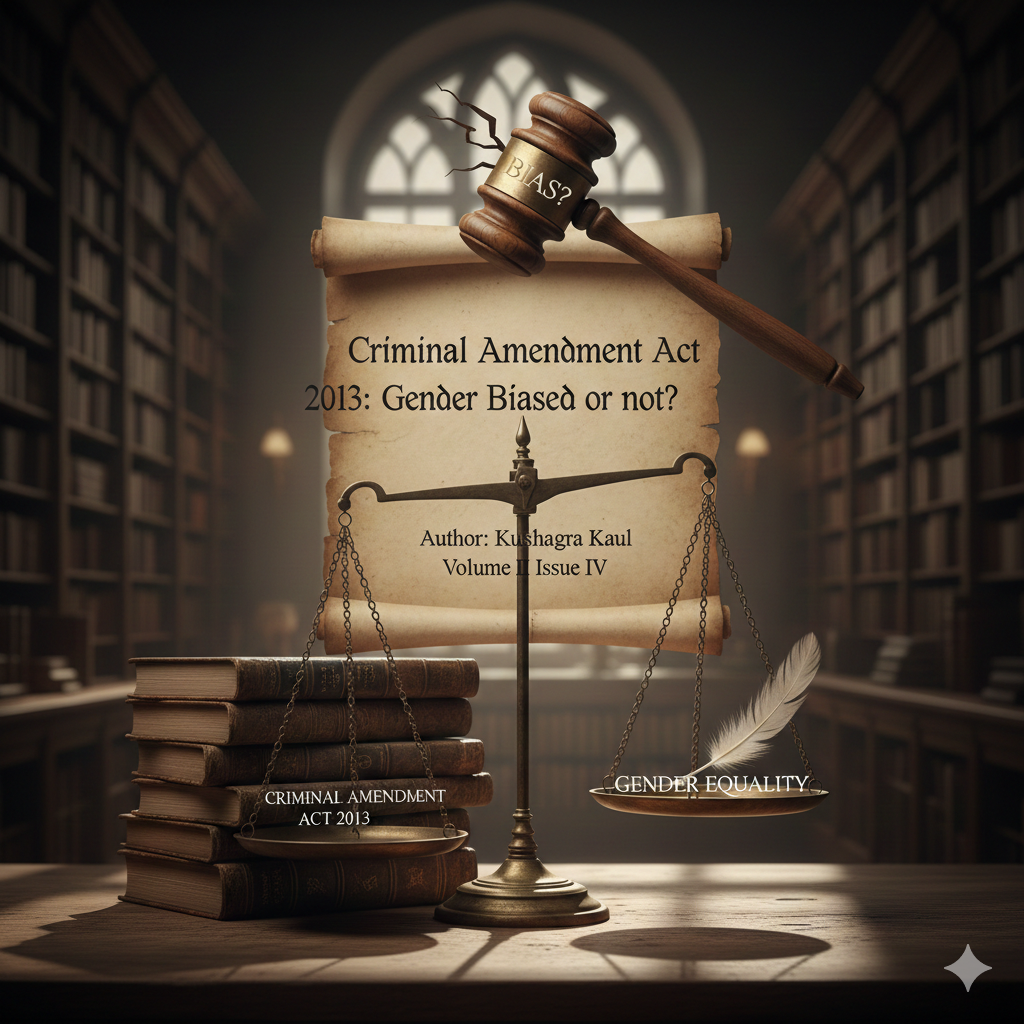
Criminal amendment Act 2013: Gender Biased or not?
Introduction
In the aftermath of the notorious Nirbhaya sex assault trial, the 2013 criminal amending act was passed. In a charter bus she was riding with her male partner, a 23-year-old female physiotherapist was abducted, gang raped and tortured. Tis event was so serious it shook the world as a whole. The girl was tried to save everything but she died.The prisoners faced a long trial with them time and time again using petitions of grace and other pleas to postpone and prevent hanging, but they are due to be executed on 20 March right now.
This incident created a storm in the country with people going out on the streets seeking justice and calling for law reform to include a more stricter code such that these events will never be replicated in the future. The Central Government named a committee of retired judges led by J. S. Verma, a retired supreme court judge, to suggest amendments to criminal law to strictly deal with sexual violence cases. The committee, which also included retired judge Liella Seth and leading advocate Gopal Subramaniam, was given a month to submit its report.
“The Committee presented its report within 29 days, on 23 January 2013, ostensibly after evaluating the 80,000 recommendations and petitions they received from the public at large and in particular from jurists, lawyers, NGOs and advocacy groups during the same time. The study suggested that policy and police shortcomings were the root cause of woman’s crimes women.”[1]
On 1 February 2013, the Union Ministers gave its consent to bring an ordinance to give effect to changes in policy as recommended in the report of the Verma Committee.
“According to Ashwani Kumar, former Minister of Law and Justice, 90% of the suggestions made in the Verma Commission report have been integrated into the amendment.The legislation was eventually replaced by a Act, which had been passed by the Lok Sabha on 19 March 2013”[2]. This bill ensured more stricter rules to curb upon such heinous crimes some of the main point of this act are-:
Section | Felony | Reprimand | Applicability | |
354A | “Sexual Harassment | Rigorous imprisonment up to three years, or with fine, or with both in case of offence described | Only protects women. | |
354B | Act with intent to disrobe a woman | Imprisonment not less than three years but which may extend to seven years and with fine. | Only protects women from anyone “assaulting or using delinquent pressure against any woman or abetting such act with the aim of disrobing or forcing her to be naked.” | |
354C | Voyeurism | In the case of a first arrest, sentence is not less than one year, but may increase to three years, and is also subject to fine, and punishable on a second or subsequent prosecution, with either definition being imprisoned for a period not less than three years, but which may extend to seven years, and also liable to fine. | Only the women safe. The prohibited behaviour is described as follows: watching or catching a woman in a “private act” that involves an act of observing performed in a position which, in the circumstances, should reasonably be assumed to provide security and where the victim’s genitals, buttocks or breasts are exposed or covered in underwear only; or the victim uses a washing machinery the individual performs a sexual act which is not normally done in public.”[3] | |
Outcome
Although this act has extensively defined and elaborated law to be in favour of women and to ensure their safety one of the main things to note about it is that Section 354A,B and Section 354C only protects women of their respective crimes. Although we know that this act was passed to ensure the safety of women and one of its main aim was to ensure women are protected and can live in a safe environment but the above stated crimes are those which can happen with men also.
These cases although do not come into the picture very often but even men can face sexual harassment or being public ally disrobed and humiliated and can face the crime of Voyeurism. On this point it was even criticised by many law makers that it only focuses on a particular gender too much that it forgets that crime don’t happen while taking into consideration the gender of the person. To sum this up we can say “It said so for gender biased and giving women the legal authority to commit exactly the same crimes (against which they seek protection) against men with impunity.”[4].
Reports of Different Cases
To prove this point we can see cases that have filed by women against men after the introduction of this bill in which we can observe one thing out of it that the number of false cases have increased at a rapid pace. For example-:
“Police in Jaipur have found that between 2015-16 4,206 fake cases were registered in Jaipur. In most cases, a false complaint was filed for the intent of extorting money or defaming a individual for settling personal scores.
Such false incidents, according to a senior police officer, included charges of dowry abuse, molestation, adultery and rape. Such shocking figures emerged when the additional police commissioner Prafull Kumar (First) asked all DCP headquarters to provide details of cases where the preliminary report (Aut) was found to be false.”[5]
The report found that fifty of the cases filed under Section 376 were false and focused on Flimsy charges. This is a stunning unfortunate number. There is still a surge of incidents overburdening the police stations.
In one of the cases one of a girl claimed that her property owner abused her, it was found that perhaps the girl was lying as her landlord when investigating was carried out.
“Especially looking at sexual abuse of children, the Indian government found in 2007 that 57.3 percent were boys and 42.7 percent were girls of interviewed children who reported witnessing serious sexual harassment, including rape or adultery. More recently, the Centre for Civil Society based in Delhi found that approximately 18 percent of polled Indian adult men reported being forced or pressured to have sex perpetrator.”[6]
The only thanks to giving some kind of justice to these male survivors were at times charges under IPC Section 377. A research found that about 51% of suicides among men accused of sexual misconduct were due to false charges of sexual abuse against them and that this figure grew over time to include false cases of dowry.Studies have also shown that women often marry men and then divorce them as alumni in order to get compensation. Such cases increased after the president signed the amendment bill.
In one of its kind case it was found that a “In her lawsuit, woman alleged her senior had sexually assaulted her in 2011. She had charged that the man had stepped out of line and behaves inappropriately against her, In order to investigate the accusation, an ICC was established where the man had refuted the allegation and argued that the accusation was the result of a vendetta towards him in the absence of other official work.
The committee had observed that the exact content of communication of the incident could not be established and gave benefit of doubt to the man.”[7]
The women also argued that the person should not be given the assumption of innocence, and that his retirement benefits should be removed right then and there. High Court later found this was a wholly false allegation of women extracting money from the man.
In another famous case that later became highlight of Delhi was Saravjeet Singh[8] case. A college student at Delhi’s St Stephen’s College posted a picture of Singh at a pedestrian crossing on the internet and said he had passed lewd remarks and abused her as she was attacked. News outlets and politicians came to the girl’s rescue and also made her an example of how to fight back against these people, meanwhile the boy’s life became miserable, a case was filed against him under the charge of harassment and his family was also humiliated public ally, However, the boy lost his career during the trial, his sister’s marriage was postponed and he had to go to court every time when, but at the other hand, the girl only appeared once in four years before the court and moved to Canada.
All of this was later discovered to be incorrect because there was no evidence to indicate that such misconduct ever happened to her and the man was acquitted.
Over time, several politicians and parliamentarians have sought to change the legislation because of all those concerns facing the legislation. Senior attorney and parliamentarian KTS Tulsi introduced a personal members bill in Rajya Sabha to incorporate criminal law changes to form gender based sexual offences.
” There has to be a balance in the law. The dynamic got disturbed. They will be gender based for all sexual crimes. Men, women and other races may be both perpetrators and victims of these crimes. We need men, women and others to be protected,” parliamentarian KTSTulsi said.
The report recommends changes to the Indian Penal Code (IPC), the Code of Criminal Procedure and, thus, the Indian Evidence Act to ensure that the words “any guy” and “any woman” in the sections on sex offences under the law are updated to read as anyone.
It will expand the protection of the law to women, men and transgender people, and include gender equality. The bill also notes that there was a “spate of incidents leading Spate of events resulting in injury, gender or sex psychological distress due to multiple sexual crimes and abuse against them”.In addition to other changes, the bill also involves adding a substitute violation into the rape laws-introducing penalties for “touching” without penetration of the victim’s genitals.
The declaration of subject-matter of the bill states that it is intended to “provide effective defence of the civil rights of all persons subjected to sexual abuse and crimes, punish acts of sexual harassment and rape of all ages, including but not limited to men and transgender people, as well as defence Entitled to women under current criminal law and prosecute criminals of either sex or gender thereto.”[9]
Hence we can see that law is being changed and implemented accordingly to be more specifically gender neutral and not be discriminatory towards the other gender.
In this paper I am not saying that always this happens but over the years women have taken undue advantage over these legal rules and law and law moreover not being gender neutral just like criminal ordinance bill 2013.
With the coming up of these rules and regulation we could expected a more clarity and ensured safety for women, however even after this ordinance many sexual harassment cases were registered against women such as-:
IV. Shakti Mills gang-rape, July-August, 2013[10]
The incident that happened in a closed Mumbai mill sparked wide-ranging anger in public criticism. A 22-year-old photojournalist was assaulted and her co-worker was raped by five men, on August 22. The accused was blackmailed that, if she protested, her pictures would be shared online to defame her.
On 13 July, an 18-year-old reportedly was raped in the same factory. Three of the five people convicted–Vijay Jadhav, Qasim Sheik and Salim Ansari–were imprisoned for both committing the crimes and sentencing them to death. Two other defendants were minors, who were charged and sentenced to three years in an exceedingly juvenile detention facility.
V. Rape of six-year-old at Vibgyor High, July, 2014[11]
Protest stirred up in Bangalore after school workers raped a six-year-old at a global school, Vibgyor High. The incident triggered a lot of public outrage and protest and organized a bandh to concentrate on women’s security issues in the region.
Both in the case two instructors of gymnastics, Lal Giri and Wasim Pasha, were arrested. They got prosecuted under the POCSO Act. The case is very important because it saw changes being made to the State Goondas Act[12] that enabled bringing sex offenders under its cover
VI. Uber rape case, December, 2015[13]
A 27-year-old woman was raped by her driver whilst in a Uber cabin in Delhi after dwelling in the passenger seat and waking up to find him molesting her. Threatening to kill her, the perpetrator then clobbered her inside the vehicle and raped her.
The lady sent an FIR, and lab tests concluded that she had been raped. The accused, Yadav, was arrested in state at Mathura. Further investigation revealed that the accused had obtained
A fake Certificate of Character for his work at Uber. On 20 October 2015, a long-drawn trial followed in which Yadav was imprisoned. The case is especially significant because criminal charge against Uber was possible, and it was also briefly prohibited in Delhi
VII. Sivagangai minor girl rape case, July, 2019[14]
One of the relatives of the rape victim, Selvi, lodged a complaint with local police alleging that her father and her brother coerced the girl into prostitution, namely Muthupandi and Karthik respectively..
The case was referred to CID’s Crime Division in Sivagangai. The case took an surprising turn when the aunt was revealed to be the crime’s key culprit and was charged, and the victim, in addition to that, said she was forced to call her father and uncle, too. A final indictment sheet was filed before the Mahila Court Fast-track, with 12 guilty people. It refers to Selvi; Dr.Manivannan and Dr.Karnan, two clinical professionals who are suspected to have performed victim abortions; and four minors, including Selvi’s wife.
So we can see clearly how these laws have not been fully applied until now, and their usefulness is still lacking somewhere.
Another thing to remember is that #Me Too was also in the news over the year, it was also a campaign launched by women to come open and share the experience of being harassed by the other people.
- #Me Too
“Similar to other social justice and empowerment movements based upon breaking silence, the purpose of “Me Too”, as initially voiced by Burke as well as those who later adopted the tactic, is to empower women through empathy and strength in numbers, especially young and vulnerable women, by visibly demonstrating how many women have survived sexual assault and harassment, especially in the workplace”[15].
The’ me too’ motion helps survivors of sexual abuse by linking survivors to outlets, providing network coordinating tools, creating a reporting forum for’ me too’ and collecting scholars and studies on sexual violence. Me Too’ movement paintings are a combination of grassroots organizations that disrupt sexual abuse and build digital networks to link survivors to assets.
While the Me Too campaign has offered women a voice to come out of the enclosed space and at the same time become more conscience-empowered, Me Too has started to show off its dark side. This was found in a research that almost 34 percent of the MeToo accusation were false and were blamed purely for gaining public attention or for taking personal enmity against them. Another research shows people trailing MeToomovement have started to exclude women from their social clubs or after work parties only with a fear in their minds that to have a safe distance from them.
Conclusion
As we can clearly notice one thing that the environment is created of fear and hostility because of these un-favouring laws towards a specific gender which has to be challenged as the need of the hour is not to place one gender over the other but to bring about equality at the same time having a safe and secured environment where women feel safe and free to live without any restrictions upon them so that there can be an environment where every person irrespective of their gender be open and not be afraid to express themselves as has been enshrined in our constitution.
1Sandeep Joshi, Shinde Calls Meeting Of Chief Secretaries, Police Chiefs To Review Crime Against Women, The Hindu (Dec. 24, 2012, 17:42 IST), https://www.thehindu.com/news/national/shinde-calls-meeting-of-chief-secretaries-police-chiefs-to-review-crime-against-women/article4235212.ece.
[2]Sunil Prabhu, Cabinet Clears Anti-Rape Law Ordinance, Says Death Sentence For Extreme Cases, NDTV (Feb. 01, 2013, 11:21 IST), https://www.ndtv.com/india-news/cabinet-clears-anti-rape-law-ordinance-says-death-sentence-for-extreme-cases-512101.
[3].Criminal Law (Amendment) Act, 2013, No. 13, Acts of Parliament, 2013.
[4]Times Now Network, Sexual Crimes Ordinance: Open To Revisions In Anti-Rape Bill: Govt, India News – Times Of India (Feb. 3, 2013, 04:40 IST), https://timesofindia.indiatimes.com/india/Open-to-revisions-in-anti-rape-bill-Govt/articleshow/18313164.cms.
[5]Dishank Purohit, False Report: 4,206 Fake Cases Filed In Jaipur In 2016 | Jaipur News, Times Of India (Jan. 20, 2017, 10:36 IST), https://timesofindia.indiatimes.com/city/jaipur/4206-fake-cases-filed-in-city-last-year/articleshow/56673897.cms.
[6]John Stokes, India’S Law Should Recognise That Men Can Be Raped Too, Quartz India (Sept. 12, 2014, 10:14 IST),https://qz.com/india/264512/indias-law-should-recognise-that-men-can-be-raped-too/.
[7]PTI, Delhi HC Imposes Rs 50,000 Cost On Woman For Filing False Sexual Harassment Plea, India Today ( July. 2012, 2019, 23:22 IST), https://www.indiatoday.in/india/story/delhi-high-court-rs-50000-cost-woman-false-sexual-harassment-plea-1567985-2019-07-12.
[8]Asian News International, Complaint Doubtful: Delhi Court Acquits Sarvjeet Singh In 2015 Sexual Harassment Case, India Today (Oct. 26, 2019, 12:34 IST), https://www.indiatoday.in/india/story/complaint-doubtful-delhi-court-acquits-sarvjeet-singh-in-2015-sexual-harassment-case-1613088-2019-10-26.
[9]supra note 4.
[10]The State of Maharashtra v. Vijay Mohan Jadhav and Ors,(2019) SCC OnLine Bom 2000.
[11]Mr. Shiju Abraham Verghis vs The Principal Secretary To The … , (2014) 3 HKC 145.
[12] East Bengal Control of Disorderly and Dangerous Persons (Goondas) Act, (1970) 22 DLR 496.
[13]State (NCT of Delhi) v. Shiv Kumar Yadav (2015) 2 SCC 402.
[14]M. Muthukumar vs The Inspector Of Police (2018) 2 MWN 88.
[15]Shloka Verma, Me Too – Is It The Right Approach For Equity?, Pen Acclaims (Dec. 23, 2018, 10:34 IST), http://www.penacclaims.com/wp-content/uploads/2018/12/Sholka-Verma.pdf.