‘Biotechnology can transform humanity, provided humanity wishes to be transformed.’
Abstract:
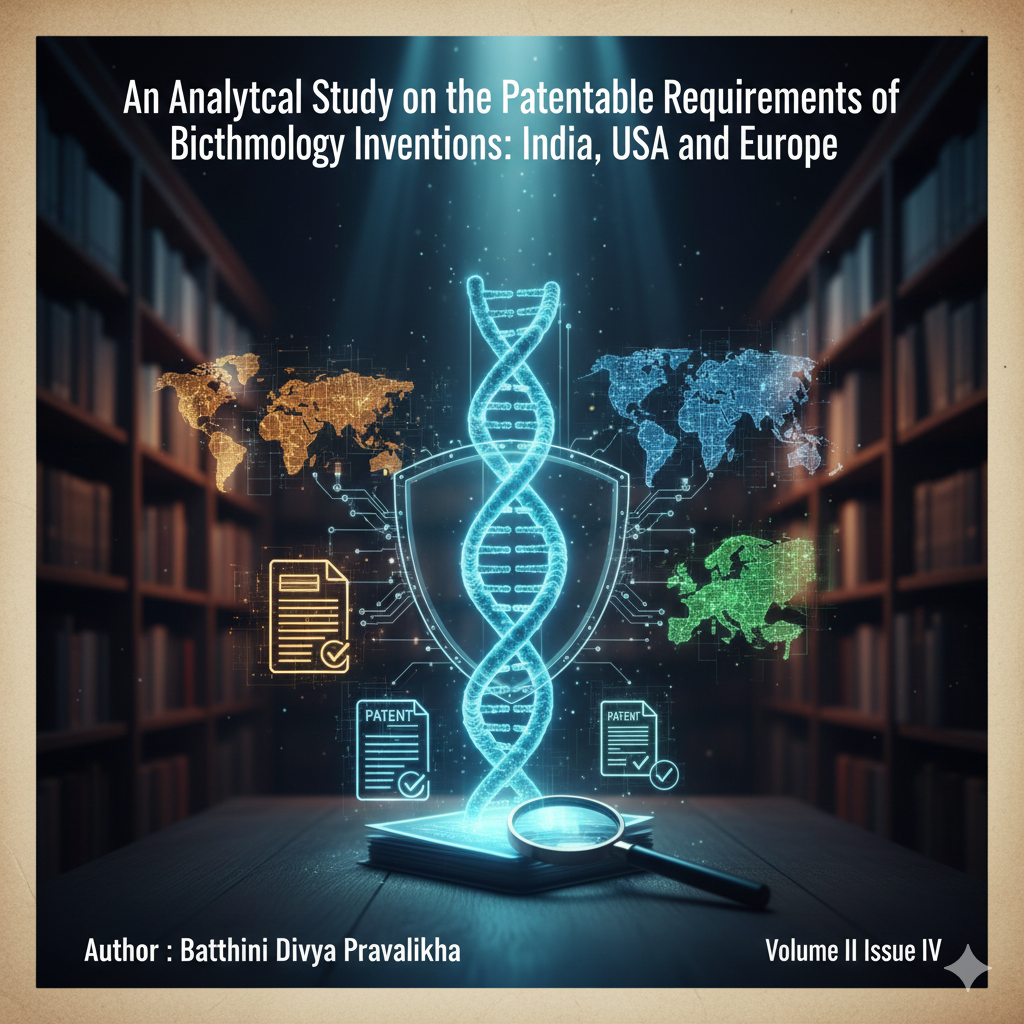
Intellectual property is considered to be a creative work of the human intellect. The field of intellectual property rights protect the ‘creations of mind’ of a person through copyright, patents, trademarks, service marks, layout designs of the integrated circuits, commercial names and designations including geographical indications. This paper herewith deals with one of the aforementioned intellectual property i.e., patent especially in context of the biotechnology inventions. It is pertinent to note that ‘Patent’ is provided to the first and true inventor of an invention by assuring exclusive rights to the inventor for his invention which is granted by the Patent Office to make full use of his invention and thereby deriving benefit from the same for a period of 20 years in India. During this period the inventor is entitled to exclude anyone else from commercially exploiting his invention. An invention is considered to be patentable only when it is new, has some inventive step and is capable of industrial application. Once the patent is expired, it falls into public domain and therefore it becomes public property. In furtherance, this paper also elaborates the concept of patentability exclusively in context of biotechnological inventions with special reference to India, USA and Europe. It is very important to grant a patent for the biotechnology invention because too much of capital and many years are invested in developing a biotechnology invention. It has further been discussed in detail about the patentability requirements for biotechnology inventions. In India, USA and Europe patentability requirements are implemented separately when compared to the inventions where patent is granted excluding biotechnology. Moreover, this paper provides an insight to the principles discussed in the various important biotechnology cases in India, USA and Europe relating to patentability and morality determination of biotechnology inventions.
Keywords: Intellectual property, patent, biotechnological inventions, case laws, India, USA, Europe.
Introduction
The World Intellectual Property Organization (WIPO) defines “biotechnology as any technology using living entities, in particular animals, plants or microorganisms, or causing change in them.”[1]
The field of biotechnology promises better drugs, medical treatments, new crops and new industrial processes. The companies which deal with biotechnological inventions spend money in abundance and also invest many years to advance a product. Therefore, by granting patent protection to such biotechnological inventions, an assurance is given to the people who have invested i.e. the investors who took risk by investing money which is required for the development of an invention. Moreover, such an investment leads to profit in abundance. In absence of the patent protection to the inventors of the biotechnological inventions, the investors’ may not invest huge amount of capital on long term basis for research and development since the research output may be exploited by any person and this would jeopardize returns and profits. Thus, the arena of biotechnology in granting patent to the inventor is considered as very important due to the rigorous research and investments.
Nature of Biotechnology
‘Diversity’ is considered as one of the most unique feature of biotechnology. Biotechnology has number of sub-fields and each sub-field has characteristics which are very different from others that the broad set of general rules cannot be taken into consideration for the field of biotechnology as a whole. For example, genomics and tissue culture, both are different and unique in characteristics, applications, processes and products etc. Similarly, a plant tissue culture has different characteristics when compared to animal tissue culture.
The following are some of the diverse sub-fields that fall under the scope of biotechnology:
- Bioprocessing technology:
- It is a technique which tends to produce material related to biotechnology, such as genetically engineered microbial strain for commercial purposes.
- Hybridoma and Monoclonal Antibody Technology:
- Through this method identical antibodies are created in a large number. It is also known as Monoclonal Antibodies
- Cell Culture:
- It is a process where cells are made to be grown under some controlled conditions outside their natural environment.
- Cloning:
- It is a process wherein genetically identical individuals of an organism are produced either naturally or in an artificial manner
- Genomics and Proteomics:
- These two fields are related closely to each other. The difference between both is that genomics is the study of the set of genes in the genome of a cell and protemics is the study of the proteins produced by the cells.
- DNA Fingerprinting:
- It is also known as DNA typing, DNA profiling, genotyping or identity testing, genetic fingerprinting, method of isolating and identifying variable elements within the base-pair sequence of DNA
Since there is a diversity in the field of biotechnology and variation in its sub-fields, it becomes cumbersome to establish patent principles or rules for biotechnology. Therefore, applying the principles of patent law to such a diverse field becomes very complex. Also, it is pertinent to note that there has always been misconception about biotechnological inventions that the inventions might result in environment hazards. Due to all this, the development of biotechnology is considered to be very controversial.
- Importance of Granting Patent Rights for Biotechnological Inventions
“Patent is a monopoly right conferred by the Patent Office on an inventor to exploit his invention for a limited period of time. While an invention means a new product or process involving an inventive step and is capable of industrial application.”
It is not mandatory for an inventor to apply for a getting a patent right for his invention, rather it is an optional thing to do for an inventor. The inventor may maintain secrecy regarding his invention instead of applying for a patent right over his invention. But it is very important to note that if an inventor does not choose to apply for getting a patent right for his invention, there would be a high risk factor for his invention being disclosed to others such as his competitors through communication of information by someone who possess such information and therefore the competitors are under no obligation to maintain secrecy of invention or by an independent discovery. In such a case, other persons may start manufacturing the article by using the same invention. In Shining Industries v. Shri. Krishna Industries[2], it has been held by the High Court of Allahabad that an inventor cannot consider his invention as his property right unless the said invention is provided a patent right.
Therefore, it is considered to be beneficial as well as advisory to apply for getting patent, thereby procuring monopoly rights for certain period of time to utilise the invention by excluding others to interfere with the invention.
- Patentable Subject Matter: India, Europe and USA
Patentable subject matter requirement is the first and basic filter for assessing patentability rights over an invention. The government of the countries defines the list of subjects that are eligible and ineligible for patent grant. In Europe as well as in India, an invention which has product or process is considered as an eligible subject. Whereas, any invention which includes process, machine, manufacture or composition of matter is considered as an eligible subjects in USA.
Apart from the aforementioned eligible subjects, there are certain ineligible subjects under the laws of various countries, which are known as ‘exclusions’ or ‘non-patentable inventions’. In USA, such exclusions are created by the judiciary, while in India and Europe the said exclusions are provided under the statutes of the respective countries. Furthermore, the following are the exclusions in USA:
- Abstract Ideas, Physical Phenomenon and Laws of Nature.
While, there is a long list of exclusions in India and Europe.
- Patentable Subject Matter from the Perspective of Biotechnology Inventions
- Patentable Subject Matter: USA
USA considers an invention to be patentable if it possesses ‘process’ and ‘machine’. Apart from process and machine an invention should also have ‘Manufacture or composition of matter or any improvement thereof.’[3] As mentioned above, the following are the three exclusions created by judiciary is considered in USA:
- Laws of Nature
- Physical Phenomenon
- Abstract Ideas
In USA, one of the most relevant exclusion for the biotechnological inventions is ‘Laws of Nature’ exclusion. The said exclusion means that anything that naturally exists or is a ‘product of nature’ is not patentable.
The questionability about ‘patentable subject matter in USA’ was first laid down in Funk Bros. Seed Co. v. KaloInnoculant Co.[4]The said case involved an issue about whether micro-organisms are patentable. “The case was related to mixed culture of ‘Rhizobium bacteria’ which is capable of inoculating at the same time the seeds of plants of several cross-inoculation groups”.After hearing, the court held that mere aggregation of species is not an invention under the patent regime. Since, there has been no production of new bacteria which was not invented before and also there was no change in the species of bacteria. It further pointed out that quantities of the non-inhibitive strains is not manmade but it has been occurred due to the nature i.e., work of nature and therefore the said invention was not patentable.
Furthermore, in a landmark judgment by US Supreme Court i.e., Diamond v. Chakrabarty, it has been held that in the field of biotechnology, everything which is made by man is considered as a patentable invention.[5] This case was with regard to the “genetically modified pseudomonas bacteria”’ which is efficient of degrading oil spills and a process by which four different plasmids, capable of degrading four different oil components, could be transferred and maintained stably in a single Pseudomonas bacterium. In the said case, the patent was not granted on the ground that it was not made by man but occurred in nature and is a living organism. Aggrieved by this, an appeal was made before the US Supreme Court. The Apex Court held that ‘the bacterium was patentable’ because it was a new bacterium with unique features from others though it has been occurred in nature. The Supreme Court also explained elaborately that if an invention occurred in the nature but has involves a hand of man can be patentable. In the said case the ‘pseudomonas bacterium’ though occurred in nature but it actually involved a hand of man in inserting 4 various plasmids into it. Therefore, it was not existing naturally but invented through a process followed by human so it was held to be patentable. The Supreme Court has highlighted that the living organisms shall included as a patentable subject matter in US.
After such a landmark decision by the US Supreme Court by including living organisms as a patentable subject matter, Patent’s have been further granted to many multi-cellular organisms, polypoid oysters, rabbits, genetically modified rats and so on. In USA gene sequences as well as gene therapies are also included as a patentable subject matter.
USA, has made very broad scope regarding patentable subject matter. But, it excluded ‘human beings’ to be under the purview of patentable subject matter. In another case, an application for the patent was filed with regard to cover fusion of embryonic human and animal cells to generate ‘chimeras’ for medical research was rejected by USPTO and the Court.[6]
Patentable Subject Matter in Europe
The laws related to patent are discussed in the European Patent Convention (EPC). According to EPC, everything shall be patentable unless it falls within the purview of the excluded subject matter or inventions.[7] It further clarifies that any invention will be patentable, irrespective of technology through which it has been generated. It further makes clear that an invention shall be patentable subject matter if it is new, has an inventive step and industrial applicability. Also, it should not fall within the purview of the long list of ‘excluded subject matters’ as mentioned in the Article 53 of the EPC.
As mentioned above, Europe has long list of ‘exclusions’ when it comes to granting patent. The exclusions such as inventions contrary to public order or morality, inventions involving plant an animal varieties, inventions which are produced due to biological processes for the production of plants or animals. Moreover, an invention which includes methods of providing treatment shall be excluded.
The scope of patentability of biotechnological inventions have been clearly clarified to a very large extent in the directive passed in the year 1998 known as ‘The European Union Biotechnology Directive’[8]. The said directive was not binding on the EPO (European Patent Office), but the implementing regulations were modified to make EU Biotechnology Directive as a supplementary source for looking into patentability of biotechnological inventions under the EPC.
According to Article 53 (b) of EPC, as mentioned above, plant varieties as well as animal varieties and biological processes for producing plants and animals were not considered to be patentable and therefore considered as ‘exclusions’. But it is pertinent to note that in Europe, micro-organisms are considered to be patentable. But, the rule 27 (b) of the Implementing Regulations of EPC grants patents to an invention which solely includes plants and animals but it should possess the point of ‘TECHNICAL FEASIBILITY’ which should not be just confined to any plant or any animal. So, it can be concluded that in Europe, genetically modified plants and animals shall be patentable as they are not included within the purview of animal or plant variety.
In a landmark ‘Novartis’ case, it has been held that if a genetic modification is applied not only to one but more than one variety then that invention is covered within the patentable subject matter. Moreover, it falls outside the purview of exclusions with regard to plant varieties. In the said case, the issue was regarding the patentability of transgenic plants into which DNA has to be inserted using recombinant technology.[9]
Moreover, ‘gene sequences are also considered to be patentable subject matter in Europe because when a biological material is isolated from its nature or when it is generated through any technical process though it has occurred earlier in the nature is considered to be patentable subject matter.[10]
Rule 29 (2) of Implementing Regulation mentions that gene, cannot constitute a patentable invention, an element isolated from the human body or otherwise produced by the means of a technical process, including the sequence or partial sequence of a gene, may constitute a patentable invention, even if the structure of that element is identical to that of a natural element. Human beings or parts of human beings are not patentable subject matter in Europe.Patentable Subject Matter in India
When compared to Europe, India too has a wide scope of ineligible subjects. In, India any product or process comes within the patentable subject matter irrespective of technology. The Patent Act also provides long list of exclusions for grating patent which also includes biotechnology inventions.[11] Exclusions such as any discovery of living things which has been occurred in nature is not considered to be a patentable subject matter in India.[12] “Prohibited biotechnology subjects further include plant and animals in whole or any part thereof including seeds; varieties, species and essentially biological processes for production or propagation of plants and animals.”[13]But, patent is granted to micro-organisms or microbiological processes. Also, any genetically modified multicellular organisms which further includes plants, animals and human beings are considered to be exclusions under the Patent Act.
But, gene sequences and DNA sequences which has disclosed functions are included under patentable subject matter. Whereas, human beings and embryonic stem cells, methods of any medical treatment comes under exclusions.[14]
- Utility/ Industrial Applicability
- Concept of Utility in USA
In a literal sense, utility means ‘usefulness’ of an invention. Since there is a lack of maturity in the field of biotechnology, the measures with regard to utility have been heightened.
Utility examination guidelines were revised in the year 1999 for patent examiners since the gene based inventions had a very unique nature i.e. Expressed Sequence Tags’ which are also known as ESTs, USPTO. In the year 2001, these guidelines were further amended. Therefore, as per the amended guidelines, an invention for a grant of patent, should be specific, substantial and credible in terms of utility from the viewpoint of layman i.e., a person who has ordinary skill in art. These mentioned three conditions should be satisfied for qualifying in terms of utility requirement.
The vital condition in the field of biotechnology inventions is ‘Specific Utility’. Specific Utility necessarily means a use specific to the claimed subject matter rather than a general utility. [15] While an invention, which is in need for further research to ascertain practical usage was held to be not useful as it had lacked the concept of specific utility. Therefore, a biotechnology invention must satisfy substantial, credible and specific utility so as to satisfy the utility requirement.
Concept of Utility in Europe
As per the Article 57 of EPC, it is sufficient that the invention is capable of being industrially produced in order to fulfil the industrial applicability.[16] For, biotechnology inventions it is very difficult for the ascertainment of industrial applicability since the field of biotechnology is full of challenges. It is worthy to mention that as per the ‘Implementing Regulations’ any partial or complete gene sequences are patentable. But, Rule 29(3) of Implementing Regulations clearly mentions that the industrial application of a complete or partial sequence must be disclosed in the application for patent. Therefore, in the nutshell, a partial or complete gene sequence is patentable under EPC, provided the function of the invention is clearly mentioned in the patent application.
In a landmark decision i.e., Max Planck’sdecision , it has been held that industrial applicability can only be fulfilled, only if the practical application of a invention is disclosed.[17] The issue in this case was related to ‘Brain Derived Phosphatase’. It was further held that biotechnology inventions can satisfy industrial applicability only if it has uses, i.e. practical uses and the invention should also be disclosed in the patent application.
Concept of Utility in India
In India, for fulfilling the requirement of utility, an invention should be used in at least one field of activity and it shall also be reproduced with similar features when found necessary.[18] The Patent Act, has not specifically mentioned anything regarding the applicability of biotechnology, therefore general industrial applicability features are applied for biotechnology inventions. Furthermore, the guidelines with regard to examining biotechnology inventions in the Manual of Patent Practice clearly mentions that gene sequences and DNA sequences, the functions of which are not disclosed do not satisfy the utility requirement.
- Novelty
- Concept of Novelty in USA
The novelty requirements in USA, has not be laid down in a very stringent manner so that some relaxation is provided to grant patent to biotechnology inventions. In USA, courts have laid down that isolated and purified gene sequences are considered to be novel though they are identical to the sequences in nature. It has also been laid down by the courts that isolation and purification of a gene existing naturally tends to be novel to the sequence. The issue with regard to novelty in biotechnology inventions usually relate to conception and reduction of a gene sequence.
In, Amgen v. Chugai[19], which is considered to be one of the most important novelty cases, wherein the court stated that gene is considered to be a chemical compound, very complex in manner and so it should be patentable. The Court then pointed out it as a well established in US law that conception of a chemical compound required that the inventor was able to define it so to distinguish from other materials and to describe how to obtain it. The court further held that conception of a generalized approach for screening a DNA library that may be used to identify and clone the Erythropoietin (EPO) gene of unknown constitution was not a conception of a purified and isolated DNA sequence’ encoding human EPO. A biotechnology invention for proving novelty should be reduced to practice.
Concept of Novelty in Europe
The concept of novelty has always been a subject of uncertainty at EPO. The Implementing Regulations to EPC clearly provides that any biological material which is isolated from nature or which is produced through a technical aspect/process and which also includes complete or partial sequence of a gene is considered to be an invention which shall be patentable, even though its actual features are identical to that of a natural element. Therefore, a gene sequence is regarded to be novel in the light of what exists in natural environment and such a sequence, should be isolated from nature.[20]
The aforementioned principle was very well applied in the Relaxin Decision.[21]The issue in the said case was with regard to the process for getting H2-relaxin, the DNA encoding, chemical structure of the same and moreover, the use of protein. It was very well pointed out that isolation of a gene of a known protein for the primary time through conventional methods shall make a gene sequence novel. The Board further stated that natural existence of genes would not anticipate their isolation, as the isolated genes containing only the coding regions were different from their natural counterparts. It can be concluded from the situation similar to USA, the requirement for novelty with respect to biotechnology invention is relatively low, so an isolated gene sequence with a bit difference when compared to the prior art can be held as novel.
Concept of Novelty in India
The Patent Act in India, does not specifically provide provisions regarding to the biotechnology inventions rather in India, patent is not granted to the biotechnological inventions as these inventions are produced due to natural phenomenon since they are present in the living organisms. But, the Manual of Patent Procedure has provided some relaxation by granting patent to biological methods such as recombinant DNA, plasmids and process of manufacturing the same, provided these all shall have human intervention. It is worth mentioning that several patents have been issued for isolated gene sequences in India since such a sequences are held to be novel by the office of patent in the light of natural counterparts.
- Non-Obviousness / Inventive Step
- Concept of Inventive Step in USA
In USA, standards relating to inventive step which are required for the biotechnology inventions have been interpreted differently by the courts when compared to generally accepted norms. A case which involves granting patent rights over ‘Immunometric Assays Using Monoclonal Antibodies’, it was held by the court that the grant of patent was due to inventive step despite there was an existence of 20 prior art references. Prior art as a whole did to make the invention obvious when the invention was invented. Though there are references which helped the invention, the court clarified that they were prepared after the conception of an invention, thus excluding the scope of prior art. ‘The Court in this case reiterated the importance of secondary indicia by determining the sandwich assays using monoclonal antibodies to be non-obvious because of the commercials success, unexpected advantages and praise from experts of the diagnostic kits made by Hybritech.’
In another landmark case, ‘Amgen v. Chugai[22]patent was not given for DNA sequences encoding erythropoietin (also referred as ‘EPO’) and the granting patent to them was also held invalid when compared to non obviousness step and along with other claims. It was further held by the Federal Court that the patent was non-obvious based upon the reason that DNA sequence was not isolated with the proper set of experiments.
In ‘In re Deuel’[23]issue was with regard to isolated and purified DNA and cDNA molecules which relates to encode heparin binding growth factors. It was held to be non obvious by the Federal Circuit despite there as ‘Bohlen’ and ‘Maniatis’ factors which disclosed a group of proton growth factors and also methods of general gene cloning. The primary issue was if the combination of prior art reference teaching method of gene cloning along with references which discloses partial amino acid sequence of a protein, can be considered prima facie obvious. It was held that solely on basis of teachings, a subject matter of invention cannot be conceived. It was also further stated that what cannot be conceived cannot be obvious.
In ‘In re Kubin’s’[24] case, the invention was with regard to amino acid sequel of Natural Killer Cell Activation (also referred as NAIL) inducing Lingad. NAIL played active role by activating natural killer cells that are helpful in fighting tumors and viruses. It was stated that the claimed amino acid sequence was obvious when combined with 2 prior art references (Valiante’s patent bearing the U.S. Patent No. 5,688,690) and it discloses receptor protein i.e. p38 receptor. The board found it same protein as NAIL. The Federal circuit affirmed the Board’s decision stating that the specific teachings of Sambrook and Valiante, artisans in this field had every motivation to seek and every reasonable expectation of success in achieving the sequence of the claimed invention. As per the Court, the claimed invention was reasonably expected in the light of the prior art and was held to be obvious.
Therefore, there is a lack of maturity in this field in US. So, non-obviousness step in USA is lower for biotechnology inventions. It is also pertinent to note that after the decisions in Deuel and Kubin, it can be inferred that non-obviousness standards are not applied uniformly.
Concept of Inventive Step in Europe
For biotechnology inventions, various tests were taken for determining inventive step, but these tests have always been ambiguous due to uncertainty in the field of biotechnology. There has been many efforts put by the EPO and other boards for setting up clear guidelines to determine inventive step for biotech inventions.
In the Relaxin Case[25] the issue was with regard to the process of getting H2-relaxin and DNA encoding it. It was clearly pointed out by the Board that the proprietor was not making a known substance by conventional methods but the same was provided to the public for the very first time a product whose existence was earlier known, so the invention which was claimed shall be considered as having an inventive step irrespective of the methods used to make the product.
The non-obviousness determination is always done from the viewpoint of a person having ordinary skill in art. Furthermore, for determining the knowledge of a person who is skilled in the art with regard to the biotechnology inventions had been clearly elaborated in the R. v. Genentech[26], the case dealt with the interferon gamma and the DNA sequence coding. The Board explained so as to who is called a person skilled in art. It was stated that in present case, a team of specialists, who are aware about the difficulties and still considered cloning as a new gene. It was also stated that a skilled person must lack the inventive imagination to curb issues for which there are no regular measures of solution. The proper comparison not solely with a team but rather with highly skilled person in that particular arena, who shall carry out project where the instructions given were already sufficient to tell the technician as to how to overcome issues which would likely to arise.
In another case, R. v. Chiron[27], which explained inventive step regarding DNA molecule having a specified nucleotide sequence which encode insulin growth factor II (IGF-II). The Court held that there no sufficient information regarding prior art. It was stated by the board that an invention would lack an inventive step even though there is a reference of prior art which lacks complete description, provided the reference should be supplemented by the knowledge which is having with a person with ordinary skilled in art. As per the Board, reasonable likelihood of success can make an invention obvious and showing low expectation of success can rebut it. The Board pointed out that reasonable likelihood of success can be proved by prior art information, experiments, expert testimony and so on.
As per the EPC, for determining the inventive step regarding biotechnology inventions, factors such as obviousness with reference to prior art to a person with ordinary skill in art, expectation regarding success and other considerations such as commercial success and testimonies provided by the experts are considered. Moreover, the standards step up for non-obviousness are higher in Europe than in USA so there has been always difficulty satisfying the inventive step requirement on the Europe.
Concept of Inventive Step in India
In India, there has been dearth of the judgments with regard to inventive step especially for biotechnology inventions. Therefore, the approach towards inventive step in India is not clear especially for biotechnological inventions. But, as per the Manual, isolated gene sequences and protein sequences shall be considered having an inventive step when seen towards their naturally existing counter parts. Also, it is relatively easier to prove economic importance for biotech inventions since they are applied in various drugs and diagnostics. In India principles such as reasonable expectation of success, predictability of the field etc are applied for determining inventive step. But, the law in India does not show any differing standards for inventions with regard to biotechnology.
Concluding Remarks
In the nutshell, the requirements with regard to granting patent to biotechnology inventions in India, Europe and USA are differently applied when compared to other inventions were patent is granted. While some of the patent requirements like subject matter, utility have heightened standards, while non-obviousness standards have generally been lowered to accommodate ambiguities in the field. It is pertinent to note that ‘Morality’ plays a vital role in determining patentability of biotechnology inventions. Moreover, the standards has always been considered higher in Europe and India when compared to USA.
References:-
Relevant Legal Provisions:
- The Patents (Amendment) Act, 2005, 39, Acts of Parliament, 1970, (India)
- USA Patent Laws
- European Patent Convention, 2000, (Europe)
Books:
- VK Ahuja, Law relating to Intellectual Property Rights, third edition (2017)
- USPTO Guidelines and Training Materials on Written Description, Federal Register, Vol 66, January 5, 2001.
- Manual of Patent Office Practice and Procedures
- Kalyan C. Kanakanala, Genetic Patent Law and Strategy, 1st edition- 2007, pp 123-124
Internet Sources:
- Patentability of Biotech Inventions in USA- Patentable Subject Matter, BANANAIP REPORTER (Mar, 27, 2020, 7.33 PM) https://www.bananaip.com/ip-news-center/patentability-of-biotech-inventions-in-4
- European Parliament, Human Genomics in Global Health- Directive 98/44/EC of the European Parliament and the Council of 6 July 1998 on the Legal Protection of Biotechnology Inventions, WHO (Apr, 01, 2020 10.00 AM)https://www.rgnul.ac.in/PDF/f7ff0636-9075-47f2-8e17-a5ba7be7a3cf.pdf
- European Patent Convention, 2000, EUROPEAN PATENT OFFICE (Mar, 27, 2020, 7.00 PM) https://www.epo.org/law-practice/legal-texts/html/epc/2016/e/r27.html
- Gov, 2107 Guidelines for Examination of Application for Compliance with the Utility Requirement (Apr, 03, 2020, 11.20 AM) https://www.uspto.gov/web/offices/pac/mpep/s2107.html
- European Patent Convention, 2000, Article 57, EUROPEAN PATENT OFFICE (Mar, 30, 2020, 7.00 PM) https://www.epo.org/law-practice/legal-texts/html/epc/2016/e/ma1.html
[1] SHEILA A.M. MC LEAN ed., Contemporary Issues in Law, Medicine and Ethics, 238 (Dartmouth Publishing Company Limited) (1996)
[2] Shining Industries v. Shri. Krishna Industries, AIR 1975 All 231 (India)
[3] Patentability of Inventions, 35 USC Section 101 (2005)
[4] Funk Bros Seed Co. v. Kalo Inoculant Co., 333 U.S. 127 (1978)
[5] Diamond v. Chakraborty 100 S.Ct. 2204 (1980)
[6] Patentability of Biotech Inventions in USA- Patentable Subject Matter, BANANAIP REPORTER (Mar, 27, 2020, 7.33 PM) https://www.bananaip.com/ip-news-center/patentability-of-biotech-inventions-in-4
[7] European Patent Convention, 2000, Article 52. EUROPEAN PATENT OFFICE (Mar, 27, 2020, 9.00 PM ) https://www.epo.org/law-practice/legal-texts/html/epc/2016/e/ar52.html
[8] European Parliament, Human Genomics in Global Health- Directive 98/44/EC of the European Parliament and the Council of 6 July 1998 on the Legal Protection of Biotechnology Inventions, WHO (Apr, 01, 2020 10.00 AM)https://www.rgnul.ac.in/PDF/f7ff0636-9075-47f2-8e17-a5ba7be7a3cf.pdf
[9]Novartis/Transgenic Plant, Technical Board of Appeal 3.3.4, (1994) E.P.O.R. 123
[10] European Patent Convention, 2000, EUROPEAN PATENT OFFICE (Mar, 27, 2020, 7.00 PM) https://www.epo.org/law-practice/legal-texts/html/epc/2016/e/r27.html
[11] The Patents (Amendment) Act, 2005, 39, Acts of Parliament, 1970, Section 3 (India)
[12] The Patents (Amendment) Act, 2005, 39, Acts of Parliament, 1970, Section 3(c) (India)
[13] The Patents (Amendment) Act, 2005, 39, Acts of Parliament, 1970, Section 3(j) (India)
[14] The Patents (Amendment) Act, 2005, 39, Acts of Parliament, 1970, Section 3 (i) (India)
[15]uspto.Gov, 2107 Guidelines for Examination of Application for Compliance with the Utility Requirement (Apr, 03, 2020, 11.20 AM) https://www.uspto.gov/web/offices/pac/mpep/s2107.html
[16] European Patent Convention, 2000, Article 57, EUROPEAN PATENT OFFICE (Mar, 30, 2020, 7.00 PM) https://www.epo.org/law-practice/legal-texts/html/epc/2016/e/ma1.html
[17] Max Planck/ BDP1 Phosphatase, Legal Board of Appeal 3.3.8, (2006) E.P.O.R. 14. (2004)
[18] Manual of Patent Office Practice and Procedure, The Office of Controller General of Patents, Designs and Trademarks, Chapter II, Para 2.4, Page 13
[19] Amgen, Inc. v, Chugai Pharmaceutical Co., Ltd., 927 F.2d 1200 (C.A. Fed.(Mass) 1991)
[20]Patentability of Biotech Inventions in Europe- Patentable Subject Matter, BANANAIP REPORTER, (Apr, 6, 2020, 13.15 PM) https://www.bananaip.com/ip-news-center/patentability-of-biotech-inventions-in/
[21]Bioethics and Patent Law: The Relaxin Case, WIPO MAGAZINE, April 2006, Issue 2/2006.
[22] Amgen,Inc. v. Chugai Pharmaceutical Co., Ltd., 927 F. 2d 1200 (fed Cir. 1991)
[23] Inre Thomas F. Deuel, Yue-Sheng Li, Ned R. Siegel and Peter G. Milner, 51 F. 3d 1552, 34, U.S.P.Q.2d 1210 (Fed Cir. 1995)
[24] In re Kubin, 561 F. 3d 1351 (2009)
[25] Bioethics and Patent Law: The Relaxin Case, WIPO MAGAZINE, April 2006, Issue 2/2006.
[26] R. v. Genentech/ HIF- Gamma, Technical Board of Appeal 3.3.2, July 20, 1993 (FN1), (2003) E.P.O.R. 12. 184 Id.
[27] R. v. Chiron/ IGF-II, T475/93, Technical Board of Appeal 3.3.4, July 17, 1997 (FN1), (2003) E.P.O.R 48