ARTICLE 370 AND HUMAN RIGHTS VIOLATION OF KASHMIRI PANDITS
ABSTRACT: The Article concentrates upon two concepts, on one hand the revocation of Article 370 and 35A of the Indian Constitution and on the other hand the violation of Human Rights which took place in the year 1990 in the state of Jammu and Kashmir. And how did the revocation of Article 370, helped in delivering justice to people who were forced to leave their own houses and to all the torture given to them by the extremist organizations and the local Kashmiri Muslims. This Article defines, some of the important provisions of the Constitution, its significance, reasons why the article was formulated and the special provisions given to the state of Jammu and Kashmir and its permanent residents. On the other hand the Article speaks about the Human Rights violation which took place in the year 1990, 30 years ago of the inhuman event. Having known how the people residing there peacefully were abandoned from their houses, their livelihood and dignity at gunpoint. The Article explains the event which took place in the year 1990, which violated the most important fundamental right which is given to each one within the territory of India, under Article 21 of the Constitution, also question the delay of justice which was done to them. To conclude, the article helps in knowing the significance of how the revocation helped the people to attain justice and how it would develop the two different Union Territories to grow. The Article rounds up discussing about, how the kashmiri pandits were served justice by revoking the provision.
- INTRODUCTION-ARTICLE 370 AND 35A:
Article 370 and 35A of the Indian constitution are read together and are interconnected. Article 370[1] speaks about the temporary provisions provided to the state of Jammu and Kashmir and Article 35A helps the state government to identify and define its permanent residents, as a result it provides some special rights and privileges to its residents. The people from other states, who are not the residents of Jammu and Kashmir, are prohibited from purchasing property in the state.
The history of formulating Article 370 and inserting it into the constitution goes back to the difficulties which were faced by the Congress party and its leaders to unite all the princely states into one independent state, with its constitutional objectives and values. In the process many princely states peacefully agreed to be a part of India, while some other states revolted against it and made some conditions to merge into the state, all these princely states revolting to merge into the state wanted to have their own independent states, which some of the eminent congress leaders like Sardar Vallabhai Patel did not agree on, and amongst all the princely states which revolted, the state of Jammu and Kashmir was the major state to revolt. The whole process of providing special status to Jammu and Kashmir started with the partition, when India was divided into two different nations. As a result the king of Kashmir, Raja Hari Singh proposed to the government of India to provide Kashmir special status, because of all the threats from Pakistan which wanted to gain control over Kashmir, because of which the Agreement of Stand still[2] was entered by both the nations not to attack and enter into the territory of Kashmir. Later the ruler of Kashmir signed Instrument of Accession[3]with Indian government which provided special status, autonomy, separate constitution and flag.
- REVOCATION OF ARTICLE 370:
The state has ever since the independence has faced a lot of problems and terrorist activities from in and outside the territory, the major attacks are from the Pakistan side, where the government of Pakistan, has in one or the other way supported and denied the participation of their government and Inter Services Intelligence (ISI).And in such circumstances, the Indian government ever since the independence has fought against such terrorist activities.
The effect of this 73 years old provision of Constitution which provides special status to the state of Jammu and Kashmir was brought to an end by passing a resolution in the houses of parliament by the Bharatiya Janata Party in 2019. The resolution passed in the parliament to revoke the provision gained majority of both the houses of parliament and was passed to revoke the article, the provision providing special status to Jammu and Kashmir, which made it different and superior to other states, was revoked along with Article 35A. And after the revocation, it opened doors of economic and social development in the state, the revocation of the provision became a major political issue as well as a controversial issue which created opposition and was also questioned in the apex court of the country. The state of Jammu and Kashmir after the revocation was divided into two separate Union Territories, Ladakh and Jammu and Kashmir both were given a separate identity, where it will be controlled by the Central government in future like the other Union Territories. [4]
- HUMAN RIGHTS VIOLATIONS IN JAMMU AND KASHMIR:
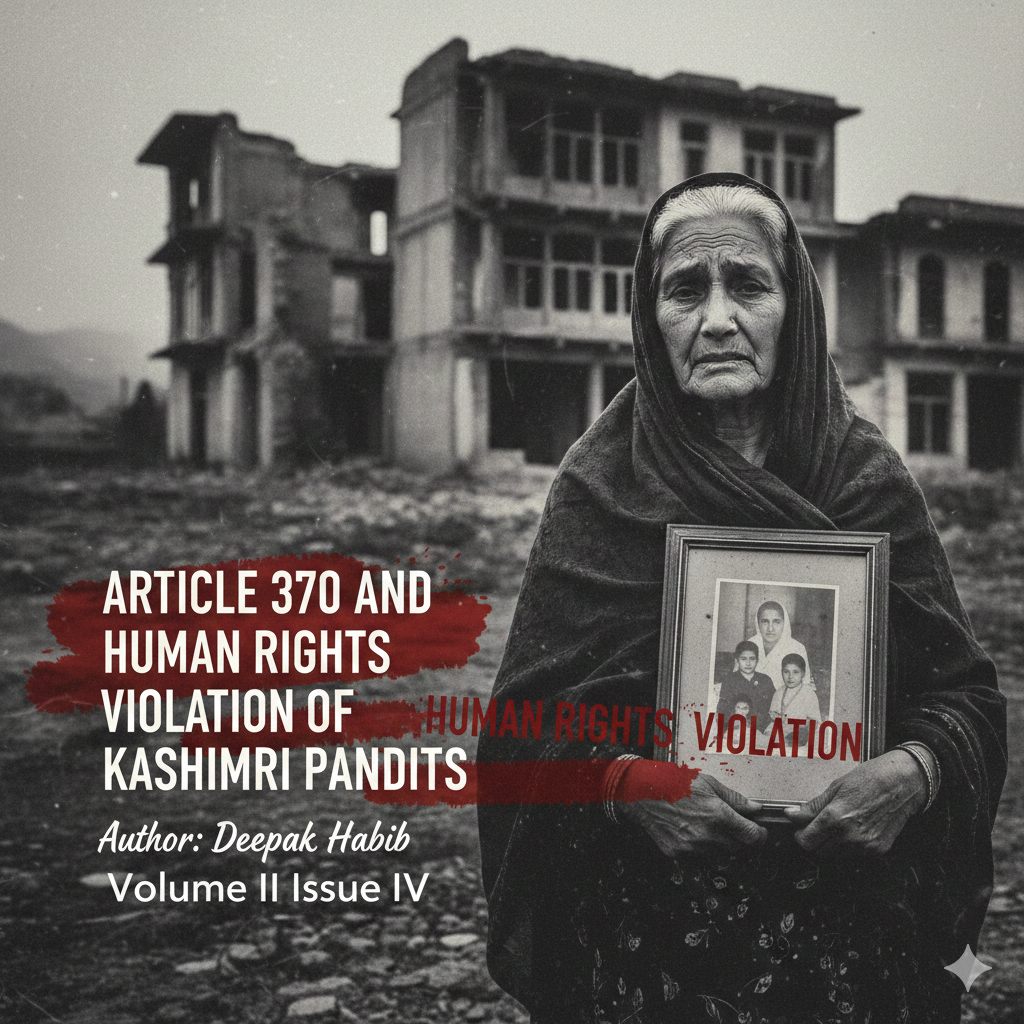
The state has witnessed some of the darkest events which happened in the history of the nation, from 1980-2000, most of the people living there belonging to Hindu and Sikh religion were tortured and forced to leave the state, these people who peacefully lived there for a long time were in shock experiencing all the events. The Kashmiri pandits, who were residing in the state peacefully, were attacked in that period. They were forced to do activities irrespective of their will, they were forced to abandon their own houses and move to other parts of the nation. They were tortured, raped, killed by the people of Kashmir having connections with terrorist organizations and also some of the local people residing there helped these people to do such inhuman activities against the pandits.
The cold, night of January 19, 1990, had stirred into the worst nightmares of Kashmiri pandits living in the valley. Screaming from loud speakers and crowded streets was a message for the Sikhs and Hindus living in Kashmir. The extremist there torturing the people raised slogans like RALIVE, TSALIV YA GALIVE (either convert to Islam, leave the place or die) the Hindus and Sikhs residing there were only attacked and were asked to leave the place just on the basis of their religion and the people who decided not to leave the place were raped, kidnapped and killed. The threats had been coming in for a long time, but the night of January 19 is said to have seen a demented assault of a different level. Even after years later, Kashmiri pandits shiver remembering that night. Thousands of Kashmiri Muslims came out and started shouting slogans like, Death to India and Death to Kafirs[5]. More than 4 lakh according to some figures, were thrown out of their own houses and the state, these lakhs together people were left with no option of defending themselves and their Human rights provided by the constitution of India.
Many questions were raised against the activity. Like who were the people who did it? The people who planned to do it? The people who supported it? The people who funded for all these activities? And did they take advantage of the benefits given to them by Constitution of India under Article 370? But the most important amongst all the questions which were raised against those activities, was what happened to the Human rights of those Kashmiri pandits who were forced at gun point to leave their houses? The particular night in Kashmir, ISIS level of horror and brutality was seen, because of which many families lost their homes, livelihood and the way of life. Where were all the human right activists at that time when the pandits were killed by the Muslims living there? The islamist state of Kashmir where other religions were not welcomed and were intolerant, in such place the human rights of a person was given no importance and there was no hesitance in violating those human rights of the people. The human rights violation which happened in Kashmir was neglected due to political interference. And the Kashmiri pandits were left with no justice for a very long period of time.[6]
Article 21 of the Indian Constitution; speaks about protection of life and personal liberty, no person shall be deprived of his life or personal liberty except according to procedure established by law[7].
The article includes various Human rights like;
Right to Life; this right is the most fundamental of all the rights where everyone has the right to life, liberty and the security of person. No person has the right to take anyone’s life and also his own life because it is considered to be against the concept of Right to life under the article.
Right to Live with Human Dignity; this right speaks about basic necessities like nutrition, clothing and shelter.
Right against Rape; rape has been held to a violation of a person’s fundamental life guaranteed under Article 21.
Right to Livelihood; an equally important facet of life is right to livelihood because no person can live without the means of livelihood[8].
When it came to those activities which happened in the year 1990, those activities violated all the rights mentioned above, under Article 21 of the Constitution. The pandits in the valley were forced and left with no option to take decisions on their own.
- CONCLUSION:
The revocation of Article 370 and 35A is restoration of Human rights of the people who had to see the unwanted consequences, and due to the revocation of Article 370 and 35A, the people of Jammu and Kashmir residing across the country can go back to their actual homes where at once their ancestors and parents lived peacefully. The Kashmiri pandits finally got justice for what they had suffered from last 30 years. Along with the revocation of the articles, the displaced Kashmiri pandits hailed scrapping of the article, hoping it would bring peace to the region and make a way for them of their return to the valley with honor and dignity. The Global Kashmiri Pandit Diaspora (GKPD)[9], a body representing the community across the world, said the decision cements territorial, political and cultural unity of the Indian union. This is for the first time in years that the community has felt a relief of its identity, culture and symbols of heritage has found full protection of their community. After all the autonomy that the state has enjoyed with their own constitution, and minimum interference by the central government finally the article has been revoked, and along with it the, the doors of social and economic development also opened, and the chances of investment will increase which would provide decent standard of living to the residents of both the union territories.[10]
[1]V.N.SHUKLA, CONSTITUTION OF INDIA, 1103 (13th ed. Eastern Book Company 2017).
[2] Standstill Agreement with India and Pakistan, August 12 1947, Shodhganga Inflibnet (April 7, 2020, 4:55)https://shodhganga.inflibnet.ac.in/bitstream/10603/6534/15/15_appendix.pdf
[3]V.N.SHUKLA, CONSTITUTION OF INDIA, 1104 (13th ed. Eastern Book Company 2017).
[4] No Article 370 for Jammu and Kashmir, historic move by Modi govt, India Today, (April 7, 2020, 5:03)https://www.indiatoday.in/india/story/kashmir-unrest-amit-shah-parliament-reservation-bill-amendment-artcle-370-1577275-2019-08-05
[5] Exodus of Kashmiri Pandits, India Today, (April 7, 2020, 5:05)https://www.indiatoday.in/fyi/story/exodus-of-kashmiri-pandits-january-19-jammu-and-kashmir-304487-2016-01-19
[6] Sunanda Vashisht, where were Human Rights when Hindus fled Kashmir, India New England News (April 7, 2020,5:08)https://indianewengland.com/2019/11/where-were-human-rights-when-hindus-fled-kashmir/
[7] V.N.SHUKLA, CONSTITUTION OF INDIA, 210 (13th ed. Eastern Book Company 2017).
[8] Riya Jain, Article 21 of the Constitution of India, Lawctopus (April 7, 2020, 5:12)https://www.lawctopus.com/academike/article-21-of-the-constitution-of-india-right-to-life-and-personal-liberty/
[9]Global Kashmiri Pandit Diaspora to hold series of events worldwide to mark 30 yrs of Kashmiri pandits’ exodus, Times Now News, (April 7, 2020, 5:17) https://www.timesnownews.com/india/article/global-kashmiri-pandit-diaspora-to-hold-series-of-events-worldwide-to-mark-30-yrs-of-kashmiri-pandits-exodus/538766
[10]More jobs and growth in tourism in J&K, India Today, (April 7, 2020, 5:20) https://www.indiatoday.in/india/story/j-k-government-abrogation-of-article-370-1596161-2019-09-06