TABLE OF CONTENTS
4.1. INDIAN ORIGIN HILL COUNTRY ‘REFUGEES’. 13
4.2. ROHINGYAS, THE ‘ILLEGAL MIGRANTS’. 14
ABSTRACT
John Locke in his Social Contract theory mentions how people in primitive society denounced their sovereign rights of self-governance to an elected individual in lieu of protection from external elements. The principle of Parens Patriae, now more than ever, is of utmost importance, but what we have instead is a State machinery which has forgotten its welfare functions and is actively investing more in defence and national security. In recent years the Indian federation has been extensively scrutinizing all its inhabitants and separating the ‘citizens’ from the undesirable intruders or ‘ghuspet’, a term most used by the government when addressing such people. There are people who have been detained in Assam which will soon be the case pan India with the implementation of NRC.As per the principles of Jus Soli or Jus Sanguinis every individual, be it a citizen or otherwise,deserves a life of dignity and not mere animal existence[1], which has been reiterated by the Apex court in many of its landmark judgments.If one were to look into India’s history, it can be concluded that its people have always been accepting of refugees, starting as early as the Syrian Christians also known as Malankara Nasrani to the recent Tibetans. Despite not signing the 1951 Refugee Convention or the 1967 Protocol[2], India has been adhering to the principle of Non-Refoulment. In addition to this, the judiciary in India under the aegis of the Hon’ble SC has always placed primary importance on Right to Lifefor the non-citizens[3].
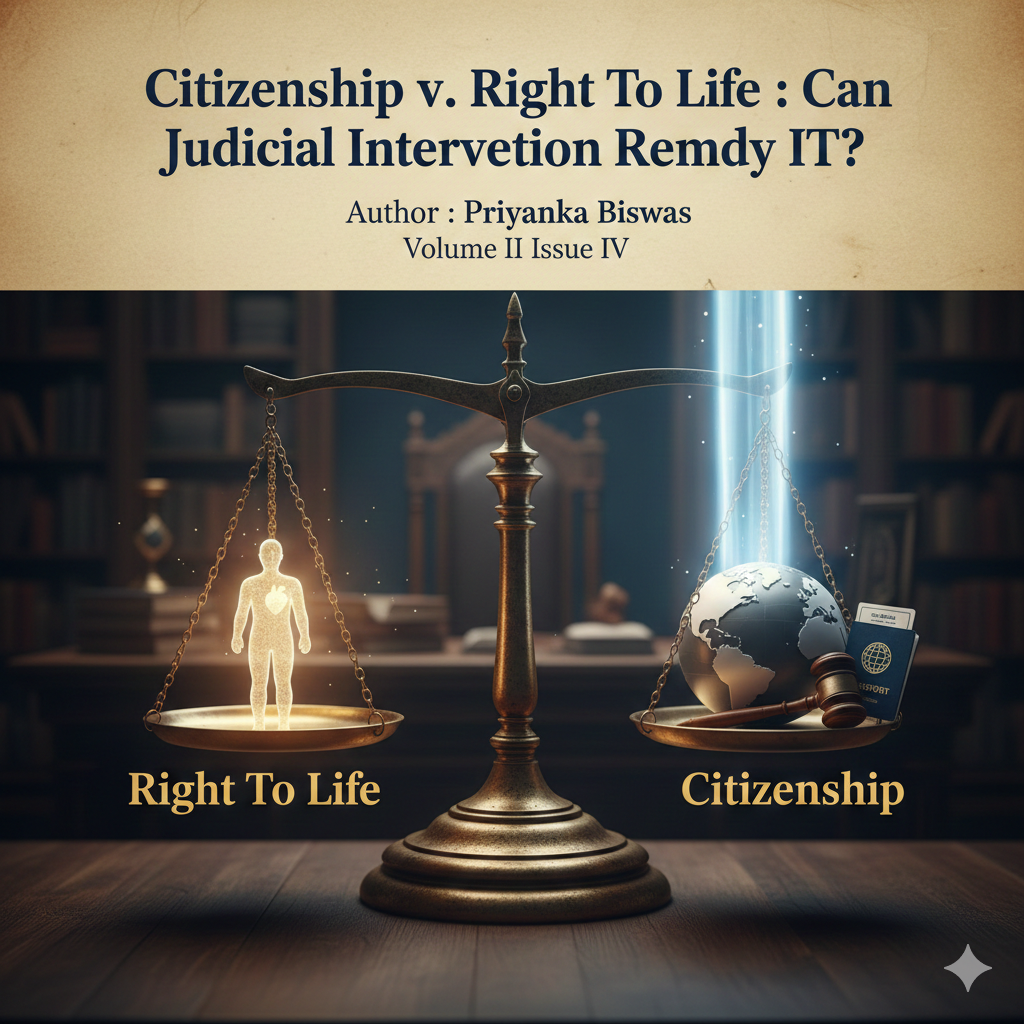
This paper seeks to explore how NRC would affect the Right to Life of two of the most vulnerable communities currently seeking shelter in India: Sri Lankan Thamizhs[4] and Rohingyas. The paper further seeks to understand the jurisprudence and the scope of citizenship and its relationship with A.21 and how the present scope of A.21 can be expanded to include all people. Last but not the least, the paper seeks to introspect NCR through the lens of objectivity and will look into the motive and nexus between NRC, the insipid Citizenship Amendment Bill and most importantly the internal and current geopolitical climate of South Asia.
“PIRAPIRKKUM ELLA UYIKUM…”
This phrase by Thiruvalluvar roughly translates to,
“IN BIRTH THERE ARE NO DIFFERENCES BETWEEN MEN”
1. INTRODUCTION
Despite the phrase being centuries old, it is a known fact that all men have never ‘lived’ or been ‘offered protection’ as equals. Locke explains in the Social Contract Theory that man gives up certain rights and takes up certain duties and obligation to gain the protection of the State[5].Locke in his Social Contract theory mentions how people in primitive society denounced their sovereign rights of self-governance to elect an individual who would provide them protection from external threats of man and nature.The practical applicability of this theory is the Citizenship process as implemented by each sovereign nation state. The eligibility criteria for Citizenship in a country is through Jus Soli, Jus Sanguinis and Naturalization. Critics have often argued that the concept of Citizenship has been exclusive in nature, dating back to the Greeks, wherein slaves and women were not considered as citizens. In the past few decades there has been a major trend all over the world towards newer definitions for the inclusion of various groups by the State. The most recent struggles were framed by Zapatists, Chechens, Kurdish and Tibetan nationalists fighting for the recognition of their language rights.Few scholars have termed these struggles as‘rights revolution’, which has been a recurring theme of ‘Western’ political history[6]. The ancient Greeks and Roman peasants,plebeians, Italian artisans, French proletariathave all at one point in history articulated the right to recognition and invoked the ideals of citizenship.
What has been happening with regard to citizenship in the past few decades is neither revolutionary nor a novel concept but a recurrent fundamental aspect of democratizing polities. The novel idea to the struggle, is the economic, social and cultural conditions that embarks the articulation of new claims on the citizenship rights. These struggles seek to enlarge and change the notion of State from awarding citizenship to a select few and abandoning the rest to including citizenship for everyone under right to life. This enlarges the scope of citizenship rights to include the status of immigrants, aboriginal people, refugees, diasporic groups, environmental injustices and the homeless.This has been expressed through the language of rights and obligations under the mandate of law to ensure right to life for all.[7]
This has led to redefining the rights and obligations of what it means to be a citizen, which individuals and groups are enabled to possess such rights and obligations have become key issues of concern. The three fundamental axes, extent (rules and norms of inclusion and exclusion), content (rights and responsibilities) and depth (thickness and thinness) of citizenship are being redefined and reconfigured by modern societies.[8] The modern society has come to an understanding that the conception of citizenship is a mere status held under the authority of state and has been contested and broadened to include various politico-social struggles of recognition and claim-making. This redefinition and reconceptualization has been an inadvertent product of the growing right-wing political polities all over the world, their understanding of citizenship wherein from the polities that have been regulating the access of public utilities in some countrieslike in Britain, where various conservative governments have restricted the use of railways to the Government in India that has been using citizenship and nationality laws to encourage the growth of a single religion in a multi-religious society. The only way forward to contest these arbitrary laws is to contrast citizenship rights with that of the duty of the State to provide all people i.e. both citizens and non- Citizens, the right to life. Therefore, in this context a reinterpretation of citizenship laws and rights with the help of right to life and consecutive expansion of the term ‘right to life’ has come to be of vital importance.
2. CITIZENSHIP: AN EXCLUSIONARY RIGHT?
Citizenship has been a vital component of statehood. It bestows legal rights upon an individual for belonging to a state which can be exercised in case of a breach. It reiterates Aristotle’s man being a social animal and with that comes the need to belong in a society or a community withhomogeneity. Since the demarcation of borders and the formation of sovereign nation-states, citizenship has always been a sort of tie, a continuous series of transactions between persons and agents of a given state in which each has enforceable rights and obligations uniquely by the virtue of the person’s membership in an exclusive category. The native-born plus the naturalized and the agent’s relation to the state rather than any other authority the agent may enjoy. Citizenship thus is a contract, according to various sociologists. Citizenship has etymologically been connected to a city and therefore to the State.
Citizenship by nature has always been an exclusionary right; this statement is evidenced by the acquiring of rights by the ‘man in the city’ who had acquired both rights and culture, as compared to the forgotten ‘Pagans in the countryside.’ On the creation of the treaty of Westphalia and thereby the system of states, distinct boundaries and therefore as a by-product, sovereignty and citizenship, the concept of citizenship had further emerged as a fundamental tool wielded by the nation-states. With the development of administration, the concept of citizenship then became perpetually connected to the feeling of nationality, belongingness, homogeneity and therefore inherently inclusion and exclusion.
Citizenship in a way can be defined, therefore, as a deliberate exclusionary act by the state to homogenize and integrate certain groups and exclude the others that the state deems unfit. Political philosophers like Hegel and Marx recognized citizenship as a means to maintain class inequality in liberal capitalism and claimed that citizenship was being used as a shield to mask economic exploitation.[9] With these claims on one side, the other side argues that citizenship emphasizes individual rights as only one version and that the other version would be the collective social rights wherein the proletariat has mobilized behind the discourse of citizenship to claim rights of their own.[10] This theory has also been supported by the creation of welfare states wherein citizenship has been used to enact welfare measures and to achieve equality amongst citizens. This led to critics raising the question of could this exclusion by the state be allowed while trying to achieve equality? Especially when the Colonialization, the two World Wars and the new world order comprising of liberalization, privatization and globalization has led to the increasing numbers of statelessness, refugees and migrants. And because citizenship rights and protection have always been encompassed by the nation-state and were unavailable to those who were inherently and have perennially been excluded- human rights were sought to be held as a shield to protect the rights of Aboriginal and Native Groups, Refugees, Stateless People and children. Therefore, since the 20th century, the international legal institutions have always forced and coerced the State to protect the rights of the excluded groups under the banner of human rights legislations. This became stronger with the signing of the Bill of Rights through the right to life.
In India, Citizenship is provided under A.5 through A.11. These articles detail the various categories of persons eligible and the processes through which citizenship may be availed. Therefore, in India, citizenship can be acquired or determined by birth, by registration, by descent and by naturalization. Once a citizen, the relationship between the individual and State becomes a reciprocatoryrelationship wherein both have certain duties and responsibilities towards each other. The State here assumes the role of the parent, as under the principle of parens patriaeand therefore acts as the protector and facilitator of fundamental rights and duties as mentioned in the Constitution. The Citizenship Act and the Constitution of India excludes a group of people or deems a group of people automatically ineligible. This group of people are dubbed as illegal migrants/ refugees/stateless people- terms that have been interchangeable used due to the legal void in Refugee Law. The Citizenship act only differentiates between a citizen and an illegal migrant and therefore- refugees, stateless people and illegal migrants are accorded the same definition as per the Act. These three groups were unable to get citizenship in India till the passing of the Citizenship Amendment Act of 2019. As they cannot be citizens the state does not have a contact or a relationship with the people- this is remedied by A.21 of the Constitution, which the Courts have on many occasions applied to both citizens and non-citizens alike.
As sub-theme eight deals with Citizens/People, laws and right to life the authors feel that it is important to discuss at length the rights of people, which leads to the follow up question of who all fall under the category of ‘People’? Are not Citizens ‘People’ too? How are ‘People’ any different from Citizens? People encompasses all persons who are Foreign nationals in a country i.e. exchange students who visit another country for a semester, Refugees who are fleeing from persecution in their country of origin i.e. Syrian refugees fleeing from persecution to Europe and other western countries, Stateless people who have been denied citizenship by both their country of origin and the country in which they are seeking refuge i.e. the Rohingya populace of Rakhine region in Myanmar, Asylum seekers who seek safe haven in another country, mostly one which is not on good diplomatic terms with his country of origin i.e. whistleblowers like Edward Snowden, Julian Assange, Kathryn Bolkovac who have exposed critical information about governments and international governmental bodies, Internally Displaced People i.e. Tibetan who are living in Chinese occupied Tibet.
These questions are very pertinent considering the present geo-political climate of India and the world. We are witnessing a more apprehensive Europe that is shutting its borders and is reluctant to take in any more refugees from West Asia, growing popularity of right-wing conservative governments, whose larger interest is to secure the borders and keep the refugees out, and an overtly unstable Washington on its foreign relations, especially with Iran. The erstwhile Foreign Security and National Security Advisor Shivshankar Menon is of the opinion that India will face diplomatic isolation because of Citizenship Amendment Act (CAA), 2019 and National Register of Citizens (NRC).[11]
The government’s intention behind implementing NRC in Assam and National Population Register (NPR) pan India can be speculated to segregate the Muslimsin particular who fail to present identity documents, further alienating the community and increasing the communal rift between Hindus and Muslim. This segregation has had a massive effect on the tribal community, SC/ST, OBCs andother marginalized sections who have failed to produce documents proving their parents and grandparents’ lineage. Detention centers across Assam have one thing in common i.e. vulnerable sections of the society, both socially, educationally and economically disadvantaged, are being rendered Stateless in broad daylight. India does not define in any of its laws ‘Statelessness’ but as per Article 1(1) of the 1954 UN Convention relating to the Status of Stateless Persons, ‘a person who is not considered as a national by any State under the operation of its law’has been defined as Stateless.Now considering what is happening in Assam wherein every person who is unable to furnish identity documents are being thrown unceremoniously into detention camps, including children, are neither Indian citizens nor will they be given citizenship by Bangladesh, hence fulfilling the definition of Statelessness under the 1951 convention.[12]
Right to life of the Indian constitution extends to both citizens and non-citizens alike. If one were to go back to the constituent assembly debates, the provision of ‘procedure established by law’ as under Article 21 was vehemently opposed by some members who believed that the American concept of ‘due process’ would be a better fit for the newly independent country. ‘Due process’ clause has evolved over the years in the United States Supreme Court which bestows the power to review any law, be it substantial, procedural, judge made laws or laws made by the legislature, and strike it out as unconstitutional if found to be in derogation of life, liberty and property. Our constitutional forefathers felt that inserting the due process clause would ensure that the Courts interpret and safeguard the rights of the citizens, putting a check on the overwhelming powers of the legislature and executive. During the Constituent Assembly debates on 6th December 1948, Kazi Syed Karimuddin, spoke on then Article 15, which is our current article 21, stating if the ‘procedure established by law’ clause were to be enacted
“there will be very great injustice to the law courts in the country because as soon as a procedure according to law is complied with, there will be an end to the duties ofcourt and the judges cannot interfere with any law which might have been capricious, unjust or iniquitous.”[13]
Despite the ‘procedure established by law’ being implemented in the Constitution the Courts have strived tirelessly to widen the ambit of right to life in the last two decades. Landmark judgments in cases such as Olga Tellis & Ors. v. Bombay Municipal Corporation[14], Maneka Gandhi v. Union of India[15], Francis Coralie Mullin v. The Administrator, Union Territory of India[16], the apex court has reiterated the right to a ‘dignified life’ i.e. life is more than mere animal existence and that right to life and liberty of an individual cannot be dispensed arbitrarily unless it is prescribed under ‘procedure established by law’[17]. In Kharak Singh v. St. of Uttar Pradesh, the supreme court has held:
“By the term “life” as here used something more is meant than mere animal existence. The inhibition against its deprivation extends to all those limbs and faculties by which life is enjoyed. The provision equally prohibits the mutilation of the body by amputation of an armored leg or the pulling out of an eye, or the destruction of any other organ of the body through which the soul communicates with the outer world.”[18]
Similarly, in the case of Sunil Batra v. Delhi Administration[19], it was reiterated that the “right to life” includes the right to lead a healthy life so as to enjoy all faculties of the human body in their prime conditions. It would even include the right to protection of a person’s tradition, culture, heritage and all that gives meaning to a man’s life. It includes the right to live in peace, to sleep in peace and the right to repose and health.[20] In the case of Vishaka v. State of Rajasthan[21] the Apex Court acknowledged the void of a domestic law against sexual harassment and thus implemented CEDAW[22]. Supreme Court has taken cognizance of international conventions whenever there has been a legal vaccum in the domestic legal policy.The Courts have today expanded the scope of Right to Life to all ‘People’ rather than just Citizens.
What we are witnessing in the country right now, with respect to the change in the Nationality Law[23] and the consequences of it, the warning of the dissenting constituent assembly members, including the man most vital to the creation of the constitution, Dr B.R. Ambedkar, comes to mind,wherein he had feared a state where the legislature and executive with unchecked federal power and a weakened, timid judiciary that has next to no powers to review laws passed by the legislature. Under the current state of affairs, the basic human rights guaranteed under the Indian Constitution are being denied to both citizens and non-citizens alike. It is indeed a sorry state of affairs to see innocent citizens, especially students being ruthlessly prevailed upon by law enforcement agencies for going out on the streets and exercising their fundamental right dissent against the mighty power of the State, in lieuof the recent Citizenship Amendment Act, 2019. Civil societies have taken it upon themselves to express its displeasure and remind the ever-increasing autocratic government to roll back this amendment, before the flames of sectarian violence engulfs the nation and chars the unique fabric of our society.
4. JUDICIAL INTERVENTION AND THE EXPANSION OF ‘RIGHT TO LIFE’
In the previous parts the article detailed on the jurisprudence of right to life and citizenship rights. The relationship between the both is such that where citizenship right ends- the right to life ought to begin. The A.21 rights flow both parallelly to the citizens at the same time includes those excluded from citizenship. In India, the context of right to life for non-citizens has gained utmost importance in the present scenario wherein the nationality laws have brought a threat to right to life of both citizens and non-citizens in an arbitrary manner on a religious basis in a multi- religious, ‘secular’ country like India. The law in question is the Citizenship Amendment Act, 2019 along with National Population Register and the NRC.In order to understand the problematic aspects of CAA and NRC one must look into the historical background, India’s foreign policy, post-independence and the lessons taught by partition. Post-independence India did not think it necessary to have a refugee legislation, even though one could argue that the sheer number of people rendered stateless due to partition, horrors of communal violence i.e., systematic rape, mob lynching, systematic cleansing of a particular religion had been used as tools to create fear and hatred amongst communities, should have served as an impetus to pass a refugee law. End of the Second World War saw the rise of a bipolar world divided into two power blocs: the capitalist west and the communist east, wherein India became one of the key architects of the Non-Aligned Movement, which is why it termed the 1951 Conventionas ‘Euro-centric’ and cited reasons such as a highly ‘porous border’ as reasons for not signing the convention and it’s protocol in 1967[24].
Keeping with the tenets of Non-refoulement[25] i.e. a vital component of customary international law, a person who is fleeing persecution in his country of origin seeking refuge in another country must not be deported back to the war-torn zone where his life would be in imminent danger. However, parties not signatory to the international convention such as India often are in violation of non-refoulement as customary international law has no binding effect on nation states but are meant to be adhered to nonetheless as it constitutes Jus Cogens and secondly, sovereign nations have the right to take decisions on matter of internal and external affairs of their nation. India has done the woeful error of letting geopolitics to guide its refugee policy- lack of a municipal law allows New Delhi a certain amount of flexibility to decide its course on refugees and in cases where it has felt extending safe haven to a community may jeopardise its relations with a benevolent nation state i.e. on which it depends heavily for trade and commerce, arms trade, regional security, it has denied to host and recognise such communities as refugees fleeing from persecution.
The Citizenship (Amendment) Act, 1955 defines ‘Illegal Migrant’ as:
“foreigner who has entered into India-
-
without a valid passport or other travel documents and such other document or authority as may be prescribed by or under any law in that behalf; or
-
with a valid passport or other travel documents and such other document or authority as may be prescribed by or under any law in that behalf but remains therein beyond the permitted period of time”[26]
The problem with this definition is that every refugee is at one point an illegal migrant. It is a preposterous notion that people who are running for their lives with only the clothes on their backs, the only priority being to move their families to safety, would be carrying paperwork such as passport and other travel documents. Secondly, after having reached to safety, with or without travel documents, it would be inhumane on behalf of the host nation to expect such people to return back to a war-torn country.
The effects of the recent nationality law have been studied in this part using two groups: Sri Lankan Thamizh Hill Country ‘Refugees’ and ‘Illegal Migrants’ from Rohingya.
4.1. INDIAN ORIGIN HILL COUNTRY ‘REFUGEES’
During the Civil War in Sri Lanka a large group of Hill Country Indian origin- Sri Lankan Thamizh Refugees were brought to India under the Shastri Pact, wherein they were promised Indian Citizenship. Of the 525,000 people promised only 150,000 were offered citizenship and the rest were placed in camps and plantations without citizenship.[27] The Government then failed to fulfill its promise, the repercussions of which their future generations will be facing due to the amended laws, today. This group of people do not have any nationality as of date, because they have been renounced by the Government of Sri Lanka and have not been given Citizenship by the Government of India. As of today, this group is Stateless, with the Amendment to the CAA, wherein Sri Lanka has been conveniently forgotten, this group of people are not eligible to become citizens or apply for citizenship using the new law. They cannot avail citizenship using the older provisions as per the 1955 act because they cannot prove their citizenship due to the loss of their documents while fleeing persecution. Therefore, those who cannot avail the citizenship or cannot prove their citizenship will be detained in detention camps despite the promise of the Government made in the pact dated in the year 1964.
4.2.ROHINGYAS, THE ‘ILLEGAL MIGRANTS’
The mass exodus of Rohingyas since 2012 has grabbed the world’s attention. The Rohingyas have historically been a discriminated group of people, hailing from the erstwhile Arakan region, now known as Rakhine. The Indian government has termed Rohingyas fleeing persecution as ‘threat to national security’ and has refused to recognise them as ‘Refugees’. New Delhi’s stance on Rohingyas is clear as water- ‘Illegal Migrants’ who due their socio-economic and religious pre-disposition can be easily radicalised.[28] Then Junior Interior Minister Kiren Rijiju declared in the Parliament that the central government had ordered all state governments to identify and deport all Rohingyas.[29]Unlike the hospitality extended to the Tibetans and Sri Lankan Thamizh communities, the Rohingyas have been treated as social pariahs; no government identity proofs recognising them as refugees, which creates problems when seeking employment. They live in settlements, without proper sanitation, access to electricity, portable water, with the constant fear of being deported back to Myanmar.
With the recent amendment to the Citizenship Act[30], future of the Rohingya community in India is bleak as Muslims from Myanmar do not qualify under the category of six recognised ethnic minorities from Bangladesh, Pakistan and Afghanistan. In the wake of existing laws, or rather the absence of a proper legal framework for refugees and stateless persons, introducing NRC and CAA is a fruitless exercise. NRC and CAA is a dual edged sword- firstly, it aims to churn out all ‘minorities’ who fail to produce identity documents and secondly, with the amendment, it wants to provide a backdoor entry to ethnic minorities i.e. Hindus, Buddhists, Sikhs, Jains, Christians, Parsees from three Muslim nation states i.e. Bangladesh, Pakistan, Afghanistan. It is clear as day that the government, without paying any heed to the Constitutional protections provided under articles 13, 14, 21, is sending a clear message that India is a homogenous nation of only Hindus.
It is because of this arbitrary law and its consequences of this law that the scope of A.21 needs to be expanded to protect not just human life but also to ensure that the basic structure of the Constitution is preserved. The expansion of article 21 has always been a vital trait of the article initself. The very fact that law uses the word right to ‘life’- life being a wide term encompassing various characteristic traits in them shows the scope for its expansion when the need arises. Therefore, in order to counter the effects of CAA and NRC and to further fill the legal void in the absence of a refugee framework, the existing judgments on the ever-expanding scope of A.21 as stated in S.P. Gupta v. UOI,[31] wherein the Hon’ble Justice P.N. Bhagwati stated that, “the court has to innovate new methods and strategies to provide access to justice to large masses of people who are denied basic human rights, to whom freedom and liberty have no meaning”P.N. Bhagwati in the caseOlga Tellis v. Bombay Municipal Corporation and Ors.[32] had mentioned that right to life is not just a mere animal existence but also includes right to live with dignity. In the case ofP. Mohammad Khan v. State of Andhra Pradesh,[33]a petitioner who was an Afghan national approached the court against the order of the government passed under section 3(2)(c) of the Foreigners Act,1946 asking him to leave India. The Court had observed that there was a duty on the officers to decide on the stay of the refugee in the country, but that the duty should be discharged in a fair manner without arbitrariness. The court further held that the concept of fairness dictates that the authorities can proceed against the person concerned only after giving him notice and opportunity of being heard.
Whereas in the case of National Human Rights Commission v. State of Arunachal Pradesh,[34] the Supreme Court gave a very liberal interpretation to the law and observed that refugees are a class of people different from foreigners deserving protection under Article 21 of the Indian Constitution. The court directed the government of Arunachal Pradesh to provide adequate protection to Chakma refugees. In Digvijay Mote v. Union of India[35]the court directed the government of India to provide basic amenities including food to the refugee children.
Most importantly, inNedumaran v. Union of India,[36] the petitioners who are Sri Lankan refugees approached the Madras High Court praying for the issuance of writ of mandamus against the central government and state of Tamil Naidu to allow UNHCR authorities to look into the voluntary repatriation of the Sri Lankan refugees. The court while emphasizing the need for voluntary repatriation observed that it is the duty of the UNHCR to look into the matter of consent and not of the court. In the case of Gurunathan v. Union of India[37], a writ petition was filed before the madras High Court alleging that Sri Lankan refugees are forced to go back against their will and the consent given by them is not free consent as it is induced by coercion. The court held that it was not appropriate for it to look into the matter of consent especially when UNHCR is there to look into the voluntariness of consent. Once again court reiterated the faith in the working of UNHCR.
In 2018 the Supreme Court refrained from interfering in the government’s decision to deport seven Muslims back to Myanmar.[38] The apex court is apprehensive to move beyond its mandate and into judicial activism, especially in a matter wherein the executive’s stance is staunchly against recognising the Rohingyas. This is a specific case wherein irrespective of Articles 21 and 51(c) of the Indian constitution, which ensures protection of life and personal liberty, to both citizens and non-citizens, non-refoulement was breached and seven detained Rohingya men were deported back to a conflict torn Myanmar where they are bound to face persecution.
In the case of Syed Ata Mohammadi v. State,[39] the government of India was planning to deport back the petitioner, an Iranian citizen who was not in possession of valid visa. The court held that the petitioner cannot be deported back to Iran especially when he has been recognized as refugee by the UNHCR.Most recently in a case file before the Madurai Bench of the Madras HC, the court has ordered the Central Government to look into the Circumstances of granting citizenship to 60 odd refugees who were promised citizenship under the Srimavo-Shastri Pact. In the most recent case in the wake of the implementation of NRC is that the SC had ordered the State to ensure that children who do not have documents ought not to be detained in Detention Camps.[40]
As per the illustrations given through the judgments by the courts, it can be seen that the Courts have always been expanding the scope of A.21 to ensure that the basic right to life of all the people within the territory of India has been protected. With the recent amendment and the addition made to the nationality laws, the duty to expand the scope further to include important aspects of right to life ought to be done by the courts.
Lawacts as a tool of social transformation in society andit‘ought’ to be a progressive movement which brings within its fold each and every person without exclusion. But there are certain laws, like citizenship laws that are exclusive in nature. The reason for such exclusiveness is to ensure national security, better welfare schemes and programmes for the marginalized sections of the society. The State therefore, needs to find a balance to ensure that in the name of protecting and or / ensuring the rights and welfare of its citizens it does not violate the rights of the non-citizens, which is blatantly obvious through the recent amendment to the Citizenship Act. The Hon’ble Supreme Court of India is the only beacon of hope and must take it upon themselves to interpret the Constitution judiciously, as evidenced through the previously held judgments, thusfulfilling its duty to protect and ensure the rights of all ‘People’ and not just ‘Citizens’.
REFERENCES
-
Constitution of India, 1950.
NATIONAL STAUTES:
-
Citizenship Act, 1955.
-
Citizenship Amendment Act, 2019.
INTERNATIONAL STATUTES:
-
Convention Relating to the Status of Refugees, July 28th, 1951
-
Convention relating to the Status of Stateless Persons, September 28th, 1954
-
Convention on the Elimination of All Forms of Discrimination Against Women, December 18, 1979
-
Protocol Relating to the Status of Refugees, October 4th, 1967
BOOKS:
-
Cyril and Paranavitana, A Concise History of Ceylon, Ceylon University Press, (1961).
-
Isin& Turner, Handbook of Citizenship Studies, Sage, (Ed. 3, 2005).
-
Routledge and Kegan Paul, Towards a Transformation of Philosophy, (ed:1, Oxford, 1980).
-
Arendt, Men in Dark Times, Penguin, (1973).
-
Heater, World Citizenship and Government: Cosmopolitan Ideas in the History of Western Political Thought, Basingstoke: MacMillan, (1996).
-
Linklater, Men and Citizens in the Theory of International Relations, London: MacMillan, (1990).
ARTICLES:
-
Nussbaum, M, ‘Patriotism and Cosmopolitanism’, Boston Review, xix, (1994)
-
Himani Dutta, John Locke’s Social Contract Theory and the Constitution of India: Convergence and Divergence, Legal Services India.
-
Suryanarayan, “Sri Lankan Refugees in Tamil Nadu’s Humanitarian and Security Dimension”, Background Conference, Sri Lankan Refugees in India, Madras Centre for South and South East Asian Studies, University of Madras, Chennai, 11th April 1997, p. 37.
-
Dower, World Ethics: The New Agenda, Edinburgh University Press, (1998)
-
Schnabel and R. Thakur, Kosovo and the International Community: Selective Indignation, Collective Intervention and International Citizenship. Tokyo: United Nations University Press.
LIST OF CASES
|
Sl. No. |
Title of Case |
Citation |
|
1. |
Olga Tellis and Ors. v. Bombay Municipal Corporation and Ors |
A.I.R. 180, 1985 SCR SUPL. (2)51 |
|
2. |
Digvijay Mote v. Union of India |
WA 354 of (Karnataka High Court) |
|
3. |
Francis Coralie Mullin v. The Administrator, Union Territory of India |
1981 AIR 746, 1981 SCR (2) 516 |
|
4. |
Gurunathan v. Union of India |
WP 6708 and 9168 (Madras High Court) |
|
5. |
Kharak Singh v. St. of Uttar Pradesh |
AIR 1963 SC 1295 |
|
6. |
Maneka Gandhi v. Union of India |
1978 AIR 597, 1978 SCR (2) 621 |
|
7. |
Mohammad Khan v. State of Andhra Pradesh |
AIR 1986 SC 180 |
|
Mohammad Salimullah v. Union of India |
WP (C) 793/2017 |
|
|
8. |
National Human Rights Commission v. State of Arunachal Pradesh |
(1996)1SCC742 |
|
9. |
Nedumaran v. Union of India |
WP 12298 and 12313 of 1992 (Madras High Court) |
|
10. |
S.P. Gupta v. UOI |
1981 Supp SCC 87 |
|
11. |
Sayed Ata Mohammad v. Union of India |
AD Cri 48 of 1994 (Bombay High Court) |
|
12. |
Sunil Batra v. Delhi Administration |
1980 AIR 1579, 1980 SCR (2) 557 |
|
13. |
Vincent Ferrer v. District Revenue Officer, Anantpur |
[AIR 1974 AP 314] |
|
14. |
Vishaka v. State of Rajasthan |
AIR 1997 Sc 3011 |
[1]Olga Tellis and Ors. v. Bombay Municipal Corporation and Ors., (1986), A.I.R. 180, (1985) SCR SUPL. (2)51.
[2]Convention Relating to the Status of Refugees, July 28th, 1951.
[3]Vincent Ferrer v. District Revenue Officer, Anantpur A.I.R. 1974 AP 314 (India).
[4]Tamils hereinafter is referred to as Thamizh/ Thamizhs.
[5]Himani Dutta, John Locke’s Social Contract Theory and the Constitution of India: Convergence and Divergence,Legal Services India(Jan. 8, 2020, 11.15 AM), http://www.legalservicesindia.com/article/1726/John-Lockes-Social-Contract-Theory.html.
[6]Isin& Turner, Handbook of Citizenship Studies(3rd Ed. 2005).
[7]Isin& Turner, Handbook of Citizenship Studies(3rd Ed. 2005).
[8]Ibid.
[9]Routledge & Kegan Paul, Towards a Transformation of Philosophy(1st ed. Oxford Publication1980).
[10]Hannah Arendt, Men in Dark Times (1st ed. Penguin Books1973).
[11]Special Correspondent, India will face international isolation because of NRC-CAA: Shivshankar Menon, THE HINDU, January 3, 2020.
[12]Convention relating to the Status of Stateless Persons, September 28th, 1954.
[13]Kazi Syed Karimuddin, Constituent Assembly Debates on Article 15-A,Constituent Assembly (15th–6th September 1949).
[14]Olga Tellis & Ors. v. Bombay Municipal Corporation,(1986) A.I.R. 180, (1985).
[15]Maneka Gandhi v. Union of India,(1978) A.I.R. 597, 2. S.C.R. 621.
[16]Francis Coralie Mullin v. The Administrator, Union Territory of India,(1981) A.I.R. 746, 2. SCR 51.
[17] Mr. A.H. Hawaldar, Evolution of Due Process in India, B.L.R., Oct.-Dec.(2014).
[18]Kharak Singh v. St. of Uttar Pradesh,A.I.R.(1963) S.C. 1295.
[19](1980) A.I.R. 1579, (India).
[20]Riya Jain, Article 21 of the Constitution of India- Right to Life and Personal Liberty, LAWCTOPUS(Jan. 9, 2020),https://www.lawctopus.com/academike/article-21-of-the-constitution-of-india-right-to-life-and-personal-liberty/.
[21]Vishaka v. St. of Rajasthan, A.I.R. 1997 S.C. 3011.
[22] Convention on the Elimination of All Forms of Discrimination Against Women, December 18, 1979.
[23] Nationality laws hereinafter includes CAA, NRC and NPR.
[24]Protocol Relating to the Status of Refugees, Oct. 4th, 1967.
[25]UN High Commissioner for Refugees,UNHCRNote on the Principle of Non-Refoulement, refworld(January 7, 2020), https://www.refworld.org/docid/3ae68ccd10.html.
[26] The Citizenship (Amendment) Act, Section 2(1), 1955.
[27]Cyril & Paranavitana, A Concise History of Ceylon (Ceylon University Press1961).
[28] Editorial, Caution needed: on Supreme Court decision on Rohingya’s status, The Hindu,July 11, 2019.
[29] Krishna N. Das&Sanjeev Miglani, India says to deport all Rohingya regardless of U.N. registration, Reuters (August 14, 2017, 11.30 PM), https://www.reuters.com/article/us-myanmar-rohingya-india/india-says-to-deport-all-rohingya-regardless-of-u-n-registration-idUSKCN1AU0UC.
[30]Ibid.
[31]S.P. Gupta v. UOI,(1981) Supp S.C.C. 87.
[32]Olga Tellis v. Bombay Municipal Corporation and Ors.,A.I.R. 1986 S.C. 180.
[33]P. Mohammad Khan v. State of Andhra Pradesh,1978 (II)A.P.W.R. 408.
[34]National Human Rights Commission v. State of Arunachal Pradesh,(1996)1S.C.C. 742.
[35]Digvijay Mote v. Union of India,(1993) 4 S.C.C. 175.
[36]Nedumaran v. Union of India,(1993) 2 A.L.T. 291.
[37]Gurunathan v. Union of India, WP 6708 and 9168 of 1992.
[38] Mohammad Salimullah v. Union of India, WP (C) 793/2017.
[39]Syed Ata Mohammadi v. State, Criminal writ petition no.7504/1994.
[40]P.Ulaganathan v. The Government of India, WP(MD) no.5253/2009.