I.ABSTRACT
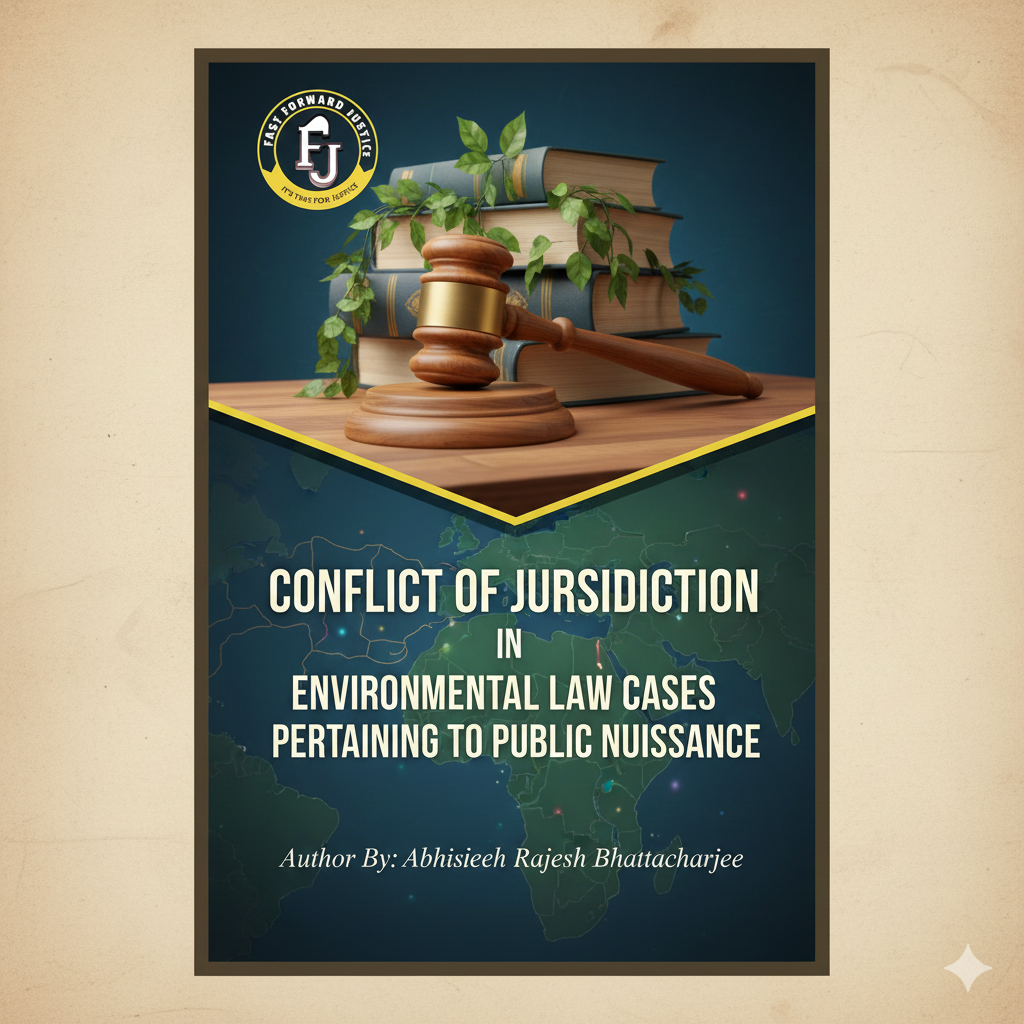
It is very much important for a court to not exceed its jurisdiction and to fulfil the jurisdiction within its area properly. The jurisdictional aspect becomes much more complex when many remedies are available for a single act under different statutes. This complexity arises in the cases of environment law matters pertaining to public nuisance. A case of public nuisance can be approached under 5 different provisions of different statutes. The primary of them all is section 133 of the Code of Criminal Procedure, 1973 which covers all the aspects of public nuisance unlike the other provisions. Another major remedy can be obtained under section 91 of the Code of Civil Procedure, 1908. Barring these two acts, injunctions can be sought under the Specific Relief Act, 1963 or the provision of the special acts can be adhered to under the Water (Prevention and Control of Pollution) Act, 1974/Air (Prevention and Control of Pollution) Act, 1981, but help of these provisions can be taken only when the public nuisance is caused by way of water or air pollution. This paper deals with the conflict which arises in the jurisdictional aspects of the courts while dealing with a case of public nuisance. Firstly, it gives a statutory explanation, then it gives a judicial comparison and finally it lays down the conclusion where the answer to the conflict has been provided. It deals with various case laws whereby the court has laid down different things pertaining to the jurisdictional aspect but finally it can be seen that the conflict currently has been solved to a much larger extent.
Keywords – Jurisdiction, conflict, judicial comparison, special acts.
II.INTRODUCTION
Public nuisance is defined as a wrongful act which causes nuisance or annoyance to the public at large. It can also be viewed as an act which wrongfully infringes the rights of general public. In English Criminal Law, public nuisance is considered as a class of common law whereby the injury or damage is sustained by the public as a whole rather than any individual. In many common law cases it has also been defined as an act which hinders the safety of the people at large and disturbs their day to day life. There is an interference with the rights of the public as a whole and this interference is substantial and unreasonable.Public nuisance covers a variety of wrongs which threaten the health, moral, safety, convenience etc. of the general public. Generally, a private nuisance which is caused to an individual is considered to be a civil wrong and public nuisance which is caused to the public at large is considered to be a criminal wrong. But in India public nuisance can be viewed both as a criminal wrong as well as a civil wrong. In India there are multiple avenues through which the court can be approached in the case of public nuisance. Remedies can be sought not only under the Code of Civil Procedure, 1908 and Code of Criminal Procedure, 1973 but it can also be sought under the special acts.
Section 268 of the Indian Penal Code, 1860 gives an appropriate understanding of the term ‘public nuisance’. It provides that “A person is guilty of a public nuisance, who does any act or is guilty of an illegal omission, which causes any common injury, danger or annoyance to the public or to the people in general who dwell or occupy property in the vicinity, or which must necessarily cause injury, obstruction, danger or annoyance to persons who may have occasion to use any public right. A common nuisance is not excused on the ground that it causes some convenience or advantage.”[1]The section lists the following essentials to constitute a public nuisance: –
- Doing of any act or illegal omission to do an act.
- The act or omission;
- Must cause any common injury, danger or annoyance to the public to the people in general who dwell or occupy property in the vicinity;
- Must necessarily cause injury, obstruction, danger or annoyance to persons who may have occasion to use any public right.[2]
The whole concept of public nuisance is based on the maxim “sic utere tuo ut rem publicum non laedas” which simply means that one should enjoy his own property without injuring the right of the public. According to section 12 of the Indian Penal Code, 1860 the word ‘public’ denotes any class of public or community. Thus, a group of people living in a particular locality can also come within the purview of the term ‘public’.
To get justice in the case of public nuisance, there are mainly 5 gates through which a person can proceed. Firstly, filing a civil suit under the Code of Civil Procedure, 1908. Secondly, filing a criminal case under the Code of Criminal Procedure, 1973. Thirdly, by way injunction under the Specific Relief Act, 1963. Fourthly, approaching the appropriate authority under the Water (Prevention and Control of Pollution) Act, 1974 in cases of public nuisance pertaining to water. Lastly, approaching the appropriate authority under the Air (Prevention and Control of Pollution) Act, 1981 in cases of public nuisance pertaining to air. In many cases it has been seen that there has been a conflict of jurisdiction in cases of public nuisance especially in the presence of special acts, i.e. the air and the water act respectively.
III. STATUTE ANALYSIS
a.The Code of Civil Procedure, 1908.
Section 91[3] of the Code of Civil Procedure, 1908 deals with the aspect of filing of suit in case of public nuisance or other unlawful acts distressing the public at large. The section clearly says that a suit for public nuisance can be filed for seeking remedy in the form of declaration, injunction or such other relief as may be suitable depending upon the facts and circumstances of a particular case. In the landmark case of Municipal Council, Ratlam v. Vardichan[4], the Apex Court observed that an act of public nuisance is a threat to the social justice component of the Rule of Law. It is both the power as well as the duty of the Government or local authorities to take appropriate steps against public nuisance. Under the provisions of this code no special proof of damage is required in order to get a relief in the case of public nuisance. A suit of this type can be filed by an Advocate General or two or more persons with the leave of the court or any private person who has suffered damages due to the nuisance.
- The Code of Criminal Procedure, 1973.
Section 133[5] of the Code of Criminal Procedure, 1973, empowers a district magistrate or a sub-divisional magistrate or any other executive magistrate to pass a conditional order to remove or regulate nuisance or any kind of obstruction on receiving the report of a police officer or any other information in this regard. The cases of public nuisance which can be dealt with under this section has been divided into six categories. They are as follows: –
- The wrongful obstruction or nuisance shall be removed from any public place including rivers, lawfully used by the public.
- The carrying on of a trade or occupation or keeping of any goods which poses a threat to the health and the physical comfort of the community at large.
- The construction of any building or disposal of any substance likely to cause a huge damage shall be prevented.
- Any kind of structure likely to fall and poses a danger for the people living around.
- A dangerous animal which poses a threat to the people around.
- A tank or any kind of excavation formed in a very dangerous manner and the people in the vicinity likely to face a grave danger for the same.
Once case has been instituted under this code and an order regarding the same has been passed by the concerned magistrate, is allowed to be questioned in a civil court. Although an individual is allowed to enjoy his property and his rights, he or she should not do so in the expense of violating the rights of the others. Proceedings under section 133 of this code are not intended to settle disputes between two individual persons but the main aim in the proceedings is to protect the public at large from inconvenience. In Vansant Manga Nikumba v. Baburao Bhikanna Naidu[6] it was clearly mentioned that nuisance as such cannot be provided with a precise definition. The word basically denotes an inconvenience which interferes with the ordinary physical comfort of human existence. To apply section 133 of the Code of Criminal Procedure, 1973 the presence of imminent danger to the property and consequential nuisance to the public is very much a mandatory. Section 144 of the Code of Criminal Procedure, 1973 also provides the powers mentioned under section 133 of the Code to the respective magistrates. The only requirement under this section is that the case of public nuisance should be an urgent case of apprehended danger or nuisance.
- Specific Relief Act, 1963
In cases of public nuisance, the aid of the Specific Relief Act, 1963 by way of different kinds of injunctions can also be taken. The first and foremost way is to take the help of section 37 of the Specific Relief Act, 1963 which is concerned with the aspect of permanent injunctions. Such an injunction permanently prohibits the person, against whom the order for the same has been passed from doing any particular act or exercising any particular right which is hampering the right of the other person or people. An order of such kind remains in force forever. An order for the same can be passed in cases of public nuisance caused by the acts of the individuals. Another very important aspect under the Specific Relief Act, 1963 which can be taken help from is mandatory injunction governed by section 39 of the act. It basically involves the compulsion of doing such acts as may be decided by the court. An order for the same can be passed compelling any official or any person to do an act for the removal or regulation of the nuisance in question.
- Special Acts
The aspects of water pollution and air pollution which are two of the major causes of public nuisance which are guided by the Water (Prevention and Control of Pollution) Act, 1974 and Air (Prevention and Control of Pollution) Act, 1981 respectively. The provisions of the same govern the cases where due to effluents in the water and the air, public nuisance takes place. Under section 49 of the Water (Prevention and Control of Pollution) Act, 1974 and section 43 of the Air (Prevention and Control of Pollution) Act, 1981 it has been expressly stated that no courts inferior to that of the metropolitan magistrate or the judicial magistrate of the first class shall try any offence under the respective acts.
IV.JUDICIAL DECISIONS AND RECENT TRENDS
In cases of public nuisance, mainly three remedies are available and they can be looked as options for getting relief whereby either of them shall be chosen. The first remedy can be obtained by instituting a suit under section 91 of the Code of Civil Procedure, 1908 for declaration, injunction (temporary) or other applicable relief depending upon the facts and circumstances of the case. The second remedy can be obtained by way of injunctions, either permanent or mandatory, depending upon the facts and circumstances of the case under the Specific Relief Act, 1963. The third remedy can be obtained under section 133 or section 144 of the Code of Criminal Procedure, 1973 whereby a district magistrate or a sub-divisional magistrate or an executive magistrate is empowered to order for the removal of public nuisance in certain cases. When the public nuisance is caused due to air pollution or water pollution, remedies can also be sought under the special acts, i.e. the Water (Prevention and Control of Pollution) Act, 1974 and the Air (Prevention and Control of Pollution) Act, 1981 respectively. There is an intense conflict of jurisdiction since the remedies available are manifold.
In the case of Luckhee Narain Banerjee v. Ram Kumar[7] it was held that “a distinction is drawn at between a claim of right which the Magistrate thinks well founded and a claim of rights which the Magistrate does not think well-founded but considers to have been made bona fide. It was laid down that in the former case the Magistrate will take no further proceedings but in the latter he should allow the defendant an opportunity of asserting his claim by civil proceedings and that if he does not go to a Civil Court within a reasonable time or fails there the Magistrate will proceed.”
But in the case of Belat Ali v. Abdur Rahim[8] it was held that even though the claim of rights as mentioned in the above case is not well founded the Magistrate has the power to move forward with the proceeding under section 133 of the Code of Criminal Procedure, 1973. This position was also upheld in the case of Ram Sagar Mondal vs Alek Naskar And Bhola Nath Mondal[9]. If the magistrate can by himself determine the exact claim of rights, he has all the power to continue with the proceeding.
The conflict of jurisdiction has been much more intense in the cases where the public nuisance has been caused as a result of air or water pollution. In the case of Abdul Hamid v. The Gwalior Rayon Silk Mfg. (WVG) Co. Ltd.[10]the court considered the issue of jurisdiction of the sub-divisional magistrate. It was held: –
“The Water and Air Acts are special Acts brought on the statue-book and constitute a complete Code for prevention and control of water and air pollution by any trade or industry. It has expressly been mandated therein that notwithstanding anything inconsistent therewith contained in any enactment order than the Acts their Provisions have to prevail. Inconsistent provisions in any other Act cannot, therefore, be permitted to come in the way of the provisions of the special Acts and defeat them. In view of the express provisions in Section 52 of the Air Act and Section 60 of the Water Act it has to be held that to the extent of inconsistency the provisions of the Penal Code. General Clauses Act and the Code stand repealed. In matter relating to pollution of Air or Water by trade or industry recourse has to be taken to the provisions of the special Acts. On that ground the Court has held that the SDM has no jurisdiction to try the case.”
A contradiction to the fact laid down above lies in the commentary by Maxwell on Interpretation of statutes which was cited in the case of Harihar Polyfibers And Another vs The Sub-Divisional Magistrate[11] which states the following: –
“A later statute may repeal an earlier one either expressly or by implication. But repeal by implication is not favoured by the Courts, “forasmuch,” said Coke, as Acts of Parliaments are established with such gravity, wisdom and universal consent of the whole realm, for the advancement of the commonwealth, they ought not by any constrained construction out of the general and ambiguous words of a subsequent Act, to be abrogated. If, therefore, earlier and later statutes can reasonably be construed in such a way that both can be given effect to, this must be done. If, as with all modern statutes, the later Act contains a list of earlier enactments which it expressly repeals, an omission of a particular statue from the list will be a strong indication of an intention not to repeal that statute. And when the later Act is worded in purely affirmative language, without any negative expressed or implied, it becomes even less likely that it was intended to repeal the earlier law.”
The Judge in the case of Harihar Polyfibers And Another vs The Sub-Divisional Magistrate[12] said that, “the petitioners argued that the Water Air Pollution and Environment (Protection) Laws is a self-contained Act. It has also prescribed all the procedures to be followed. That being the case, these Acts have impliedly repealed the Sec. 133 of the Act. The Court has come to the conclusion that Sec. 133 covers a wide area and range, but it takes in pollution of water also which is the area and range specially covered by the Act. Sec. 133 of the Code contemplates enquiry by an Executive Magistrate into the complaints of pollution and measures being taken by the Magistrate to obviate such pollution or nuisance. Similar power is conferred on the State Board in the first instance and also on the Judicial Magistrate. These two Acts are co-existent and are not a conflict of jurisdiction. In similar circumstances it is found in Maxwell on Interpretation of Statutes that if earlier and later statutes can reasonably be construed in such a way that both can be given effect to, that this must be done. It is also clear that the later Act is worded in purely affirmative language without any negative, express or implied, it becomes even less likely that it was intended to repeal the earlier law. The doctrine of implied repeal is based on the theory that the Legislature, which is presumed to know the existing law, did not intent to create any confusion by retaining conflicting provisions and, therefore, when the Court applies the doctrine, it does no more than give effect to the intention of the Legislate by examining the scope and the object of the two enactments and by a comparison of their provisions. A repeal by implication will not be inferred merely from something contained in the preamble of the Act. The continuance of existing legislation, in the absence of an express provision of repeal, being presumed, the burden to show that there has been a repeal by implication lies on the party asserting the same. The presumption is, however, rebutted and a repeal is inferred by necessary implication, when the provisions of later Act are so inconsistent with or repugnant to the provisions of earlier Act “that the two cannot stand together”. From the above discussion, it is clear that there is no direct conflict between the two provisions. The legislature intended to lay down an exhaustive Code in respect of the subject-matter replacing the earlier law, the two laws occupy the same filed. Under the circumstances, it cannot be said that there is implied repeal of Sec. 133, Cr.P.C. The Andhra Pradesh High Court in M/s. Nagarjuna Paper Mills Ltd. v. Sub-Divisional Magistrate and Revenue Divisional Officer[13], has clearly held that Water (Prevention and Control of Pollution) Act, 1974 has not taken away powers of Sub-Divisional Magistrate under Section 133.”
Therefore it was a decided fact that the Sub-divisional Magistrate under section 133 of the Code of Criminal Procedure, 1973 has all the powers and the jurisdiction to entertain a matter pertaining to public nuisance and the presence of special acts of that of Water (Prevention and Control of Pollution) Act, 1974 as well as the Air (Prevention and Control of Pollution) Act, 1981 do not take away the jurisdiction of the Magistrate as mentioned above. Thus, pertaining to the topic of conflict of jurisdiction one must remember that the jurisdiction provided under section 133 of the Code of Criminal Procedure, 1973, no special acts or for that matter the Code of Civil Procedure, 1908 can annul the jurisdiction drilled by a district magistrate or a sub-divisional magistrate or an executive magistrate as the case may be. It is upon the discretion of the particular magistrate if he or she wants the rights claimed by the plaintiffs well defined. In order to do the same, he may allow the civil court to be loomed for a civil suit under section 91 of the Code of Civil Procedure, 1908. Moreover, it shall also be kept in mind that the enactment of any special act does not take away or impliedly repeal the general statues which are existent. Both shall be dealt with in the same manner and looked into with the same footing. It should be left upon the plaintiff to choose or as the case may be plaintiffs as to which remedy will be appropriate.
V.CONCLUSION
Under the common law, public nuisance or for that matter cases pertaining to public nuisance has always been dealt with as a tort. Thereafter it was adopted in the English criminal law system from the same because of the fact that public nuisance if addressed through a criminal viewpoint would ensure speedy remedial. Though in the Indian legal system multiple ways have been provided to approach the judiciary for a remedy in cases of public nuisance, it is always advised to take the help of section 133 of the Code of Criminal Procedure,1973 for a speedy and effective disposal of the matter. In urgent cases of apprehended danger, it is only section 144 of the Code of Criminal Procedure, 1973which shall be approached.
There lies no conflict of jurisdiction as it is up to the concerned person or persons as to how one wants to knock the doors of justice. The presence of a special act cannot nullify the powers provided under the general act except in case the special act expressly repeals the provisions of the general act. There is no such thing as implied repeal of a general act due to the enactment of any new act. If the case of public nuisance is pertaining to air or water pollution the method of getting remedy is wide open. It is not necessary to follow the provisions of the Air act or the water act. If a person has approached the court under section 91 of the Code of Civil Procedure, 1908 or section 133 (or section 144) of the Code of Criminal Procedure, 1973 it cannot be said that the court which has been approached do not have the jurisdiction to entertain the matter. It is to be remembered always that the aspect of public nuisance is dealt with a wider scope under section 133 of the Code of Criminal Procedure,1973.
[1]The Indian Penal Code, 1860, No. 45, Acts of Parliament, 1860 (India).
[2]Supra. 1.
[3]The Code of Civil Procedure, 1908, No. 28, Acts of Parliament, 1908 (India).
[4]Municipal Council, Ratlam v. Vardichan,(1980) 4 SCC 162.
[5]The Code of Criminal Procedure, 1973, No. 2, Acts of Parliament, 1974 (India).
[6]Vansant Manga Nikumba v. Baburao Bhikanna Naidu,(1995) Supp (4) SCC 54.
[7]Luckhee Narain Banerjee v. Ram Kumar,15 C. 604 at p. 570. 7 Ind. Dec. (N.S.) 960.
[8]Belat Ali v. Abdur Rahim,1 Cr. L.J. 70.
[9]Ram Sagar Mondal vs Alek Naskar And Bhola Nath Mondal,67 Ind Cas 177.
[10]Abdul Hamid v. The Gwalior Rayon Silk Mfg. (WVG) Co. Ltd., 1989 Cri LJ 2013.
[11]Harihar Polyfibers And Another vs The Sub-Divisional Magistrate, 1997 (1) ALT Cri 946.
[12]Supra. 11
[13]M/s. Nagarjuna Paper Mills Ltd. v. Sub-Divisional Magistrate and Revenue Divisional Officer,1987 Cri LJ 2071.