ABSTRACT:
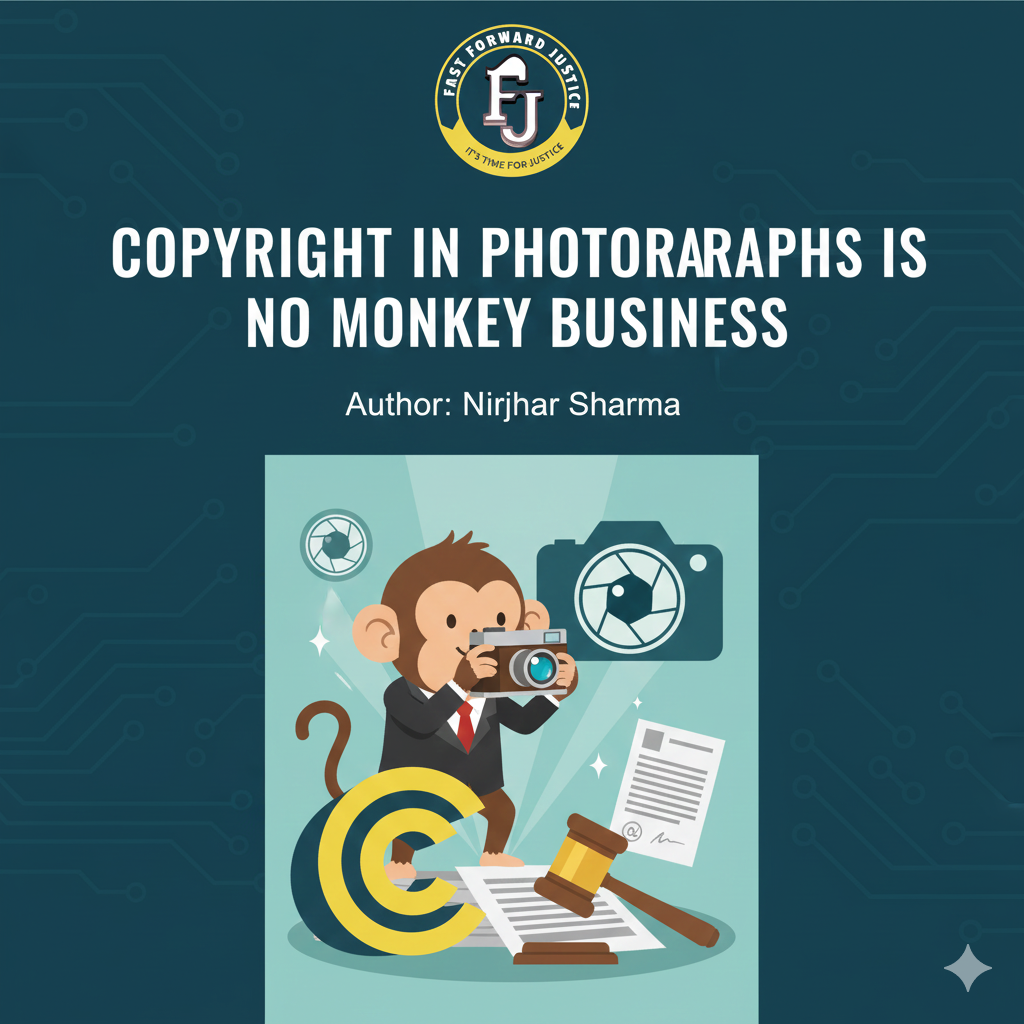
In April 2018, the U.S. court of Ninth Circuit put rest to the Naruto v. Slater[1] controversy, popularly known as the Monkey selfie case. The case raised some important questions regarding authorship of a work, and the elements of creativity sufficient to afford protection to a work. However, different jurisdictions, namely the U.S., the U.K. and India, suggest different outcomes for the same case, even though they have almost identical copyright regimes. This paper analyses the case as it happened under the US copyright law, the probable outcome under UK copyright law and the Indian copyright law. It goes further and tries to prove the judgement of the court of ninth circuit to be regressive and against the basic principles of copyright law.
Keywords: monkey-selfie case, authorship, creativity, photographic work
INTRODUCTION
Affording copyright protection to photographs is a little trickier than other kinds of work. This is so because a photograph can be created by just a click of the shutter button. The process of the production and creation of a photographic work is highly mechanized. One is required to only press a button once for the photo to be clicked, and sometimes, the camera automatically enhances the lighting, focus etc. thus, not leaving a lot of scope for the author to inculcate creativity in the work.
It is a settled principle of copyright law that for a work to be eligible for copyright protection, it must be original (the Berne convention only protects original works, as can be seen from the stress it lays on the distinction between original and derivative works)[2] and that it should be expressed in a tangible form[3]. Berne convention specifically focuses on the protection of literary and artistic works, of which photographic work forms a part.[4] Thus, it protects photographic works which are original and tangible.
While the Berne convention stresses on originality of the work, it does not define the term anywhere. Various jurisdictions have adopted that originality consists of two components- a) the work should emerge from the author and b) it should not be a copy i.e., it should possess some minimum amount of creativity.
This definition, while similar in several jurisdictions like the U.K., The U.S., and India, has evolved differently and at a different pace. The qualification for copyrightability has moved from the initially accepted sweat of the brow test to the minimum creativity test. Earlier, a work would be granted copyright protection if the author could show that he has put in sufficient labor and skill into his work. The work did not have to be original, in the literal sense of the word. The test has since then shifted, with importance now given to some amount of creativity, in addition to the skill and labor.
This test has seen different evolution in different jurisdictions. A stark difference can be seen in the stance of the courts when it comes to acknowledging and accepting creativity and the concept of authorship- the two prongs of originality.
This came up for deliberation in the court of Ninth Circuit in Naruto v. Slater[5], when a curious six year old male crested macaque clicked innumerous ‘selfies’ from the unattended camera of British photographer, David Slater, in the jungles of Indonesia. While Slater acknowledges that it was the monkey who took the selfies, he claims that all the other work except for pressing the button was done by him- from pursuing the monkeys, to fixing the correct lens setting to enable them to click pictures and this came after two hard days of pursuing them and trying to gain their trust. The camera was purposely left on a tripod, with all the settings in place and the rest was handled by the monkeys. What resulted were hundreds of photos (out of which three were used by Slater on various forums) and two very long and distinct disputes striking right at the roots of copyright law.
The first dispute dates back to 2014, when Slater had a tiff with the Wikimedia foundation, owner of the online encyclopedia, Wikipedia, when they put up the monkey selfie on its website and refused to take it down, not acknowledging Slater’s copyright in them. They countered that no copyright subsisted in the images as US copyright law does not afford copyright to works not created by humans. This dispute in the copyright office led the authority to embed and elaborate on in their Compendium[6] the importance of human authorship of the work in qualifying for a copyright.[7] Thus, the copyright office refused to register copyright in pictures created by the monkey and decided in the favor of the pictures being in public domain.
The second dispute arose between David Slater and People for Ethical Treatment of Animals (PETA).[8] PETA insisted that copyright be afforded to Naruto, the monkey who is the ‘author’ of the pictures in question. While the court acknowledged that he has a standing under Article III of the U.S. Constitution because of an earlier precedent stating that animals enjoy the constitutional stand to pursue a claim,[9] he lacks the statutory standing to sue under the copyright law of the U.S. In appeal, the Court of Ninth Circuit affirmed the judgment of the trial court, and reiterated the principle that an animal cannot claim copyright.
The important question that arises from the above disputes is whether a photographer can be disregarded from giving copyright for a photograph if he did not press the shutter button? Looking at the bigger picture, what exactly qualifies a work to be author’s independent creation, which lies at the core of originality, and consequently, copyright protection?
In a world which is advancing in technology at a pace which is unparalleled, similar issues are bound to come up. For example, if an artwork is created by a machine, with sufficient inputs from the another person machine, who is the author in this case? Can the monkey selfie case solve be of assistance in cases such as these?
This paper tries to analyze the judgment from the U.S. perspective, the U.K. perspective and finally the Indian perspective and tries to evaluate whether this judgment will help shape up the copyright regime across the world or will it do more harm than good.
SCENARIO IN THE U.S.
Similar to the Berne convention, the US copyright act of 1976 affords protection in original pictorial, graphic, and sculptural works of authorship[10] (among other works), which includes photographs[11], fixed in any tangible medium of expression.[12] The copyright act of 1976 moved the qualification of protectable works from “all writing of the author”[13] to ‘original work of authorship’, thus signifying moving away from the sweat of brow test to the minimum creativity test. Thus, we find that originality is the sin qua non of copyright.[14]
Under the US copyright act, ‘author’ has not been defined. The compendium however, does elaborate on the fact that to qualify as a work of authorship, it must be created by a human,[15] that is, for the work to be protectable, the author of the work should be human. The definition of ‘author’ has been provided by the judiciary in a landmark case, Community for Creative Non-Violence v. Reid[16] which defines author as the party who actually creates the work, that is, the person who translates an idea into a fixed, tangible expression entitled to copyright protection.”[17] In Burrow-Giles Lithographic Company v. Sarony[18], it was said that the author is one he to whom the work owes its origin, or the originator.
The second prong, that is the creativity aspect, was also elaborated upon in Burrow-Giles case. It said, for creativity, some work must be put in by the author that makes it original to him. His own original mental conception- the pose of the subject, selecting and arranging the costume, draperies, and other various accessories in a photograph, arranging the subject so as to present graceful outlines, arranging and disposing the light and shade, suggesting and evoking the desired expression, and from such disposition, arrangement, or representation- are enough proof that the work is author’s own mental conception and deserve protection under copyright law.
Thus, it is evident from the above discourse that the monkey cannot be granted copyright of the said photograph, as U.S. copyright law stresses on human authorship. While he may have constitutional right, he lacks the statutory rights under the copyright act to hold copyright. The next question that comes up for discussion is whether Slater can be considered as the author of the work. It is evident from the above case laws that the author of the work is the one to which the work owes its origin to. Applying this definition to the present facts in Naruto v. Slater, it is evident that the work was Slater’s creation in the sense that he, after a lot of trial and error, put the camera on the tripod, arranged the background, put the lens on the widest setting etc., and the only input by Naruto was clicking the shutter button, which was just the catalyst for clicking the photograph. While these monkeys are said to be highly intelligent, there is no doubt that the picture would not have come into existence lest for the work put in by Slater. The hard work put in by him fulfills the minimum creativity criteria, which is an important component of originality. Further, the authorship cannot be taken away from Slater just because he was not the one to press the button, which is the easiest and the least creative step out of the whole process. Not only is this argument against the basis of copyright, which is to incentivize the creators of the work to create more, and to reward them for their creations, it also goes against plain logic.
SCENARIO IN THE U.K.
A lot of arguments have arisen that Slater should have filed for a copyright in the UK, considering he is a British citizen, so it is only fair to evaluate the case from the U.K. copyright scenario.
The copyright regime is somewhat harmonized across the European Union (EU). The EU takes out various directives which are binding on the member states, and are to be embedded in their relevant statutes. Directive 2006/116[19] grants protection to those photographs which are original, where originality stands for being author’s own intellectual creation.[20]
Section 1(1)(a) of the Copyright, Designs and Patents Act, 1988, which is the authority on copyright in U.K., says that copyright subsists original literary, dramatic, musical or artistic works. A photograph is defined as a recording of light or other radiation on any medium on which an image is produced or from which an image may by any means be produced, and which is not part of a film[21] and is considered as an artistic work.[22]
Author has been defined as the creator of the work[23], and thus, in case of photographs, the photographer. U.K. laws do not consider animals ‘persons’ and thus, Naruto is at the first instance itself, barred from claiming a copyright. The next question, which is probably more relevant, is whether Slater would’ve been able to own copyright on the said photo. The answer lies in the definition of ‘originality’ evolved by the judiciary over the years.
In the EU, a landmark case for defining the threshold of originality is Infopaq International A/S V Danske Dagblades Forening[24] case, decided by the CJEU in 2009. Copyright within the meaning of Article 2(a) of Directive 2001/29 is liable to apply only in relation to a subject-matter which is original in the sense that it is its author’s own intellectual creation.[25] This very explicitly states that to be eligible for protection under copyright law, the work should be author’s own creation. The various parts of a work thus enjoy protection under Article 2(a) of Directive 2001/29, provided that they contain elements which are the expression of the intellectual creation of the author of the work.[26] Regarding the elements of such works covered by the protection, it should be observed that they consist of words which, considered in isolation, are not as such an intellectual creation of the author who employs them. It is only through the choice, sequence and combination of those words that the author may express his creativity in an original manner and achieve a result which is an intellectual creation.[27] Thus, in Infopaq, the originality threshold was set as- author’s own creation, which speaks of the minimum creativity. Emphasis was given on the selection process as well.
In Eva-Maria Painer v. Standard Verlags GmbH & others,[28] the key question was whether portrait photographs could be protected by copyright under the copyright law, or whether the limited creative freedom portrait photography offers says otherwise. The CJEU reiterated the judgment of the Infopaq case that copyright can subsist – in a photograph or other subject matter – which is original in the sense that it is the author’s own intellectual creation. A work can be said as the author’s own intellectual creation, if it embodies the author’s personality, which is reflected in his choices regarding the background, pose, lighting, angle, atmosphere and techniques. Thus, it is evident that photographers are given enough ground to show their creativity in the work, which will afford copyright protection.
In Temple Island Collections v. New English Teas[29], the court held that the work qualifies for protection if the photographer’s choices reflect in the work in as much as relating to the basic photograph itself: the precise motif, angle of shot, light and shade, illumination, and exposure and also in terms of his work after the photograph was taken to manipulate the image to satisfy his own visual aesthetic sense. The resulting composition is capable of copyright protect as they satisfy the Infopaq test, and thus show that the work is author’s own intellectual creation.
Thus, it is very evident from the above case laws that Slater would have gotten copyright protection under UK laws. As is evident from the Temple Islands Collections case, the courts have given heavy emphasis on the composition process. Further, the Painer case also emphasizes the reflection on the creator’s intellectual labor in the selection process.
SCENARIO IN INDIA
Indian courts have never dealt with cases like the monkey selfie case, but taking into account its fast paced development, it surely is vulnerable to technological advancements and the issues that come with it. Indian copyright law, like other jurisdictions, protects original literary, dramatic, musical and artistic works[30] and artistic work includes a photograph.[31] This implies that copyright subsists in original photographs.
The term original has not been defined under the copyright act but this job has very efficiently been done by the judiciary. From the sweat of brow test, which requires the author to put in (only) his skill and labor to qualify his work for copyright protection, as propounded in Rupendra Kashyap v. Jiwan Publishing House[32], the qualification of protection has moved to include not only skill and labor, but also some amount of creativity. The work should not be just a product of mere skill and labor.[33]
The next aspect that needs to be elaborated upon is the concept of ‘author’. Author, in case of photographs, is the photographer, unless there is an agreement to the contrary.[34] The copyright act does not say anything about whether the term ‘person’ mandatorily means a human. ‘Person’, as defined by the general clauses act[35], is a Company or Association or body of individuals whether incorporated or not, and this definition is followed by the Indian copyright act as well.[36] However, this definition is blatantly inclusive, not exhaustive. The Supreme Court has held in Karnataka Bank Ltd v. State Of A.P. & Ors.[37] that the definition of ‘person’ in Section 3(42) of the General Clauses Act is undoubtedly illustrative and not exhaustive. The well known rule of interpretation regarding such inclusive definitions has always been to treat the other entities, which would not otherwise have come strictly within the definition, to be a part thereof, because of illustrative enactment of such definitions.[38] This very clearly implies that while the copyright act follows the definition of person as included in the GCA, it is still within the power of the act to expand the definition of the term in accordance with the context.
The question then arises as to whether an animal can be included in the definition, if the definition of ‘person’ under the copyright is expanded and read with context of the monkey selfie case. According to the Wildlife protection act 1972, animal includes amphibians, birds, mammals, and reptiles, and their young, and also includes, in the cases of birds and reptiles, their eggs.[39] Thus, Naruto, definitely qualifies as an animal.
Finally, it is evident that the Indian courts rely on the minimum creativity test. This minimum creativity, in cases of photographs, includes the setting of the angle, the background, the focus of the camera lens, etc., showing input from the photographer. This input in clicking the picture, as well as the developing techniques, requires sufficient amount of skill and labor, as well as the exercise of his mental capabilities. Further, the selection process shows the judgment of the photographer, which will qualify the work for protection as selection reflects creativity as well. Thus, it is only fair that he should be granted the copyright, instead of the ‘person’ just pressing the button which induces the clicking of the photograph. Further, while we have established that the copyright act can include an animal in the definition of a person, if the context so requires, it still does not make a good enough ground to grant a copyright to animal, as there can possibly be no creative effort put in by him. Thus, had the case happened in India, it is very probable that the copyright a would have been afforded to Slater.
CONCLUSION
It is evident from various case laws of all the three jurisdictions that originality is the qualification for affording copyright to a work. Originality has two prongs- a) the work should emerge from the author; and b) it should not be a copy. it has been reiterated again and again that an author is the one to whom the work owes its origin to. Thus, for a work to be protectable, it should be a work of a human author, and should be a fruit of his own creation, containing some amount of creativity. This minimum amount of creativity is reflected in various aspects of a photograph- its composition, the effort put into the lighting, the focus, etc. It is a stamp of author’s personality in the work. Further, the selection process of the photograph reflects judgment on part of the author.
While all the countries have similar definitions of originality and authorship, and follow the same test for determining whether a work is qualified for protection under their relevant copyright laws, we still come to different results of the Naruto v. Slater case in all the jurisdictions.
In the U.K., the copyright protection would have been easily afforded to Slater, as emphasis in case of work, and specifically photographs, is laid on the efforts put in by the author in the composition of the picture. The setting of the lens, background, lens, etc., is enough to qualify the work for protection under copyright law of the U.K., as it shows creativity of author in the work.
In India, while the law is unclear about whether an animal can hold a copyright or not, it does stress upon the fact that a work to be protectable under the Copyright act of 1957, it must be the product of author’s creative capabilities and an animal does not possess the mental ability to display the requisite level of creativity. Similar to the U.K., Slater would have gotten a copyright in the photograph and would have been the author of the work, had the case happened in India.
Funnily enough, the U.S. copyright law has developed faster than both the Indian and the U.K. copyright law regimes. However, the court’s stance in Naruto v. Slater has put the U.S. copyright law two steps behind the laws of both the countries. It is evident from the facts of the case that the photo came out as it did because of the efforts and decisions taken by Slater in his inputs in the setting of the camera. While it is not debated that it was Naruto who pressed the button, the judgment only talks about not granting a copyright to the monkey. There is no mention being made to affording copyright to Slater, which ideally should have been. The copyright office disregarded Slater’s claim for a copyright just on the basis that it was Naruto who pressed the button and thus, the work is the creation of an animal and not qualified for registration under the copyright act.
The basis of copyright is to further public interest by making available to the public new creations and thus furthering knowledge and innovation. In doing so, the copyright law, in the pursuit of being fair to the creators, offers them remuneration in form of copyright in their works. The court, by not affording copyright to Slater, has struck directly at this principle, in which the copyright law finds it emergence.
In a technologically advanced world, twenty years from now, a number of such cases will have emerged where the definition of the term ‘author’ will change drastically. It will be more inclusive, include machines, artificial intelligence, etc. Therefore, the laws need to be redefined when it comes to copyright in photographic work as soon as possible, as it will be the most vulnerable in the new, redefined copyright regime of the future, owing to its highly mechanical nature. The judiciary, further, needs to set a test for recognizing the actual author of the work, and view the concept of authorship in a broader frame, as opposed to the narrower approach adopted in the monkey selfie case
[1] Naruto v. Slater, 888 F.3d 418 (9th Cir. 2018).
[2] Berne Convention for the Protection of Literary and Artistic Works art 2, cl. 3, September 9, 1886, 25 U.S.T. 1341, 1161 U.N.T.S. 3.
[3] Id at art 2(2).
[4] Berne Convention, supra note 2, at 2(1).
[5] Naruto v. Slater, 888 F.3d 418 (2018).
[6] U.S. Copyright Office, Compendium of U.S. Copyright Office Practices, (3d ed. 2017).
[7] Id at § 306 (3d ed. 2017)
[8] Naruto, et al. v. Slater, et al., no. 15-CV-04324 (2016).
[9] Cetacean Community v. Bush, 386 F.3d 1169 (2004)
[10] 17 U.S. Code U.S.C. § 102(a)(5) (2016).
[11] Id at § 101(2016).
[12] Id at § 102(a) (2016).
[13] 17 U.S. Code § 4 (1909).
[14] Feist Publications, Inc. v. Rural Telephone Service Co., Inc., 499 U.S. 340 ¶ 17 (1991).
[15] U.S. Copyright Office, Compendium Of U.S. Copyright Office Practices § 313.2 (3d ed. 2017).
[16] Community for Creative Non-Violence v. Reid 490 U.S. ¶ 730, 737 (1989).
[17] Id at ¶ 737 (citing 17 U.S.C. § 102).
[18] Burrow-Giles Lithographic Company v. Sarony, 111 U.S. 53 (1884) .
[19] The European Parliament and of The Council Directive 2006/116/EC of 12 December 2006 on the term of protection of copyright and certain related rights.
[20] Id. at Art. 6.
[21] Copyright, Designs and Patents Act, 1988 § 4(2)(b).
[22] Copyright, Designs and Patents Act, 1988 § 4(1)(a).
[23] Copyright, Designs and Patents Act, 1988 § 9.
[24] Infopaq International A/S v Danske Dagblades Forening (C-5/08) [2009] ECDR 16.
[25] The European Parliament and Of The Council Directive 2001/29/EC of 22 May 2001 on the harmonization of certain aspects of copyright and related rights in the information society, Art. 2(a).
[26] Infopaq International A/S v Danske Dagblades Forening (C-5/08) [2009] ECDR 16 at ¶ 39.
[27] Id at ¶ 45.
[28] Eva-Maria Painer v Standard Verlags GmbH & Others (C‑145/10) [2013] CJEU.
[29] Temple Island Collections v New English Teas [2012] EWPCC 1 ¶ 66.
[30] The Copyright Act,1957 § 13
[31] The Copyright Act,1957 § 2(c)(i)
[32] Rupendra Kashyap v. Jiwan Publishing House, (1994) (1) ARBLR 156 Delhi.
[33] Eastern Book Company & Ors v. D.B. Modak & Anr, (2008) 1 SCC 1.
[34] The Copyright Act,1957 § 2(d)(iii).
[35] General Clauses Act, 1827 § 3(42).
[36] Indian Constitution art. 367(1).
[37] Karnataka Bank Ltd v. State Of A.P. & Ors, (2008) 2 SCC 254 ¶ 39.
[38] Id.
[39] Wildlife Protection Act, 1972 § 2(1).