ABSTRACT
Article 325 says that no person to be ineligible for inclusion in, or to claim to be included in a special, electoral roll on grounds of religion, race, caste or sex:- Article 325 says that there shall be one general electoral roll for every territorial constituency for election to either House of Parliament or to the House or either House of the Legislature of a State and no person shall be ineligible for inclusion in any such roll or claim to be included in any special electoral roll for any such constituency on grounds only of religion, race, caste, sex or any of them. As it is the constitutional duty to conduct elections and enable all eligible voters to cast their vote in the elections, the Election Commission should take all necessary steps to provide congenial atmosphere during the time of elections. The Election Commission should not fix qualifying date for voter registration far away from polling date. At no cost the right to vote should be denied to any eligible voter at the time of elections as every vote has much value in the simple majority system. The commission should fix the qualifying date as one day before the commencement of polling. If the date is far away from the polling date many would lose the right to vote in the elections. The School Teachers and Panchayat staff should be undertaken as Assistant Electoral Registration Officers so that accuracy in updation of electoral rolls can be maintained as these officials would have full information about the households of the localities. The commission should authorize the booth level officers to register on the spot if eligible voters’ names are missing in the voter lists and enable the voter to cast his vote in the elections.
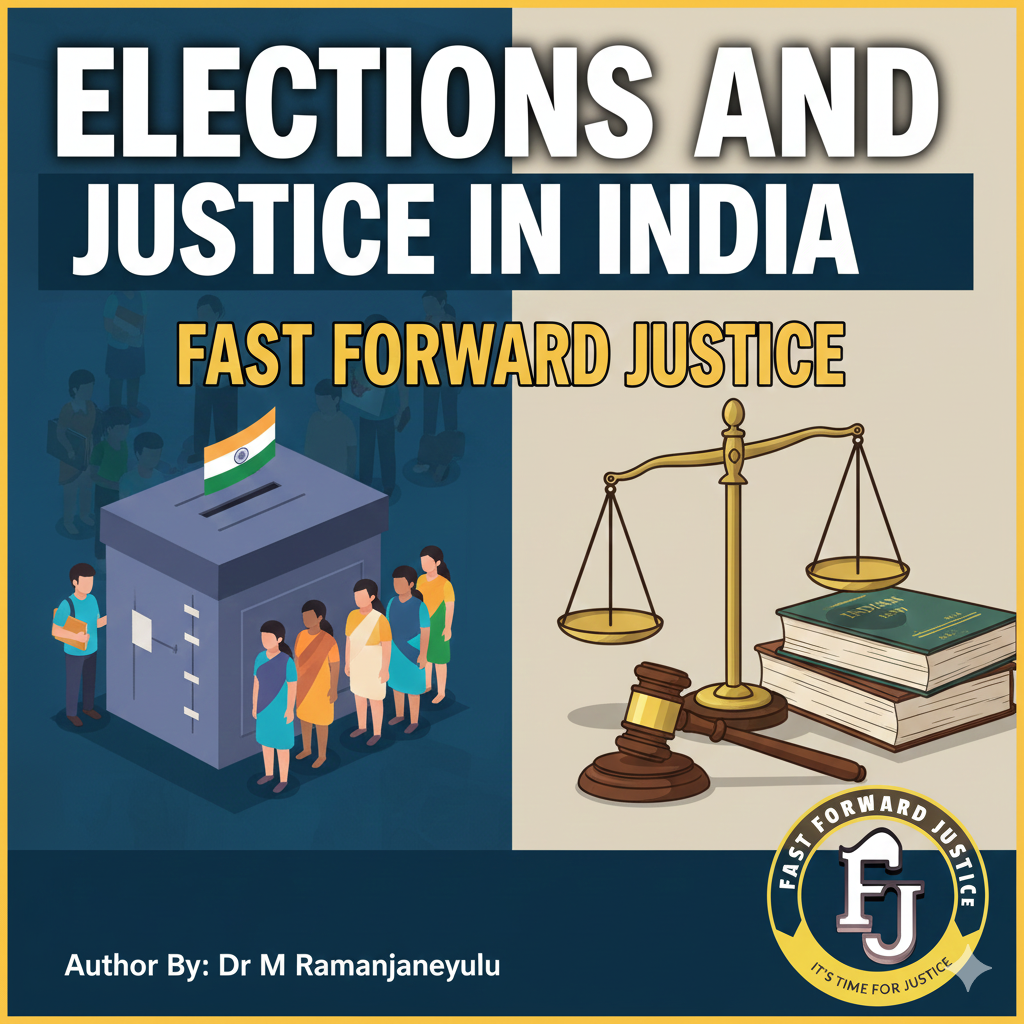
ELECTIONS AND JUSTICE IN INDIA
The Honourable Dr. B.R. Ambedkar stated in the Constituent Assembly that the elections to the House of the People and to the Legislative Assembly of every state shall be on the basis of adult suffrage; that is to say, every citizen, who is not less than twenty one years of age (now eighteen) on such date as may be fixed in this behalf by or under any law made by the appropriate Legislature and is not otherwise disqualified under this Constitution or any law made by the appropriate Legislature on the ground of non-residence, unsoundness of mind, crime or corrupt or illegal practice, shall be entitled to be registered as a voter at any such election.”[1]
Article 325 says that no person to be ineligible for inclusion in, or to claim to be included in a special, electoral roll on grounds of religion, race, caste or sex:- Article 325 says that there shall be one general electoral roll for every territorial constituency for election to either House of Parliament or to the House or either House of the Legislature of a State and no person shall be ineligible for inclusion in any such roll or claim to be included in any special electoral roll for any such constituency on grounds only of religion, race, caste, sex or any of them.
Subhash C. Kashyap (2005) stated that the biggest revolution since the independence of the country was the adoption of universal adult franchise for elections to the Lok Sabha and the Legislative Assemblies of the states.[2] Democracy which has been described by Abraham Lincoln as ‘the government of the people, by the people and for the people’ has no meaning unless the elections are free and fair. In fact, it is not wrong to say that democracy and free and fair elections go together because they are the two sides of the same coin. Keeping this fact in view, the framers of the Constitution provided for an Election Commission entrusted with the duties of conducting elections in an impartial manner on the basis of universal adult franchise (Art 326) and without any discrimination on the grounds of religion, race, caste, sex or any of them (Art.325).
While providing for the Election Commission the problem before the Constituent Assembly was whether to provide for:
(a) A permanent Election Commission of four or five members who would continue in office without any break, till they retire; or
(b) An ad hoc body appointed by the president at the time of election; or
(c) A permanent machinery by providing for the office of a Chief Election Commission.
The other problem before the Constituent Assembly was whether to have centralized Election Commission as in the U.K. or to allow the States to have their own separate Election Commissions as in the U.S.A. The Constituent Assembly after considering all the pros and cons of the problem provided for permanent election machinery only at the centre. This was done because a permanent election machinery was needed to conduct not only the poll after a regular interval of five years but also to conduct mid-term poll and by-elections in one state or other and this could be a regular feature keeping the size of the country in view. Secondly, it was also decided to have only one centralized Election Commission because it was brought to the notice of Constituent Assembly that in some of the provinces people belonging to different racial, cultural and linguistic groups have been excluded from electoral rolls with the connivance of provincial governments dominated by influential groups. This was a dangerous development and, hence, provision for a Central Election Commission had to be made.[3]
Elections are the most significant aspect of most contemporary political systems, democratic or otherwise. Elections remain the first and foremost touchstone on the basis of which the representativity and legitimacy of a system is to be judged. In fact, elections are complicated political processes which provide a link between the society and the polity and between the traditional social systems and evolving social structures. Nevertheless, elections perform different roles in indifferent political systems. In some, they are central while in others they may be peripheral. They may contribute to political development in some, to political decay in others. They may sometimes be used as veiled disguises for authoritarianism, while in established democracies, they are the institutional procedures for system-maintenance and also the instruments for support-building, interest-aggregation, peaceful and orderly transfer of power, recruitment and training of leaders, and above all for an increasing democratization of the political system.
Thus, the elections are devices for legitimacy, identification, integration, communication, political education, participation, socialization, mobilization, conflict-resolution, political choice, political control and are inextricably linked with the distinctive characteristics, traditions, experiences, values and goals of different political systems.[4]
Elections induct an element of accountability into a political system and make it possible for the citizens to exercise a genuine and meaningful degree of political choice and political control. This, in turn, makes the system itself a democratic and effective instrument of governance. In the words of Morris- Jones and Biplab Das Gupta, “Elections in India provide the occasion for the widest degree of popular participation; elections constitute the most important single arena for genuine competition between political groups; elections are the principal agency through which recruitment to a significant part of the political elite is affected; and the skills and resources which they especially call forth figure prominently in political life in general… Elections in India can now be seen not merely as useful indicators but actually as the events through which the party system and hence, in a measure, the political system achieve their evolution”.
Some of the obvious packages of reforms which Romesh Thapar recommends are as follows;
(i) Election funds would be established under an enlarged Election Commission at central and State level to publicize the responsibilities of citizens in an election year, to print the appeals of all the political parties, to cover the area of the election without discrimination, and to print all the other materials which assist voters to cast their ballot, including lists of candidates to be nominated by the parties.
(ii) Election Commission has to check voters’ lists and update them from time to time.
(iii) In the context of the massive expansion of radio and television, it would be the permanent task of the Election Commission to ensure saturation coverage for the parties in these state-controlled media, and to see that the mass media are not misused by the ruling party at the centre and in the States.[5]
N.S. Gehlot, in his book, ‘Trends in Indian Politics’, stated that the success of democracy depends upon the free and fair elections and the elections are essential for the assertion of popular sovereignty in a democratic state. The author emphasized that Indian democracy stands for representative government and in the interests of democracy, Indian Constitution provides for an Election Commission to assume the charge of superintendence, direction and control of the elections in India. The author expressed that the elections in India are centralized under the sole control of a single integrated authority and its independence and impartiality are guaranteed.[6]
Anand R.K (2012) states that TN Seshan was a man who refused to compromise on his principles, which often placed him on the warpath with politicians. He had once commented that “good elections require four elements: an election law that is fully tuned to provide free and fair elections; an election commission which is truly autonomous and fearless; Administrative procedures that ensure even the smallest man and woman can exercise their franchise freely and without fear; and an electorate which is fully aware of its rights and responsibilities”.[7]
Sunder Raman (1985), had expressed that adult suffrage was the most striking feature of Indian Constitution. Free, fair and peaceful periodic elections are the life-blood of any democracy. In fact a democracy is known by the elections it holds and the participation that it allows in the elections. The author stated that democracy is a form of government which allows both dissent and Political plurality. Without political plurality a democracy will degenerate into a dictatorship. Debates, discussions and interactions on ideological planes lead to a more democratic and tolerant society. But emphasis on caste, religion, region etc would create unending rift in the society. The author also emphasized on the safeguards against misuse of official machinery during elections. The safeguards include non-use of the government vehicles, machinery and personnel for furtherance of the interest of the Party in power, non-monopolisation of the public places such as maidans etc.[8]
The Representation of the People Act, 1951 states as follows
Every adult who is, enrolled in the electoral roll of any constituency shall be entitled to vote in that constituency and no person shall vote at a general election in more than one constituency. And if a person votes in more than one such constituency, his votes in all such constituencies shall be void.[9]
- Errors in the Updation of electoral rolls accurately
Many eligible voters could not find their names in the voters list and hence could not vote on the polling day. So, there is need to update electoral rolls accurately so that all eligible voters will cast their vote at the time of elections. Many eligible voters have expressed angry with the Election authorities. Some of the incidents are explained in the present chapter. The electoral roll revision exercise of the Municipal Corporation of Hyderabad (MCH) fell flat on its face when thousands of voters in the twin cities and surrounding municipalities with valid Electoral Photo Identity Cards (EPICs) were deprived of their right to vote. Many found their names struck off from the rolls. Enraged voters staged dharnas in the hot sun for several hours at Malkajgiri, Marredpally, Punjagutta, Ramanthapur and Uppal demanding the authorities to restore their right to vote.
A large group of voters staged a sit-in at the Zilla Parishad High School in Malkajgiri hoping they would get a chance to vote, but to no avail. After prolonged arguments with the police, they were shooed away. At Government Polytechnic, East Marredpally, angry residents of Addagutta gheraoed officials and demanded to know how their names disappeared all of a sudden from the voters’ list. “Are we dead that our names have been deleted? What are these photo identity cards for? We used them in the last elections. How come they turned invalid overnight?” Sarojini Devi, a resident of Malkajgiri, sought to know. But their arguments were put aside by the officials. In a string of polling booths in Malkajgiri under Secunderabad Cantonment Assembly constituency, half of the voters found their names missing. In booth no. 127 covering three streets of Vani Nagar, of the 965 voters only 506 found their names in the list. In the adjoining booth no. 126, only 655 figured in the list out of the 1,100 voters in the area.
“Some lazy enumerator of the Municipal Corporation of Hyderabad has robbed me of the right to vote. Even the President, A.P.J. Abdul Kalam, was keen on every Indian exercising his franchise,” an incensed senior citizen, Gajendran, said at the S.P. College polling station in Padmaraonagar. A resident of Skandagiri Temple Layout, he and his wife, Mythili, had come to vote only to be turned away by the polling staff. “We have been voting for the last 40 years and have genuine voter identity cards. How can they just remove our names,” he demanded. Interestingly, the names of his children with whom the couple stays figured in the list.”My mother’s name is in the list, but mine is missing, though we stay together. What is the logic behind this,” questioned K.L.N. Murthy, a resident of Sainagar working for Baan. “How is that my wife’s name is missing while my name is there when we both enrolled at the same time,” Gangadhar wanted to know at Lal Darwaza. Krishna Rao, a 65-year-old man agitated at being shown the door, fumed, “I had voted during the MCH polls also. Within two years they decided I do not exist.”
People living at Nayaknagar in Chandrayanagutta were seen arguing with the police and poll officials as the names of many were missing despite having I-cards. “This colony has been there since 1976 and we never faced this situation,” was the refrain. “Why did you give me the card if you do not even know why my name was deleted,” Mr. Khaleeluddin shouted at officials in Saidabad. The wife of M.S.S. Sharma, Latha, was crestfallen as her husband’s name figured in the list but not hers. “We shifted our house but officials assured us there was no need for fresh enrolment,” she complains. 132 The Returning Officer of Secunderabad Assembly constituency, M. Rajeshwar Rao, airing his helplessness, said the final electoral list was published on January 20 and people were asked to check the lists displayed in MRO and ERO offices and on the Internet as well. “We have looked into all complaints we got till March 23. We cannot do anything for those who did
not check the lists and found their names missing now,” he maintained. The argument of the voters was that they were in the dark about checking the final revised electoral list since they already had an identity card. [10]
At the Jubilee Hills Public School, filmstar of yesteryears, Muralimohan was visibly angry when he found his name missing in the electoral rolls.[11] The 67-year-old Mekala Ailaiah of a village in Alair mandal of Nalgonda District felt it is a prestigious issue. Mr. Ailaiah gave a tough time for the poll officials when he found that his name was missing from the electoral rolls. Shellshocked by the “deadly mistake” committed by the officials, he sobbed like a child in front of other voters. He showed his voter identify card (No: AP/41/291/555034) and ration card in support of his claim. He took up the matter to the poll officials and registered his protest for “unceremoniously excluding” his name from the voters’ list. “I never migrated to other place. I don’t know why they deleted my name from the list. They might have thought that I had passed away,” the furious farmer maintained adding that he had been exercising his franchise in every election without fail. As he was sent away from the polling booth due to non-inclusion of his name in the voters’ list, Mr. Ailaiah staged a dharna at the polling booth. He demanded that he must be allowed to cast his vote, “since I am alive and I am very much eligible to vote.”All Opposition parties joined hands with Mr. Ailaiah and staged a dharna in protest against the “injustice” done to the elderly person. Opposition leaders took cudgels on his behalf and bargained for a vote for him resulting in the halting of polling for sometime. “We can’t allow him to vote as his name is not figured in the electoral rolls. We don’t know why his name was deleted even after the verification. We feel sorry for him,” a poll official said. Later the revenue officials met Mr. Ailaiah and conveyed their inability for helping him. They assured him that he would be given a vote in the next elections. After a great deal of persuasion by the officials, Mr. Ailaiah went home with a heavy heart.[12]
Telangana’s election body chief admitted that the names of many people were missing from the voters’ list at booths in various parts of the state. Many people who have been voting for years, complained they could not find their names at their regular polling station.”We put out a lot of advertisements that people should ask for Form 7 and enroll. But I am sorry not everyone was able to use it,” Telangana Chief Electoral Officer Rajat Kumar said. Among them were ace badminton player Jwala Gutta and a senior IPS officer. Chief Electoral Officer has admitted that there was a major complaint about voter name deletion in the electoral roll revision and has apologised to voters who were denied their right to vote. Complaints came from across the state of voters denied their right to vote from celebrities to a senior IPS officer. Ms Gutta alleged that she couldn’t vote in Telangana as her name was missing from the voters’ list. In a series of tweets, the shuttler wrote she was surprised to see her “name disappear” from the list. The election officer said he is getting a report from the official who is in charge of Ms Gutta’s neighbourhood.”I do empathise with Jwala Gutta. Actually, her name has been missing from electoral roll since 2016. So, in 2016, 2017, 2018, the inclusion was not there. We will rectify that situation,” Mr Kumar said. Senior police officer T Krishna Reddy also posted on Twitter and Facebook that his name had gone mysteriously missing. Today, I went to the Polling Station only to be told that my name is not there in the Voter list inspite of having a Voter ID card issued by ECI and verification. I returned home dejected. My Right to Vote has been denied. Thanks to Election Commission. Protests were reported from districts like Adilabad after hundreds of voters found they could not vote. Disappointment, anger and frustration among those whose names were missing from the voters’ list at multiple polling stations across Telangana have raised concerns about what the scale of the problem may have been.[13]
- over 2,000 fail to vote Due to lack of proper information about Identity Cards
Many voters are not aware of the permitted identity cards apart from voter identity card to cast the vote on the polling day by the Election Commission and are not going inside the polling booth to cast their vote because they thought that without voter identity card they are not allowed to cast their vote. So, there is need to create awareness among the voters about the permitted identity cards to cast their vote by the election authorities. More than 2,000 voters could not exercise their franchise on April 16, 2009 in 197 polling stations in the entire Assembly segment of Rampachodavaram of East Godavari district as the polling officials or administration failed to explain them in advance that any of the 16 identity cards can be considered to cast vote. From Rampachodavaram to Gurthedu about 100 to 150 tribals said that they had ration cards and last time voting cards, but no one outside polling station told them whether they could vote with that card or not. Particularly, in front of Daragadda, Aakumamidi Thota, Bodlanka and Gurthedu polling stations a number of tribals went back without casting their vote in the first hour. “Our people from Boddagandi, Bobbilova, Jajivalasa, Lingavaram, Polova, Chaparai and Jalagalova villages returned without casting their vote,” said Kondla Swami Reddy of Jajivalasa, Andela Ramaiah of Bobbilova and Pallam Mangi Reddy of Chaparai and Bonangi Trinath of Godugu Mamidi. All these voters walked 5 km to 15 km to reach their polling booths.[14]
III. Polling Stations located at faraway places
Due to the location of polling stations at faraway places to their villages many voters faced a lot of problems in casting their vote on the polling day. So, there is need to locate the polling stations very nearer to the villages and enable all the voters to cast their right. Forty voters in the remote tribal hamlet of Gandibandala on the Andhra Pradesh-Orissa border had to trek a distance of 50 km to cast their vote on April 16, 2009.They began their day by starting at 4 a.m. to reach Boitali in G. Madugula mandal of Visakhapatnam district at 9 a.m., reflecting their enthusiasm to take part in voting. Despite the poll boycott call and two-day bandh called by the CPI (Maoist) who have a sway over several hamlets in the agency areas in the district forming part of Eastern Ghats, the tribals including women and the aged trekked long distances in G. Madugula, GK Veedhi, Chintapalle, Koyyuru and other mandals, braving all odds. Of the 1,500-odd voters, 50 per cent trekked hilly terrain, traversing a distance of 22 km in three hours to reach Gulelu polling station from Bangaram panchayat in Pedabayalu mandal. Lombaru Appalaraju, a resident of Boitali, said several tribals were put to hardship by being made to walk long distances to cast their vote. Sarpanch Kidari Bhimbabu said that instead of allotting Goraneerudu polling station, some 1,500 of nearby Kunturla panchayat should have been permitted to vote at the Boraneerudu booth to avoid walking a long distance.[15]
“Vote veyyadumu ma janma hakku” (voting is our birth right), said Gaduta Ram Padal, a girijan farmer, after voting at Chaparaki, trekking five kilometres, on April 20. Many other girijans like Padal were keen to vote, ignoring the PW’s boycott-poll call at GK Veedhi, Chintapalli, Koyyuru, Sileru and other mandals.The voters of Gorligunde, Bojjulabanda, Godampalli, Yegulam, Chagerpalli, Panasaladdu and Kotapanta of Visakhapatnam Distict trekked 10 to 12 km. to reach RV Nagar to vote.[16]
- Voters run around to identify polling stations
At the time of voting voters had to run from polling station to polling station to cast their vote because of lack of information about the polling station where they have to cast their vote. So, there is need to provide information about the polling booth to all the voters one day before the polling day. An instance was that of 81-year-old Aryadevi originally from Vijayawada but a resident of Jubilee Hills for the last 12 years. But when polling officers could not find her name in the list, she was told to try other polling stations in the vicinity. In Banjara and Jubilee Hills many voters many were angry as they had tough time locating the correct polling station with no voter’s slips delivered to them beforehand. Another instance was that Seventy-five-year-old P.V.Murthy and his wife Ramani were exasperated that they had been running around checking for the polling station in which they could vote. “We have been to five polling stations but could not find our names. What is the use of these ID cards then? When we are residing in Jubilee Hills how come our names are not listed in polling stations in this area?” he asked. Some voters suggested that if names are missing in one list, then there is another amended list. But the polling officers were not showing it to voters unless they insisted, they said. The polling officers added to the confusion in some booths at Padmavathinagar, Borabanda, Polling Station No.410. Even as polling agents were drawing attention that there is amended list, a polling officer said they could not allow one to vote if the name was not in the list they have.[17]
Dr.Inamdar, in his book, ‘Profiles of Indian Government and Politics’, stated that the Election Commission does not have direct control over the personnel manning the elections in the States and the Union Territories which control them. The provisions of the Representation of the People Act and other legislations and the rules under these are required to be complied with by the personnel looking after the elections. The author also expressed that the Election Commission with its sole member, the Chief Election Commissioner, and his limited staff monitors the compliance with these statutory provisions and rules by the personnel of the State Governments and the union territories.[18]
Political parties ‘advice to Election Commission on electoral rolls
Many Political parties have advised the Election Commission on updation of electoral rolls after they came to know that many eligible voters could not exercise their voting right on the polling day. The Lok Satta Party has suggested that post offices be made the nodal agencies for voter registration thereby ensuring that the voters’ lists become flawless. The party President Jayaprakash Narayan said that the Election Commission has, in the last one decade, brought down the percentage of errors from 40 in urban areas and 15 in rural areas to 12 and 5 respectively. The percentage of errors was still high and unacceptable in the present day. He said that in its present form, the voter registration process doesn’t associate the citizen with the process. If the post office is made the nodal agency and the post master is authorised to register and delete the names of voters on a continuous basis, such errors would not creep in. In such a system, he said, an appeal mechanism could also be provided to redress people’s grievances, if any. Telugu Desam Party president N. Chandrababu Naidu has demanded that the Election Commission launch a special drive to update all voters lists before the next general elections in Andhra Pradesh. Addressing a press conference here on Friday, Mr. Naidu said that the EC should concentrate on updating the voter lists, as the names of voters belonging to some communities and those in TDP strongholds were being deleted in a planned way. “I don’t know if the officers are incompetent or doing it on purpose, or doing it at the behest of Congress leaders,” he wondered.[19]
J.C.Chatturvedi (2005) emphasized on compulsory voting and stated that the experience of the few countries that have forced their citizens by some mild but well-administered sanctions to vote shows that the turnout during polls got increased tremendously. In Australia, the adoption of a compulsory voting law in 1924 imposing a $10 fine on nonvoting brought an increase in participation from 59.4 per cent in 1922 to 91.4 per cent in 1925, 93.6 per cent in 1928, and 94.9 per cent in 1929. The author also expressed that Belgium, Holland, Czechoslovakia, Spain and the Argentine Republic also experimented with compulsory voting. The author expressed that the vote is only one of the many devices used by representative governments. The author also stated that although, a century ago most elections were conducted viva voce, that is, by a verbal expression of preference for a candidate before the polling officials, the secret ballot is universal today. The secret ballot was first introduced in Australia.[20] There is need to introduce compulsory voting in India also so that participation of all adults in the electoral process is possible.
Jayaprakash Narayan (2005) stated that the Lok Satta movement, as a part of its Election Watch Campaign for voter awareness, has studied the Flaws in voter registration and polling irregularities. Both these can be easily corrected by changes in procedures and rules and do not need new legislation. Correction of registration flaws and elimination of polling irregularities are fundamental to the purity of the election process. The Election Commission prepares new rolls and revises the existing ones from time to time, normally before every general election to the Lok Sabha and assemblies. They may also be revised on the instructions of the Election Commission before a by-election. Theoretically, additions and changes in the rolls can be made at any time, but in reality, accessing them at ordinary times is a painstaking process. When special revisions are not called for, the voter Lists may be checked only at the office of the taluk revenue officer or in the Municipal Office. Once the elections are announced and the election process is underway, changes are difficult to make. Legally, additions and deletions may be made until just before the deadline for filing nominations. But from a practical viewpoint, it is best to have one’s name included, or any changes made when the Election Commission calls for such periodic revisions. The local revenue official, tehsildar or Mandal revenue officer is normally the person in charge of the electoral registration process. During this process he is called the Assistant Electoral Registration Officer, and he functions under his superior, who is called the electoral Registration Officer. The District magistrate or collector or deputy commissioner is the District Election Officer under whose supervision electoral rolls are prepared and published. In cities of certain states, the electoral registration work may be entrusted to municipal corporation officials. The electoral registration officials prepare the rolls based on birth and death registers, available census data, field surveys, door-to-door enumeration and other available information. The electoral roll contains the name of the voter and details such as the name of the father/husband, age, residential address. Generally, the age of the voter is noted as on 1 January of the year in which the revision is carried out. If the voter List is prepared after April, the age as on 1 April is noted.[21]
As soon as the electoral roll for a constituency is ready, the registration officer publishes the draft by making a copy of it available for inspection and displaying a notice to the public. The Election Commission widely publicizes the release of revised electoral rolls. Two copies of each electoral roll are supplied to recognised political parties free of cost. As per law the draft electoral roll should be displayed at each polling booth (the concerned part) in each village for the people to examine. The Election Commission expects all objections to be made at that time. However, the electoral rolls are not displayed everywhere and officers discharge their duties in a casual and perfunctory manner and the people’s involvement in the revision electoral rolls is minimal.
As it is difficult to make changes to the electoral rolls once the revision is complete, it is best to add or delete names during the update undertaken by the Election Commission. Citizens can then inspect the electoral rolls and if they find it that their names are missing, can file claims for inclusion in Form 6. Citizens should register only in one polling station, generally the one closest to their residence. If there is any objection to the inclusion of a name in a roll, an objection can be filed in Form 7 by any person whose name is already included in that roll. Every change to the details in an entry in the roll like spelling, age, name of father, address, gender, etc. should be filed in Form 8 by the voter. Similarly, a request for change of polling station is filed in Form 8A by the voter, and a request for deletion of entry due to death, migration etc. By any enrolled voter in Form 8B. All such objections and requests should be filed before the due date prescribed by the Election Commission. This process appears fair and reasonable. But in reality citizens have little knowledge of the process, nor do they have access to voter lists or appropriate forms for filing claims or objections. Therefore, by default the voter list carries many errors of omission or commission. It is this huge margin of error and inaccessibility of the voter list and the bureaucratic process which make our electoral rolls defective. Much needs to be done to cleanse our electoral process. But the first step is to improve voter registration through greater access to citizens and simplified procedures. Once the registration process is demystified and made people friendly, millions of public spirited citizens, activist groups and political workers could play a pro-active role to cleanse the electoral rolls. A second step is to recognise the tendered vote as proof of rigging and ordering a re-poll when such votes exceed a pre-determined norm.[22]
Conclusion: As it is the constitutional duty to conduct elections and enable all eligible voters to cast their vote in the elections, the Election Commission should take all necessary steps to provide congenial atmosphere during the time of elections. The Election Commission should not fix qualifying date for voter registration far away from polling date. At no cost the right to vote should be denied to any eligible voter at the time of elections as every vote has much value in the simple majority system. The commission should fix the qualifying date as one day before the commencement of polling. If the date is far away from the polling date many would lose the right to vote in the elections. The School Teachers and Panchayat staff should be undertaken as Assistant Electoral Registration Officers so that accuracy in updation of electoral rolls can be maintained as these officials would have full information about the households of the localities. The commission should authorize the booth level officers to register on the spot if eligible voters names are missing in the voter lists by verifying the age and enable the voter to cast his vote in the elections.
References:
1..Election Commission of India, Debate in Constituent Assembly on Part-XIII-Article-289, Existing part XV-Elections, p-59.
- Anand, R. K. (20 June 2012). ‘Time to “Seshan” the EC’ Suara Sarawak. (Baru Bian, Malaysia)
3.www.thehindu.com, April 21, 2004, Andhra Pradesh,
4.www.the hindu.com, S . Ramu, May 30, 2008.
- J.R.Siwach,’Dynamics of Indian Government and Politics’, Sterling Publishers Private Limited, 1985.
6.M.P.Singh, Himanshu Roy, ‘Indian Political System’, Manak Publications, New Delhi, 2005.
7.Romesh Thapar,’The Indian Dimension’ (Politics of Continental Development), Vikas Publishing House Pvt Ltd, New Delhi.
8.Subhash C.Kashyap, ‘Our Constitution-An Introduction to India’s Constitution and Constitutional Law, National Book Trust, New Delhi, 4TH Revised edition, 2005.
9.Sunder Raman, ‘Indian Government and Politics’, Allied Publishers, New Delhi, 1985.
10.The Representation of the People Act, 1951.
11.NDTV, Uma Sudhir, Telangane, Dec 08,2018, 13:53 IST.
- 1 www.thehindu.com, April 17, 2009.
- www.thehindu.com, May 31, 2008.
14.Dr. Inamdar, ‘Profiles of Indian Government and Politics’, Vishwanil Publications, Poona, 1989.
15.J.C.Chatturvedi, Political Governance (Comparative Politics) Vol 1, p-254, Isha Books, Delhi, 2005.
- Jayaprakash Narayan- ‘Distorted Verdicts’, p-13, Concept publishing company, New Delhi, 2005.
[1].Election Commission of India, Debate in Constituent Assembly on Part-XIII-Article-289, Existing part XV-Elections,
59.
[2].Subhash C.Kashyap, ‘Our Constitution-An Introduction to India’s Constitution and Constitutional Law,.309, National Book Trust, New Delhi, 4TH Revised edition 2005.
[3]. J.R.Siwach,’Dynamics of Indian Government and Politics’, .312, Sterling Publishers Private Limited, 1985.
[4] M.P.Singh, Himanshu Roy, ‘Indian Political System’, .236, Manak Publications, New Delhi, 2005.
[5]. Romesh Thapar,’The Indian Dimension’ (Politics of Continental Development), .60, Vikas Publishing House Pvt Ltd, New Delhi.
[6] N.S.Gehlot, Trends in Indian Politics, 207, Deep$ Deep publications, New Delhi, 1988.
[7]. Anand, R. K. (20 June 2012). ‘Time to “Seshan” the EC’ Suara Sarawak. (Baru Bian, Malaysia)
[8].Sunder Raman, ‘Indian Government and Politics’, .284, Allied Publishers, New Delhi, 1985.
[9]The Representation of the People Act, 1951
[10]. www.thehindu.com, April 21, 2004, Andhra Pradesh, 00:00 IST
[11] www.thehindu.com, May 30, 2008
[12]. www.the hindu.com, S . Ramu, May 30, 2008
[13].NDTV, Uma Sudhir, Telangane, Dec 08,2018, 13:53 IST
[14]. www.thehindu.com, April 17, 2009
[15]. ibid.
[16].www.thehindu.com, Apr 21, 2004
[17].www.thehindu.com, May 30, 2008
[18].Dr.Inamdar, ‘Profiles of Indian Government and Politics’, p. 33, Vishwanil Publications, Poona, 1989.
[19].www.hindu.com, May 31, 2008.
[20].J.C.Chatturvedi, Political Governance (Comparative Politics) Vol 1, p-254, Isha Books, Delhi, 2005.
[21] Jayaprakash Narayan- ‘Distorted Verdicts’, p-13, Concept publishing company, New Delhi, 2005
[22]Ibid,15