Abstract
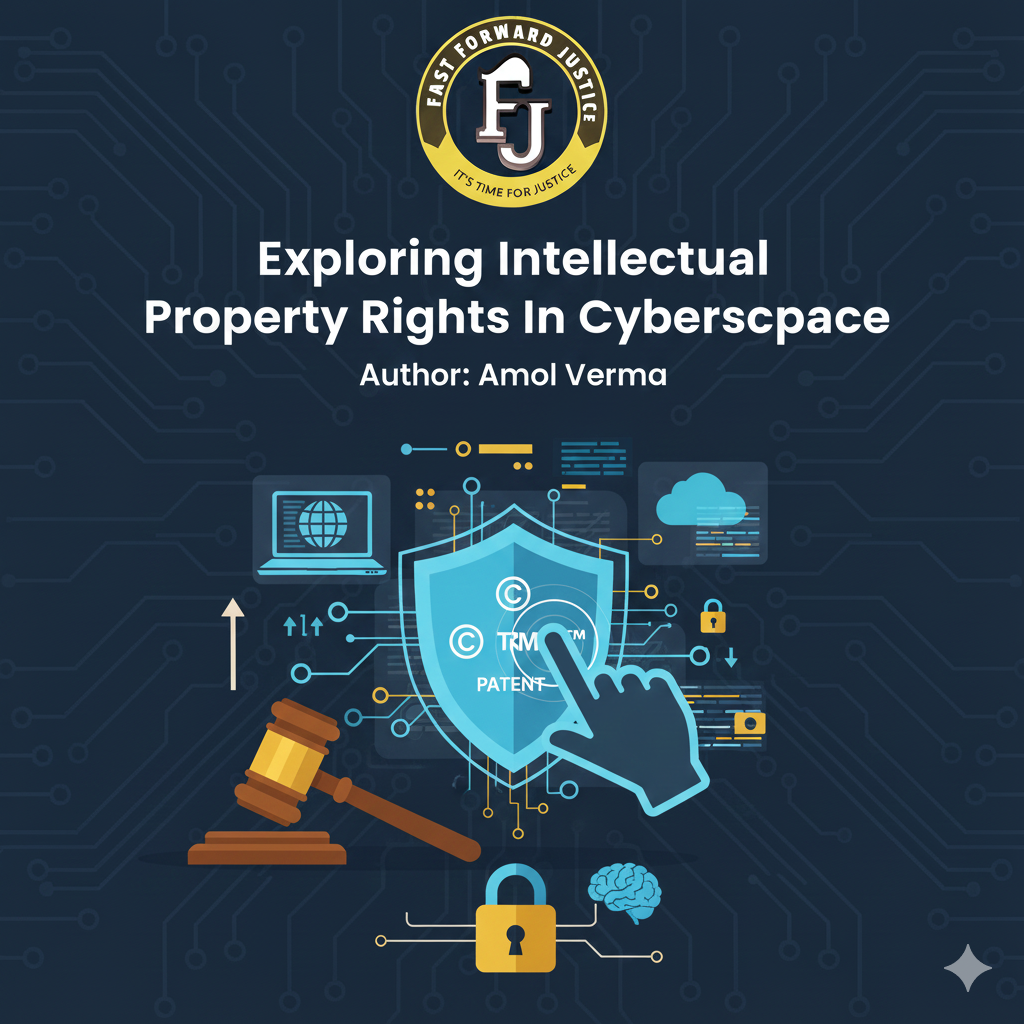
Private Property is that which belongs to an individual whereas Public Property belongs to a community or state but the term intellectual property refers to that property which is the product of the mind or the intellect and deserves the same protection by law just like any other property. Unlike Public or Private Property it is an intangible property. By law, we have the right to get it protected. Unless these properties are entitled to a legal protection, the creators of these properties would not get an incentive to create or produce such intellectual goods. The important tools of protection under its umbrella are: Patents, Trademarks, Geographical Indications, Copyrights, Trade Secrets etc.
Cyberspace is an interconnection between the virtual world. Technology has become a conduit through which the produce of an original author is altered and distorted by someone else for personal gains. The networking and digital arena itself have such intricacies that it needs protection. The content created in the cyberspace is such that it can be easily breached and the authors of such content seek legal protection for the same. Article 10.1 provides that “computer programs, whether in source or object code, shall be protected as literary works” under the Berne Convention (1971). In India, the existing intellectual property regime that deals with the protection of computer software is the Indian Copyright Act, 1957.
In its very inception of the research paper, the authors have dealt with the meaning of Intellectual Property Rights and Cyberspace. Further, the authors have delved deep into the National and International Provision of the law and the intricacies involved in it. In the subsequent chapter Infringement of Copyright in Cyberspace and Piracy in the Digital Era has been analysed.
Intellectual Property Rights And Cyberspace
Intellectual Property can be defined as creations of human mind.
Intellectual property rights are the rights given to persons over the creations of their minds. They usually give the creator an exclusive right over the use of his/her creation for a certain period of time.[1]
Intellectual property rights are the means to encourage innovation. Innovation could be in any field whether it be technology or R&D. It gives the creator of the work/produce an internal satisfaction that they would retain control over their work when disclosed on a public platform. The era of the internet has penetrated in such a manner that exchange of information between the creators and the viewers and between the viewers and further viewers has accelerated. This creates a fear of loss of credit in the mind of the original authors which could limit their growth or incentive to grow, prosper and innovate. The basic reason for such a limitation is the rampant violation of intellectual property which affects the rights of the IPR owners. The intangible nature of these properties differs them from the tangible property like land and building making it more difficult in the process of acquiring rights. Intellectual property is the only such resource which cannot deplete irrespective of its endless consumption.
Consider a situation to draw a line between Intellectual property rights and other rights like property. The entry of a house could be well protected by guarding it day and night thereby securing the rights of the owner against trespass whereas an author of a literary work could become helpless when the first buyer makes several copies of it and sell it at a lower price. Thus the author’s property is devoid of any protection in such cases and he/she loses control over their property which is now unsecured unlike in the former case. Therefore, a procedural law is required which could regulate such malpractices thereby fostering authors not to limit their dissemination.
The tools which have been subsequently granted for the protection of the interests and rights of the owners of intellectual property which provides incentives to them to produce or innovate are as follows:
- Patents
Patent is an exclusive right granted for an invention which must offer a technical solution to the problem.[2] A patent owner has the right to prevent others to have an unfair advantage of the original work and can legally bar a person to use, distribute or sell the work without the consent of the patent owner. Patent is granted for a term of 20 years from the date of application.
Three conditions are required for successfully acquiring a patent:
- Novelty: A product lined up to be patented must be new or should be already published or existing in knowledge.
- Non-obviousness: Invention should not be easily discovered by the person who is an expert in the respective field to which the invention relates.
It must be useful and capable of industrial application
Copyright
Copyright is a bundle of exclusive rights granted to the owner for protection of their artistic and literary creations. Protection of computer software and program is also covered under Copyright. Copyright is granted for lifetime and a term of 60 years after the creator’s death. Copyrights are recognized nationally i.e., by the national laws and extend to the territorial limits of the country where the copyright is granted.[3]
- Trademark
A Trademark is a distinctive insignia, symbol or phrase that identifies a product or service. Trademark protection ensures that the owners have the exclusive right to use them and it can be enforced by courts. It must be used or proposed to be used in relation to the goods and services and must be capable of distinguishing the goods or services of one person from those of others.
- Geographical Indication
A geographical indication (GI) is a sign used on products that have a specific geographical origin and possess qualities or a reputation that are due to that origin.[4] The protection of geographical indication in all respect is in the interest of consumers and producers of goods or authorized services. Without such protection, competitors with illegitimate right on a geographical indication might ride free on its reputation.
What Is Cyberspace?
Cyberspace is a gap or a space or a connection between the virtual world and the real world and describes the flow of digital data between these worlds. Any event happening across the internet is not actually happening where the participants are physically standing or where the servers are located but it is happening in a cyberspace. Cyberspace presents a relationship between “online” and “offline” form of interaction. To simply understand, “the space between your telephonic conversation and the receiver’s telephonic conversation is your cyberspace.”
The term cyberspace was initially introduced by William Gibson in his 1984 book, “Neuromancer.”[5] The original content on the cyberspace are entitled to legal protection and information in the online world could be protected by the Copyright Law. Thus, the laws related to copyright comes into effect whenever legal protection to the online content is invoked.
National And International Provisions Of Copyright Relating Cyberspace
- National Provisions
The Copyright Act, 1957 is the first post-independence copyright legislation and has faced amendments six times, the most recent one being in 2012. This law has been evolved from the colonial era under the British Empire.
The protection of Digital Copyright has also been dealt with this legislation. A ‘computer program’ is described as a ‘set of instructions expressed in words, codes, schemes or in any other form, including a machine readable medium, capable of causing a computer to perform a particular task or achieve a particular result’.[6] Computer programs are accorded the status of ‘literary works’[7] under Indian Copyright Laws. Thus under the national provision, a software could be defined as a computer program. The Copyright protects computer programs but it does not protect individual files of the program.
Section 51 of the Indian Copyright Act, 1957 states that Copyright in a work shall be deemed to be infringed when someone sells or hires, or, distributes for the purpose of trade any infringing copies of the work.
There is an exception mentioned under Section 52 of this act which deals with the principle of ‘fair use’ which says that the making of the copies or adaptation of a computer programme by a lawful possessor of a copy of such computer program in order to utilize computer programs or to make backup copies purely as a temporary protection against loss or destruction, then in such cases it would not be considered as an infringement of copyright. The fair principle is often used in Indian copyright regime on software and data protection. In simple words, ‘fair use’ is a defense against a claim of copyright infringement.
- International Provisions
The Berne Convention of 1866 has fostered the way for Copyrights. Article 4 of this treaty guarantees that computer programs are protected as literary works in all modes and forms of expression. Many countries were signatories to it including India. The organization subsequently relocated to Geneva in 1960 and was succeeded in 1967 with the establishment of the World Intellectual Property Organization (WIPO) by treaty as an agency of the United Nations. The World Intellectual Property Organisation (WIPO) copyright regime is one of the earliest initiatives aiming to balance the interests by addressing the copyright issues in cyberspace. The WIPO regime also does not effectively addresses all the issues regarding copyright in cyberspace.
The WIPO Copyright Treaty (WCT) and WIPO Performances and Phonograms Treaty (WPPT) are the two major international instruments relating to cyberspace.[8] The WIPO copyright treaty at its inception deals with providing technological solutions to any technological developments. This treaty requires countries to provide copyright protection to computer programs, sound recordings, articles, photographs stored in electronic format, circulated via the internet. The WPPT enhances the intellectual property rights of performers and of producers of phonograms and requires a copyright protection to digital audiotapes, CDs, MP3 etc.[9]
The Agreement on Trade-Related Aspects of Intellectual Property Rights (TRIPS) is an international agreement administered by the WTO and it also seeks protection of copyright to computer programs and data compilation.
Infringement Of Copyright In Cyberspace And Digital Piracy
The rapid growth of reliability on the internet in our day to day life has raised concerns with respect to proprietary rights involved therein. The birth of internet has brought into existent digital copyrights in the spear of copyright law which could be considered for protection on the proof of originality.[10] With the emergence of the internet and increasing use of the web (www), possibilities of piracy of copyright have become regular and quite often.[11] The option to download the content and the technology of copy and paste has given way for infringement. To convert the produce or labor of some other person and use it for our own advantage is an easy form of infringement of copyright. Digital piracy can be defined as ‘‘the illegal copying/downloading of digital material, such as software, music, videos, audiobooks, and other copyrighted material.”[12] The Copyright Act, 1957 and Information Technology Act, 2000 are the two pieces of legislation that offers protection to the digital works including computer programs, software, online databases etc.
- Infringement Of Digital Copyright
The infringement of copyright seeks no boundaries and the mens rea of the online pirates utilize and duplicate the work in such numbers which becomes enough to destroy the market of the original creator. The issue of digital copyright is very critical and very hard to catch out. Piracy starts from where the work is first brought onto the platform. For instance, Bollywood industries are not immune to piracy. It is a herculean task to make a movie and when it comes to piracy someone with a camera records a movie in the theatre and sells it to the pirate websites at a meagre amount and thereby makes the producer suffer monetary loss. Bollywood industry has suffered a loss close to $4 billion in 2007.[13]
A copyright is infringed when a user does any work, the exclusive right of which is with the owner or permits for profit any place to be used for communication of the work to the public unless he was not aware and had no reasonable ground for believing that such communication to the public would be an infringement of the copyright.[14]
There are various ways through which infringement of digital copyright takes place thereby leading to digital piracy:
- An original work could be shown as the work of a copier.
- An online-parody of an original work could be done to criticize the work of the author or an online endorsement could be done which shows admiration for the original creator by the copier.[15]
- An original image could be extracted and be altered slightly or distorted until it is not recognized.
- A copier may copy the style of the original creator’s work and can show it as his own.
- Responsibilities Of Isp
In the Cyberspace there are three persons who matter – Author, User, and Internet Service Provider (ISP). An author creates the work and acquires a copyright in its name and as soon as it puts it in the public domain by the issue of copies it is known as communication to the public. The user may it be an adult or a teenager having an access over the internet if copies or alters such work without the consent of the creator it is a copyright infringement. Thus, the Internet Service Providers are held liable when they make the work available on the internet without the consent of the owner thereby violating digital rights.
The present scenario will only change if the access providers themselves become more active in policing their clients. This would be the case if the ISPs are themselves more directly benefited from value or content added services. Many of the laws that exist in different countries impose responsibility on the ISPs to keep a check on such infringements. It might seem impossible for the service provider to filter information but the only way out is to devise a system in which violation of specific standards laid down will be brought to the attention of the provider who will, in turn, take necessary action.
Other Related IPR In Cyberspace
Apart from IPR, there are other related issues in cyberspace. Firstly, the issue of trademarks in the context of domain names have surfaced at significant levels in cyberspace. Illegitimate use of a trademark by registering the same as a domain name is known as cyber-squatting. This practice deprives the owners of the trademarks of using their trademarks as domain names on the internet. Cyber-squatters register domain names of very popular trademarks and has no interest in being the owner of the domain but later on try to cash in by later transferring the name to the trademark owner for huge sums. Conventional trademark principles have not contemplated domain name rights as part of the trademarks and this led to the initial confusion as to whether trademark principles can be expanded to domain names. Trademark owners are concerned about the infringement as well as the dilution of their trademark caused by domain name threats.[16] The growing significance of cyberspace presence and identity warrants the expansion of the conventional trademark rights to include domain names.
Computer software is foremost among the valuable and technologically sophisticated information-based products that bear the hallmarks of an intellectual good.[17] Patent protection in cyberspace comes from the underlying hardware which provides the networking infrastructure. Patent protection in software is to protect the innovation in software. Patent accelerates software development and investment in R&D and protects the ‘idea’ and ‘functionality’ of the software. Though software was protected under copyright it was considered to be more efficient under patent because it prevents competitors to distribute or copy the same product and derive benefits. A functional relationship must exist between the software and the computer to get a patent on the claimed software and the software must be a useful computer process. A Patent provides monopoly over the invention.
[1] What are Intellectual Property Rights? , WORLD TRADE ORGANIZATION (https://www.wto.org/english/tratop_e/trips_e/intel1_e.htm).
[2] Definition given by WIPO, http://www.wipo.int/patents/en/, visited (September 14, 2018, 3:36 AM).
[3] Sreenivasulu N S, Law Relating To Intellectual Property 356 ( 2nd ed. 2018).
[4] Definition given by WIPO, http://www.wipo.int/geo_indications/en/, visited (September 16, 2018, 12:39 PM).
[5] Cyberspace, Technopedia (September 16, 2018, 2:57 PM), https://www.techopedia.com/definition/2493/cyberspace.
[6] Section: 2(ffc), The Copyright Act, 1957, No. 14, Acts of Parliament, 1957 (India).
[7] Section: 2(o), The Copyright Act, 1957 (India), “literary work” includes computer programmes, tables and compilations including computer databases.
[8] R. Muruga Perumal, Copyright Infringement in Cyberspace: The Need to Nurture International Legal Principles, 14 International Journal of The Computer, the Internet and Management 20, 8-31 (2006).
[9] The International Framework of Copyright Law, https://cyber.harvard.edu/people/tfisher/IP/International_Framework.pdf.
[10] Sreenivasulu N S & Hemanth Kumar, H.S, Originality under Copyright Law, January 2013, MIPR, Volume 1, Part:1.
[11] Mohd. Salman Waris, Indian ITA 2000 and Copyright Issues, SCJ 18 (2002).
[12] Sulaiman At-Rafee & Kamal Rouibah, The fight against digital piracy an experiment, Telematics & Information Journal (2009).
[13] Joshi, Virtual Bites: Digital Piracy Robs Bollywood, (October 12, 2008, 10:04 PM), http://www.business-standard.com/india/storypage.php?autono=328043.
[14] Section 51: The Copyright Act, 1957, No. 14, Acts of Parliament, 1957 (India).
[15] Jenifer Carpenter, Intellectual Property in Cyberspace (March 12, 2000, 6:58 PM), https://cyber.harvard.edu/property00/respect/.
[16] R. Muruga Perumal, Copyright Infringement in Cyberspace: The Need to Nurture International Legal Principles, 14 International Journal of The Computer, the Internet and Management 23, 8-31 (2006).
[17] Dan L. Burk, Patents in Cyberspace: Territoriality and Infringement on Global Computer Networks, 68 Tulane Law Review 28, (1993).