
Abstract
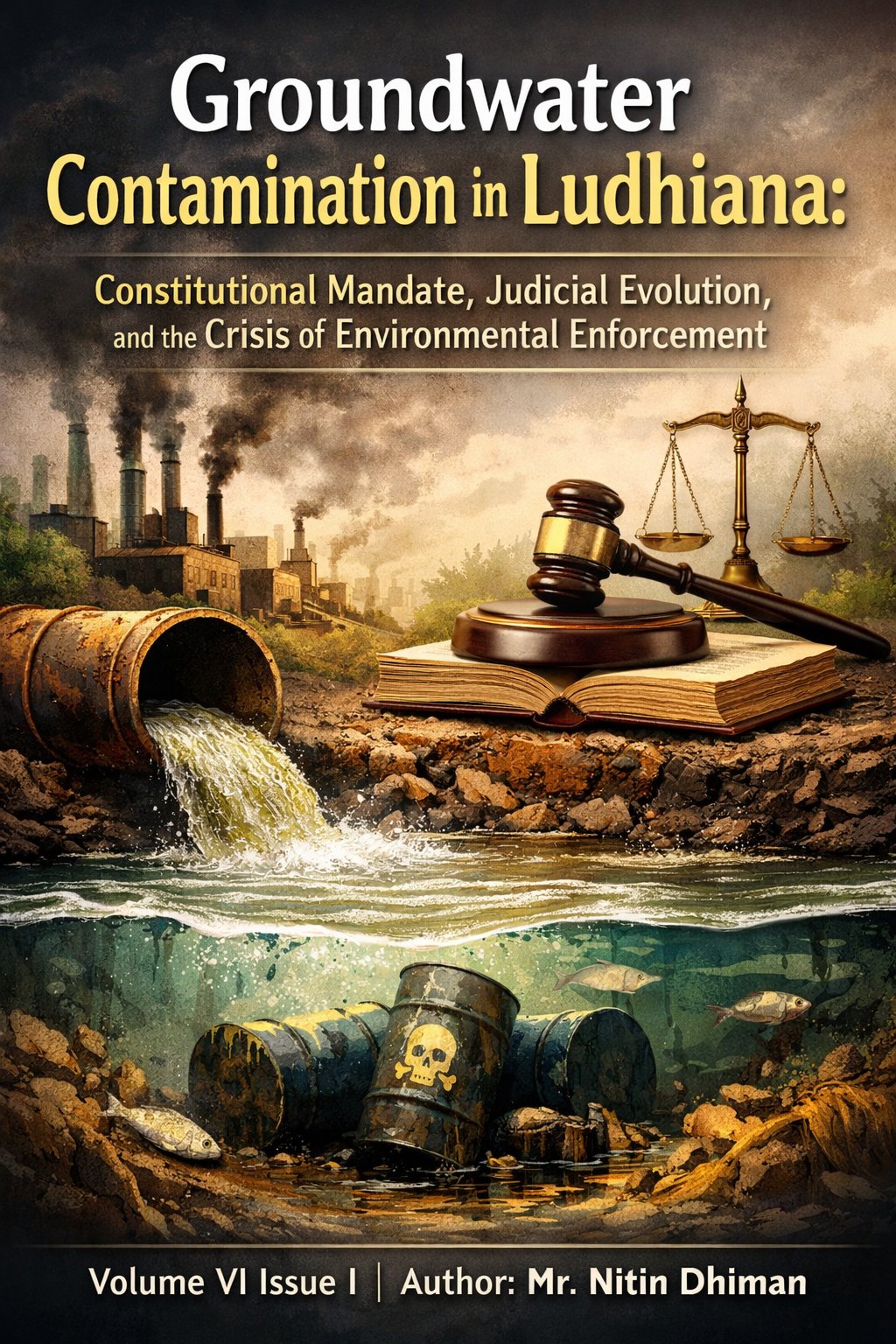
Groundwater contamination in Ludhiana, Punjab, presents a serious constitutional, environmental, and governance challenge arising from rapid industrialization, untreated effluent discharge, and infrastructural inadequacies. Despite a comprehensive statutory framework under the Water (Prevention and Control of Pollution) Act, 1974 and the Environment (Protection) Act, 1986, groundwater degradation continues to threaten public health and ecological sustainability. This paper undertakes a doctrinal examination of constitutional provisions, statutory architecture, judicial development of environmental jurisprudence, and the role of the National Green Tribunal (NGT) in addressing groundwater contamination. It argues that Article 21 of the Constitution firmly embeds access to clean and safe water within the right to life, thereby imposing a positive obligation upon the State. While judicial innovation and tribunal activism have strengthened environmental accountability through principles such as sustainable development, precautionary principle, and polluter pays doctrine, enforcement deficiencies and institutional fragmentation undermine effective implementation in Ludhiana. The study concludes that the crisis is not legislative inadequacy but governance failure. Strengthening regulatory institutions, technological monitoring, transparency mechanisms, and coordinated enforcement is essential to align groundwater governance with constitutional mandates.
Key Words: -Groundwater Contamination,Constitutional, Environmental, Governance, Challenge.
- Introduction
Groundwater constitutes one of India’s most critical natural resources, supporting domestic consumption, agriculture, and industry. Punjab, often described as the agricultural heartland of India, relies heavily on underground aquifers. Ludhiana, as one of the most industrialized cities in the State, presents a complex interface between economic development and environmental sustainability.
Over the past decades, rapid industrial growth—particularly in textile dyeing, electroplating, steel rerolling, and manufacturing sectors—has contributed to the discharge of untreated or inadequately treated effluents into water bodies and soil. These pollutants percolate into underground aquifers, resulting in contamination that poses serious public health risks.
This paper examines whether the existing constitutional and statutory framework is inadequate or whether enforcement failures are primarily responsible for persistent groundwater contamination in Ludhiana.
- Historical Aspects of Groundwater Governance in India
Historically, water regulation in India focused primarily on irrigation and resource management rather than pollution control. During the colonial period, legislative measures concentrated on canal administration and revenue generation.
The Water (Prevention and Control of Pollution) Act, 1974 marked a shift toward environmental regulation.[1] It established Central and State Pollution Control Boards and introduced consent mechanisms for effluent discharge.
The Bhopal Gas Tragedy of 1984 triggered a broader environmental regulatory response, resulting in the Environment (Protection) Act, 1986.[2] This legislation empowered the Central Government to regulate industrial pollution comprehensively.
However, groundwater governance remained fragmented, often treated indirectly through pollution control rather than as an independent regulatory domain. Scholars such as Philippe Cullet have noted that groundwater regulation in India suffers from structural gaps and inadequate aquifer-specific governance frameworks.[3]
Industrial expansion in Ludhiana outpaced regulatory capacity, creating a widening enforcement gap.
- Constitutional Provisions and Environmental Rights
Article 21 of the Constitution guarantees the right to life and personal liberty.[4] Judicial interpretation has expanded its scope to include environmental protection and access to clean water.
In Subhash Kumar v. State of Bihar, the Supreme Court held that the right to life includes the right to enjoy pollution-free water and air.[5] This marked a foundational moment in constitutional environmentalism.In M.C. Mehta v. Union of India, the Court reinforced state responsibility in controlling industrial pollution. [6]In Vellore Citizens’ Welfare Forum v. Union of India, the Court incorporated sustainable development, precautionary principle, and polluter pays doctrine into Indian environmental law.[7]Further, Articles 48A and 51A(g) impose duties upon the State and citizens to protect and improve the environment.[8]Judicial scholarship has observed that environmental rights in India represent one of the most progressive expansions of fundamental rights jurisprudence globally. [9]
Thus, access to clean groundwater is constitutionally entrenched.
- Statutory Framework Governing Groundwater Protection
The Water Act, 1974 prohibits pollution of water bodies and wells.[10]It empowers Pollution Control Boards to inspect industries and initiate prosecution.The Environment (Protection) Act, 1986 grants wide executive powers, including closure of polluting industries.[11]The National Green Tribunal Act, 2010 establishes a specialized adjudicatory forum for environmental disputes.[12]
Despite legislative comprehensiveness, enforcement in Ludhiana suffers from:
- Limited inspection capacity
- Inadequate technological monitoring
- Weak prosecution
- Overburdened treatment infrastructure
Scholars such as Sujith Koonan have critically noted that groundwater governance requires stronger regulatory integration and aquifer-based management models.[13]
- Judicial Contribution to Groundwater Protection
Indian courts have played a transformative role in environmental governance.In Indian Council for Enviro-Legal Action v. Union of India, the Supreme Court strictly enforced polluter pays doctrine against industrial polluters. [14]In A.P. Pollution Control Board v. Prof. M.V. Nayudu, the Court emphasized precautionary governance and scientific expertise.[15]
Judicial activism through Public Interest Litigation expanded access to environmental justice. Lavanya Rajamani observes that Indian courts have democratized environmental litigation while simultaneously shaping policy directions.[16]
However, judicial intervention remains reactive and case-specific.
- Contribution of the National Green Tribunal
The NGT applies principles of sustainable development, precautionary principle, and polluter pays doctrine under Section 20 of the Act.[17]
In Paryavaran Suraksha Samiti v. Union of India, strict timelines were imposed for installation of effluent treatment systems.[18]In Almitra H. Patel v. Union of India, the NGT emphasized scientific waste management compliance.[19]In Sterlite Industries (India) Ltd. v. Tamil Nadu Pollution Control Board, environmental compensation principles were elaborated.[20]The Tribunal has directed Punjab authorities to upgrade sewage infrastructure and monitor effluent discharge affecting groundwater.
However, the NGT lacks independent enforcement machinery and depends on executive agencies for compliance.
- Critical Analysis
The Ludhiana groundwater crisis reflects a governance paradox: strong constitutional and statutory norms coexist with weak administrative realization.
Key structural deficiencies include:
- Fragmented institutional authority.
- Absence of real-time digital effluent monitoring.
- Procedural complexity in prosecution under the Water Act.
- Technological inadequacy of STPs and CETPs.
- Political economy pressures in industrial regions.
- Limited transparency and public participation.
- Weak implementation of precautionary governance.
- Inconsistent application of environmental compensation.
Ramaswamy Iyer argues that water governance in India suffers from institutional compartmentalization and policy incoherence.[21]
Thus, the enforcement gap is systemic rather than incidental.
The doctrinal hypothesis is validated: legislative adequacy exists; governance performance is deficient.
- Conclusion and Suggestions
Groundwater contamination in Ludhiana represents an enforcement crisis within a constitutionally sound framework.
Article 21 jurisprudence unequivocally guarantees access to clean water. Statutory provisions provide enforcement tools. Judicial and tribunal activism strengthen normative standards.
However, effective groundwater governance requires:
- Real-time digital effluent monitoring systems.
- Strengthened Pollution Control Boards.
- Strict environmental compensation enforcement.
- Transparent groundwater quality disclosure.
- Technological modernization of treatment plants.
- Coordinated institutional governance mechanisms.
- Community participation in monitoring frameworks.
Bridging the gap between constitutional ideals and administrative practice is essential for sustainable groundwater protection in Ludhiana.
- References A. Constitutional and Statutory Materials
- INDIA CONST.
- Environment (Protection) Act, 1986, No. 29, Acts of Parliament, 1986 (India).
- National Green Tribunal Act, 2010, No. 19, Acts of Parliament, 2010 (India).
- Water (Prevention and Control of Pollution) Act, 1974, No. 6, Acts of Parliament, 1974 (India) B. Judicial Decisions (Supreme Court of India)
- P. Pollution Control Bd. v. Prof. M.V. Nayudu, (1999) 2 S.C.C. 718 (India).
- Indian Council for Enviro-Legal Action v. Union of India, (1996) 3 S.C.C. 212 (India).
- C. Mehta v. Union of India, (1987) 1 S.C.C. 395 (India).
- Paryavaran Suraksha Samiti v. Union of India, (2017) 5 S.C.C. 326 (India).
- Subhash Kumar v. State of Bihar, (1991) 1 S.C.C. 598 (India).
- Vellore Citizens’ Welfare Forum v. Union of India, (1996) 5 S.C.C. 647 (India). b C. National Green Tribunal Decisions
- Almitra H. Patel v. Union of India, O.A. No. 199 of 2014 (Nat’l Green Trib.).
- Sterlite Indus. (India) Ltd. v. Tamil Nadu Pollution Control Bd., Appeal No. 10 of 2011 (Nat’l Green Trib.). D. Government and Institutional Reports
- Central Ground Water Board, Ministry of Jal Shakti, Dynamic Ground Water Resources of India (2022).
- Punjab Pollution Control Board, Environmental Status Report (2023).
- NITI Aayog, Composite Water Management Index (2018). E. Books and Treatises
- Leelakrishnan, Environmental Law in India (5th Ed.).
- Shyam Divan & Armin Rosencranz, Environmental Law and Policy in India (3d Ed.).
- M. Jariwala, Environmental Law (2008).
- Upendra Baxi, The Indian Supreme Court and Politics (1980). F. Journal Articles (Expanded Academic Weight)
- Lavanya Rajamani, “Public Interest Environmental Litigation in India: Exploring Issues of Access, Participation, Equity, Effectiveness and Sustainability,” 19 J. ENV’T L. 293 (2007).
- Armin Rosencranz & Shyam Divan, “Environmental Law and Policy in India: An Overview”, 7 IND. J. GLOBAL LEGAL STUD. 423 (2000).
- Philippe Cullet, “Groundwater Law in India: Towards a Framework Ensuring Equitable Access and Aquifer Protection”, 26 J. ENV’T L. 55 (2014).
- Joyeeta Gupta & Naho Mirumachi, “The Rise of Hydro-Hegemony and Transboundary Water Governance”, 33 WATER INT’L 132 (2008).
- Ramaswamy R. Iyer, “Water and the Laws in India”, 44 ECON. & POL. WKLY. 43 (2009).
- Sujith Koonan, “Legal Regime Governing Groundwater in India: A Critical Appraisal”, 4 ASIAN J. ENV’T L. 1 (2013).
- Anil Agarwal & Sunita Narain, “Dying Wisdom: Rise, Fall and Potential of India’s Traditional Water Harvesting Systems”, 28 ECON. & POL. WKLY. 1787 (1997).
- Muralidhar, “Judicial Activism in Environmental Matters”, 35 J. INDIAN L. INST. 442 (1993).
- Bharat H. Desai, “Environmental Jurisprudence and the Supreme Court of India”, 28 J. ENV’T L. & LITIG. 233 (2013).
- Chandrasekharan Rajagopal, “International Environmental Law and Domestic Courts in India”, 9 J. INT’L ECON. L. 737 (2006).
[1]Water (Prevention and Control of Pollution) Act, 1974, No. 6, Acts of Parliament, 1974 (India).
[2]Environment (Protection) Act, 1986, No. 29, Acts of Parliament, 1986 (India).
[3]Philippe Cullet, Groundwater Law in India, 26 J. ENV’T L. 55 (2014).
[4]INDIA CONST. art. 21.
[5]Subhash Kumar v. State of Bihar, (1991) 1 S.C.C. 598 (India).
[6]M.C. Mehta v. Union of India, (1987) 1 S.C.C. 395 (India).
[7]Vellore Citizens’ Welfare Forum v. Union of India, (1996) 5 S.C.C. 647 (India).
[8]INDIA CONST. arts. 48A, 51A(g).
[9]Bharat H. Desai, Environmental Jurisprudence and the Supreme Court of India, 28 J. ENV’T L. & LITIG. 233 (2013).
[10]Water Act § 24.
[11]Environment (Protection) Act § 3.
[12]National Green Tribunal Act, 2010, No. 19, Acts of Parliament, 2010 (India).
[13]Sujith Koonan, Legal Regime Governing Groundwater in India, 4 ASIAN J. ENV’T L. 1 (2013).
[14]Indian Council for Enviro-Legal Action v. Union of India, (1996) 3 S.C.C. 212 (India).
[15]A.P. Pollution Control Bd. v. Prof. M.V. Nayudu, (1999) 2 S.C.C. 718 (India).
[16]Lavanya Rajamani, Public Interest Environmental Litigation in India, 19 J. ENV’T L. 293 (2007).
[17]National Green Tribunal Act § 20.
[18]Paryavaran Suraksha Samiti v. Union of India, (2017) 5 S.C.C. 326 (India).
[19]Almitra H. Patel v. Union of India, O.A. No. 199 of 2014 (Nat’l Green Trib.).
[20]Sterlite Indus. (India) Ltd. v. Tamil Nadu Pollution Control Bd., Appeal No. 10 of 2011 (Nat’l Green Trib.).
[21]Ramaswamy R. Iyer, Water and the Laws in India, 44 ECON. & POL. WKLY. 43 (2009).