I.Abstract
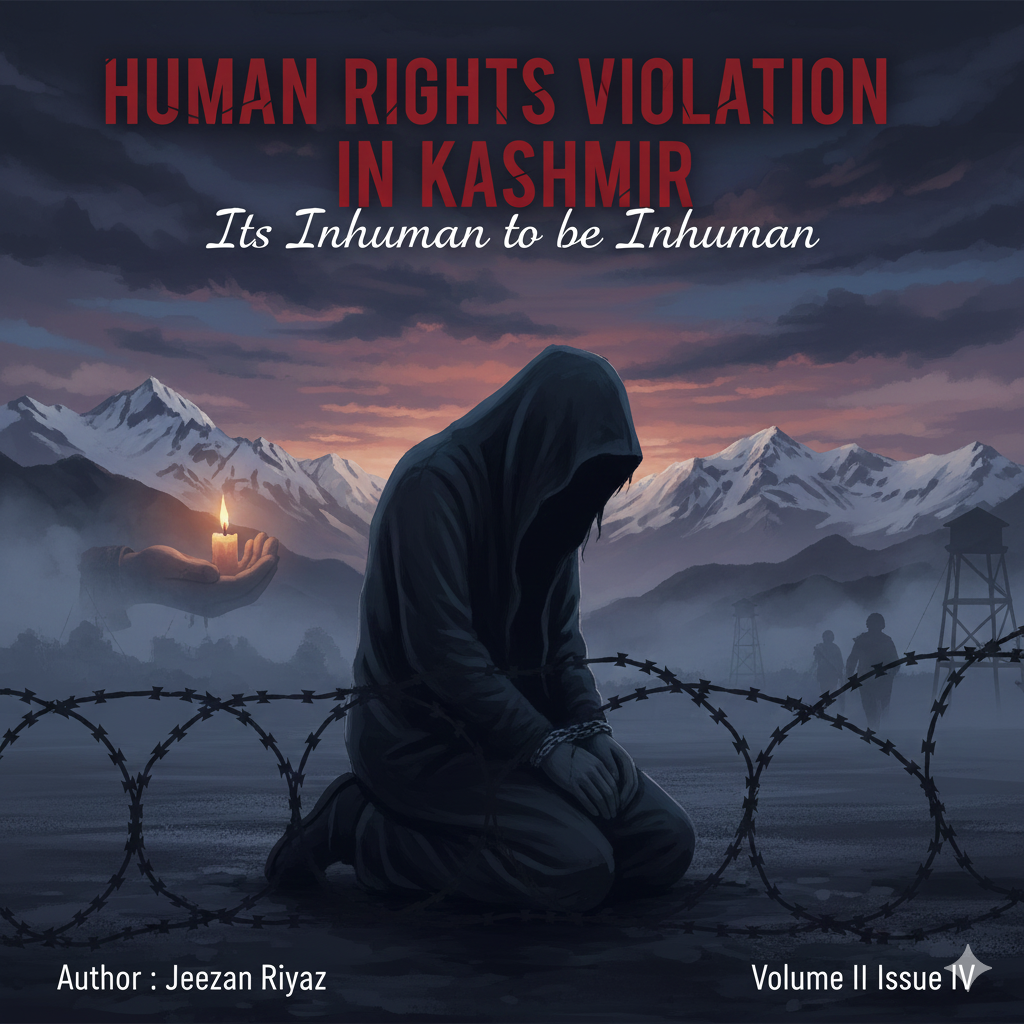
In an uncontrollable conflict between the two super nuclear powers: India and Pakistan, it has affected the people of Kashmir badly. The place which is referred to as paradise by the entire world have now merely been reduced to the status of a warzone. The excessive military might making it the highest militarized zone in the world has been at the Centre of all the agony for the people of Kashmir. Physical horrification, moral reprehension and grave human rights violation that go unchecked very well define the story of the then paradise, now hell. The greatest thing about pain is that it demands to be felt and who else can explain it better than the poor, isolated and helpless Kashmiri’s themselves. The human rights violation hasshunned the people of Kashmir to speechlessness. This research people will give an accurate and proper account of the agony, pain that the people of Kashmir have been witnessed to and therefore will try to provide the solution to the roadblocks created by years of oppression and undemocratic rule. Hence it is not unfair to say that no democracy can be successful if the draconian and undemocratic laws prevail over the basic human rights and dignity of individuals. One can only know the pain of others if one himself goes through it. Therefore in blatant disregard of the draconian laws, there is a need to have a more transparent and accountable system because with “power comes responsibility and with more power comes even greater responsibility”.
II.Introduction
The Republic of India is a country in South Asia. It is the seventh-largest country by area, the second- most populous country (with over 1.2 billion people), and the most populous democracy in the world. Pakistan on the other side is another country in South Asia and on junction of West Asia, Central Asia and East Asia. It is the fifth-most populous country with a population exceeding 207.77 million people. Kashmir is a state in India, located in the northern part of the Indian Subcontinent which has been the subject of dispute between India, Pakistan and China lately. After partition the land occupied by the Indian administration is known as Indian Occupied Kashmir and the land occupied by the Pakistani forces is known as Pakistan Occupied Kashmir. Both India and Pakistan, which once were a one state under the British Colonial rule received their independence in 1947 after witnessing a bloodiest partition that resulted in the creation of these two states, Pakistan being the Muslim Majority State and India being the Hindu Majority state in the region.”
“Kashmir is the only Indian State with a Muslim majority population. A beautiful topography amidst the snowcapped mountains and water bodies is this aesthetic place which looks perfect in almost every way. Not only the physical beauty but the inner beauty of the people as well as the rich cultural heritage and healthy boundaries which adds to the perfections of this place. But soon it became the hotspot of human rights violation and got crushed between the two nuclear states, i.e. India and Pakistan.”
III.Instrument of Accession
“The Instrument of Accession is a legal document signed by Maharaja Hari Singh, the then ruler of the princely state of Jammu & Kashmir, on October 26, 1947, stating that the state of Jammu & Kashmir accedes to India. The Instrument of Accession gave the Parliament of India the power to legislate only in respect of matters concerning defense, external affairs and communications. Apart from defense, communications and external affairs, the Instrument of Accession states certainancillary subjects that include elections to the dominion legislature and offences against laws with respect to any of the said matters. Under Clause 5 of the Instrument of Accession[1],it was clearly stated that the terms of the Instrument of Accession “cannot be varied by any amendment” of the Government of India Act, 1935[2], or the Indian Independence Act, 1947[3], “unless such amendment is accepted by an Instrument supplementary to this Instrument””.
Initially, HariSingh was not of the opinion not to join with either India or Pakistan and instead chose to remain independent. However, on October 22, 1947, when thousands of armed men backed by Pakistan’s army attacked the state forcing Hari Singh to take help from India and accede to it. Using the Instrument of Accession, Article 370 was incorporated in the Constitution of India which served as a bridge connecting Kashmir to India[4]. However attempts have been made at times to amend various provisions of the said article through the President but he doesn’t enjoy the power to do so. The Maharaja agreed that J&K’s accession to the “Dominion of India” would be with the intent that the “Governor-General of India, the Dominion Legislature, the Federal Court and any other Dominion authority established for the purposes of the Dominion” will be legally authorized to carry out in relation to the state such functions vested in them by or under the Government of India Act, 1935. Soon after the accession, an interim state government was instituted by a proclamation made by the Maharaja on March 5, 1948.”
“After signing of the Instrument of Accession the fortunes of Kashmir have been bad as the region has been paralyzed with the draconian laws and the military might which lead to chain of events affecting the overall development of people in the region. Physical horrification, moral reprehension, sexual abuse, grave human rights violation and mental agony define the history of the region.”
IV.Counter Insurgency Laws (Armed Forces Special Power Act)
The major Act that governs military action in Jammu & Kashmir is the Armed Forces (Special Powers) Act, 1958 [as amended in 1972][5]. Human rights activists time and time again have pointed fingers on this law but to their advantage the act has always got a clean chit and a backing from the Supreme Court of India. The Supreme Court on numerous occasions have upheld the validity of such a law time and time again. In nutshell it is a law which tantamount to a lawless law violating the basic human rights of the individuals in that region.”
“Under Section 4(a) of the Act[6], a noncommissioned officer can even order his personnel’s to shoot any individual if he deems fit in his best interest that such an act is necessary for the maintenance of law and order situation and better public order. This gives wide discretion to junior officers and prima facie is not appropriate as on mere pretext or belief that the officer thought a particular person is a suspect and thus violates the basic human rights of the individual. It unnecessarily leads to the death of a large number of innocent civilians.”
“Similarly, Section 4(b) of the act[7] allows the armed personnel’s to destroy any house or shelter where in the opinion of the armed forces such a place has been used for armed attacks or where such a place has been utilized as a hide out for the operations to be commenced .This act permits the destruction of such buildings. This is also a violation of rights of people as merely on a belief it gives the armed personnel the right to vandalism in the name of law which is completely wrong.”
“Section 4(c) of the Act[8] permits the arrest without any warrant, with any force which the armed forces may deem fit against anyone wherein they have a reasonable suspicion about the commission of an offence by that person. This act thus exploits the innocent civilians on the basis of indiscriminate arrests and the use of brute force including the detrimental firing at times.”
Section 4(d) of the act[9]authorizes the entry and search without any kind of warrant obtained from the competent authorities. This act even gives the right to make arrests if there is reasonable suspicion that the said person has wrongfully restrained or confined, or stolen property or any arms, ammunition or explosive substance. This is tyrannical as it allows the forces to displace any person or the property on their own will and rates. For military personnel operating in a culturally alien terrain, ‘beliefs’ and ‘reasonable suspicions’ are often wholly unfounded leading to human rights abuses and such violation of rights go unchecked.”
“Though Section 5 of the Act[10] explicitly lays down that, a person who has been arrested by any armed personnel shall have to be presented to the office in charge of the concerned police station with least delays. This has been repeatedly violated which adds on to the list of human rights violations in Kashmir .Section 6 of the Act[11] exempts Armed personnel’s from prosecution i.e. without the sanction of central government, the armed personnel’s are free from any sort of legal proceedings .The exemption from prosecution is not only for what is done under this Act, but also for what is “purported to be done.” Therefore it gives armed personnel’s a sense of freedom to displace a particular community or group of individuals on their own will and rates.”
“Experts in the UN Human Rights Committee, which met in Geneva in March 1991, were categorical that this Act violates several Articles of the International Covenant on Civil and Political Rights to which India is a signatory as it doesn’t respect the covenants which gives utmost supremacy to the human rights and undergoes certain procedures to preserve the same”. Article 2(3)[12]basically states that an individual has the right to an effective remedy which has time and time again been violated. Also this text legitimately requires direct observance of its provisions without regard to national laws or constitutional law. Therefore after violating any rights of an individual, they should be given an effective remedy for the same otherwise it leads to violation of the covenants of ICCPR. Also Article 4(1)[13] permits State Parties to take measures derogating from their obligations in the time of national emergency, Article 4(3)[14] lays down that any such derogation must be reported to other State Parties through the UN Secretary-General. The Indian government has made no such communication. In any case, as pointed out by the UN Human Rights Committee, such an emergency must be a temporary measure, and cannot be in operation for decades, as this Act has been in various parts of India
“Further, Article 4(2)[15]clearly stresses on the fact that there must be no derogation from these key articles including Article 6 [right to life but Section 4 of the AFSPA[16] gives autonomy to the armed personnel’s even a junior officer for that matter to open fire on the civilians if he believes or has a reason to believe that this is important in the maintenance of public order and thus clearly violates the provisions of the covenant and doesn’t respect the human rights clauses as this is something which is completely inhuman. Just on the basis of mere suspicion you cannot put human bodies at stake because its inhuman to be inhuman. This even violates Article 6(1) of the Covenant[17] which inter alia states that, “No one shall be arbitrarily deprived of his life.””
Under international law, once India has signed this Covenant, its duty is to ensure that whatever has been stipulated in the covenants has to be strictly followed even if it’s in contradiction with the law of the land. In other words, the Armed Forces [Special Powers] Act cannot be upheld as legal and valid on the ground that it is consistent with the Constitution, even if it violates the Covenant because human rights is to be given the utmost importance over any other rights because it forms the basic fundamental right to life. In any case, human rights activists have consistently held that the Act also violatesthe Constitution. It’s like TADA, which violates Articles 14[18] and Article 21[19] of the Fundamental Rights, and is in derogation with Entry 1, List II of the Seventh Schedule[20]. Article 13[21] which states that all laws inconsistent with the Fundamental Rights can be infringed. Article 19[22], which protects freedoms of speech and expression, and the right to form associations and unions, is also violated. Though the Supreme Court has upheld the Act, after laying down detailed guidelines to curb misuse, it should be remembered that the apex court also upheld TADA, to be overruled later by parliament.”
- Kunan and Poshpora incident
“The scariest night that still haunts the entire village when talked about, a tragic night of 1991, a group of soldiers and officers of the Indian army stormed into two villages in Kashmir, seeking out militants assumed to be hiding there. According to village accounts, as many as thirty-one women were raped. The Indian army initially carried out cursory investigations before shelving the case without explanation. Kunan and Poshpora have since become known as the villages of raped women, and their residents have found it difficult to escape this stigma. The inhuman treatment of the forces which destroyed the integrity, jeopardized the values and the most costly ornament that Kashmiri women wear with pride, i.e. their shyness and the pride they take in their values and healthy boundaries. All was over for once and all. Imagine the entire battalion still walks free as if nothing had happened or its their duty to teach innocents a lesson.””
“There have been various reports of rape by Indian security forces in Kashmir .Reports of rape by Indian security forces in Kashmir emerged soon after the government’s crackdown began in January 1990.[23] Despite evidences that army and paramilitary forces were engaged in widespread rape, few of the incidents were never investigated by the authorities. Those that were reported did not result in criminal prosecutions of the security forces involved. Section 376 Of the Indian Penal Code, 1860[24] provides for punishment of rape which shall be imprisonment of either description for a term which shall not be less than seven years but which may be for life or for a term which may extend to ten years and shall also be liable for fine. These laws are there to protect the women from inhuman acts of the predators but it seems to be nonoperational and nonfunctional in the territory of Kashmir as such laws only find their place on paper and not in ground realities. With the clean chit given to the forces, this incident still haunts many and the justice not being delivered just adds to the mental agony of the victims and at the same time gives the armed forces complete autonomy to deal with certain situations.”
“Just a normal incident for many but this is for sure the scariest recollection of the people of Kashmir. The trauma the victims had to go through cannot be explained in words, the pain and the cry for justice was suppressed and thereby just worsening the situation for the victims. A survey of rape case judgments clearly point out that the judges continue to base their decisions largely on the “character” of the rape victim. India’s military laws, particularly the Army Act governing the armed or paramilitary forces, provide for courts-martial and punishments for members of these forces responsible for rape. In general, military courts in India have not proved so accurate and transparent in dealing with cases of serious human rights abuse and have functioned instead to cover up evidence and protect the officers involved. Therefore it is recommended that all military or paramilitary suspects in rape cases be prosecuted in civilian courts[25] for transparency and better accountability.
- The misfortunes of Mubina, Asiya and Neelofar:
“In one publicized case, in May 1990 a young bride, Mubinawas raped by the soldiers of BSF while she was traveling to her beloved husband’s home. Meanwhile her aunt was also raped, not only this, theforces had opened fire on them as well and ended upkilling one man and wounding many others. The government was so dramatic about it and thus claimed that they had been caught in cross fire and thus the forces were not at fault. After the incident was all over in the local and international press, Indian authorities ordered the police to conduct an inquiry. Even after the inquiry concluded and proved that the women had been raped, the security forces were never prosecuted.[26]Mubina and many others like her have been on the brunt of archaic social structures and the huge military might. Incidents like these send down a very wrong message to the masses and creates an environment of hostility and hatred towards the armed forces which is quite normal as after the commission of such heinous crime if they are allowed to walk freely, then the entire system is corrupt and therefore the blame cannot be shifted on the local youth for the current situation of Kashmir. Amidst all this such incidents have not stopped and instead have continued to increase. This is a question to all the readers how can you expect the general public of Kashmir to respect and acknowledge the men in uniform when they are the only fear the people have.”
“On the afternoon of 29 May, 2009, two young women left home for their orchard. Neelofar and Asiya were sisters-in-law. Neelofar had married Asiya’s brother Shakeel, and had an infant son. Asiya a schoolgoing teenager aspired to become an engineer. In the evening Shakeel learnt that Neelofar and Asiya had not returned home. These are trying times in Kashmir, and there is much cause for concern when people do not return home before dark. Neelofar’s husband took the matter to the police and they accompanied him to the spot and called off the operation when it was dark and promised to resume in the morning. After the operation was resumed a dead body of Neelofar was found near the CRPF Camp and about a kilometer away from it the dead body of Asiya was also found. The police didn’t cordon off the area for investigation and the material which could prove useful in the later stages of the trial were not collected. Moreover the forensic reports, medical evidences and many technicalities leading to the chain of events were tampered to delete any evidence which would go against the government forces. . The valley joined the call for justice. 6 months later, the CBI reportedly claims that what happened that night was a case of drowning. No one is to blame.[27]”
“Therefore the inquiry carried out be CBI was prima facie full of flaws as its not practically possible to drown in river which is just 2.5 feet deep and thus points out the tail of injustices and unwillingness to carry out investigation against the armed forces. The reports of CBI send shimmers down the spine to the victim’s family and the entire village as how could it even be possible to come out with the decision of such an inquiry which is full of flaws. This further goes on to show that Kashmiris as people exist outside the paradigm of what constitutes justice in the Indian legal system, further justifying their demand for freedom from India. These horrifying stories still echo in the entire village and thus make it desolation which the government calls an attempt to restore peace. With the death and burial of the 2 women, it’s not those women who have been buried or exhumed rather it’s the justice that has beenburied as well within the walls of Shopian. Also the expectation of the people after such incidents has completely fallen as they believe that thegovernment has always failed us in the cry for justice and it makes our case even more stronger and powerful to be firm on our stance that is the freedom from such inhuman occupation.”
- Abrogation of Article 370
“Article 370 of the Constitution of India[28] is like a bridge that connects Kashmir to India and gave the special status to the state of Jammu & Kashmir. Home minister Amit Shah announced the Presidential order abrogating Article 370 at a time when there is no Legislative Assembly functioning in Jammu and Kashmir which is completely wrong as there was no concurrence and consultation of the state government thereby making the move completely undemocratic. The state is under President’s rule from December 2018 and governor holds the position of senior most figure in the Indian politics. This leads to series of questions as Article 370 can only and only be abrogated after taking the Constituent Assembly into confidence. In order to revoke article 370, the concurrence and consultation of the state government is very important therefore it holds an important position to scrap off such a special status and in nutshell its completely ironic how the Centre has taken its own permission to revoke something that they didn’t have the power to do at the very first place.”
In the case of State Bank of India v. Santosh Gupta[29], Justice Nariman drew additional solicitor general Tushar Mehta’s attention to the SC’s 2017 judgment over article 370 and stated that the said article has acquired permanent space in the Constitution and it could no longer be abrogated. Article 3 of the Jammu and Kashmir Constitution[30] declares the state to be an integral part of India. In the preamble of the Kashmir Constitution, there is no scope for sovereignty as opposed to the Constitution of India which recognizes the concept of sovereignty. Also there is a categoric acknowledgement about the object of the Jammu and Kashmir Constitution which is “to define the relationship that exists of the state with the Union of India as its integral part”. In addition to this people of the state are referred to as mere residents and not citizens.
“Section 6(a) of the 1947 Act[31] clearly states that the act of joining the two countries was to be through an Instrument of Accession. Therefore a state so joining under Section 6(2)[32]could put it out quite clearly as to the reasons of it joining one of the two dominions and thus makes it amply clear with regards to the connotation it attaches for the same. These would be those terms which the ruler of the Princely state accepts as matters on which the dominion legislature (Indian Parliament) may make laws for the state. It further limits the power ofthe dominion legislature to make laws for the state and exercise executive authority of the dominion in the said princely state. In nutshell, the Instrument of Accession was to completely regulate the powers and govern the distribution of such powers between the central government and the concerned princely state thereby abiding and sticking to the principles of Federalism. Technically speaking, the Instrument of Accession was like a treaty between two sovereign countries which had decided rather agreed to work collectively for the betterment of the region .It was like any other normal contract signed by the two countries in order for harmony and peace to prevail.”
The maxim under International law which governs the same is PuctaSuntServanda[33], i.e., promises between states must be honored. If there is a breach of contract, the quintessential rule is to restore the status of the parties to the original position, i.e., the pre-agreement status. Theaspect of international law must be kept in view because if due to the breach of any condition of the Instrument of Accession, the princely state of Kashmir gets its pre-accession status, it will not be in India’s interests and in blatant disregard of the scrapping off the Article 370, India therefore has lost its control and grip over the territory of Kashmir as the article itself served as a bridge connecting Kashmir to India. The resolution was passed when Jammu and Kashmir was virtually under lockdown and two of its chief ministers and other mainstream party leaders were under house arrest, therefore the sweeping resolution which was passed and later on further supported with a bill to abrogate the same was completely undemocratic as the interest of the Stakeholders was not taking into consideration and the concurrence as well as consultation of the state government was not present. Also in the entire history of India, there have been instances where Union territories have been converted into states but it has never happened that a state has been converted into a union territory. The move therefore goes against the federal and democratic nature of the Constitution as it brings more power under the control of the center, when ideally the flow of power should be in the reverse direction and doesn’t give adherence to the notions and principles of federalism.
- Why Scrapping Off Article 370 is against the Law?
“There have been many instances where we have seen the Hon’ble Supreme Court stating that through years of practice and being in force, Article 370 has acquired a permanent status and therefore cannot be abrogated. Therefore the center have used a brilliant loophole in the law to its own advantage and have used the power under Article 370(1) to amend Article 367 by adding an interpretation clause. As per the 6thamendment[34] government of Jammu and Kashmir equals the governor of Jammu and Kashmir; the Sadar-i-Riyasat equals to the governor[35] and most importantly, the Constituent Assembly of Jammu and Kashmir now equals the state legislature which makes it easier for them to take their own consultation in the name of the consultation of the state government. In plain words, to scrap Article 370, the President needed a recommendation of the Constituent Assembly of the state. This amendment of Article 367 equated the Constituent Assembly to the state legislature, and the state legislature was made equal to the governor, and the abrogation was complete. This resolution which was passed was beyond comprehension as it was the daylight murder of democratic values and also against the principles of doctrine of colorable legislation[36] which clearly states that “what cannot be done directly cannot be done indirectly” and thus if the government cannot abrogate the Article 370 prima facie, they cannot do so indirectly by adding an Interpretation clause in Article 367 and thereby creating loopholes in order to abrogate Article 370.”
- Communications Blackout
Communications are often blocked in Indian Administered Kashmir but this clampdown was something different for it was the most pathetic of all and lasted nearly for about 7 months. The greatest thing about pain is that it demands to be felt and who else can explain it better than the poor, isolated and helpless Kashmiri’s themselves. The blackout had shunned them to speechlessness.”
After revocation of article 370 what people forgot was the 7 month long communications blackout cutting off Kashmir from the rest of the population entirely. Schools, colleges and resource Centre’s were closed marking the most tragic blackout witnessed by the people of Kashmir. People working outside of Kashmir were not able to communicate with their families, friends and were in utmost chaos regarding the state of affairs. Residents were made prisoners of their home and that too without internet the life in the entire valley had come to a standstill. Uncertainties, dilemmas and worries about what is going to happen made it even more troublesome. The anger, frustration and pain made it even worse to cope up with each passing day. Mothers across the valley were almost clueless about their children studying, working outside the valley and standing in long queues for hours and hours just to hear the voice of their children. In this modern world where everyone was so busy with their tight schedules, there was this part of the country which was cut out in isolation from the rest of the world. Media houses were banned from reporting and were not given the permit to telecast anything from the valley. This is grave violation of human rights and fundamental rights and this is surely not democratic at any cost. A blackout is the most blunt tactic for online control, completely destructing communications at the very core level. Companies which manage the country’s internet infrastructure are ordered to cut off the entire population form the rest of the world. During the exams application procedure, students faced a lot of trouble due to the prepaid and SMS ban, as they were not able to receive the necessary one-time password on their registered mobile numbers which might be a very small concern for the rest of the world but puts millions of students on a standstill with uncertainties regarding their future. It is high time now for the government to think about the 2 million prepaid users and let them communicate with their loved ones and carry on with their careers. As its very inhuman to not let anyone talk to their loved ones. Not only this the current communications blackout violated the fundamental rights of the residents, it lead to the violation of Freedom of speech and expression[37], Freedom of press as the residents were not given the freedom to propagate one’s own views. It’s a very smart yet cunning move to curb the internet thereby preventing the people to criticize about the current situation in the aftermath of the abrogation of Article 370 and at the same time showcasing the world everything is in sync and working smoothly. This is not improper to say that the Indian government has failed miserably to win the trust of Kashmiri’s and therefore lost a grip on Kashmir when it comes to acceptance and recognition from the people of Kashmir. Physical horrification, moral reprehension, Grave human rights violation that go unchecked mark the history of Kashmir and the biggest irony is that “the people fear men in uniform”.
- Conclusion
Thus we can conclude by stating that:
Based on the current situation in Kashmir and the unlimited powers enjoyed by the armed forces it is almost next to impossible to bring back normalcy in valley. Therefore the most important thing to help retain normalcy in Kashmir is in the form of a dialogue between the two nuclear armed nations. Central government needs to win the trust of the people as there is great satisfaction and immense pride in working for one’s own people rather than working against them. Power of education, infrastructure, widening of horizons can help improve the situation but what actually can help the people take the flight towards superstardom is by winning the people of Kashmir. Emotional connection can do a world of good and thereby giving people a sense of that attachment can help build this territory and at the same time will do wonders for the nation in its entirety. And therefore the Indian Occupied Kashmir will be termed as India’s Kashmir.
[1]Instrument of Accession, cl.5.
[2] The Government of India Act, 1935, Acts Of Parliament, 1935
[3] The Indian Independence Act, 1947, Acts of Parliament, 1947
[4]INDIA CONST. art. 370.
[5]The Armed Forces Special Act, 1958, No. 28, Acts of Parliament, 1958 (India).
[6] The Armed Forces Special Act, 1958, § 4(a), No. 28, Acts of Parliament, 1958 (India).
[7]The Armed Forces Special Act, 1958, § 4(b), No. 28, Acts of Parliament, 1958 (India).
[8] The Armed Forces Special Act, 1958, § 4(c), No. 28, Acts of Parliament, 1958 (India).
[9]The Armed Forces Special Act, 1958, § 4(d), No. 28, Acts of Parliament, 1958 (India).
[10]The Armed Forces Special Act, 1958, § 5, No. 28, Acts of Parliament, 1958 (India).
[11]The Armed Forces Special Act, 1958, § 6, No. 28, Acts of Parliament, 1958 (India).
[12]International Covenant on Civil and Political Rights, 2007, art.2(3), No. 56.
[13]International Covenant on Civil and Political Rights, 2007, art.4(1), No. 56.
[14]International Covenant on Civil and Political Rights, 2007, art.4(3), No. 56.
[15]International Covenant on Civil and Political Rights, 2007, art.4(2), No. 56.
[16]The Armed Forces Special Act, 1958, § 5, No. 28, Acts of Parliament, 1958 (India).
[17]International Covenant on Civil and Political Rights, 2007, art.6(1), No. 56.
[18]INDIA CONST. art. 14.
[19]INDIA CONST. art. 21.
[20] INDIA CONST, 7th schedule, entry I, list II.
[21]INDIA CONST. art. 13.
[22]INDIA CONST. art. 19.
[23]Numerous incidents of rape have been reported by Indian and Kashmiri human rights group. See, for example, Committee for Initiative on Kashmir, Kashmir Imprisoned (July 1990).
[24]The Indian penal code, 1860, § 376, No. 45, Acts of Parliament. 1860.
[25]Flavia Agnes, “Fighting Rape — Has Amending the Law Helped?” The Lawyers, February 1990, pp. 4-11.
[26] Amnesty International, India: Torture, Rape and Deaths in Custody, (London: March, 1992), p.21.
[27]Shopian: Manufacturing a Suitable Story A Case Watch: Independent Women’s Initiative for Justice.
[28]INDIA CONST. art. 370.
[29]State Bank of India v. Santosh Gupta, A.I.R. 2016 S.C. 12240-12246 (India)
[30]JAMMU AND KASHMIR CONST. art. 3.
[31]The Indian Independence Act, 1947, § 6(a), Acts of Parliament, 1947.
[32]The Indian Independence Act, 1947, § 6(2), Acts of Parliament, 1947.
[33]PuctaSuntServanda, international law maxim.
[34]JAMMU AND KASHMIR CONST. 6thAmmendment Act, 1965.
[35]Mohd.MaqboolDamnoo v. State of Jammu And Kashmir(1972) AIR 963, SCR (2) 1014 (India).
[36]Doctrine of Colorable Legislation.
[37]INDIA CONST. art.19(1)(a).