Abstract
Hailed as the fourth pillar of democracy, the media has always played a central role in channelizing the opinion of the masses. Media acts as a link and liaison between the government and the governed. It shapes the political ideologies and affects the political inclinations of the general populace within a country. Existence of free media has been instrumental in bringing about great revolutions all around the globe and oiling the wheels of democratic thoughts and struggles in civil society.
The media, however, has never been free in India – whether pre-independence or post-independence. The saw of censorship has been run over and over on newspapers, radio and television by the ruling governments to control what the public sees. The papers and magazines started by Indian freedom fighters and leaders of the renaissance were clamped down by the British government. In the present day, the government resorts to censorship to further its own propaganda.
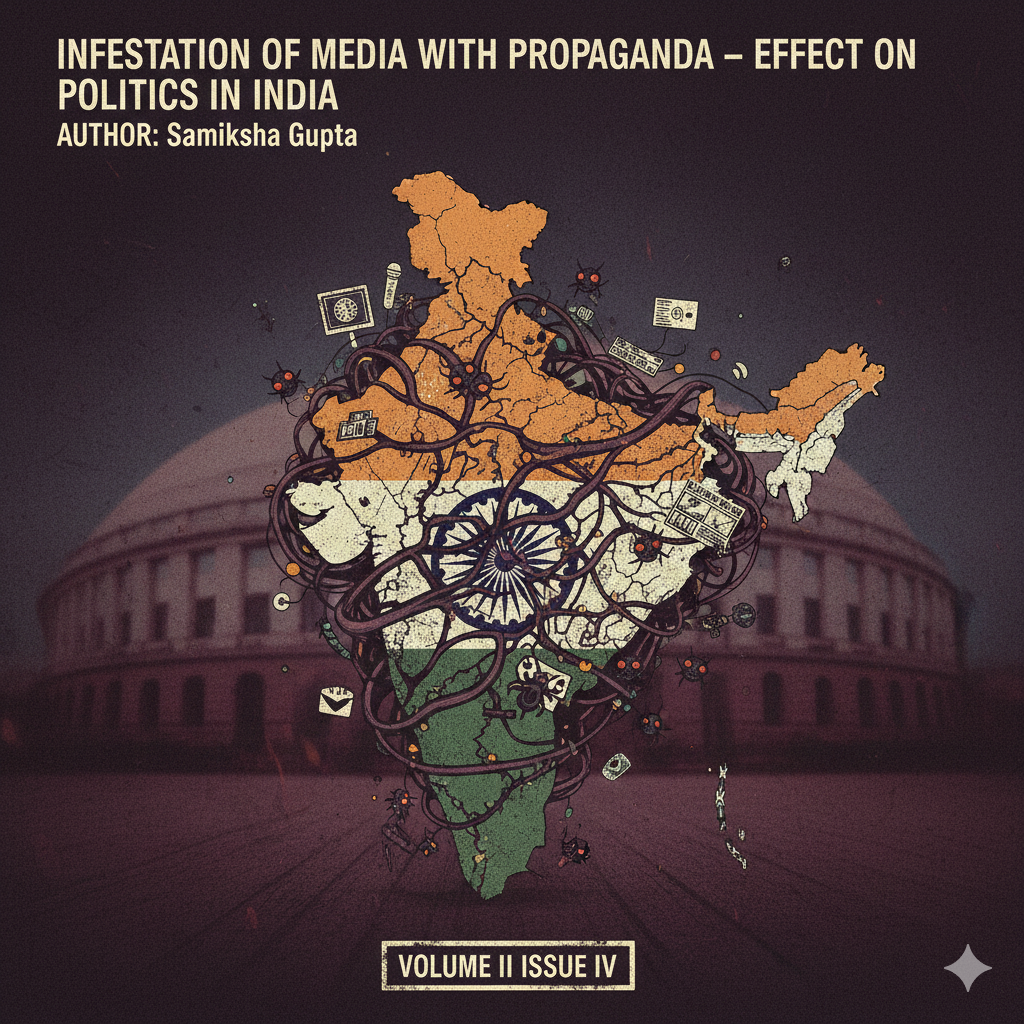
The media is supposed to develop and encourage critical thinking among the people and answerability amongst the rulers. TV and newspapers have completely turned pro-government, and thus, are blinding the mob rather than objectively reporting the political scenario, events and happenings. Further, the ubiquitous presence of social media makes it easier to spread fake news created by IT cells and further the propaganda of the political parties.
This article is an attempt by the author to study the role that the media plays to further the objectives of the political parties. It throws light on the nexus between censorship and propaganda spread through media, especially around elections in the country. This article critically comments upon the methods employed by the political parties to give effect to their ulterior political intentions, sway the public in their favours and maximize and expand their respective vote banks. The author has analysed these events in the context of freedom of speech and defamation provisions in the legal system.
Introduction
“The media’s the most powerful entity on earth. They have the power to make the innocent guilty and to make the guilty innocent, and that’s power. Because they control the minds of the masses.”
~ Malcolm X[1]
Ever since the 18th century, media, in all its forms, shapes and sizes, has been an omnipresent and unavoidable component of our lives. In independent India, media emerged as the fourth pillar of democracy; the legislature, executive and judiciary being the other three. It has played an active role in sensitizing people and shaping their opinions about various issues in the country, particularly issues of political nature and importance.
The phenomenon of censorship has always gone hand in hand with the media that brought political ideologies to the forefront. Hickey’s Bengal Gazette, the first Indian paper printed in the 1780s, was soon shut down by the British Government for being too free.[2] The regulation of content exhibited across multiple media platforms still continues in explicit or implicit forms.
With the advent of technology, social media has emerged as the newest, biggest, most easily accessible and most effective platform. Its impact is so huge that the leading ruling and opposition political parties of our country have their own special social media cells to propagate and propagandize. In simplest words, propaganda refers to spreading information, mostly political, that may be incorrect, to further the cause of a particular political group.[3] Due to the laws regulating media, and particularly social media, being hazy and lax, it is the most convenient platform to spread propaganda.
Through this research article, the author intends to discuss the use of different platforms of media for furthering political propaganda in historical times in the country. The article also analyzes the direct and indirect ways of doing the same in modern times, particularly around the times of elections. The author brings the impact of using social media for spreading propaganda, to the forefront. The author has also analyzed the legal implications of such acts with respect to laws pertaining to defamation and freedom of speech. A discussion on overall efficacy of censorship laws in regulating the current scheme of things forms the conclusion of the article.
- Historical Impact of Media in Politics
In the pre-independence era, Raja Ram Mohun Roy was the initiator of Indian renaissance who raised his voice to demand, inter alia, the freedom of press. It is said that the colonial government could have had an idea of the impending uprisings, had they controlled the Press more closely and strictly then. Lord Elphinstone observed that freedom of the press was not compatible with the colonial government’s rule. As a measure of regulation, or censorship as we call it today, the infamous Gagging Act, Vernacular Press Act etc. were put to use by the British Government.[4]
The nationalist Press was significant in effectuating the uprising of nationalist sentiment amongst the countrymen during the struggle for independence. Many leaders, including Mahatma Gandhi, vehemently supported the idea of freedom of the press. The readership of his journals Young India and Harijan was massive. Lord Listowell applauded Indian newspapers for their role in shaping the country’s opinion.
The Constitution of India bestowed the freedom of speech and expression to each citizen, which encompasses the freedom of media within itself.[5] It is one of the cornerstones to building a civil society on the foundation of the rule of law. During Nehru’s years till mid-1960s, the press had emerged strongly to provide information on nation-building.[6]
During the later part of the decade, radio was extensively used to project Indira Gandhi in a positive light. Gradually, in the 1970s television broadcasting also came into the picture. The then-government supported big industrialist groups who controlled the press. Most of the press was under direct or indirect state influence. Therefore, although the freedom of speech and expression existed on paper, it was extensively curbed in practice. During the period of national emergency, press censorship was at its peak.[7] Therefore, the public could not say or hear anything against the ruling political party. Thus, democracy was in jeopardy.
- Instrumentality of Media for Spreading Propaganda in Present Day
The role of propaganda and censorship has more layers than are visible on the face of it. Its effect is subtle at times and obvious at others.[8] A strategic, systematic and strong use of censorship can be instrumental in spreading of propaganda at the hands of controllers. The ruling governments in our country have been adept at using propaganda as a political tool for their own hidden advantages. There have been several instances where the government has blown its achievements and has degenerated opposition’s image out of proportion. This behaviour gets heightened as elections approach nearer.
III.A Direct Manipulation:
All the major news channels today have seen investments from big corporate houses – Network 18 from Reliance Group, The Times Group from The Bennet Coleman & Co. Ltd., etc. Furthermore, radio news and Doordarshan are owned by the government itself. In such a scenario, the news that matters is suppressed and ‘manufactured’ comedy is served to the public in the form of news.[9] A subtle form of pre-censorship dictates what is shown to the citizens of the country and what is discretely brushed under the carpets of political houses.
Another example of strict media regulation is that the government is believed to participate in scripted interviews for news channels, rather than answering ‘real’ questions about governance that the citizens expect to be answered.[10] People have admitted to having been ‘coached’ beforehand to say only the praiseworthy things about the current government.[11]
The Journalists who tried to bring the truth of the matter to the foreground have reported to having received death threats for themselves and their families.[12] The data presented by the Committee to Protect Journalists indicated that over 70 media persons have been killed in the past two decades.[13] Such form of corporate and politically inspired censorship has degraded the quality and independence of media.
III.B Indirect Propaganda:
Entertainment media has been used to disseminate propaganda based thoughts and views amongst the common mob for a lot of years. There have been a lot of controversial movies that have political colouring to them. The executive arm of government, functioning through the Central Board of Film Certification, or as we commonly know it, the Censor Board, has time and again imposed politically inspired restrictions on such movies. Some examples could be movies like Aandhi (allegedly about Indira Gandhi’s life), Black Friday (about 1993 Mumbai bomb blasts), Kissa Kursi Ka (allegedly a spoof on Sanjay Gandhi), Madras Café (about the assassination of Rajiv Gandhi), Parzania (about Gujarat communal riots), Lamha (highlighting issues in Kashmir), Amu (based on 1984 Anti-Sikh riots), and many more.[14]
The current government sends it religious propaganda across though movies. The recent most example being of censorship of movie Padmavat, to protect the sentiments of their vote bank which consists of Hindus. Apart from this, there has been a surge in political-thriller genre movies in the past few months. Movies like Uri – the surgical strike, Thackeray (a biopic on Bala Saheb Thackeray, founder of one of the member parties of the current ruling alliance) highlighted the achievements and lives of the leaders of the current government.
On the other hand, the latest movie ‘The Accidental Prime Minister’ portrays the former Prime Minister and the opposition party leaders in a negative and shady light. The release of such movies a few months before the General Election of 2019 in the country was about to take place, clearly indicated how strategically the current government was spreading its propaganda.
- Circulation via Digital Media
With the advent of technology in gadgets as well as the telecommunication industry, smartphones, installed with smart apps have been made easily accessible to over 300 million people in the country.[15] The easiest way to reach out to masses today is electronic media. Political parties are estimated to spend 15-20% of their expenditure on advertising and promotion on digital media marketing.[16] Meticulously manufactured messages that highlight the achievements and failures of each political party keep on circulating on social media.
Since a huge chunk of voters in the 2019 General Elections were young people, digital media reasonably appeared to be the most efficient way to target and reach out to such class of voters. The spread of propaganda through social media takes place very discreetly. Opinion based posts and messages are created and circulated, at times through paid promotions over Google and Facebook. The wordings are intended to be provocative a lot of times and appear to be thoroughly researched and fact-based. The content is heavily biased to appeal the voters and facts which may not appeal to them are conveniently suppressed.
Online authors can hardly be traced down and held accountable for their content. Platforms like WhatsApp offer both – anonymity and visibility, simultaneously. Most of the people who interact with such content are too busy to invest their efforts in finding the truthfulness behind these messages and conveniently base their opinions on the same. Moreover, “Bots” can be held responsible for creating ‘Trends’ by raising the number of views on favourable posts and hashtags and drowning the ones that do not support the government’s propaganda.[17]
- Legal Analysis
V.A Freedom of Speech:
The Constitution of India has endowed the right to freely speak and express one’s opinion,[18] subject to certain reasonable restrictions[19] for the greater good. The controllers have been using censorship as a tool to fan their propagandas. The propaganda, at the level on which it exists today, obstructs the media from showing the fuller and truer picture of facts to the public. It is too pervasive, massive and systematic. Such an extent of control results in reducing the media from the status of a ‘watchdog’ to a ‘lapdog’.[20]
It strikes at the fundamentals of the profession of journalism and is detrimental to the existence of media in an independent form. The media is left with no option but to convey what the ruling party wants to convey to the people. It also spreads distrust amongst people against the media.[21]
To be free in its truest sense, media needs to exercise dual functions- one of reporting credible information, and the other to be investigative, critical and adversarial in nature. The former serves the task of public education and the latter promotes critical thinking, discussion and debate about governance amongst the countrymen.[22] For the rule of law to be strictly protected in a democratic nation, the existence of an independent media is of utmost instrumentality.[23] A democracy where the difference of opinion is not allowed to exist or be voiced is no democracy at all.
The attempts of Election Commission to combat the paid-propaganda and to censor the content spread on digital media during the no-campaigning period have fallen way behind their objectives.[24] This is due to the vacuum in legal space regarding the proper regulation of media. Media has merely become a dancing puppet in the hands of corporate and politicians, the whole of the country’s mob is expected to enjoy the show. The ultimate losers are the people of India who are being deprived in many ways. There’s a pressing need for diversification and pluralism of Indian media, now, greater than ever before.
V.B Defamation:
Defamation falls within one of those exceptions on the basis of which, freedom of speech may be curtailed. As per the penal laws of the country, a statement may be said to be defamatory in nature if it is made to harm the image of the concerned person when the perpetrator is aware of it to be untrue.[25]
The Governments at the central and state level try to hinder the outreach of news to people by leaning on defamation provisions in the country. Jayalalitha government filed over 100 defamation suits in a span of 5 years.[26] Once a case of defamation is filed against a journalist or media house, the credibility and reliability of the news is put to question. The masses do not resort to waiting until the pronouncement of a judicial order regarding the truthfulness of the claims made by the questioned media person.
Furthermore, the corporate media highlights the fact that suit worth Crores of rupees has been filed against websites, or publishing houses. Such news almost never comments upon the maintainability of the high-profile ‘suit against defamation’. Therefore, the provisions regarding defamation are extensively employed by the government to ban the content that disadvantages them and implicate the people who try to bring such information into the public domain.
- Conclusion
‘The quality of news has gone down’, is something that can be heard very often these days. The media that was the flag-bearer of nationalist sentiment among the masses in the pre-independence era slowly started losing its autonomy at the hands of various political groups and corporate houses. Its condition has deteriorated to the extent that independent media almost does not exist today and the citizens are in a fix. With multiple State Legislative Assembly elections always happening in the country at regular intervals, people need to be educated so that they can make an informed choice, rather than a misinformed choice.
The acts of propagandizing falsely through media are not just unethical, but also a crime against democracy. The Election Commission needs to ensure that a vigil is placed upon such acts. It is the right time for the legislature to widen the definition of ‘corrupt practices’[27] to include the activities of spreading propaganda through traditional and digital media. Some level of responsibility also needs to be placed upon digital media owners to regulate the content circulating on their cyberspaces. In the opinion of the author, the freedom of the press can only be given effect to when the role of censorship can be curtailed to the bare minimum levels to ensure non-chaotic and harmonized existence.
[1] Dr. Jawara D. King, The Awakening of Global Consciousness: A Guide to Self-Realization and Spirituality 199 (2010) (accessed on Mar 15, 2020) https://www.azquotes.com/quotes/topics/media-propaganda.html
[2] Media in India: Raj to Swaraj,43-45, Shodhganga http://shodhganga.inflibnet.ac.in/bitstream/10603/27658/9/09_chapter%201.pdf
[3] Cambridge English Dictionary, https://dictionary.cambridge.org/dictionary/english/propaganda
[4] Supra 1, 46-50
[5] Art 19(1)(a), Constitution of India, 1950
[6] Supra 1, 50-55
[7] Supra 1, 60-72
[8] Veronica Ma, Propaganda and Censorship: Adapting to the Modern Age, 37 Har Intl Rev 46-47 (2016)
[9] Pushkar Raj, Why Propaganda passes as news in (Indian) Media, Indian Cultural Forum (Nov 28, 2017) https://indianculturalforum.in/2017/11/28/why-propaganda-passes-as-news-in-the-indian-media/
[10] As interpreter reads answers, Modi is accused of ‘Scripted’ Interview, The Wire (June 5, 2018) https://thewire.in/politics/narendra-modi-scripted-interview
[11] Arshad, Scripted PM Modi Interviews Exposed, The Siasat Daily (Aug 4, 2018) https://www.siasat.com/news/scripted-pm-modi-interviews-exposed-1388237/
[12] Saurav Kumar, Censorship, Propaganda, Cold blooded murder: The Future of Indian Media, Youth Ki Aawaz (June 2018), https://www.youthkiawaaz.com/2018/05/intimidating-truth-speaking-and-seeking-journalists/
[13] Supra 8
[14] Shradhha Verma, 40 Bollywood movies that Courted Controversies, (May 25, 2015) https://www.scoopwhoop.com/entertainment/controversial-bollywood-movies/#.augw5ed87
[15] Number of Smartphone users in India, https://www.statista.com/statistics/467163/forecast-of-smartphone-users-in-india/
[16] Medha Dutta, ‘Election 2014 is all about Social Media’, The Times of India, (Apr 17, 2014) https://timesofindia.indiatimes.com/news/Election-2014-is-all-about-social-media/articleshow/33835014.cms
[17] Divij Joshi, India’s Electoral Laws are Ill equipped to Deal with Digital Propaganda, The Wire (Nov 28, 2018) https://thewire.in/politics/indias-electoral-laws-are-ill-equipped-to-deal-with-digital-propaganda
[18] Supra 4
[19] Art 19(2), Constitution of India, 1950
[20] Supra 11
[21] Propaganda and the Freedom of Media, https://www.osce.org/fom/203926?download=true
[22] N. Ram, The Changing role of the News Media in Contemporary India, 10-18, https://www.thehindu.com/migration_catalog/article13408537.ece/BINARY/Contemporary%20India%20section%20of%20the%2072nd%20Session%20of%20the%20Indian%20History%20Congress
[23] Madabhushi Sridhar, The Mind-Rigging by Media: Electoral Offences and Corrupt Practices, 1 MLR 67-76 (2010)
[24] Supra 16
[25] Sec 499, Indian Penal Code, 1860
[26] Pushkar Raj, Why Propaganda passes as news in (Indian) Media, Indian Cultural Forum (Nov 28, 2017) https://indianculturalforum.in/2017/11/28/why-propaganda-passes-as-news-in-the-indian-media/
[27] Sec 123, Representation of People’s Act, 1951.