
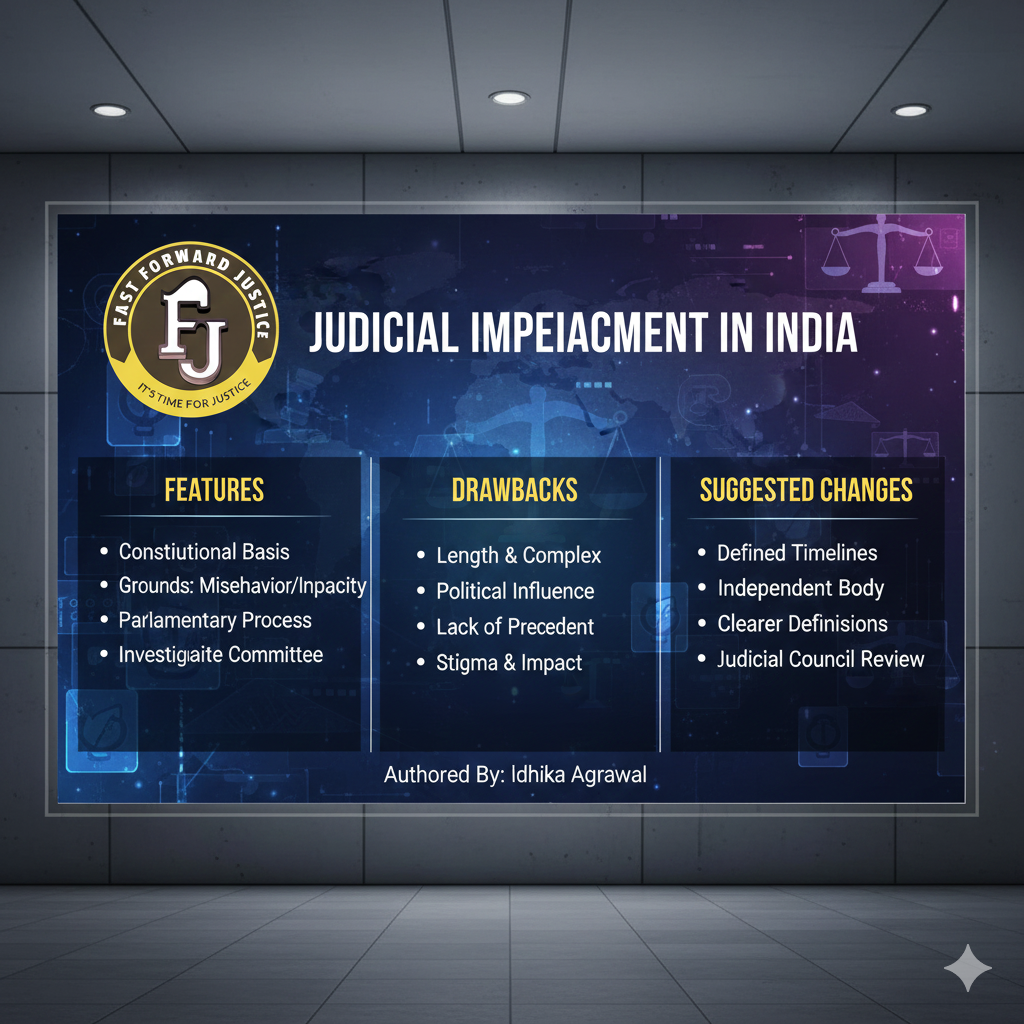
I. Abstract
A study titles “Judicial Impeachment in India: Features, Drawbacks and Suggested Changes -An effort to uphold legal spirit and interests of the citizens”was conducted. This detailed paper focuses on understanding the level of awareness and outlook of the individuals towards the existing impeachment process of the Judiciary in India.This Research paper will be discussing the particular issue of Judicial Impeachment in India along with its features and drawbacks with respect to other foreign laws. The foreign countries covered are namely: England, Wales, United States and France. A detailed questionnaire was put together for the collection of the required information. Some relevant questions being “knowledge of impeachment”, “review on the foreign processes”, “suggested changes in the Indian Process” were included in the questionnaire. Various people who belonged to a legal background as well as non-legal background were approached, in order to get a wholesome and unbiased perspective on the said matter. The data was received from the sample size of 52 people in various cities across India. This data was extensively analysed and the following conclusions and inferences were drawn. Result of this data in a nutshell was in favour of changing the Indian Impeachment procedure in accordance to the foreign laws. This study also extensively points out the loopholes in the Indian Impeachment method and other suggested recommendations.The paper also aims to understand the concepts of Judicial Accountability and Judicial Independence, in order to highlight the need for both parallelly based on the situation and give a detailed suggestion to the current judicial impeachment mechanism existing in India.
II. Keywords
Impeachment, Independence, Accountability, Judiciary, Legislature, Misbehavior, Incapacity.
III. Objectives
The study focuses on three-fold primary objectives:
1. To study the Impeachment process in India
i. Law relating to Impeachment
ii. Essentials for a successful Impeachment Process
iii. Defining ‘misbehavior’ and ‘incapacity’
iv. Need for Impeachment
(i) Conflict between Judicial Independence and Accountability
2. To understand the Foreign Approach to Impeachment Mechanism
3. To understand the drawbacks of the Indian Impeachment Process
i. Judicial Correction and Impeachment in other Countries
ii. Suggested changes in Indian Process
IV. Review of Literature
The impeachment process has been studied enormously across the globe in various countries. The key component being how does it hamper the judicial independence.
The ‘A NATIONAL JUDICIAL COMMISSION JUDICIAL APPOINTMENTS AND OVERSIGHT’ by Vaidya Gullapalli& Jayaprakash Narayan presented the Impeachment processes of various countries including Australia, France, US, UK and India. It helped me draw clear and defined parallels between Indian Law and other Foreign Laws. This analysis aided in suggesting recommendations and changes that could be incorporated in the Indian Judiciary.
In 2015, a detailed analysis under the Commonwealth Secretariat titled ‘The Appointment, Tenure and Removal of Judges under Commonwealth Principles’, written by J.van Zyl Smit was released. This study focused on various aspects like appointment, stability of tenure and removal of a judge. This study helped be identify the conflict between Judicial Independence and Accountability as per Rule of Law. It highlighted the Latimer Principles and how each commonwealth country is incorporating ‘misbehavior’ and ‘incapacity’ as grounds of impeachment. It helped me identify 3 main mechanisms of removal namely, ad-hoc basis, parliamentary and disciplinary tribunals.
In January 2002, the Office of democracy and governance published an analysis titled ‘Guidance for Promoting Judicial Independence and Impartiality- Revised Edition’. Chapter 4 of this document defines a unique relationship between Judicial Independence and Accountability, placing both at important stature differentiated by the timing of application. Judicial independence is a pre-control measure whereas Accountability is a post-control method. It helped me make suggestions to the existing Indian Legal System and how both these essentials could be respected and implemented.
On the other hand, the 1979 article titles ‘Chilling Judicial Independence’ by Irving R. Kaufman is a very well-articulated work. It presents the drawback of internal methods of correcting judges, i.e. letting judges correct each other. It appreciates the current impeachment method that is direct impeachment for offences that qualify. The articles seems to favour the Judicial Independence as it believes in providing a ‘breathing space’ to the judiciary. It aided me in getting an insight to the minds of the judges and what hampers their performance in court.
V. Introduction
The Indian Democracy is based on the three pillars namely: Legislature, Judiciary, Executive. Even though they are considered to be equally important, they are not supposed to encroach the area of operation of the other as enshrined in the Doctrine of Separation of Powers. However, the Judiciary checks instances or nuances where the legislature and the executive act beyond the scope of their authority.
In India, the citizens and their lawyers always seek the truthful administration of justice, regardless of religion, caste, gender or place of birth, The law guarantees fundamental freedoms and to secures justice – social, economic and political – to every citizen through rule of law.
If the Constitution is a blessing for the citizens, then the Judiciary acts as a blessing in disguise. Where on one hand the Constitution provides for all our Fundamental rights and obligations, on the other, the Judiciary makes sure the same rights are upheld and enforced. Thus, the judiciary needs to be given a certain sense of independence in order to safeguard justice.
The rights of the citizens often coincidewith the freedom of the judges to deliver an unbiased and a fair judgement while discharging their duties. When the judges fail to do their duty rightfully, the Constitution provides for the Members of Parliament to vote and act upon the same and initiate the impeachment proceeding.
The corrective measures taken by the elected representatives of the people are often considered to violative the Doctrine of Separation of Powers since the legislature tends to encroach into the purview of the Judiciary. It is also considered to disturb the peaceful functioning and Independence of the Judiciary. The other side of the coin seems to highlight the fact that the legislature needs to step in, in order to scrutinize the judiciary when they fail to perform their duties. The provisions that enable removal of judges are also a manner of reinstating the trust of the people in the Indian Legal System and its mechanisms. They uphold the Doctrine of Judicial Accountability. Thus, their interventionbecomes imperative at times.
This Research paper will be discussing the particular issue of Judicial Impeachment in India along with its features and drawbacks with respect to other foreign laws.
1. Impeachment Process in India
The word ‘Impeachment’ is derived from the French very- Empecher which means to prevent as well as the English term ‘impede’.
(A) Law relating to the Impeachment Procedure
In India the impeachment process of the judge finds its origin in the Article 124 (Establishment and Constitution of Supreme Court) of the Constitution of India. Law relating to this aspect can also be found in the Article217(1)(b)(Appointment and conditions of the office of a Judge of a High Court) and Article218(Application of certain provisions relating to Supreme Court to High Courts) of the Constitution of India.
The parliament is permitted to regulate the procedure for the investigation and collecting proof of a Supreme Court Judge’s misbehavior or incapacity as per Article 124(5). In furtherance of this,the Legislature has come up with the Judges (Inquiry) Act, 1968. Section 3 of which deals with the steps of investigation into misbehavior or incapacity.
Article 217(1)- (a) provides that the resignation of the Judge should be in writing and addressed to the president. (b) the Judge may be removed by the President in the manner prescribed by Article 124 (4).
Since the Article 124 only provides for judges of the Supreme Court, there was no provision with respect to misbehavior or incapacity of the High Court Judges. Articles 218 therefore extends the scope of the impeachment process even to the judges of the High Court. Article 218, fills the probable casus omissus in law. This thereby increases the uniformity among the judiciary as each judge can be brought to scrutiny for their acts.
(B) Essentials for a successful Impeachment Process
Articles 124 provides for the necessary requirements for initiating and concluding the impeachment process of a judge.
124 (4)-“A Judge of the Supreme Court shall not be removed from his office except by an order of the President passed after an address by each House of Parliament supported by a majority of the total membership of that House and by a majority of not less than two-third of the members of the House present and voting has been presented to the President in the same session for such removal on the ground of proved misbehavior or incapacity.”
The requirements for the process as per Article 124(4) read withSection 3 can be summarized as:
The Process of Judicial Impeachment/Removal in India by virtue of Article 124 & Section3
It is certain that an impeachment comprises of two stages; first being the initiation of investigation to prove misbehavior and incapacity which is open to judicial review and the second stage of the parliamentary process which is not open to judicial review.
(C) Decoding meaning and scope ‘proved misbehaviour’ and ‘incapacity’
Justice K. Ramaswamy in a Supreme Court Case reiterated multiple times that even in the absence of a fixed set of principles there exists an unwritten code of conduct which inculcates various guidelines for judicial behaviour. Grounds like misbehaviour and incapacity act as preventive measuresto avoid the arbitrary removal of a judge. Adjudicating upon these measures requires critical examination.
Misbehaviour is an expression with a wide connotation and could not be construed in a restricted manner. It is a vague term. Even the Restatement of Values of Judicial Life, could not be conclusive to constitute as misbehaviour. Mere bad or abstract behaviour is not misbehaviour in the eyes of law.
It has been held that “Every act or conduct or even error of judgment or negligent acts by higher judiciary per se does not amount to misbehaviour. Defined in Section 2(j) of the Judges (Inquiry) Bill, 2006; wilful abuse of judicial office, wilful misconduct in the office, corruption, lack of integrity, or any other offence involving moral turpitude would amount to misbehaviour” or an “improper or unlawful behavior” in the eyes of law.
Incapacity on the other hand is defined as physical or moral incapacity, which partially permanent in nature.
A few guidelines in respect of the conduct of Judges provided by the International Bar Association are as follows:
30. A judge shall not be subject to removal unless by reason of a criminal act or through gross or repeated neglect or physical or mental incapacity he/she has shown himself/herself manifestly unfit to hold the position of judge.
40. A judge should always behave in such a manner as to preserve the dignity of his office and the impartiality and independence of the Judiciary.
42. Judges may take collective action to protect their judicial independence and to uphold their position.
Even these guidelines do not clear the doubt as to what can amount to judicial misbehaviour or incapacity and therefore there exists a lacuna which is highly subjective in nature.
The US study has concluded two views upon what may constitute as an impeachable offence.
“At one extreme is the contention that impeachment is limited to indictable criminal offenses.” The other view is a remark by Rep. Gerald Ford-“What, then, is an impeachable offense? The only honest answer is that an impeachable offense is whatever a majority of the House of Representatives considers [it] to be at a given moment in history; conviction results from whatever offense or offenses two-thirds of the other body considers to be sufficiently serious to require removal of the accused from office”
Judges could nonetheless be removed by Parliament for any reason. This approach thereby decreases the predictability and stability which should be one of the features of law.
2. Foreign Approach towards the Impeachment Mechanism
(A) Europe
The Source for the professional conduct comes from the profession itself. “Judges have to be dignified, honest, independent and loyal.”
England and Wales
Impeachment mechanisms were firmly established in England during the reign of Henry IV (1399-1413) and it was the preferred method for removing judges for misconduct or any unwanted behaviour. According to the English Rule, judicial acts constituting high crimes and misdemeanour must be committed by the judge while administering justice.
To receive and investigate the complaints against the members of the Judiciary, a Judicial Appointments and Conduct Ombudsman was established under the Constitutional Reform Bill 2005. The Ombudsman will also handle complaints about the appointment process.
The Ombudsman is appointed by the Queen on the advice of the Secretary. Any person who is in the civil service or is a practising barrister or solicitor in England and Wales, Scotland, or Northern Ireland is not eligible for the said post.
France
Conseil Supérieur de la Magistrature (CSM) is a Constitutional body, created by Article 64 in 1883. The 1993 amendment widened the CSM’s jurisdiction and gave it an advisory role in the nomination and disciplining of judges.
In the Ethical guidelines which were published CSM’s Report 2009, there are six themes; Each value is detailed considering the personal, functional and institutional aspects. For example, “Integrity includes obligations of probity, a general requirement of honesty, which includes that the Judge being forbidden to use his/her position to obtain benefits (personal), efficient practice in Court duties (institutional) and rejection of favouritism (functional).”
Transparency in the removal process is also ensured by the appointment of an Ombudsman.
The Conseil Supérieur de la Magistrature (CSM) can impose a range of sanctions:
1. A reprimand that will appear in the judge’s file
2. Transfer
3. Withdrawal of certain functions
4. Lowering in rank
5. Mandatory retirement
6. Dismissal with pension
7. Dismissal without pension
(B) The United States impeachment process
“Impeachment is one of the “checks and balances” incorporated into the American constitutional scheme.” However, in the last 25 years, only 2 judges have been impeached. It is also established that judges cannot be impeached for their rulings on the bench or any reasonable discharge of their official duty.
Section 1 of Article 3 of the Constitution of US says:“The judicial Power of the United States, shall be vested in one supreme Court, and in such inferior Courts as the Congress may from time to time ordain and establish. The Judges, both of the supreme and inferior Courts, shall hold their Offices during Good Behaviour, and shall, at stated Times, receive for their Services a Compensation which shall not be diminished during their Continuance in Office.”
Good Behaviour is a requirement for the Judge to continue office as reinstated in recent Impeachment cases of Justice Clarence Thomas, Justice Brett Kavanaugh, Justice Samuel Chase and many more.
The United states has a statutory provision called the Judicial Conduct and Disability Act of 1980. This statute allows the citizens to file complaints or allegations against the Federal Judge who has engaged in a “conduct prejudicial to the effective and expeditious administration of the business of the courts” or has become, by reason of a mental or physical disability, “unable to discharge all the duties” of the judicial office.
Article VI of the Act :
20 (D) take remedial action to ensure the effective and expeditious administration of the business of the courts, including:
(i) censuring or reprimanding the subject judge, either by private communication or by public announcement;
(ii) ordering that no new cases be assigned to the subject judge for a limited, fixed period;
(iii) in the case of a magistrate judge, ordering the chief judge of the district court to take action specified by the council, including the initiation of removal proceedings under 28 U.S.C. § 631(i) or 42 U.S.C. § 300aa-12(c)(2);
So apart from direct Impeachment, the act also offers other methods like :
“Rule 20(b)(1)(D) recites the remedial actions enumerated in 28 U.S.C. § 354(a)(2) while making clear that this list is not exhaustive.“
VI. Research Methodology
The method of collecting data and research used in this research paper was the ‘Questionnaire Method of data collection’ The questionnaire is the main instrument for collecting data in a survey form of research. A questionnaire was formulated on the online platform by Google called ‘Google Forms’ and circulated it among targeted people and institutions by firstly sending emails and messages to them. The questionnaires were filled and the data was saved onto an online file. The data was further used for analysis, discussion and making of charts along with formulation of the suitable conclusions.
VII. Results and Discussions
3. Do you belong to a legal/law oriented background?
This question was of vital importance. People belonging to a law oriented background are more capable of understanding the legal terminology as well as will be able to judge the advantages and disadvantages of the Indian and Foreign processes better than people who have no connection to law. 48 people (92.3%) out of the 52 surveyed had a legal background. They consisted of law students, teachers and practicing lawyers. Only 4 people (7.7%) out of 52 did not have a legal backing. This adds up to the authenticity of the data.
4. Are you aware about the Impeachment Process of Judges in India
46 out of 52 (88.5%) people had a fair idea about the impeachment process existing in India. 11.5% (6 people) of 52 had no knowledge about the impeachment procedure prevalent in India.
3.Are you aware of the Impeachment proceedings against:
This question was not made mandatory since it as related to the legal background. Majority of the answers (21answers out of 26 recorded for this question) were aware about the Impeachment proceedings against Justice Deepak Misra. The 2nd most followed process was that of Justice Ramaswamy (13/26 answers recorded). The people were least aware about Justice P.D. Dinakaran (20/26 answers recorded).
4. Should India have Impeachment process led by the Legislature?
This question tries to gather views of the citizens with regard to the legislative interference in the impeachment process. 40 people, 76.9% of the people voted for the legislature to intervene and lead the impeachment process.
5. Are you aware of any other Country’s approach to Judicial misconduct?
Since this question was the very basis of my next question, I provided background information to the people about Indian and Foreign Impeachment Process. This was done to enhance the knowledge base of the people as well as make sure that their responses add value to my study. As many as 22 people (42.3%) were still unaware of the Impeachment mechanism of other countries apart from India. Only 24 people (46.2%) had knowledge about countries other than India.
6. Do you think India should adopt this policy of less stricter measures for offences short of Impeachment ? (based on the Background Information provided).
After reading the Background Information provided, as many as 34 people (65.4%) out of 52 were in favour of introducing less stricter measures for judicial misconduct. Only 12 people (23.1%) were strictly against any change in the statutory provision regarding impeachment.
The Last question was an open ended question and a summary of those answers was that for the Judiciary to function efficiently, the Doctrine of Checks and Balances should be executed and if this attracts a breach in Separation of Powers, then it is very well justified.
7. Any other comments and/or questions?
VIII. Conclusion
34 people put of 52 who answered the survey have voted for a change in the current Indian Impeachment standards. In my opinion, the following could be the reasons for people wanting a change:
1. Drawbacks of the Current Impeachment Process
Since there has not been a single impeachment in India so far, there can be multiple drawbacks inferred for the same.
(i) The motion should be addressed by each house of the Parliament -Another recent impeachment case was that of the Calcutta High Court Justice Soumitra Sen. The Inquiry committee had investigated the two charges of misappropriation of Lakhs of Rupees and misrepresentation of facts held the opinion that Justice Soumitra Sen is guilty of “misbehavior”. The Rajya Sabha had voted in favor of the impeachment making it the first ever successful vote. The voting of the Lok Sabha was awaited, but before the they could be put to vote, Justice Sen resigned from his post. Since his resignation was accepted, the motion of the impeachment stood elapsed. Thus, the need for the motion to be addressed in both houses, may act as a bar for genuine cases of misbehavior.
(ii) The motion should be supported by a Special Majority-
a. The first ever case of impeachment was with respect to Supreme Court Justice V. Ramaswami. The allegations were of misappropriation and misuse of public funds to an extent of 9.10 Lakhs along with abuse of authority in the form of using resources and sanctioning trips which were personal in nature. The final report was laid down in the House on the 17th December 1992 for voting. The findings of the report were that Justice V. Ramaswami was guilty of misbehavior. The Motion owing to this report could not be passed due to lack of sufficient support from the members of the houses. The voting outcome was less that 2/3rd since the ruling party under the leadership of then Prime Minister Narsimha Rao abstained from voting, and thus the motion failed. This highlights one of the drawbacks of the impeachment process in India. Since, despite the Judge being found guilty by the Committee constituted in conformity with the statue, the President was unable to pass an order to the same effect.
b. Impeachment proceedings against Justice C.V Nagarjuna Reddy have been attempted twice in 2016 and 2017. His allegations were criminal in nature for setting up his domestic house help on fire (2017). The same had failed to materialize both the times due to lack of support. In 2016, 19 signatories out of 61 withdrew their signatures from the Rajya Sabha thereby making the process inexecutable, thereby acting as a bar for legitimate cases.
(iii) Resignation before conclusion of the Impeachment Process- Former Chief Justice of the Karnataka High Court, Justice P.D. Dinakaran wasaccused of corruption with a total of about 12 charges against him in 2011. The charges included land-grab, abuse of judicial office, destruction of evidence, violation of human rights, etc. The Rajya Sabha had set the motion with a majority of 76 members. The Supreme Court had also constituted the three-member committee to investigate the charges.Just one day before the hearing of the investigating committee, Justice P.D. Dinakaran resigned.The impeachment proceedings were thus put to an end.
(iv) Alteration in the Subject Matter framing the basis of the Charges- Another subjective controversy was with respect to the initiated impeachment proceedings against Justice J.B. Pardiwala of the Gujarat High Court in 2015. His opinion on reservation in his judgement was used against him and termed as unconstitutional. Soon after the impeachment notice was sent to Hamid Ansari the then Chairman of Rajya Sabha, Justice Pardiwala removed the controversial wording from his judgement and thus the impeachment motion could not be implemented. Thus, there is no certainty in the process.
(v) Grounds for Impeachment –
a. In the case of A.M. Bhattacharjee, a new in-house “peer review” procedure had come up. This lets the other judges correct the mistakes and wrongful behavior of the fellow judge where the allegations are not very serious and do not attract the want of removal that is “the hiatus between bad behaviour and impeachable behaviour.”Due to the lack of any statute pertaining to the ‘minor measures approach’, Justice A.M. Bhattacharjee was not impeached since his allegations of unjustifiably high payments were not considered so serious and worth impeaching.
b. The phrase “proved misbehaviour” is not defined anywhere in the constitution or any other statute to this respect. Therefore, the Parliament is at utmost liberty to deliberate upon what constitutes to misbehaviour or incapacity on an individual case to case basis.
Furthermore, it was held in Veeraswami case that no judge should be subject to an investigation of any criminal offence or others without the prior written consent of the Chief Justice of India. This acted as a barrier for the police to approach the chief justice on mere speculation and absence of any substantial evidence. Furthermore, in the Mid-Day Journalists case, no action was taken against Justice Y.K. Sabharwal and later the journalists were convicted of contempt of court. This shows two main aspects:
i. That the judges can misuse the provision of contempt of court for personal benefits as and when seems convenient.
ii. The media also refrains from covering the investigation or any news on the matters of judicial corruption.
This aspect is still debatable as it promotes the absence of any political or otherwise pressure on the Judges and also gives them a chance to evade investigation.
2. Judicial Accountability versus Judicial Independence
Judicial Accountability and Independence are the two sides of the same coin.
Judicial Accountability in simple terms could be understood as answerability, liability or responsibility. Whereas Judicial Accountability acts as a pre-requisite for every judge to act without any fear or external pressures.
The accountability of a judge is measured in a two-fold manner; first being the mandate to provide reasoning in every decision and the second being the security of tenure and removal.
Judicial accountability is in fact a corollary of the independence of the judiciary. Simply put, accountability refers to taking responsibilities for your actions and decisions. It generally means being responsible to any external body; some may insist accountability to principles or to oneself rather than to any authority with the power of punishment or correction.
The method of removal and appointment of judges is a key element when considering the facet of judicial accountability. It is a widely accepted notion that the judiciary shall be independent and deserves a certain degree of immunity; as reinstated in America.
It is very well established that the legislature can indulge in the removal of a judge but, to guard against “legislative tyranny,” lawmakers have no absolute power to remove officials at own whims an fancies. It seems unwise to allow bureaucrats, whether lawyers or not, to determine, even in part, the fate of judges.
Thus, we can also not be certain as to what is the real basis of impeaching a judge. The recent example is of Justice Dipak Misra. There were rumours that the opposition wanted to impeach him due to his decision in a case as it turned out to be unfavourable for them. As per the constitution, the allegations against him did not amount to misbehavior and incapacity. Judges should be subject to suspension or removal only for reasons of incapacity or misbehaviour that clearly renders them unfit to discharge their duties. The fact that the opposition doesn’t agree to the decision of a judge cannot be grounds for initiating an impeachment proceeding. It is also well established that any impeachment or removal process of a judge should not be based on ‘content of their ruling, verdicts or judicial opinions, judicial mistakes or criticisms of the court.’ This is in direct violation of the Judicial Independence and if allowed would amount to irreparable loss to the very essence of justice and of public faith in the Constitution.
It is very essential that the judiciary be free from executive pressure or any sort of influence which has been conferred by the provisions in the Constitution. “The independence of judiciary is a wider concept which takes within its sweep independence from any other pressure and prejudices.”
Justice Douglas in his dissenting opinion in stated: “No matter how strong an individual judge’s spine, the threat of punishment- the greatest peril to judicial independence – would project as dark a shadow whether cast by political strangers or by judicial colleagues.”
Alexander Hamilton wrote that an independent judiciary is an “excellent barrier to the encroachments and oppressions of the representative body. And it is the best expedient which can be devised in any government to secure a steady, upright and impartial administration of the laws.”
Framers of constitutions across the globe believed that independence, and not accountability, was the better means of ensuring an effective judiciary, free from corruption by political pressures. For this, the Framers intended to provide for limited judicial accountability. Greater accountability was rejected by the framers because it would subvert the very goals safeguarded by independence.
Thus, every attempt must be made to secure the independence of the judiciary “as a citadel of public justice and public security to fulfil the constitutional role assigned to the Judges.”
On the contrary, “Judicial performance beyond scrutiny as liberty without accountability is freedom for the foolish. Power without responsibility is the antithesis of constitutionalism.” Judicial misconduct may very certainly jeopardize both the fairness and efficiency of the judicial process and ultimately threaten the judicial system’s credibility and lead to loss of faith and trust of the citizens.
Since the early 1970s, the need for increased judicial accountability has engendered proposals for constitutional amendments pertaining to removal of judges by means other than impeachment and increased demands for discipline short of impeachment. Eg : House of Representatives Joint Resolution 454 (US) and the Judges (Inquiry) Bill, 2006. (India).
Separation of Powers suggests the idea of allowing fellow judges to correct each other, which will be nothing else but lack of any credibility and authenticity. Thus, to implement the doctrine of Checks and Balances, the Legislature must step in. Doing so would not only ensure that correct measures are taken but will also strengthen the trust of the citizens in the judiciary as well as the fairness and reasonableness of the entire System.
The Constitutional mandate of judicial independence limits the permissible scope of judicial correction and discipline. It also limits the actions of the authorities to discipline the judges as and when required. Needless to say, this will only increase the arbitrariness of the judicial acts and make them fearless and unaccountable. Since the judges will not be held responsible for any of their act, the quality of their work and the attitude will not be fruitful and as expected. They will breach their boundaries and nobody will ever be able to rectify the error they make intentionally. Even the citizens have reasonable restriction on their fundamental rights, then why shouldn’t the judges have certain restrictions too? Thus, holding them accountable and responsible for their actions is the key to a balanced society with an equally credible legal system. Accountability and independence can be differentiated by the timing of the relationship. Independence focuses on prior control of judicial actions-the extent to which external forces shape decisions which are the judiciary’s to make. Accountability is ex-post control, and refers to the requirement that the judiciary relate and explain both its administrative and functional operations and outputs. Thus, the disciplinary actions will not disrupt the independence of decision making or any other power in the scope of their profession.
Unless some corrective steps are taken against judges whose conduct is perceived by the Bar to be detrimental to the independence of the judiciary, people would lose faith in the efficacy of judicial process and this is certainly not what any of us want.
IX. Recommendations
Just like a corporate company needs written and substantiated rules and regulation similarly, the judiciary is a much larger and more important pillar of this nation. The citizens worship the justice rendered and thus keep faith in the legal system. Thus it becomes imperative to maintain a healthy and efficient judiciary. There is immense need to establish the correct and required code of conduct in this professional atmosphere.
It is true that impeachment mechanism for minor offences or abrasive conduct on the part of a Judge seems a disgrace and disregard of their honesty, commitment and professional capability. This will also go against the Judicial Independence immensely. Therefore there is all the more reason to establish punishments for offences short of impeachment.
The current statutory mechanism for judicial misbehaviour embedded in the Judges (Inquiry) Act, 1968, has hopelessly failed to discipline judges as intended. Ironically all the impeachment cases are more grave in nature day by day. The current Indian legislation has created a procedure for impeaching judges but it does not address infractions that are not serious enough to attract impeachment. Two Bills in 2006 and 2010 to impose accountability short of impeachment failed to clear parliament in their original sense.
Judicial indiscipline has flourished in this legal vacuum. The Indian Legislature can analyse the laws prevailing in Europe and United States to amend their own laws.
There is a dire need to increase the strictness for even minor misconducts. Transfer of judges is not the option. Justice C.S Karnan’s inacceptable behaviour has subsisted owing only to the legal lacuna in the Indian Legal System. His transfer in 2015 from the Madras High Court to the Calcutta High Court dueto his caste based and sexually discriminatory comments didn’t turn out to be of any use. Justice Karnan’s behaviour has seen no improvement.
The lower Court judges are more susceptible to getting prosecuted than the higher court judges. This is because the higher court judges use the ‘Contempt of Court’ on many accusations or criticisms. The Supreme Court Judges also claim immunity from the Right to Information Act, 2005.
There is immense scope of implementingminor measures for correcting the judicial misconduct, such as:
• Reprimand
• Fines
• Temporary suspension from duty
• Demotion to lower post
• Public apology
• No more consideration in promotions
The Legislature should also consider that the resignations of the judges after the beginning of the impeachment procedure elapses the motion. This proves to be a great wastage of resources as well as the time of the parliament. Thus, the in-between and abrupt resignations like that of Justice Sen or Justice P.D. Dinakaran should be negated and disallowed since it dissolves the entire purpose of initiating the impeachment procedure.
On the other hand, for the aforementioned laws to be implemented, requirements mentioned below also need to be fulfilled to a certain extent:
• Informed and educated media
• Stricter mechanism to Fightcorruption
• Reforming legal education for all
• Reducing political influence in many matter like – education, religion etc.
Doing so would not only make the general public more aware but also increase the deterring effect on judges from doing a wrongful act.
Thus, I suggest incorporating these measures with minor changes as per the legislative permissibilitymay ensure an honest and efficient judiciary and Legal System for India.
It has also been established that the conduct of judges, both on and off the Bench should be above the conduct of ordinary mortals in the society. Judges are worshiped and reversed as super humans as well as considered to be of high esteem. Thus, if a judge indulges in act below the standards set by the statute or the society he should be punished. Any conduct that weakens the trust and faith of the citizens in the judicial system should thus be eschewed.
X. Citations
Cases
• C. Ravichandran Iyer v. Justice A.M. Bhattacharjee, (1995) 5 SCC 457.
• Sub- Committee of Judicial Accountability v. Union of India, (1991) 4 SCC 689.
• Krishna Swami v. Union of India &Ors., (1992) 4 SCC 605.
• C.S. Karnan, In re, (2017) 7 SCC 1.
• In re Mehar Singh Saini, (2010) 13 SCC 586.
• K.Veeraswami v. Union of India, (1991) 3 SCC 655.
• Bradley v. Fisher, 80 U.S 335, 352 (1872).
• S.P. Gupta v. Union of India, (1981) Supp. SCC 87.
• Stephen S. Chandler v. Judicial Council of the Tenth Circuit of the United States, 398 US 74:26 L.Ed. 2d 100.
Statutes
• Article 124, Constitution of India, 1950.
• Judges Inquiry Act, 1968.
• Article 217(1), Constitution of India, 1950.
• Article 218, Constitution of India,1950.
• Article 124(4), The Constitution Of India, 1950.
• Constitution of India, 1950.
• Section 2(j), Judges (Inquiry) Bill, 2006
• Constitution of The United States.
• The Judicial Conduct and Disability Act of 1980.
• Right to Information Act, 2005.
Articles
• Restatement of Values of Judicial Life, Adopted by the Full Bench of the Supreme Court on 7th May, 1997.
• G. Manoher Rao, G.B. Reddy, V. Geeta Rao, Judiciary In India; Constitutional Perspective 113 (2009).
• K.C. Jena, Judicial Independence And Accountability: A Critique 9 (Indian Bar Review, (4) 2012, Volume. XXXIX).
• Sunil Deshta And Kamal Jeet Kaur Sooch, Philosophy Of Judicial Accountability: An Introspection 54(Civil and Military Law Journal, April-June, 2009).
• Rangin Pallav Tripathi, Defining Misbehaviour for Removal of Judges: The Logical Fallacy and Necessary Politicisation, [2015] 5.1 NULJ 01.
• Justice R.K. Abicbandani, Judicial Independence of Dependent Judiciary 14-15 (The GNLU Law Review, August, 2008, Volume I, Issue 1).
• Aharon Barak, The Judge in a Democracy 112 (Princeton University Press, 2006).
• Shimon Shetreet & Wayne McCormack, The Culture of Judicial Independence in a Globalised World441 (2016);
• Morgan, Eastman, Gale &Areen, Impeachment: An Historical Over- view5 (SETow HALL L. REV. 689, 712, 1974).
• L. Nathanson, Impeachment: The Constitutional Problems2 (Fla. St. U. L. Rev. 209, 211, 2014).
• Paula Abrams, Spare the Rod and Spoil the Judge?: Discipline of Federal Judges and the Separation of Powers 41 (DePaul L. Rev. 59, 62, 1991).
• Keith A. Scarborough, “The Awful Discretion”: The Impeachment Experience in the States 55 (Neb. L. Rev. 91, 1976).
• Acquaviva Naïs, Castagnet Florence & Evanghelou Morgane, A comparative analysis of Disciplinary Systems for European judges and prosecutors, THEMIS (2012).
• Martha Andes Ziskind, Judicial Tenure in the American Constitution: English and American Precedents, (SuP. CT. REV. 135, 137, 1969).
• Thomas, David Y. “The Law of Impeachment in the United States.” 378-395 (The American Political Science Review, vol. 2, no. 3, 1908, JSTOR).
• Douglas Keith, Impeachment and Removal of Judges: An explainer, (23rd March, 2018).
• Dalloz, Ethical guidelines, the High Council of the Judiciary (France), (2010).
• William H. Rehnquist, Grand Inquests: The Historic Impeachments Of Justice Samuel Chase And President Andrew Johnson, Paperback (February 2, 1999).
• Mona Shukla, Judicial Accountability, an aspect of Judicial Independence 7 (2010).
• Judicial Inquiry Committee, Motion For Presenting An Address To The President Under Clause (4) Of Article 124 Of The Constitution 18 (Frontline, June 1993).
• Udai Singh & Apoorva Tapas, Judicial Accountability: The Eternal Dilemma 1 (Christ University Law Journal, 1, 2012.
• R.C. Lahoti, Former Chief Justice of India, The Concept of Judicial Accountability, Indian Advocate 61 (2007); Oxford Advanced Learner’s Dictionary, (6the.d., 2000).
• Cyrus Das and K. Chandra, Judges and Judicial Accountability 101 (2004).
• Irving R. Kaufman, Chilling Judicial Independence 88 (Yale L.J. , 712, 1979).
• Alexander Hamilton, The Federalist No. 78 465 (Clinton Rossiter ed., 1961).
• Faizan Mustafa, Judging the Judges (India Today, April,2018).
• Office of democracy and governance, Guidance for Promoting Judicial Independence and Impartiality- Revised Edition149 (Jan 2002).
Online Sources
• International Bar Association, (F) Standards of Conduct, IBA Minimum Standards of Judicial Independence, (1982),https://www.google.com/url?sa=t&rct=j&q=&esrc=s&source=web&cd=1&cad=rja&uact=8&ved=2ahUKEwjglvC6oYLkAhWjV3wKHRTzCXAQFjAAegQIARAC&url=https%3A%2F%2Fwww.ibanet.org%2FDocument%2FDefault.aspx%3FDocumentUid%3Dbb019013-52b1-427c-ad25-a6409b49fe29&usg=AOvVaw3cRXCXK5cWPYwTddrLDCG9
• Vaidya Gullapalli & Jayaprakash Narayan, A National Judicial Commission Judicial Appointments And Oversight, http://www.prsindia.org/sites/default/files/bill_files/bill88_2007100588_Judicial_Commission_NAC.pdf.
• 2E, US Government, Guide to Judiciary Policy Chapter 3 41, https://www.uscourts.gov/sites/default/files/judicial_conduct_and_disability_rules_effective_march_12_2019_0.pdf.
• David Pimental, Refraining the Independence v. Accountability Debate 15, in http:// www. clevelandstatelawreview. org/57/issue/pimental, pdf.
• Commonwealth Parliamentary Association, Independence of judiciary, Commonwealth (Latimer House) Principles on the Three Branches of Government 10, (April 2004), http://thecommonwealth.org/history-of-the-commonwealth/latimer-principles.
• Bhairav Acharya, A Legal Vacuum Enabled Justice Karnan’s Bad Behaviour (The Wire May 2017), https://thewire.in/law/legal-vacuum-justice-karnan.
Books
• P. Ramanatha Aiyar, Law Lexicon, (1987).
• Henry Campbell Black & Bryan A. Garner, Black’s Law Dictionary 998 (6the.d);
• Corpus Juris Secundum58.
• Encyclopedic Law Dictionary 720 (3rd e.d).
• Webster’s Dictionary.
• Oxford Advanced Learner’s Dictionary (6the.d., 2000).
UN Documents
• Report of the Special Rapporteur on the independence of judges and lawyers, U.N. HRC, 26th Sess., U.N. Doc. A/HRC/26/32 (2014).