ABSTRACT
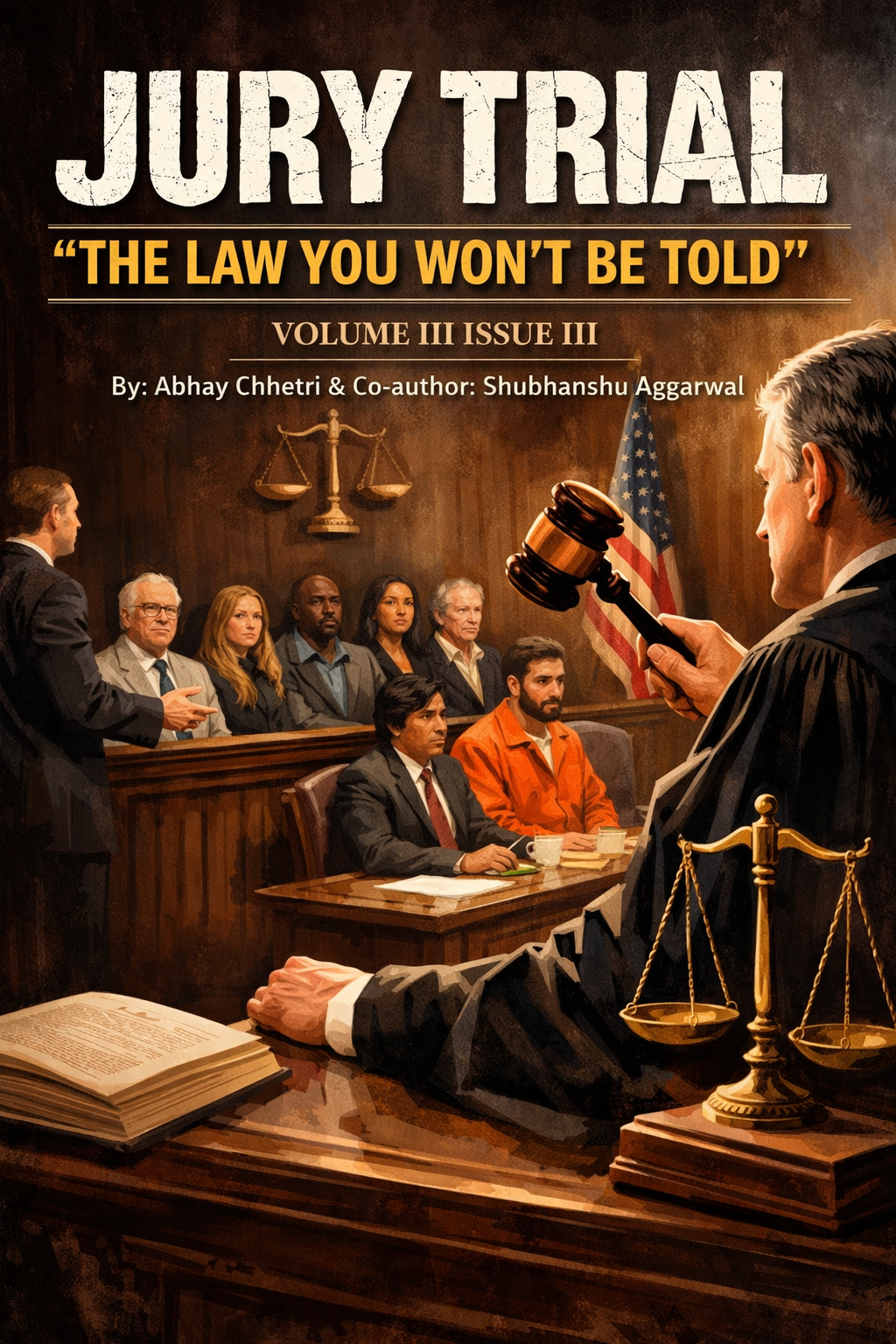
A Jury or a Trial by a Jury is a lawful proceedings in which a Jury makes a decision or finding of facts. In a Trial by jury there are a group of persons called “Jurors”. In a Jury trial the case is decided on the vote by the jurors as this system believes in ensuring equal participation of society. Jury trials are mostly used in serious criminal offences.
In this topic I have given a detailed study on the Jury System along with its types and discussing the powers obtained by a Juror. Along With this I have discussed various advantages and disadvantages of Jury Trial and how Jury came into force in India,its evolution and abolition.This study has also considered the case K.M. Nanavati VS State Of Maharashtra (1959) as this particular case has been a backbone and a change in the Jury system in India and at last I have a conclusion with my honest opinion on Jury Trial in India.
INTRODUCTION
A Jury or a Trial by a Jury is a lawful proceedings in which a Jury makes a decision or finding of facts.It is distinguished from bench trial in which a Judge or a panel of judges makes all decisions. But in a Trial by jury there are a group of persons called “Jurors”. In a Jury trial the case is decided on the vote by the jurors as this system believes in ensuring equal participation of society. Jury trials are mostly used in serious criminal offences. It first originated in the 8th century in Wales. The trial consisted of 12 Jurors. By the 12th century it was commenced in the whole of the United Kingdom Later on by the 18th century it was commenced in countries with common laws.
However with the spread of British colonial rule, this system of Jury Trial was enforced in India by 16th century.The first Jury Trial was put in 1665 in Madras.As this system seems to be affected by the sentiments of the society rather than relying on law and order it was demolished in a country with low literacy rate. The last Jury trial in India was conducted in a leading case of K.M. nanavati v. State Of Maharashtra (1959).
*Jury Trials are abolished in all courts of India except matrimonial disputes of Parsis,which is still enforced today.
OBJECTIVE OF THE STUDY
- Types of Jury Trial
- Power of Jury Trial
- Criteria of selection of “Juror”
- Advantages and Disadvantages of Jury Trial
- Journey of Jury Trial in India
- Case K.M. Nanavati VS State Of Maharashtra (1959)
- Conclusion
TYPES OF JURY TRIAL
There are mainly two types of Jury Trial: A.Grand Jury B.Petit Jury
A.Grand Jury : A Grand Jury is a group of citizens of a country who are empowered by the law. to conduct legal proceedings,investigate potential criminal conduct and determine whether criminal charges should be brought. Grand Jury does not determine guilt. A Grand Jury is physical evidence or a person to testify. It is separate from court which do not presides over its functioning, Moreover Grand Jury determines the portable cause of offence on the basis of legal proceedings,potential investigation and decide whether the case should go for trial.Grand jury is not a matter of public record which means general public can not become part of the trial.Moreover the Defendant and their attorneys do not have right to appear before the Grand Jury.
The function of a Grand Jury is to accuse a person who is guilty for offence. Traditionally Grand Jury consist of 16-23 members, The mode of acquisition is by written statement of two types.
- In solemn form describing the offence with accompaniments of time along with proper circumstances and certainty of act and person or,
- By less formal mode which is usually a spontaneous act of the Grand Jury,called Presentment.
No Presentment can be made unless at least 12 Jurors are required. It may be accused upon their own knowledge,but it is generally done upon testimony of witnesses under oath and other evidence heard before them.
However, in countries where Grand Jury does not operate,The judges are obliged to determine the portable cause and decide whether the case shall go for trial or not.
*India does not operate on Grand Jury as Judges decide the proceedings related to the case and decide if the case shall be put in trial.
B.Petit Jury:In common law a Petit Jury also called “Trial Jury”hears the evidence in the trial as presented by both Plaintiff and the Defendant.After hearing evidence and often hearing instruction form judge, the group retires for deliberation,to consider a verdict.The majority required for verdict varies.In some case it must be unanimous,while in other jurisdiction it may be majority.A jury that is unable to come to a verdict is referred to as “Hung Jury”.
“When in a Jury panel there are an even number of jury and the majority of vote is equal on both sides and the jury may not come to a verdict this is known as Hung Jury”.
A number of countries that are not in English Common Law Tradition have Quasi-Jury on which lay judges or jurors and professional judges deliberate together regarding criminal cases.
However, the common law Trial Jury is the most common type of Jury system.
In simple words:
Petit Jury, also called Trial Jury, which decides whether the defendant has committed the offence as charged in the criminal case, or whether the defendant injured the plaintiff in a civil case.
- Consist of 6-12 members.
- Trials are generally public which means it is the matter of public record and the general public is allowed to become part of trial,but Jury deliberations are private.
- Defendant has the right to appear,testify and call witness on his behalf.
- Final outcome is a verdict,in the favour of the plaintiff or defendant in a civil case,or guilty/not guilty in a criminal case.
In civil cases many trial require fewer than twelve Jurors.Juries are almost never used in civil cases outside the United States and Canada.Other states with common law traditions some time use them in defamation case, in cases involving a governmental eminent domain power,and in case involving alleged wrongful conviction.Civil Juries are available in United States and Canada in almost all cases where the only remedy sought is money damages.
POWER OF JURY TRIAL
With the pretext to the above context we can clearly see that Jury does not have much power, rather their work is to conduct legal proceedings,conduct potential investigations and determine whether criminal charges should be brought or not.
They do not have power to punish the guilty.
Whereas judges are bound by law and according to law if the accused is guilty they have to punish the accused for offence.On the other hand Jury members are not bound by law,which means even if it occurs to the Jury that accused is guilty according to the law,They may choose to acquit the on the basis of law seems to be unjust.
This is known as “Jully Nullification or Perverse Verdict”.
Therefore limited to determining guilt of accused and deciding whether the accused is guilty or not, Juries obtain power under “Jury Nullification”.Some powers of jury are:
1.Jury has a right to determine the law as well as the facts in controversy.
2.”A right of jury trial is granted to criminal defendants in order to prevent oppression by the government.”
3.The Jury’s exercises of it’s prerogative to disregard evidence and instructions of the judge.
The truth is that Jury’s have more power than police,lawyers,judge,legislators and even more than president but courts shall not tell about the power of jury,In fact they’ll punish any attorney who tries to tell powers of Jury in courtroom and also judge can dismissed any Jury who tells other about jury power even though it’s been legal. So, a jury possesses very limited power as compared to the work performed by them.
CRITERA FOR SELECTION OF JUROR
The process of selection of a juror in any country is not very complicated. The selection of a juror has limited steps to follow,But before understanding the criteria for selection of a Juror lets understand who is a “Juror”.
Whenever there is a serious offence in any country and the Jury Trial is concern,It requires set of person who represent on behalf of the country to decide whether the accused should be guilty or not as per the proceedings and potential investigation.These members are called “Jurors” who are part of a Jury Trial. Traditionally a Trial By Jury consists of members between 12-23 depending upon the seriousness of the case. And once the trial is conducted they are discharged off their duty.
Moreover,whenever there is any Jury Trial in a district theVoter-ID and Driving License of the Juror of that particular district is collected and then based on that potential Jurors are selected.
Common criteria for selection of a Juror are as follows:
1.The Juror should be a citizen of that very country where the Jury Trial is conducted.
2.Juror should attain the age of majority.
3.Juror should be capable of reading,writing and understanding the official language of the country.
4.Juror should not be involved or personally convicted for any crime in previous records.
These are basic requirements on the basis of which a Juror is selected for a particular Trial by Jury. Besides this Jury Trial also allows normal citizens to become part of the Jury,but deliberations are conducted in private. All those who are selected from the general public are issued summons from court and those who are willing to be a part of Jury Trial are personally called in court by the process of “Voir Dire” , which means to speak the truth. Voir Dire is a process of selection of potential Jurors for the purpose of trial amongst the general public.Selected public are issued with 14 days notice and are represented in court,they are asked questions by the attorney and judge so as to know there capable of being jury or not.Once they pass there is a Jury form which is to be filled by them and then they become Juror to that particular trial and once the Trial By Jury is concluded they get discharged of their duty.
*Jury trials are mostly operated in serious criminal offences except in canada and a part of United states where Jury Trial are conducted in both criminal and civil offneces.Inindia Jury was applicable for only serious offence.
ADVANTAGES AND DISADVANTAGES
Following are the advantages and disadvantages of a Jury trial:
Advantages
- New perspective of every Juror..
- Reduce chance of judge nexus.
- Ensures participation of society.
- Verdict is conducted through democrtaic votes.
NEW PERSPECTIVE OF EVERY JUROR
A Jury Trial gives a better perspective to a case as compared to bench trial as in a Bench Trial the only perspective is of a judge whereas in a Jury Trial there are a number of members deciding upon a case thus leading to better perspective towards the conduct of a case.
REDUCES CHANCES OF JUDGE NEXUS
Jury Trial reduces the chance of judge nexus which means in a Trial Bench it is possible for a judge to have relationship with the lawyer or the accused but in a Jury Trial the members are selected randomly which minimises the chance of involvement with judge or the accused,thus encouraging fear judgement.
ENSURES PARTICIPATION OF SOCIETY
Jury Trials have participation of the general public which leads to equal participation of society thus creating a thus creating liberalism in a society. Jury Trials are highly applicable in countries with good literacy rates, but with the literacy rate of India these trials shall not be recommended and thus were demolished.
VERDICT IS CONDUCTED THROUGH DEMOCRATIC VOTE
A Jury Trial is a democratic process. Thus deciding the accused to be guilty or not is decided by the democratic votes of members of the Jury Trial, encouraging equal rights and responsibilities of the general public. It can be said to be a medium of building democracy in a country with a goal of conducting verdict by the people of the country, thus enhancing peace and harmony within a country.
DISADVANTAGES
- Affected by media and public reports.
- More influenced by sentiments than law.
- Prolongst and time consuming process.
- Can be operated only in high literacy.
AFFECTED BY MEDIA AND PUBLIC REPORTS
Jurors sometimes are affected by the views and reports of the media and in some serious offences due to high pressure of society and media on Juror the Jury trial does not come to its verdict due to misleading of votes thus creating a trauma in society. Media plays a highly affected role in a Jury Trial and in a country like India where media highly affects views and decision of the public these trials are not meant to be conducted and thus were demolished.
MORE INFLUENCED BY SENTIMENTS THAN LAW
Jury Trials are most of the time conducted with wrong judgements as different members have different thoughts and most of the time the case is verdict on the sentiments rather than in a lawful manner. As Jurors are not bound by law even if the accused is guilty they can acquit the accused by just making the law unjust leading to misconception and wrong judgement of trial.
PROLONGED AND TIME CONSUMING
Jury Trial is a very time consuming process.As to the fact that the case is decided upon the majority of votes by the member of Jury Trial, each vote counts and each Juror has right to vote, thus leading to prolonged time in trial and conduct of verdict. As it is a very time consuming process the Jury Trial also becomes a very expensive process.So it can be said that Jury Trial is a prolonged and time consuming process with maximum expenses.
OPERATE ONLY IN HIGH LITERACY
Jury Trial can only be operated in country with high literacy rate, as in Jury Trial members from general public becomes Juror it is important for them to know the law and orders and should have knowledge on the trial or the case they are involved in.As Jury Trial is highly affected by sentiments and media as discussed above, it is very important to have knowledgeable members on Jury Trial. So with country with low literacy rate Jury Trial can only be operated in country with high literacy rate, as in Jury Trial members from general public becomes Juror it is important for them to know the law and orders and should have knowledge on the trial or the case they are involved in.As Jury Trial is highly affected by sentiments and media as discussed above, it is very important to have knowledgeable members on Jury Trial.judgement of trial and moreover discouraging the smooth functioning of conduct of verdict.
JOURNEY OF JURY TRIAL IN INDIA
The first Jury Trial was conducted in India in Madras in 1665 for which a British women was charged by Grand Jury, for murder of her slave girl, and Petit jury with Six Portugese and Six Englishmen fond her not guilty.With the passage time and development of East India Company empire in India the Jury system was implemented as dual system of courts.In presidency towns(Calcutta,Madras and Bombay) there were crown Juries and in criminal cases the Juries had o judge European and English people and in some case Indian people as well,and in territory outside the presidency house(called Muffossil) there were companies courts without Jury to judge most of the cases implying indogenous people.
So this is how the journey of Jury slowly and steadily came to India and got revolutionised with the development in empire of the East India Company and slowly started to operate in India.
Jury Trials were abolished in Indian courts by the 1973 Code Of Criminal Procedure. K.M. Nanavati VS State Of Maharashtra (1959) was the last case of Jury Trial conducted in India.West Bengal has Jury Trial till 1973.Indian Constitution founded no place for Jury by 1950 and it was ignored by many Indian states.In 1958,abolition of Jury was recommended by Law Commision. It has Been claimed that substantial acquittal in the case K.M. Nanavati VS State Of Maharashtra (1959) played a significant role in influencing the abolition of Jury in India.
*However Jury Trials are abolished in all courts of India except matrimonial disputes of Parsis,which is still enforced today.
K.M. NANAVATI VS STATE OF MAHARASHTRA (1959)
INTRODUCTION
Commander K.M. Nanavati VS State Of Maharashtra was a 1959 Indian court where the commander Kawas ManekshawNanavati, a Naval Commander, was tried for the murder of Prem Ahuja,his wife lover.
Commander Nanavati, accused under section 302 ,was initially declared not guilty by a Jury,but the verdict was dismissed by the Bombay High Court and the case was retired as a bench trial.This was not last Jury trial in India but as It has Been claimed that substantial acquittal in the case K.M. Nanavati VS State Of Maharashtra (1959) played a significant role in influencing the abolition of Jury in India it is considered as las Jury Trial in India.Although West Bengal had Jury Trial as late as 1973.Jury Trials were abolished in most of the courts of India except matrimonial disputes of Parsis,which is still enforced today.
Nanavati was finally pardoned by VijyalakshmiPandit,newly appointed governor of Maharashtra and sister of Prime Minister Jawaharlal Nehru.
The incident involved unprecedented media coverage and inspired many books and films such as the 1973 film Achanak,the 2016 film Rustom and the 2019 web series The Verdict.
FACTS
Kawas ManekshawNanavati(1925-2003) a Parsi, was a Commander with the Indian Naval and had settled down in Bombay with Sylvia, his english-born wife and their two sons and a daughter.
With Nanavati frequently away on assignments for long periods of time,Sylvia fell in love with Prem Bhagwan Ahuja, a Sindhi friend of Nanavati’s.
In her testimony in court, Prem’s sister Mamie Ahuja,sated that Prem had agreed to marry Sylvia,provided she divorced her husband.However, this was the first contradicted letter written by Sylvia(admitted as Sylvia’s testimony), where she expressed her desire to divorced Nanavati and marry Prem,but she doubted whether Prem had the same intentions. In a letter she wrote”last night when you spoke of your marrying me and the various girls you might marry,something inside me snapped and I knew I could not bear the thought of your loving someone else”.
After coming to know the awful relationship of Sylvia with Prem ahuja,K.MNanavati decided to settle the matter with Ahuja.He dropped his wife and children to cinema and drove to his ship,where he took a revolver on a false pretext.Then he drove to Prem Ahuja’s office.On not finding him there, he went to his house were murder took place.After shooting, the acused(K.M. Nanavati) went to the police station and surrendered himself.
JURY TRIAL
The crux of the case was whether Nanavatishooted Ahuja in the “heat of the moment” or whether it was a premeditated murder.In the former scenario,Nanavati would have been charged under the Indian Penal Code for Culpable Homicide,with maximum punishment of 10 years.This is because he could have invoked exceptions 1 and 4 of section 300 of IPC(which defines murder).
Exception 1 states:-
Culpable homicide is not murder if the offender,whilst deprived of power of self control by grave and sudden provocation, causes the death of the person who gave the provocation or causes death of any person by mistake or accident.
Exception 4 states:-
Culpable homicide is not murder if its commited without premeditation in the sudden fight in heat of the passion upon a sudden quarrel and without the offender having faken undue advantage or acted in a cruel or unusual manner.
Explanation-It is immaterial in such cases which party offers the provocation or commits the first assault.
THE QUESTION INVOLVED
- Whether Nanavati shot Ahuja in the “heat of the moment” or whether it was a premeditated murder.
- In former scenario,Nanavati would be charged under section 304 part1,IPC for culpable homicide not amounting to murder invoking Exception 1 of section 300 of IPC.
- In the later scenario Nanavati would be charged under section 300(murder),with the sentence being death or lfieimprosonment.
JUDGMENT OF JURY TRIAL
The Jury in the Bombay Sessions court pronounced Nanavati as not guilty with an 8-1 verdict. Hon’ble RatilalBhaichandMehta(the session judge) considered the acquittal as perverse and referred the case to High Court.
HIGH COURT VERDICT
The High Court dismissed the Jury’s verdict on the basis of the following arguments made by the Prosecutor.
- The onus of proving that it was an accident and not premeditated murder was on Nanavati.
- Sylvia’s confession or any specific incident in Ahuja’s bedroom, or both did not amount to grave and sudden provocation.
- The judge wrongly told the jury that the provocation can also come from third person.
- The Jury was instructed that Nanavati’s defense had to be proved, to the extent that there is no reasonable doubt in the mind of a reasonable person.
The High Court agreed with the Prosecution’s argument that the murder was premeditated and sentenced Nanavati to life improsnment for culpable homicide amounting to murder. ON 24 November 1961,the Supreme Court Of India upheld the conviction.
SUPREME COURT VERDICT
The Supreme Court upheld the decision of the High Court on the following grounds:-
- As per the defence case, the accused was thinking of the future of his wife and children which indicates that he had not only regained his senses but also was planning for the future
- The time lapse between the confession and murder was sufficient to regain his self control, so it was not a matter of sudden provocation.
- The mere fact that before shooting the accused abused the deceased and the abuse provoked an equaliy abusive reply could not conceivebly be provocation of the murder.
IMPACT
- substantial acquittal in the case K.M. Nanavati VS State Of Maharashtra (1959) played a significant role in influencing the abolition of Jury in India.
- There was media scrutiny which brought about Nanavati as a victim of foul play, who even in worst hours stood for the honor and well being of his family.
- Nanavati was pardoned by the Governor of Maharshtra Vijay Lakshmi Pandit,after spending 3 years in jail.
So this is how the case K.M. NANAVATI VS STATE OF MAHARASHTRA (1959) highly impacted the Jury system in India thus played a significant role in influencing the abolition of Jury in India.
CONCLUSION
Jury Trial has a important role in framing the law and order of a country.It has various pros in the view which frames that such Trial system is good to
Maintain a democratic environment in a society and empower federalism within a country.
But with the above study we came to the conclusion that these types of Trial were never applicable in India and will not be successful in present time as well.Jury Trial is a very sensitive system of law which can not be applied to countries like India with low literacy rate.Jurors sometimes are affected by the views and reports of the media and in some serious offences due to high pressure of society and media on Juror the Jury trial does not come to its verdict due to misleading of votes thus creating a trauma in society moreover,
Jury Trials are most of the time conducted with wrong judgements as different members have different thoughts and most of the time the case is verdict on the sentiments rather than in a lawful manner. As Jurors are not bound by law even if the accused is guilty they can acquit the accused by just making the law unjust leading to misconception and wrong judgement of trial.Also Jury Trial can only be operated in country with high literacy rate, as in Jury Trial members from general public becomes Juror it is important for them to know the law and orders and should have knowledge on the trial or the case they are involved in.As Jury Trial is highly affected by sentiments and media as discussed above, it is very important to have knowledgeable members on Jury Trial.
So by the above study It can be considered that such type of Trial are not comfortably applicable in India.
REFERENCES: