

MOAZZAM
DAKSH HADA[1]
ABSTRACT
The question of refugees has emerged as a significant humanitarian and legal challenge at national, regional, and global levels. India, being the largest democracy in the world, has historically received a substantial number of refugees from neighbouring countries due to factors such as political turmoil, armed conflicts, ethnic persecution, and economic instability. Despite hosting one of the largest refugee populations in South Asia, India has neither acceded to the 1951 United Nations Refugee Convention nor its 1967 Protocol. Furthermore, the country lacks a comprehensive and specific domestic legislation that exclusively governs refugee protection and asylum procedures.
In the absence of a dedicated legal framework, the treatment of refugees in India is primarily shaped by executive policies, administrative discretion, and judicial interpretations. Indian courts, particularly the Supreme Court, have played a crucial role in safeguarding refugee rights through progressive rulings based on constitutional principles. Article 21 of the Indian Constitution, which guarantees the right to life and personal liberty, has been interpreted to apply to all persons within Indian territory, including non-citizens such as refugees and asylum seekers.
India also adheres to the customary international law principle of non-refoulement, which prohibits the forced return of individuals to territories where they may face persecution, torture, or threats to their lives. Although India is not formally bound by the Refugee Convention, its commitment to this principle reflects a humanitarian approach in practice. Additionally, India is a signatory to several international human rights treaties, including the International Covenant on Civil and Political Rights (ICCPR) and the Convention on the Rights of the Child (CRC), which impose indirect obligations to protect the fundamental rights of refugees, particularly women and children.
However, the lack of a uniform national refugee policy has resulted in inconsistent treatment across different refugee groups. Protection often depends on political, diplomatic, and strategic considerations rather than purely humanitarian concerns. The United Nations High Commissioner for Refugees (UNHCR) operates in India but its mandate is largely restricted to urban refugees, leaving many vulnerable populations without adequate access to healthcare, education, employment, and legal assistance. This highlights the urgent need for a comprehensive refugee law in India.
Keywords: Refugees in India, Refugee Law, Non-refoulement, 1951 Refugee Convention, 1967 Protocol, Article 21 of the Indian Constitution, Asylum Seekers, Legal Protection
INTRODUCTION
India, with a population exceeding 1.4 billion, continues to be a host country for a large number of refugees fleeing conflict, persecution, and human rights violations in neighbouring states. Despite its own socioeconomic challenges such as millions living below the poverty lineIndia has provided shelter to more than 456,000 refugees and asylum seekers, primarily from Sri Lanka, China (Tibet), Myanmar, Afghanistan, Bhutan, and Nepal[2]. These individuals often flee their homelands due to civil wars, religious or ethnic persecution, and systemic political oppression.
However, India does not have a uniform national law that specifically governs refugees. It is neither a signatory to the 1951 United Nations Refugee Convention nor its 1967 Protocol, which form the cornerstone of international refugee protection[3]. Instead, the legal status of refugees in India is governed by outdated and generalized legislation like the Foreigners Act, 1946, which fails to even define the term “refugee”[4]. Refugees are legally categorized under the broad term “foreigners,” leading to inconsistent and discretionary treatment based on political and diplomatic considerations.
Over the years, various bodies such as the National Human Rights Commission (NHRC) have called for comprehensive legal reform. In 1997, a commission chaired by former Chief Justice P.N. Bhagwati proposed a “Model Law” that clearly defined the term “refugee” and aimed to standardize refugee protection. However, successive effortsincluding refugee protection bills tabled in 1997, 2006, and 2015have been rejected, often on grounds of national security and political feasibility[5].
Despite India’s non-signatory status to the Refugee Convention, it is a party to various international human rights instruments such as the Universal Declaration of Human Rights (1948), International Covenant on Civil and Political Rights (1966), and the Convention on the Elimination of Discrimination Against Women (1979), which impose moral and legal obligations to protect vulnerable populations. India is also a member of the UNHCR Executive Committee, which supervises international efforts to assist and protect refugees. Still, the role of UNHCR within India remains restricted, often only applying to urban refugee populations.
To fully understand and address the issue of refugees in India, it is essential to distinguish between refugees, asylum seekers, internally displaced persons (IDPs), and migrants. Refugees and asylum seekers are individuals who have fled their home country due to a well-founded fear of persecution and cannot return[6], while internally displaced persons face similar threats but remain within their own country’s borders. Migrants, on the other hand, move primarily for economic reasons and retain the protection of their home state.
HISTORY OF REFUGEES
- Definition of a Refugee
A refugee is a person who is forced to leave their home country due to a well-founded fear of persecution or serious threat to their life, freedom, or safety. Unlike migrants, who move voluntarily (for jobs, education, etc.), refugees do not have a choice they flee because staying could cost them their lives.
- Legal Definition (1951 UN Refugee Convention)
The most widely accepted definition comes from the 1951 United Nations Convention Relating to the Status of Refugees, which states:
“A refugee is a person who, owing to a well-founded fear of being persecuted for reasons of race, religion, nationality, membership of a particular social group, or political opinion, is outside the country of their nationality and is unable or unwilling to return to it.”
This definition was later expanded by the 1967 Protocol to cover people from all over the world, not just those affected by World War II.
- Key Elements of Being a Refugee
- Refugees are not leaving by choice. Their home is no longer safe due to violence, war, or persecution.
B. Crossing an International Border
- A person becomes a refugee only after leaving their country. If someone is displaced within their own country, they are called an Internally Displaced Person (IDP).
C. Fear of Persecution
- The person must have a genuine fear of being persecuted for:
- Race
- Religion
- Nationality
- Political Opinion
- Belonging to a particular social group (e.g., LGBTQ+, ethnic minorities)
D. Unable to Return Home
- Refugees cannot return home unless the situation improves and it becomes safe again. Until then, they need international protection.
- Ancient to Medieval Times: The Early History of Refugees
The concept of people being forced to leave their homes and seek safety elsewhere has existed since the beginning of human civilization. Although the modern term “refugee” was not used in ancient or medieval times, the experience of displacement leaving one’s homeland due to danger was a common part of life throughout history.
In ancient times, war, invasions, famine, and oppression often forced people to migrate. For example, during the time of ancient Egypt, Mesopotamia, and Rome, entire communities fled when their lands were attacked or taken over by stronger empires. People often sought safety in nearby regions or kingdoms where they could avoid violence or enslavement. Religious texts such as the Bible also mention stories of people fleeing persecution or hunger, like the Israelites moving to Egypt during a famine. These early stories show that the search for safety and a better life has always been a human need.
Some ancient cultures even developed early forms of protection for those fleeing danger. In ancient Greece, for example, temples were often considered places of asylum, where people could seek shelter if they were running from enemies or unfair punishment. Similarly, in Rome, there were certain legal protections for foreigners and people seeking refuge, though they were limited and not part of any formal international system.
As the world entered the medieval period (roughly 5th to 15th century AD), religious persecution became a more prominent reason for displacement. People who did not follow the dominant religion were often forced to convert, leave their homes, or face punishment. For instance, Jews and Muslims in medieval Christian Europe were frequently targeted. Jews were expelled from countries like England in 1290, France in 1306, and Spain in 1492, which led to large-scale refugee movements. Many of them found refuge in more tolerant regions like Poland or the Ottoman Empire.
The Crusades a series of religious wars between Christians and Muslims also created a refugee crisis, as many civilians were caught in the conflict and had to flee for safety. Likewise, the Mongol invasions of Central Asia and Eastern Europe in the 13th century caused massive destruction and led to the forced migration of countless people who were trying to escape war, looting, and death.
During these ancient and medieval periods, there was no international law or organization to help displaced people. The protection of refugees depended largely on the generosity of local rulers, religious leaders, or communities. Some rulers welcomed refugees to increase their population or benefit from their skills and trade. Others were less welcoming, and refugees were often left in a vulnerable and insecure position.
- Refugees in the Early Modern Period
The early modern period, which roughly spans from the 15th to the 18th century, was a time of major political, religious, and economic changes around the world. These changes led to new waves of migration and displacement, and many people were forced to flee their homes to escape war, religious persecution, and colonial violence. While international refugee laws still did not exist during this period, the experiences of displaced people became more widespread and more visible across continents.
One of the main causes of refugee movements during this time was religious conflict. After the Protestant Reformation began in the early 16th century in Europe, deep divisions appeared between Catholics and Protestants. These religious tensions often turned violent and led to widespread persecution. Many Protestants were forced to flee Catholic-majority regions, and vice versa. For example, the Huguenots, a group of French Protestants, were persecuted by the Catholic monarchy in France and were forced to flee to countries like England, the Netherlands, Germany, and Switzerland in the late 16th and 17th centuries.
Similarly, the Thirty Years’ War (1618–1648), one of Europe’s deadliest conflicts, had both religious and political causes. This war caused widespread destruction in Central Europe, especially in the German-speaking regions, and displaced millions of people. Towns were burned, crops were destroyed, and civilians were either killed or forced to migrate to survive. Many people became refugees within Europe or migrated to safer areas under more tolerant rulers.
Outside Europe, the rise of colonial empires also contributed to refugee movements. European powers such as Spain, Portugal, Britain, France, and the Netherlands expanded into the Americas, Africa, and Asia. This led to the forced displacement of many local populations. In some cases, indigenous peoples were forced off their lands due to colonization, slavery, and violence. In other cases, religious minorities or local groups sought protection under colonial rulers in exchange for loyalty or service.
One of the most tragic forms of forced migration in this period was the transatlantic slave trade. Although enslaved people are not technically classified as “refugees” because they were forcibly taken and not fleeing voluntarily, their suffering and displacement were massive. Millions of Africans were taken from their homelands and shipped to the Americas under brutal conditions. While they were not seeking refuge, their story is a major part of global displacement history.
In the Ottoman Empire, which was more tolerant toward religious minorities than many Christian kingdoms at the time, refugees from Europe especially Jews expelled from Spain and Portugal were welcomed. These Jewish communities were allowed to settle in cities like Istanbul, Salonica (now Thessaloniki), and Smyrna (now Izmir), where they contributed to trade, education, and culture.
Though there were no international laws or refugee organizations during the early modern period, some rulers and states began to develop policies to accept or reject displaced populations based on their political or religious interests.
- 20th Century: Crisis Becomes a Global Issue
The 20th century was a turning point in the history of refugees. For the first time in history, the refugee crisis became a global issue, affecting millions of people across continents. Wars, revolutions, genocide, and the collapse of empires forced people to flee their homes on an unprecedented scale. This period also marked the beginning of international efforts to protect refugees through laws, organizations, and treaties.
- World Wars and Mass Displacement
The First World War (1914-1918) caused large-scale displacement, especially in Europe. The collapse of major empires like the Ottoman Empire, Russian Empire, and Austro-Hungarian Empire led to the redrawing of borders and the creation of new states. Millions of people were caught in the middle of this political chaos. For example, Armenians fled from the Ottoman Empire during and after the Armenian Genocide (1915-1917), and many Russians fled the country after the Russian Revolution of 1917.
In response to these crises, the League of Nations, formed after World War I, created the position of a High Commissioner for Refugees in 1921. This was one of the first international attempts to offer aid and legal protection to displaced people.
However, the situation worsened during and after the Second World War (1939-1945). This war caused the largest refugee crisis the world had ever seen. Over 60 million people were displaced, including Jews fleeing the Holocaust, civilians escaping from Nazi-occupied territories, and people caught between advancing armies. After the war, Europe was filled with Displaced Persons (DPs) people who had lost their homes, families, and communities.
The horror of the Holocaust, in which 6 million Jews were murdered by the Nazi regime, shocked the world and highlighted the need for a permanent international system to protect people fleeing persecution. This led to major changes in how the world approached the refugee issue.
- Creation of the UNHCR and the 1951 Refugee Convention
In 1950, the United Nations established the United Nations High Commissioner for Refugees (UNHCR) to provide international protection and support for refugees. The following year, the 1951 Refugee Convention was adopted. This became the cornerstone of modern refugee law, defining who a refugee is and outlining the rights and responsibilities of both refugees and the countries that host them.
Originally, the Convention was limited to refugees in Europe after World War II, but it was later expanded by the 1967 Protocol, which made its protections applicable worldwide. The Convention introduced the principle of non-refoulement, which means that no refugee should be returned to a country where their life or freedom would be at risk.
- Post-War Conflicts and Cold War Refugees
The second half of the 20th century saw many new refugee crises driven by colonial independence struggles, civil wars, and the Cold War. Millions fled during the Partition of India in 1947, which caused the largest mass migration in history, with over 14 million people displaced between India and Pakistan.
Similarly, decolonization in Africa and Asia led to multiple refugee movements. Conflicts in places like Vietnam, Cambodia, Palestine, Bangladesh, Uganda, Ethiopia, and Afghanistan forced millions to flee. During the Cold War, many people fleeing communist regimes such as in Eastern Europe, Cuba, or Vietnam were granted asylum in Western countries as a part of the ideological struggle between the East and the West.
- Globalization of the Refugee Issue
By the 1980s and 1990s, the refugee issue was no longer seen as limited to Europe or the aftermath of world wars. It became truly global, with refugee movements in Latin America, the Middle East, Africa, and Asia drawing international attention. Media coverage, international diplomacy, and human rights organizations helped bring refugee stories to the global stage. The UNHCR became one of the most important humanitarian agencies in the world, coordinating relief efforts, managing refugee camps, and working on long-term resettlement programs.
- Cold War Era: Refugees Between Two Powers
The Cold War era (from the late 1940s to the early 1990s) was a time of intense political rivalry between the United States and its allies on one side, and the Soviet Union and its allies on the other. Although there was no direct war between the two superpowers, the world was divided into two major ideological camps: capitalism (led by the US) and communism (led by the USSR). This global tension influenced almost every aspect of life including the movement of refugees.
During this period, millions of people around the world were forced to flee their countries due to political persecution, civil wars, military coups, and ideological suppression. Unlike earlier times when refugees were mainly victims of world wars or religious conflicts, many Cold War-era refugees were people escaping authoritarian regimes, proxy wars, or violent revolutions tied to the global struggle between communism and capitalism.
One major pattern during the Cold War was the flow of refugees from communist countries to capitalist countries. These included:
- Eastern Europe: After World War II, countries like Poland, Hungary, Czechoslovakia, East Germany, and Romania fell under Soviet control. Many people fled these countries to escape oppressive governments, lack of freedom, and fear of imprisonment. A famous example was the Berlin Wall, built in 1961 by East Germany to stop people from fleeing to the democratic West Berlin. Still, many risked their lives trying to escape.
- Hungarian Revolution (1956): When Hungary attempted to overthrow Soviet control, the uprising was crushed by Soviet tanks. Around 200,000 Hungarians fled the country, most of them settling in Austria, the US, and other Western nations.
- Czechoslovakia (1968): During the “Prague Spring,” the Czechoslovak people pushed for democratic reforms, but the movement was violently suppressed by the USSR. Thousands fled the country, fearing retaliation.
- Cuba: After the 1959 Cuban Revolution led by Fidel Castro, many Cubans especially those opposed to the new communist government fled to the United States. This included both wealthy families and political dissidents.
The Cold War was also marked by proxy wars, where the superpowers supported opposing sides in local conflicts. These wars caused large-scale displacement:
- Vietnam War (1955-1975): The war between communist North Vietnam (backed by the USSR and China) and South Vietnam (backed by the US) led to a massive refugee crisis. After the fall of Saigon in 1975, over 1.5 million Vietnamese fled their country—many became known as “boat people” because they escaped by sea under dangerous conditions. Countries like the US, Canada, Australia, and France accepted large numbers of Vietnamese refugees.
- Afghanistan (1979-1989): When the Soviet Union invaded Afghanistan to support a communist government, it triggered a brutal war with resistance fighters known as the Mujahideen (backed by the US and its allies). Millions of Afghans fled to neighbouring Pakistan and Iran, making it one of the world’s largest refugee crises at the time.
- Africa and Latin America: Civil wars and military coups often influenced by Cold War politics also created refugees in places like Ethiopia, Angola, Mozambique, Nicaragua, and El Salvador. People were caught between government forces and rebel groups, often with weapons and support provided by the US or USSR.
- Post-Cold War to Present Day: A New Era of Global Refugee Crises
The post-Cold War era, which began in the early 1990s after the collapse of the Soviet Union, brought hope for peace and global cooperation. However, this period also witnessed new kinds of conflicts, ethnic violence, civil wars, and climate-related disasters that led to widespread displacement. As a result, the refugee crisis not only continuedit expanded in scale and complexity. In this new global landscape, the causes of forced migration became more diverse, and the need for international protection grew even more urgent.
- Refugees in the 1990s: Ethnic Conflicts and Civil Wars
After the Cold War ended, many long-suppressed ethnic, religious, and political tensions surfaced, especially in regions where powerful regimes had previously controlled diverse populations.
- Yugoslavia (1990s): The breakup of the Socialist Federal Republic of Yugoslavia led to a series of brutal civil wars in Bosnia, Croatia, and Kosovo. These wars were marked by ethnic cleansing, mass killings, and forced displacement. Over 4 million people were forced to flee, either becoming refugees in neighbouring countries or internally displaced within the region.
- Rwanda (1994): One of the most horrifying events of the decade was the Rwandan genocide, where nearly 800,000 Tutsis and moderate Hutus were killed in just 100 days. The violence forced millions to flee to nearby countries like Zaire (now the Democratic Republic of the Congo), Uganda, and Tanzania, creating a humanitarian emergency.
- Sudan: Civil wars in Sudanincluding the Darfur conflict and the Second Sudanese Civil Wardisplaced millions. Ethnic and religious divisions were central to these conflicts, and massive refugee populations fled to neighbouring countries or lived in refugee camps for decades.
- 21st Century: The Refugee Crisis Becomes a Permanent Challenge
As we moved into the 21st century, the refugee crisis took on new dimensions, shaped by modern warfare, terrorism, climate change, and even pandemics.
Major Refugee Crises of the 21st Century:
- Iraq (2003-present): The U.S.led invasion of Iraq and the collapse of Saddam Hussein’s regime led to years of instability and sectarian violence. Millions of Iraqis were displaced both within the country and abroad.
- Syria (2011-present): The Syrian civil war became one of the worst humanitarian crises in modern history. The conflict, which began as peaceful protests, escalated into a brutal war involving the Syrian government, rebel forces, ISIS, and foreign powers. Over 13 million Syrians have been displaced—more than half the country’s population. Many fled to Turkey, Lebanon, Jordan, and Europe.
- Afghanistan: Decades of conflictfrom Soviet occupation to Taliban rule and U.S. interventionhave made Afghanistan one of the largest sources of refugees. The Taliban’s return to power in 2021 triggered another wave of people fleeing for their lives, especially women, activists, and minority communities.
- Myanmar (Rohingya Crisis): In 2017, over 700,000 Rohingya Muslims fled from Myanmar (Burma) to Bangladesh following a violent military crackdown. The United Nations described it as a textbook example of ethnic cleansing.
REFUGEES IN INDIA
India has a long history of hosting refugees, despite not being a signatory to the 1951 UN Refugee Convention or its 1967 Protocol. The country also lacks a specific domestic refugee law. As a result, refugees in India are often treated as “foreigners” under the Foreigners Act, 1946, and their status is governed more by executive discretion than codified legal protections.
Nevertheless, India has traditionally provided shelter to refugees fleeing persecution, war, or ethnic violence from neighbouring and other countries. These include people from Tibet, Bangladesh (during the 1971 war), Sri Lanka (Tamil refugees), Afghanistan, Myanmar (particularly the Rohingyas), and others.
India’s approach to refugees is ad hoc and differentiated. For example, Tibetan and Sri Lankan Tamil refugees are handled through government-administered schemes and receive support in the form of housing, identification documents, and access to education. On the other hand, groups like the Rohingya and Afghan refugees are often left under the supervision of the United Nations High Commissioner for Refugees (UNHCR).
Because India has not signed international refugee instruments and lacks national legislation on refugees, there are significant gaps in protection, such as:
- No guaranteed right to non-refoulement (not being sent back to a country where they face persecution).
- Arbitrary detention and deportation risks.
- No access to long-term residency or citizenship.
- Limited access to public services like education, healthcare, and employment.
According to data from the UNHCR and various independent sources, India hosts a diverse refugee population, although numbers vary depending on registration status.
- UNHCR-Registered Refugees and Asylum Seekers
- As of January 2025, there are around 46,500 UNHCR-registered refugees and asylum seekers in India.
- These include individuals from Myanmar (including Rohingyas), Afghanistan, Somalia, Sudan, Iran, Iraq, and Congo.
- About 46% are women and girls, and 36% are children, highlighting the vulnerability of these populations.
- Total Estimated Refugee Population
- While UNHCR registrations reflect ~46,500 individuals, broader estimates, including those outside the UN system, suggest that India hosts between 250,000 to 450,000 refugees.
- Many refugees live in urban slums or informal settlements and lack legal documentation.
- Specific Refugee Communities in India
A. Rohingya Refugees
- There are an estimated 40,000 Rohingya Muslims in India, who fled persecution from Myanmar, especially after the military crackdown in 2017.
- Around 22,500 Rohingyas are registered with the UNHCR, but the rest are considered undocumented.
- They reside in Jammu, Delhi, Hyderabad, and Haryana (notably Nuh district).
- Many faces poverty, discrimination, and arbitrary detention.
- In May 2025, an incident came to global attention when over 40 Rohingya refugees, including women and children, were allegedly forced by the Indian Navy to swim back toward Myanmar’s waters. This was condemned internationally as a violation of the principle of non-refoulement.
- Conditions in refugee camps remain poor, with inadequate housing, sanitation, and access to education or healthcare.
B. Afghan Refugees
- India is home to over 15,800 UNHCR-registered Afghan refugees, mostly settled in Delhi, Mumbai, Hyderabad, and Kolkata.
- These refugees include both pre-2021 political refugees and those who fled after the Taliban’s takeover of Afghanistan.
- Many Afghans in India struggle with visa renewals, lack of access to public services, and difficulty integrating into Indian society.
- Despite relatively better treatment than Rohingyas, Afghan refugees often face long-term uncertainty and lack of permanent legal status.
- Challenges Faced by Refugees in India
The absence of a codified refugee policy results in inconsistent treatment of different groups and various forms of hardship, including:
- Legal Insecurity: Without a national refugee law or legal pathway to citizenship, most refugees live under constant fear of deportation.
- Limited Access to Basic Services: Many refugees are denied access to healthcare, education, and formal employment, especially those without government recognition.
- Detention and Discrimination: Refugees are often subject to arbitrary detention. For instance, many Rohingyas have been detained in Assam and Jammu without charges, and as of mid-2023, at least 271 individuals were still in custody, including children.
- Xenophobia and Political Targeting: Refugees, particularly Muslims like the Rohingya, are sometimes portrayed as “illegal immigrants” or “security threats” by political leaders and the media.
PROTECTION OF REFUGEES IN CONSTITUTION
India has a long tradition of hosting refugees, yet it does not have a specific domestic law governing refugees, nor is it a party to the 1951 United Nations Convention Relating to the Status of Refugees or its 1967 Protocol. Despite this, India has sheltered millions of refugees over decades from countries like Tibet, Bangladesh, Sri Lanka, Afghanistan, and Myanmar. In the absence of a refugee-specific law, the Constitution of India and judicial decisions serve as the primary instruments for refugee protection. The Indian courts, particularly the Supreme Court and High Courts, have played a vital role in upholding refugee rights by interpreting constitutional provisions expansively.
- Constitutional Provisions Applicable to Refugees
Although the Constitution does not explicitly mention refugees, several Fundamental Rights are available to “persons” which includes refugees, not just Indian citizens. This gives them certain legal protections under the Indian constitutional framework.
Article 14 – Right to Equality
This article guarantees that “the State shall not deny to any person equality before the law or the equal protection of the laws.” Since the word used is “person,” not “citizen,” this right is extended to foreigners, including refugees. Indian courts have held that the State cannot arbitrarily discriminate against refugees unless there is a reasonable basis to do so.
Article 21 – Right to Life and Personal Liberty
Article 21 provides that “no person shall be deprived of his life or personal liberty except according to the procedure established by law.” It has been interpreted by the judiciary to include the right to live with dignity, and it forms the cornerstone of protection for refugees. The principle of non-refoulement (not returning a person to a country where they may face persecution) has been read into this article by courts, despite India not being bound by the 1951 Refugee Convention.
Article 22 – Protection Against Arbitrary Arrest and Detention
This article gives procedural rights to persons who are arrested, such as the right to be informed of the reason for arrest, the right to consult a legal practitioner, and the right to be produced before a magistrate within 24 hours. While certain exceptions exist under preventive detention laws, these protections provide a minimum level of legal security to refugees.
Articles 32 and 226 – Right to Constitutional Remedies
These articles empower individuals, including refugees, to approach the Supreme Court (under Article 32) or the High Courts (under Article 226) for enforcement of their fundamental rights through writ petitions such as habeas corpus, mandamus, and prohibition. These provisions have been frequently used in refugee-related litigation.
- Statutory Framework Impacting Refugees
Since India lacks a dedicated refugee law, refugees are treated under general laws that apply to all foreigners. These include:
The Foreigners Act, 1946
This is the primary legislation governing the entry, stay, and exit of all non-citizens in India. It grants the government broad powers to detain or deport foreigners without any distinction between refugees and illegal migrants. This leads to ambiguity and vulnerability for genuine asylum seekers.
The Passport (Entry into India) Act, 1920 and The Passports Act, 1967
These Acts criminalize entry into India without valid travel documents. While many refugees flee persecution and arrive without documentation, they risk being prosecuted under these laws unless protected by administrative or judicial intervention.
The Extradition Act, 1962
This law enables the return of individuals accused or convicted of crimes in other countries. However, Indian courts have sometimes refused extradition of asylum seekers on humanitarian grounds, thereby protecting them indirectly.
ROLE OF UNHCR IN INDIA AND THE HUMAN RIGHTS OF REFUGEES
Human rights are the basic freedoms and protections that every person is entitled to simply by being human. These include the right to life, freedom from torture, freedom of expression, and the right to seek asylum from persecution. When a person is forced to leave their home country due to war, violence, or persecution, their human rights are often the first to be violated. These individuals become refugees, and their plight becomes not just a humanitarian concern but also a serious human rights issue.
India, despite not being a signatory to the 1951 UN Refugee Convention or its 1967 Protocol, has played a critical role in providing asylum to refugees for decades. India hosts thousands of refugees from countries such as Afghanistan, Myanmar, Sri Lanka, Tibet, and Bangladesh. However, this assistance is largely based on political and humanitarian considerations, rather than a legal framework rooted in international refugee law.
- UNHCR: The Global Refugee Agency
The United Nations High Commissioner for Refugees (UNHCR) is the main international body responsible for protecting and supporting refugees. Established in 1950, the UNHCR works in over 130 countries to provide shelter, food, medical care, legal aid, and long-term support for refugees and stateless people.
In countries like India, where national refugee laws are absent, the UNHCR plays an essential role in filling that legal and humanitarian gap.
- UNHCR in India: Operational Role
The UNHCR has been operational in India since 1981, primarily from its New Delhi office. Although its presence is not based on a formal agreement with the Indian government, UNHCR functions with informal support. Its key functions in India include:
- Refugee Registration and Documentation: UNHCR identifies and registers asylum-seekers, granting them refugee status when appropriate. This process includes conducting Refugee Status Determination (RSD) interviews.
- Legal Protection and Advocacy: The agency ensures that refugees are protected from refoulement (forcible return to their country of origin), arbitrary detention, and other forms of abuse. It also works to raise awareness about refugee rights among law enforcement and local governments.
- Education and Healthcare Support: UNHCR partners with NGOs and government hospitals to provide access to education, vocational training, and healthcare facilities for refugees.
- Livelihood and Community Support: Programs are run to help refugees become self-reliant, such as skill training, microloans, and employment support.
- Special Assistance for Vulnerable Groups: UNHCR pays special attention to women, children, LGBTQ+ refugees, and persons with disabilities.
- India’s Position on Refugees
India has always followed a humanitarian approach toward refugees, often welcoming large groups during crises (e.g., Tibetans in 1959, Bangladeshis in 1971, and Rohingyas in recent years). However, India lacks a formal refugee law, which makes the treatment of different refugee groups uneven and often dependent on political and diplomatic factors.
Instead of following international refugee conventions, India relies on:
- The Foreigners Act, 1946
- The Passport (Entry into India) Act, 1920
- The Citizenship Act, 1955
These laws treat all foreigners including refugees as a single category, with little distinction between those fleeing persecution and those entering illegally. This legal vacuum increases the risk of detention, deportation, or denial of basic rights to refugees.
- India’s Human Rights Commitments
Although India is not bound by the Refugee Convention, it has ratified many international human rights treaties, which impose obligations to protect refugees and asylum seekers:
- Universal Declaration of Human Rights (1948) – Article 14 states that “everyone has the right to seek and to enjoy asylum from persecution.”
- International Covenant on Civil and Political Rights (ICCPR).
- International Covenant on Economic, Social and Cultural Rights (ICESCR).
- Convention Against Torture (India has signed but not ratified).
- Convention on the Elimination of All Forms of Discrimination Against Women (CEDAW).
- Convention on the Rights of the Child (CRC).
These treaties provide the legal basis to argue that India has a moral and international responsibility to protect the rights of refugees.
- Role of the National Human Rights Commission (NHRC)
India’s National Human Rights Commission (NHRC), established under the Protection of Human Rights Act, 1993, has taken several steps to address refugee concerns:
- Monitoring cases where refugees are detained without cause or access to legal aid.
- Making recommendations to prevent forced repatriation.
- Collaborating with civil society to ensure refugee children have access to education and health.
- Challenges Faced by UNHCR in India
While the UNHCR continues its efforts in India, it faces several challenges:
- Lack of formal legal status: Without a memorandum of understanding (MoU) with the Government of India, UNHCR’s operations are limited in reach.
- Discriminatory treatment: Different refugee communities are treated differentlyTibetan and Sri Lankan refugees receive state support, while Rohingyas and others often face discrimination.
- Xenophobia and Statelessness: Rising anti-immigrant sentiment and lack of legal identity documents prevent many refugees from accessing essential services.
- National Security vs. Human Rights: Recent concerns around terrorism and national security have led to stricter immigration controls and threats of mass deportation.
PROTECTION GRANTED TO ASYLUM SEEKERS IN INDIA
- Who Are Asylum Seekers?
Individuals who have fled their home country due to persecution, violence, or conflict, and are seeking international protection. Their status as refugees is not yet officially determined.
Once their claims are reviewed and accepted, they may be recognized as refugees.Asylum seekers in India come from non-neighbouring countries (e.g., Afghanistan, Somalia) and neighbouring countries (e.g., Myanmar, Bangladesh), but they lack formal recognition under Indian laws since India hasn’t adopted the 1951 Refugee Convention.
India, despite not being a signatory to the 1951 UN Refugee Convention or its 1967 Protocol, has historically shown humanitarian concern for asylum seekers and refugees. However, the protection available to asylum seekers in India is a mix of constitutional guarantees, judicial activism, international commitments, and ad-hoc administrative practices.
- Current Numbers and Demographics
As per recent estimates, the total number of refugees and asylum seekers in India is approximately 2,50,000. This population includes individuals registered with the UNHCR as well as unregistered refugees from various countries and ethnic groups.
BREAKDOWN OF REFUGEE AND ASYLUM SEEKER ESTIMATES:
- UNHCR Registered Refugees and Asylum Seekers:
- 50,000 individuals are registered with the United Nations High Commissioner for Refugees (UNHCR) in India.
- Total Refugee Population (Estimated):
- The total refugee population in India is estimated at around 2,50,000.
- Afghan Refugees in India:
- An estimated 50,000 Afghan refugees reside in India.
- Out of this, about 15,800 are registered with the UNHCR.
- Rohingya Refugees:
- Approximately 40,000 Rohingya refugees are present in India.
- Chin Refugees from Myanmar:
- Around 4,000 Chin refugees are residing in Delhi.
- A significantly larger population of about 1,00,000 Chin refugees live in the North-Eastern States of India.

- No Specific Asylum Law in India
India does not have a domestic refugee or asylum law that defines who is an asylum seeker, their rights, or procedures for granting asylum. As a result:
- Asylum seekers are treated under general laws such as the Foreigners Act, 1946, and Passport (Entry into India) Act, 1920.
- These laws do not distinguish between refugees, asylum seekers, or illegal immigrants.
- This leads to a legal vacuum, where asylum seekers can be detained or deported at the government’s discretion.
- Constitutional Protections
Even in the absence of specific refugee legislation, asylum seekers benefit from certain Fundamental Rights under the Indian Constitution that apply to all “persons”, not just citizens:
Article 14 – Right to Equality
All persons, including foreigners, are entitled to equality before the law.
Article 21 – Right to Life and Personal Liberty
Widely interpreted by courts to include the right to live with human dignity, and freedom from arbitrary arrest, detention, and deportation.
- Challenges in Protection of Asylum Seekers
Despite the above frameworks, asylum seekers in India face several practical difficulties:
- Lack of legal recognition makes them vulnerable to arrest and detention.They often live in legal limbo with no long-term rights.
- Especially for Rohingya Muslims, who are viewed as illegal immigrants by many state authorities. UNHCR-issued cards are not always respected by law enforcement.
- No legal right to work, open bank accounts, or access government health and education schemes.Children may be denied school admissions or healthcare.
- Particularly in areas like Jammu or Assam, asylum seekers face hostility, police harassment, and hate campaigns.
LANDMARK CASE STUDIES ON REFUGEES: INDIAN AND INTERNATIONAL
INDIAN CASE STUDIES
- NHRC v. State of Arunachal Pradesh (1996)[7]
Court: Supreme Court of India
Facts:The Chakma refugees, originally from East Pakistan (now Bangladesh), had settled in Arunachal Pradesh. The local population and authorities attempted to forcibly evict them, deny them basic rights, and prevent them from being enrolled as voters, leading to a serious threat to their lives and dignity.
Held:The Supreme Court of India ruled that the right to life under Article 21 of the Constitution applies to all persons, including refugees. It directed the state government to ensure the Chakmas’ safety and not to evict them forcibly, thereby reinforcing constitutional protections for refugees.
Importance:This landmark ruling affirmed that refugees are entitled to fundamental human rights under Indian law, especially the right to life and protection from arbitrary eviction. It marked a strong judicial stance in favour of refugee protection despite the absence of a dedicated refugee law in India.
- Ktaer Abbas Habib Al Qutaifi v. Union of India (1999)[8]
Court: Gujarat High Court
Facts: Two Iraqi nationals, detained in India, faced deportation to Iraq where they feared persecution due to their political beliefs. They sought protection against their deportation.
Court Held: The Gujarat High Court held that deporting individuals to a country where they may face persecution would violate Article 21 (Right to Life and Liberty) of the Indian Constitution. The court introduced the principle of non-refoulement into Indian jurisprudence.
Importance: This case is significant because it established that refugees and asylum seekers are protected under Article 21, even without formal refugee status, and it recognized non-refoulement as a part of Indian constitutional law, strengthening humanitarian protections in India.
- Mohammad Salimullah v. Union of India (2021)[9]
Court: Supreme Court of India
Facts: The petition challenged the deportation of Rohingya refugees detained in Jammu, arguing it violated their fundamental rights and the principle of non-refoulement.
Court Held: The Supreme Court allowed the deportation, stating that Articles 14 and 21 apply to all, but non-citizens don’t have the right to reside under Article 19. It noted that India is not bound by the Refugee Convention.
Importance: The case highlighted a conflict between human rights and national security, with the court not recognizing non-refoulement as binding, marking a shift from earlier, more protective stances.
INTERNATIONAL CASE STUDIES
- Hirsi Jamaa and Others v. Italy (2012)[10]
Court: European Court of Human Rights
Facts: In May 2009, Italian authorities intercepted around 200 Somali and Eritrean migrants aboard boats in the Mediterranean. With no individual screenings, they were returned collectively to Libya, where they faced detention and risk of onward return to unsafe conditions
Court Held: The European Court of Human Rights (Grand Chamber) ruled:
- Italy exercised jurisdiction when it intercepted the migrants at sea.
- The interception and return exposed migrants to a real risk of torture and inhuman treatment, violating Article 3.
- The collective, non-individualized return amounted to a collective expulsion, breaching Article 4, Protocol 4.
- With no legal remedies offered, Italy also violated Article 13.
Importance:
- Expanded non-refoulement protections to include high seas interceptions.
- Established that extraterritorial actions (like pushbacks at sea) still fall under human rights jurisdiction.
- Canada (Attorney General) v. Ward (1993)[11]
Court: Supreme Court of Canada
Facts: Patrick Ward, a former member of the INLA, fled to Canada after being threatened with death for helping hostages escape. He claimed refugee status due to fear of persecution for political opinion.
Court Held: The Supreme Court of Canada ruled that refugee protection applies even when the persecution comes from non-state actors, if the state is unable or unwilling to protect the person. It also clarified the definition of “particular social group” and recognized persecution based on imputed political opinion.
Importance: This case expanded refugee protection by recognizing non-state persecution, clearly defined the grounds for refugee status, and set a global precedent for interpreting asylum claims.
- US v. Sale (1993)[12]
Court: US Supreme Court
Facts: The case involved a challenge to the U.S. government’s policy of interdicting (intercepting) Haitian migrants at sea and returning them to Haiti without allowing them to seek asylum. These actions were taken under Executive Order 12807, following a political and humanitarian crisis in Haiti.
Court Held: The U.S. Supreme Court held that the Immigration and Nationality Act (INA) and the 1951 Refugee Convention (as incorporated in U.S. law) do not apply to actions taken outside U.S. territory, such as on the high seas. Therefore, the U.S. government did not violate the law by returning Haitian migrants without a hearing.
Importance: This case is significant because it limited the extraterritorial application of U.S. refugee and asylum laws. It established that the U.S. is not legally obligated to grant asylum hearings or protection to individuals intercepted outside its borders, even if they face persecution upon return.
CAMPARATIVE ANALYSIS WITH OTHER COUNTRIES
Refugee protection has become a critical humanitarian and legal issue across the globe, with countries adopting varying approaches based on their legal systems, political priorities, and international obligations. While some nations have institutionalized comprehensive frameworks for refugee protection, others manage refugee populations through ad hoc or administrative measures. This comparative analysis focuses on the refugee policies and situations in India, Germany, and Kenya three countries with distinct legal traditions and geographic contexts. By examining their legal frameworks, refugee populations, integration measures, and international commitments, this analysis aims to highlight both best practices and existing challenges in addressing the global refugee crisis.
- Top 10 Refugee-Hosting Countries (2024):
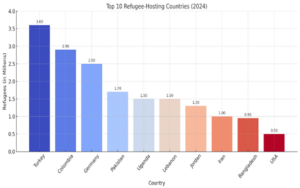
Here’s the vertical bar graph showing the Top 10 Refugee-Hosting Countries (2024):
- Turkey leads with 3.6 million refugees.
- Colombia and Germany follow with 2.9 and 2.5 million, respectively.
- The graph uses a colour gradient from red (highest number) to blue (lowest) to visually differentiate hosting capacity.
India, while not part of the top 10, is estimated to host approximately 2,50,000 refugees and asylum seekers (i.e., 0.25 million). This includes both registered and unregistered individuals from countries such as Afghanistan, Myanmar (Rohingya and Chin communities), Tibet, and Sri Lanka.
- Estimated Global Rank: Between 25th and 30th
- Comparison: India hosts about 7% of Turkey’s refugee population, and about half the number hosted by the United States.
- UNHCR Registered Refugees in India: ~50,000
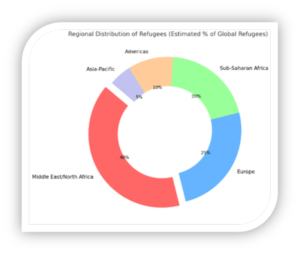
- Regional Distribution of Refugees
Here is the donut chart showing the Regional Distribution of Refugees (Estimated % of Global Refugees):
- Middle East/North Africa (MENA) is highlighted as the largest host region, accommodating 40% of global refugees.
- Other major regions include Europe (25%), Sub-Saharan Africa (20%), Americas (10%), and Asia-Pacific (5%).
- Refugee Trends (2015-2024)
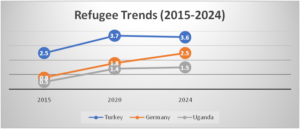
The following data illustrates the changes in refugee populations hosted by Turkey, Germany, and Uganda over a ten-year period from 2015 to 2024. These figures are based on historical data compiled by the United Nations High Commissioner for Refugees (UNHCR).
- Turkey:
- 2015: Approximately 2.5 million refugees
- 2020: Approximately 3.7 million refugees(Sharp increase primarily due to the ongoing Syrian conflict)
- 2024: Approximately 3.6 million refugees(Slight decrease, indicating stabilization or repatriation trends)
- Germany:
- 2015: Approximately 0.8 million refugees
- 2020: Approximately 1.8 million refugees(Significant rise following the European migrant crisis)
- 2024: Approximately 2.5 million refugees(Continued growth influenced in part by the Ukraine crisis and sustained asylum policies)
- Uganda:
- 2015: Approximately 0.5 million refugees
- 2020: Approximately 1.4 million refugees(Reflecting regional displacement from South Sudan and the Democratic Republic of Congo)
- 2024: Approximately 1.5 million refugees(Minor increase indicating a continued but slower influx)
CONCLUSION
From 2015 to 2024, the global refugee crisis has grown more complex and urgent due to ongoing wars, political turmoil, and humanitarian disasters. The situations in Turkey, Germany, and Uganda illustrate how different countries manage large-scale displacement depending on their location, capacity, and policies. Turkey, sharing a border with Syria, has become the world’s largest refugee-hosting nation. Its refugee population increased significantly from 2.5 million in 2015 to 3.7 million in 2020 as millions fled the Syrian civil war. Although there was a slight reduction by 2024, Turkey continues to bear a heavy responsibility because of its proximity to conflict-affected regions. Germany emerged as a key destination for refugees in Europe, especially during the 2015 migration wave and the 2022 Ukraine crisis. Its refugee numbers rose from 0.8 million to 2.5 million by 2024, reflecting its organized asylum system and commitment to protecting displaced persons. Uganda, despite limited economic resources, has displayed strong humanitarian commitment by welcoming refugees from South Sudan and the Democratic Republic of Congo, with its refugee population rising from 0.5 million to 1.5 million over the same period.
In comparison, India still lacks a dedicated national refugee law. Refugees are mainly regulated under general laws such as the Foreigners Act, 1946, which do not specifically address their unique vulnerabilities. This leads to inconsistent treatment and legal insecurity. Although Indian courts have recognized that refugees are entitled to fundamental rights like equality and the right to life, these protections are often inadequate in reality. The UNHCR provides assistance in India, but its impact remains limited due to the absence of a clear legal framework.Given the increasing global displacement crisis, India should adopt a comprehensive refugee law aligned with international human rights standards to ensure dignity, protection, and fairness for all refugees.
[1] Law Student at Seedling
School of Law and Governance, Jaipur National University
[2] United States Committee for Refugees and Immigrants, World Refugee Survey 2009; UNHCR Statistics.
[3] UN General Assembly, Convention Relating to the Status of Refugees, 28 July 1951; Protocol Relating to the Status of Refugees, 31 January 1967.
[4] The Foreigners Act, 1946 (India).
[5] NHRC Reports and Parliamentary Debates, 1997, 2006, 2015.
[6] UNHCR, Convention and Protocol Relating to the Status of Refugees, Article 1A (2), 1951.
[7]NHRC v. State of Arunachal Pradesh1 SCC 742.
[8]Ktaer Abbas Habib Al Qutaifi v. Union of IndiaCri LJ 919 (Guj).
[9]Mohammad Salimullah v. Union of India10 SCC 1.
[10]Hirsi Jamaa and Others v. ItalyApp. No. 27765/09, European Court of Human Rights, Judgment of 23 February 2012.
[11]Canada (Attorney General) v. Ward2 SCR 689
[12]US v. Sale509 U.S. 155 (1993)