
INTRODUCTION
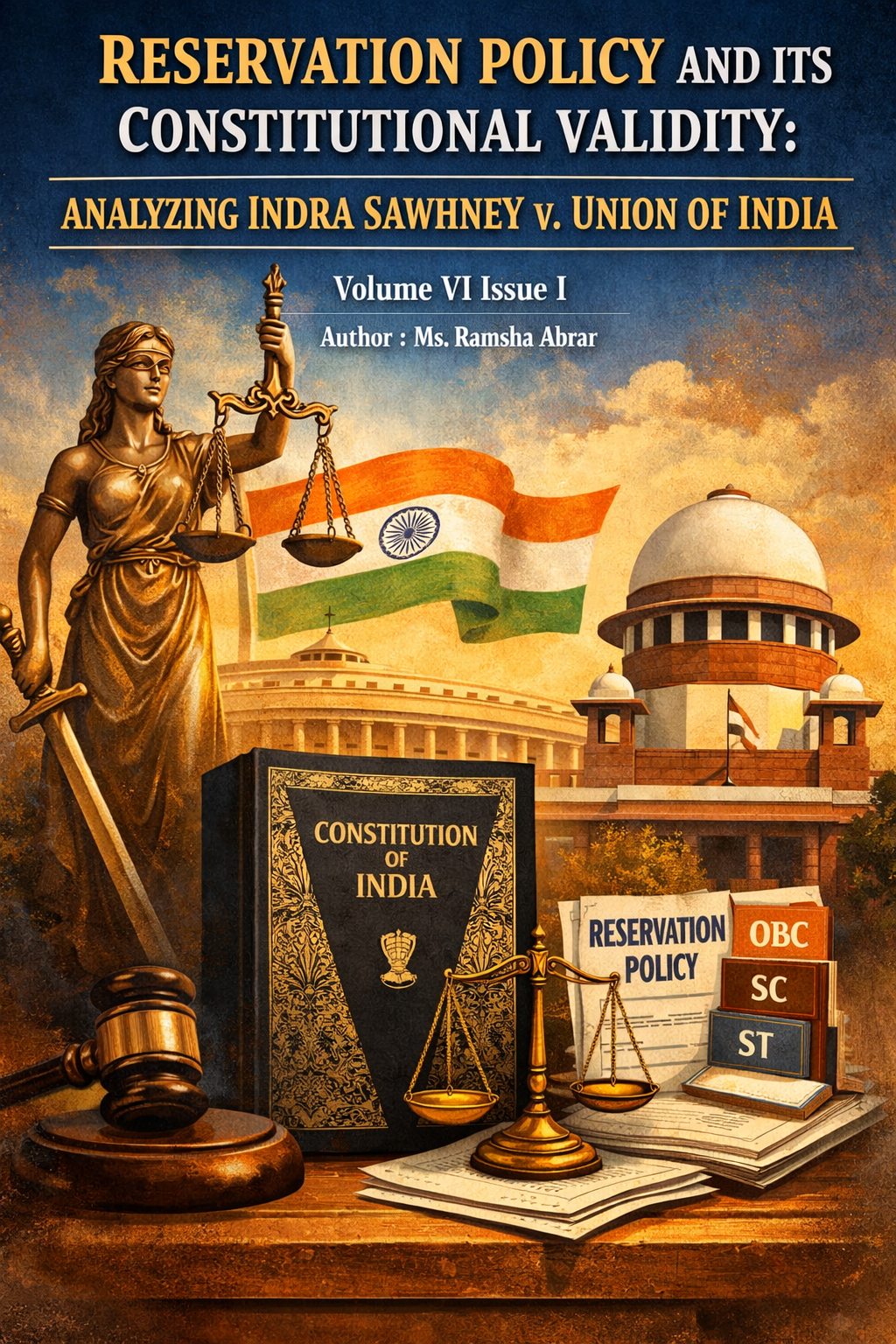
In India, reservations are a long-standing and often contested program meant to empower historically underprivileged communities. It acts as a remedy for the social and economic injustice that Scheduled Tribes (ST), Scheduled Castes (SC), and Other Backward Classes (OBCs) have endured for millennia. The goal of the reservation policy is to make society more equal by giving disadvantaged groups more access to political representation, government employment, and education. But the program has also spurred heated debates about equality, fairness, and meritocracy. Indra Sawhney v. Union of India (1992),[1] one of the most important court cases on this topic, changed how reservations operate in India. In its historic ruling, the Supreme Court maintained the legitimacy of OBC reservations but set important limitations. It established the creamy layer idea to exclude the more affluent OBCs, set a 50% reservation maximum, and decided that promotions in government positions could not be subject to reservations. This ruling marked a sea change because it balanced the constitutional ideal of equality with social justice. It prevented the abuse of affirmative action while guaranteeing that it would help those who actually needed it. Understanding the legal and social aspects of this policy via the Indra Sawhney case is essential because the fight over reservations is still going strong today. In India, reservations are a vital but divisive policy intended to improve historically marginalized groups by guaranteeing their participation in governance, work, and education. This system, which is built on the ideas of equality and social justice, attempts to rectify the long-standing disparities brought about by centuries of discrimination based on caste. But finding a balance between merit-based opportunities and affirmative action has always been difficult, and this has resulted in intense judicial scrutiny throughout the year. Thus, the reservation policy in India remains a dynamic and evolving framework, constantly tested against the principles of equality and social justice. While landmark judgments like Indra Sawhney have provided a constitutional foundation, subsequent rulings and amendments continue to redefine its scope. The challenge lies in ensuring that affirmative action benefits those who truly need it while maintaining a fair and meritocratic.
DESCRIPTION
The Reservation Policy in India constitutes a mechanism for allocating a specified percentage of seats, not exceeding 50%, to particular groups such as Scheduled Castes (SCs), Scheduled Tribes (STs), and Other Backward Classes (OBCs) in government educational institutions and public employment. This policy traces its origins to ancient societal structures characterized by the prevalence of the caste system, ‘untouchability’, and the Varna system, making it an enduring aspect of Indian social policy.[2]
The reservation policy serves as an affirmative action initiative aimed at addressing the historical and social injustices faced by marginalized communities. It provides crucial opportunities for education, employment, and participation in governance for SCs, STs, and OBCs. Nevertheless, the policy has faced judicial scrutiny regarding its constitutionality and its potential conflict with Articles 14, 15, and 16 of the Indian Constitution, which ensure equality. A pivotal moment in this discourse was the 1992 Supreme Court case, Indra Sawhney v. Union of India[3], which scrutinized the scope of reservations and established important legal principles governing their implementation.
(2.1) Constitutional Provisions Governing Reservation in India:
Part XVI of the Constitution addresses the reservation for SCs and STs in both Central and State legislatures. Articles 15(4) and 16(4) empower both State and Central Governments to allocate seats in public services for SC and ST members. The Constitution underwent an amendment through the 77th Amendment Act in 1995, introducing clause (4A) in Article 16, which allows for reservation in promotions. This clause was subsequently adjusted by the 85th Amendment Act in 2001 to grant consequential seniority to SC and ST individuals who benefited from this reservation. Moreover, the 81st Amendment Act of 2000 added Article 16(4B), permitting states to fill unoccupied reserved vacancies from the previous year, thereby overriding the previously established 50% ceiling on total reservations Article 330 and Article 332 establish provisions for the reservation of seats for Scheduled Castes (SCs) and Scheduled Tribes (STs) in both the Parliament and State Legislative Assemblies, respectively.
- Article 15(4) and Article 15(5) allow for reservations for SCs, STs, and members of socially and Educationally Backward Classes (SEBCs) in educational institutions.
- Article 16(4) provides for reservations in public employment for underrepresented backward classes in government services.
- Article 335 addresses the removal of age limits and qualifying criteria for SCs and STs concerning public employment.
- The 103rd Amendment to the Constitution (2019) broadened the scope of reservations by introducing a 10% quota for the Economically Weaker Sections (EWS) in both employment and education, extending beyond traditional caste based criteria.
- Why Reservation Needed?
The need for reservation arises from the necessity to rectify historical injustices experienced by backward castes in the nation. It aims to create an equitable environment for these groups, who have historically lacked access to resources and opportunities. Additionally, it seeks to ensure adequate representation of backward classes in state services, promote their advancement, and uphold equality as a foundation for meritocracy, ensuring that all individuals are assessed on an equal footing.[4]
- Impact and Current Significance:
India’s reservation policy continues to be shaped by the Indra Sawhney judgment, which established significant protections. Ongoing discussions focus on several issues, including:
- The potential re-evaluation of the 50% reservation cap.
- The applicability of reservation policies to newly marginalized groups.
- The effectiveness of the creamy layer concept in achieving genuine social justice.
- The balance between affirmative action and merit-based systems.
Recent demands for increased reservations from groups such as Patidars, Jats, and Marathas have sparked further legal and political discourse. The introduction of EWS reservations has added new dimensions to the conversation surrounding affirmative action.
DISCUSSION
(3.1) Historical Evolution:
The idea of caste-based reservations was first introduced by William Hunter and Jyotirao Phule in 1882. The contemporary reservation system was established in 1933 with the ‘Communal Award’ issued by British Prime Minister Ramsay Macdonald. Following discussions, the ‘Poona Pact’ was reached between Gandhi and Ambedkar, resulting in a unified Hindu electorate that included reservations. Initially, reservations were limited to Scheduled Castes (SCs) and Scheduled Tribes (STs) after India gained independence. The inclusion of Other Backward Classes (OBCs) occurred in 1991, based on the recommendations of the Mandal Commission, which advocated for a 27% reservation in government jobs for OBCs. Post-independence in 1947, Indian leaders focused on rectifying centuries of social injustice faced by Scheduled Castes, Tribes, and other marginalized groups. The Central Government, along with various State Governments, has formed numerous Commissions and Committees to tackle issues related to the identification of Scheduled Castes and Scheduled Tribes, the criteria for their identification, and the processes of inclusion and exclusion, as well as the parameters defining backwardness. These committees have consistently produced affirmative reports supporting these initiatives. As a result, the policy of reservation or affirmative action is rooted in the provisions and principles outlined in the Constitution. [5](3.2) Judicial Scrutiny of Reservation:
The case of The State of Madras v. Smt. Champakam Dorairajan (1951) SCR 525[6]marked a significant ruling by the Supreme Court regarding the issue of reservations. This landmark decision prompted the First Amendment to the Constitution. The Supreme Court noted that while Article 16(4) allows for reservations for backward classes in state employment, Article 15 does not contain a similar provision.
In the subsequent case of Indra Sawhney v. Union of India (1992), the Court explored the parameters of Article 16(4). It determined that the “creamy layer” among Other Backward Classes (OBCs) should be excluded from reservation benefits, that there should be no reservations in promotions, and that the total percentage of reserved seats should not surpass 50%. In response to these judicial pronouncements, the Parliament enacted the 77th Constitutional Amendment Act, which introduced Article 16(4A). [7]This article empowers the state to reserve 8positions for Scheduled Castes (SC) and Scheduled Tribes (ST) in promotions within public services, provided these communities are underrepresented in public employment.The Supreme Court in the case of M. Nagaraj v. Union of India (2006)8 SCC 212[8]affirmed the constitutional validity of Article 16(4A) and established that any reservation policy must meet three constitutional criteria to be deemed valid:
- The Scheduled Castes (SC) and Scheduled Tribes (ST) must be recognized as socially and educationally disadvantaged.
- There must be insufficient representation of SC and ST communities in public employment.
- The implementation of such a reservation policy should not compromise the overall efficiency of the administration.
(3.3) Case Analysis Of Reservation Policy In India:
Case: INDRA SAWHNEY VS. U.O.I AIR (1992) SC 477[9](Popularly known as Mandal Commission Case)
FACT:
The case widely referred to as the “Indra Sawhney case” pertains to the contentious issue of reservations in India. It originated from the Mandal Commission’s recommendations, which suggested a 27% reservation for Other Backward Classes (OBCs) and an additional 10% for socially and economically backward classes (SEBCs) in public sector employment. A group led by Indira Sawhney challenged the caste-based reservation system, advocating instead for criteria based on economic status.
This matter escalated to the Supreme Court, where a nine-judge bench sought clarification from the government regarding the criteria for reservations. However, the court raised concerns over the government’s inadequate explanations concerning the parameters, leading to a more in-depth judicial review. The central issues of the debate included the appropriate extent of reservations, the criteria for determining backwardness, and the application of the creamy layer concept, particularly in relation to promotions.
Issues Identified
- Whether caste alone should be the determinant factor for backwardness or if other factors should also be considered.
- Whether reservations should be limited to a certain percentage and whether there should be exceptions to this limit.
- Whether the creamy layer principle should apply to OBCs and if so, how it should be determined.
- Whether reservations should extend to promotions within public employment or be restricted to initial appointments.[10]
Judgement of the case:
The Supreme Court’s Constitution Bench, comprising nine judges, reached a decision with a 6-3 majority on the following points:
- The identification of backward classes under Article 16(4) may be based on the caste system rather than solely on economic criteria. Article 16(4) does not serve as an exception to the principle outlined in Article 16(1); rather, it illustrates the categorization process. Article 16 permits the implementation of reservations.
- The definition of backward classes in Article 16(4) differs from that of socially and educationally backward classes as described in Article 15(1).
- Individuals classified within the creamy layer must be excluded from the lower classes.
Article 16(4) allows for the classification of backward classes into those that are backward and those that are more backward. Establishing a backward class of citizens cannot be based solely on economic factors.
- Reservations should not surpass the 50% threshold.
- The ‘Executive Order’ may be utilized to implement reservations.
- There is no provision for reservations in promotions.
The majority opinion indicated that it was unnecessary to assess the validity or appropriateness of the Mandal Commission’s actions.
Post-Indra Sawhney: Expanding the Scope of Reservations:
The 77th Amendment (1995) reinstated reservations for Scheduled Castes and Scheduled Tribes in promotions under Article 16(4A), effectively reversing the
Scheduled Tribes in promotions under Article 16(4A), effectively reversing the Indra Sawhney ruling. The 81st Amendment (2000) allowed for the carry-forward of vacancies for reserved categories beyond the 50% limit. In the case of Lachhmi Narain Gupta v. Jarnail Singh (2018), [11]it was determined that the creamy layer principle applies to promotions for Scheduled Castes and Scheduled Tribes. [12][13]
Case: MR Balaji vs State of Mysore (1962)
14
In the case of Balaji vs State of Mysore, the Supreme Court examined the allocation of seats in educational institutions for socially and educationally disadvantaged groups, including Scheduled Castes and Scheduled Tribes. The court determined that categorizing backward classes into “backward” and “more backward” classifications went beyond the limitations set by Article 15(4) of the Constitution. This article allows for special provisions for truly disadvantaged communities, in accordance with Directive Principles such as Article 46. In MR Balaji v State of Mysore, the court refrained from establishing a fixed quota for reservations under Article 16(4), underscoring that such measures must not be unreasonable or excessive. The ruling emphasized the need to balance the interests of marginalized groups with those of the broader community. This case underscores the importance of fostering social and educational progress while ensuring that measures do not compromise fairness and efficiency.15
CONCLUSION
In conclusion, India’s history of reservations shows a persistent fight for social justice while upholding equality under the constitution. The system has changed dramatically from the first affirmative action laws to famous Supreme Court decisions like Indra Sawhney. However, policy modifications and legal examination will continue to be essential as socioeconomic circumstances evolve to guarantee that affirmative action fulfills its intended function without jeopardizing meritocracy.There has been much discussion about India’s reservation policy, which strikes a balance between social justice, historical injustices, and the Constitution’s guarantee of equality. Although it has given excluded communities opportunities, it has also sparked debate about meritocracy, efficiency, and whether or not reservations should be time-limited or extended. Although the 1992 Indra Sawhney ruling was crucial in establishing its constitutional bounds, the framework is still under threat from the changing socio-political environment.
Reservations are still a crucial tool for social justice, but their application requires ongoing review and adjustment. Important constitutional boundaries were established by the Indra Sawhney ruling, but changing socioeconomic realities necessitate a more flexible strategy. To build a truly inclusive society, the government must prioritize economic empowerment, greater education, and holistic development over quotas. Creating an even playing field rather than enduring social inequalities has always been the aim of reservations. Even while it has benefited many, the system needs to be continuously improved to stay equitable, efficient, and really helpful to those who need it the most. The emphasis should be on empowering communities through high-quality education, economic development, and long-term social reform rather than merely increasing quotas. India will advance toward a future where possibilities are accessible to everyone, regardless of background, with the support of a balanced approach.
RECOMMENDATION
Reservations are unavoidably necessary, but the system must be continuously assessed and improved to ensure that it benefits the people who actually need it.
We can increase its efficacy and inclusivity in the following ways:
- Regular Review to Keep it Fair and Relevant:
The goal of the reservation system was to close economic and social divides, yet these divides evolve over time. To make sure individuals who truly need assistance receive it, socioeconomic surveys should be carried out rather than depending solely on caste-based categorization.
- Reconsidering the 50% Cap:
There is ongoing discussion about the 50% reservation cap established by the Supreme Court in Indra Sawhney (1992). While some contend that the cap ought to be reexamined, others, including Tamil Nadu (69%), have gone beyond it. Instead of only raising quotas, we should look into alternative options like financial aid, mentorship programs, and scholarships to assist underprivileged students and job seekers if more areas want assistance.
- Looking Beyond Just Caste:
Caste is a significant predictor of backwardness, although poverty and regional disparities are also major contributors to social disadvantage.
A step in the direction of economic-based affirmative action was the EWS reserve (103rd Amendment, 2019), but for it to actually benefit people in need, it needs to be implemented more effectively.
- Ensuring Reservations Help the Most Needy:
Many contend that the majority of the advantages are enjoyed by wealthy families in protected categories, or the “creamy layer.” In Jarnail Singh (2018), the proposed expanding this idea to include SCs and STs, even if the OBC creamy layer is already excluded.
Caste should be taken into account, but so should income and social background, if reservations are to actually benefit the most disadvantaged.
- Strengthening Education and Employment Instead of Just Increasing Quotas:
Early access to high-quality education is essential to ending the poverty cycle. The government should prioritize enhancing schools, vocational training, and access to higher education for underprivileged populations rather than solely depending on reservations.
- Clearer Policies to Avoid Political and Legal Confusion:
Various groups call for inclusion in the reserve system every few years, which sparks political disputes, court cases, and protests. Confusion can be avoided, equity can be guaranteed, and politically influenced modifications can be avoided with a clear and consistent reservation policy that is applicable across states and sectors.
REFERENCE
BOOKS REFFERED:Indian Constitutional Law by “M.P Jain” (Eighth
Edition)
WEBSITES REFFERED:
1.https://blog.ipleaders.in(Last visited 4 March,2025)
- https://www.drishtiias.com(Last visited 4 March,2025)
- http://lawadvice.com(Last visited 4 March,2025)
- https://www.lawctopus.com(Last visited 5 March,2025)
- https://www. Lawbhoomi.com (Last visited 5 March,2025)
[1] AIR (1992) SC 4[1]77
[2] https://blog.ipleaders.in
[3] AIR (1992) SC 477
[4]https://www.drishtiias.com
[5] https://www.drishtiias.com
[6] AIR (1951) SCR 525
[7] http://lawadvice.com
[8] (2006) 8 SCC 212
[9] AIR (1992) SC 477
[11] (2018) 10 SCC 396
[12]Indian Constitutional Law by “M.P Jain” (Eighth Edition)
[13] AIR 1963 SC Supl. 439 15https:// Lawbhoomi.com