Abstract
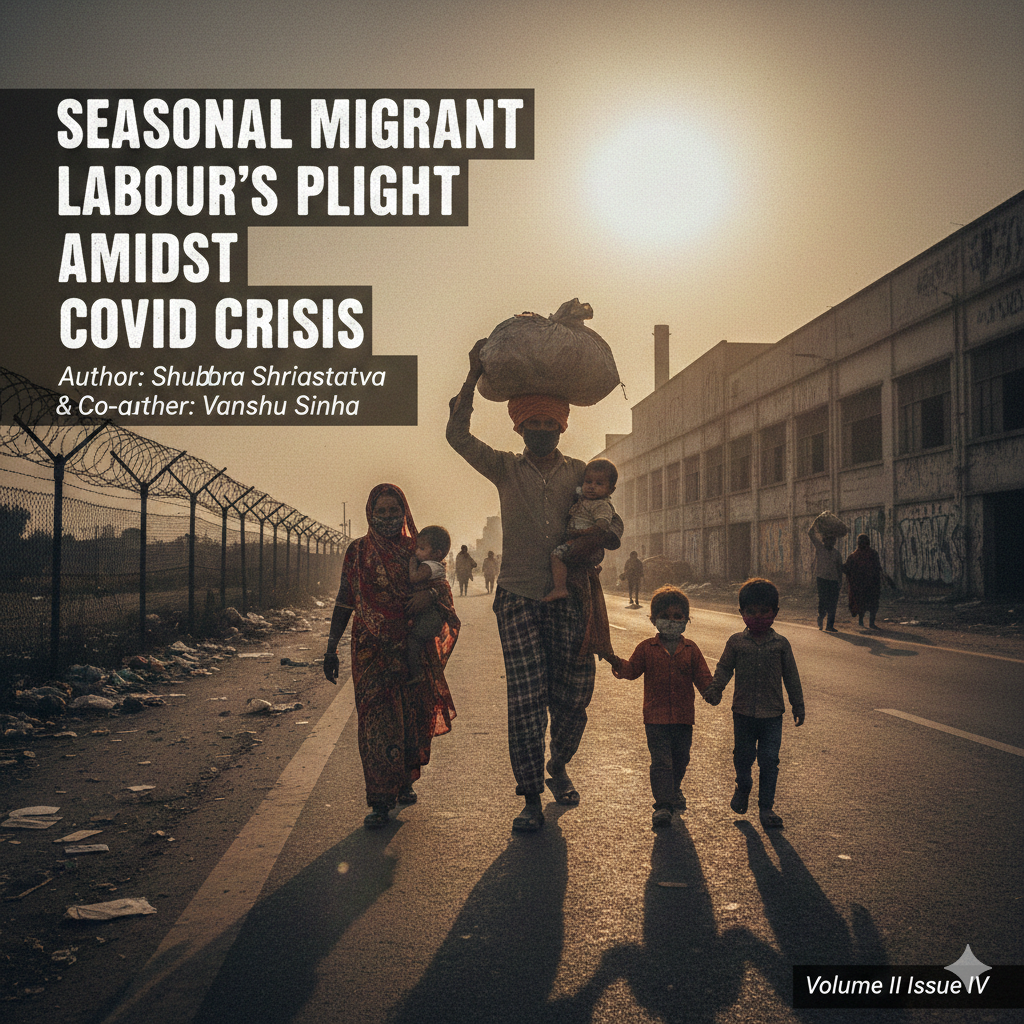
Recently some headlines made us ponder on the vulnerability of a particular section of the society that is the seasonal migrant workers. There are tens of millions of workers left on streets amidst this nationwide lockdown to contain the spread of COVID-19. The article shall discuss their plight concerning this present crisis where our nation with a massive population of over 120 Billion is forced to sit back at home to stay safe but these workers are being deprived the departure to their home and are compelled to share space and food with several unfamiliar faces in this global need of social distancing.
Owing to the ongoing crisis, the authorities are left with no option other than to restrict their movement as these people could be potential carriers of COVID-19 and they can cause a total disaster by expediting its spread to areas where its curb will become practically impossible. The article also traces the forcing factors for their migration and makes a subtle analysis of how this section of the society has turned into a political blind spot. Since our law hasn’t accommodated the needs of social security for these workers in specific, the govt. could easily compromise with their rights whereas the ground reality is that there was evident mismanagement in handling a global pandemic like COVID-19 on the part of the govt.
This article also discusses how the Judiciary has played a role of check and balance to ensure the welfare of the workers but at the same time, it refrains to interfere with the authorities tackling this current pandemic. Today India is under the spotlight of the world owing to the size of its population and is being observed how it will make a difference as the situation unravels.
KEYWORDS: Seasonal labour migrants;Seasonal workers; LabourRights,COVID-19; PIL; Right to life,
Seasonal Migrant Labour’s plight Amidst Covid Crisis
Introduction:
“What the two hands of labourer can achieve, the capitalist will never get with all his gold and silver”
~M. K. GANDHI (FATHER OF OURNATION)
Labour is one of the four pillars of production which regulates the economy of a nation. We can undeniably say that Labourers are the direct pillars of any building economy. The father of our nation rightly said that there is nothing which can substitute labourer and it is our duty to look after them.
In March 2020, the COVID-19 pandemic hit India leaving the entire India lockdown for 21 days. Over 40 million migrant workers are stuck amidst the COVID-19 crisis along with their families including women and small children on roads or the apparent “shelter homes” during the global need of social distancing. These figures aren’t just numbers but each of them is a life to which our constitution guarantees not mere animal existence but right to live with dignity. This is about those indigent lives who seek our help now when they are left in despair- foodless, moneyless and home deprived.
They are stranded due to the nature of their work. These seasonal migrants have nowhere to live now. They were laid off due to the crisis and now they are deprived of their home. Sudden notification of 21-day lockdown has caused turmoil in their lives just like in ours. The only difference is that we have cozy beds to sleep and stored food to eat while they are left on road pavements with their families starving and shelter-less. They took the courage to cross distances of triple digits in miles on foot and still not lose hope. This is an understatement of the real problems they are going through each passing day. They are being discriminated against and neglected in these times of distress when we are bestowed with the duty to look after them.
I. Tracing the migrants:Migration of Labour is a global phenomenon. In India, it is quite significantly high due to the developing status of the nation. Migration in India is international, inter-state and even intra-districts. Over 450 million internal migrants were recorded in the record of the 2011 census. According to the Indian government’s 2016-17 Economic Survey, internal migrants make up about 20 percent of the workforce. And they contribute an estimated 10 percent of India’s economic output, according to the UN Educational, Scientific and Cultural Organization.[1]Population mobility, seasonally or permanently, internal or international, rural-urban or rural-rural is universally recognized as an alternative livelihood strategy adopted by the poorest section. Thus, migration movements are an important part of human history including Labour migration. However, Labour migration in visible magnitude goes back to the beginning of the industrial era, when the rural population migrated to urban areas to find work in the growing industries leaving behind their traditional rural occupations. Since then the issue of migration has also been the subject of various development theories (Lucas, 2015).[2]
Causes of migration
There are several guiding factors like securing better prospects of employment, education of their children, unfortunate famine, caste discrimination. There are plenty of factors of economic, social, cultural and demographic character which have been identified and their combinations can be considered as motivating internal migration. But there is no hard and fast rule to decide that a single factor or combinations of some of these factors are more likely to influence migration. But the main and most common reason for their migration is economic. These factors include factors like poverty, low wages, high taxes, high unemployment, overpopulation, etc., they are also ‘push factors’. Amongst seasonal migrant Labourers, the majority of the rural workers are dependent upon agriculture as their primary source of income and they often face problems like disguised and seasonal unemployment. They are mainly required during the harvest season of Rabi and Kharif crops as a lot of manpower is required during the harvesting period. The harvest season of Rabi crops begins in March-May while for Kharif crops it is done during September-October. During these seasons they either migrate back to their towns for their inland crop harvesting or often flee to other states where there is manpower required for such harvesting. Seasonal unemployment is often caused by the unemployment of labourers between sowing and harvesting seasons. In India, states like Punjab, Haryana, Telangana, Maharashtra, Gujarat, Madhya Pradesh, etc. are major attractions due to the high demand of Labourers. This seasonal work ensures workers’ financial reserves for the rest of the year.
The migrant labourer has been exposed to a large number of employments in the unorganized sector like construction, cleaning drains, hawkers, rickshaw pullers, cobbler, selling vegetables, etc. the migrants have information about the Labour market and also the job in which they would fit in. The migrant workers often limit the risk of cost through mediators, as they are thought to be job seekers and the majority of the employment is done through agents in huge numbers of the industries while some of the migrants prefer to travel alone to the destination area for opportunities. What’s more, is that the vast majority of them have obtained work through social contacts as it is hard to get a job in an unknown place with no references. In the survey, the migrant workers are mostly engaged in the construction sector. The construction sector constitutes one of the largest categories of workers in the unorganized sector. And also, the construction industry is the single largest employer of migrant workers.[3]
Some other factors natural cataclysm and irregularity of rain and socio-economic discrimination also renders the poor labourers out of options to survive in the rural area. So, in order to escape from such life, they migrate to cities and work as labourers and sometimes these people cross over to other countries illegally because of intolerable living conditions.
Some other factors natural cataclysm and irregularity of rain and socio-economic discrimination also renders the poor labourers out of options to survive in the rural area. So, in order to escape from such life, they migrate to cities and work as labourers and sometimes these people cross over to other countries illegally because of intolerable living conditions.
Lee’s theory of PUSH and PULL explains the reasons behind the migration. It is based on multiple factors that create an effect of push from the origin and simultaneous pull towards the destination because of pull factors. The rationale of the push-pull hypothesis is that if the plusses (pulls) at the destination exceed the plusses of remaining at the source, the relocation is probably going to happen.[4]
Sudden Lockdown for 21 Days
In recent times due to the outbreak of Coronavirus in India and the immediate nationwide 21 days lockdown to curb the spread of the virus has added more hardships to the already arduous life of a seasonal migrant worker. This lockdown has left tens of millions of migrant workers unemployed. Due to the spread of COVID-19, their workplaces are shut down and with no money left in their pocket, no job and for some of them even with no shelter (because they lived in factory dormitories, which are now shut), they are forced to leave to their native villages to at least have roof and food to survive. But as the government halted the bus and train services they are stranded and have no choice other than walking a far-flung distance. But this journey has been devastating for some as they succumbed to death. They’re vulnerable to starvation and infection. Also because of the clash between centre and state government these workers were left in sitch of dilemma and chaos.
A labourer in Noida, who is peddling his family to his hometown Badayun in Madhya Pradesh said
“What do we do? More than Corona, it is a hunger that will kill us”.[5]
The concern each day grows bigger as the estimates are failing and there is an enormous population seeking the relief measures from govt. which apparently did not plan this as if they were not considered a part of the plan ever.
Due to lack of administrative planning, the panic-stricken resorting to the tragic exodus set off due to 21 days lockdown violating social distancing norms amidst the spread of the virus. Their condition is far worse than expected and they are being sent back from the borders by lathi-wielding cops and some toxic disinfectant which is used to clean buses have been sprayed on them which is inhuman. Following the reports of ill-treatment of migrant labours many media houses questioned the concerned authorities regarding the safety and security of these workers belatedly, the government decided to provide food and shelter to the migrants and as humanitarian gesture buses were dispatched to ensure the safe returns of the workers to their native villages.
“There’s been a lot of fanfare about bringing back Indians stranded abroad — a few relatively well-off people, but these migrant workers, they have to go very, very long distances. They’re not just vulnerable to hunger. They’re also vulnerable to many diseases.[6]“
~Jayati Ghosh
(Professor at JNU)
But this is an undisputed fact that whatever the crisis unfolds in this country the people who are at the lowest end of the pyramid will have to endure hardships. The present lockdown has cast an unprecedented misery on daily wage earners who are either self-employed as rickshaw pullers, domestic help, petty job workers or seasonal migrant worker who are employed in establishments which led to an expeditious loss of work and wages. Addressing this concern two PILs were filed first was by advocate Alakh Alok Srivastava to seek immediate relief to migrant workers and their families and to direct the authorities for the proper arrangement of food, shelter, water and medical aid to them. The Central government during the hearing filed a status report and informed that food was being provided to over 22.88 lakh people including the needy, migrant and daily wage workers, across the country amid the lockdown.[7]And the second PIL was filed by Harsh Mander and Anjali Bhardwaj under Section 32 of the Constitution of India for the enforcement of the Right to life (article 21) of migrant workers who are sternly affected amidst the 21 days Lockdown. This petition seeks the payment of wages by the central and the state government jointly or severally to these migrant workers within a week, whether employed in an establishment or self-employed. Supreme Court rejected this plea and said that the Court cannot impede the policy decisions of the government and no payment of wages is required to the migrant workers as they are provided with food and shelter.
Political Blind Spot
In the purview of their current situation, not only human rights but also their constitutional rights are being denied.
Right to Live with Human Dignity
In Maneka Gandhi v. Union of India[8], the Supreme Court gave a new dimension to Art. 21 and held that the right to live is not merely a physical right but includes within its ambit the right to live with human dignity.
Right to Health
In Consumer Education and Research Centre v. Union of India[9], the Supreme Court laid down that:
“Social justice which is a device to ensure life to be meaningful and liveable with human dignity requires the State to provide to workmen facilities and opportunities to reach at least minimum standard of health, economic security and civilized living. The health and strength of worker, the court said, was an important facet of right to life. Denial thereof denudes the workmen the finer facets of life violating Art. 21.”
Right to Social Security and Protection of Family
In Calcutta Electricity Supply Corporation (India) Ltd. v. Subhash Chandra Bose[10], held that the right to social and economic justice is a fundamental right under Art. 21. The learned judge explained that the right to life and dignity of a person and status without means were cosmetic rights. Socio-economic rights were, therefore, basic aspirations for meaning the right to life and that Right to Social Security and Protection of Family were an integral part of the right to life.
These migrant workers are the most vulnerable section of our society they are not literate and unaware of the exploitation done to them. Nobody is interested in the needs of the migrant workers, their proper welfare is not insured by the state which prevents them from benefits like education, health, housing, etc. their welfare is often sacrificed between the greed of government officials and intermediaries. Their needs are generally used to amplify the election manifesto of a party during elections and then nobody cares. There is no separate legislation for the welfare of these interstate migrant workers and in any situation of crisis, they are most exposed to harassment, loss of wages, starvation and destitution.
In the recent scenario under pressure to address the growing emergency, the central government last week announced a $23bn welfare scheme for the poor. This included doubling the number of free food rations under an existing national programme.[11]
Many countries have used cash transfers to support falling incomes during the pandemic. Though India followed suit by announcing an extra $20 spread over three months paid directly into Jan Dhan bank accounts – free accounts provided under the central government’s financial inclusion programme – the amount is small, worth only approximately three days of wages for an inner-city construction worker.[12]
International spotlight towards Migrant Labourers:
“The lockdown in India represents a massive logistical and implementation challenge given the population size and its density and we all hope the spread of the virus can be checked,”
~Ms. Michelle Bachelet (High Commissioner for Human Rights, United Nations)
Currently, all eyes are on India tackling the pandemic given the size of the nation and the respective population. UN human rights chief is distressed over the plight of India’s internal migrants affected by the sudden announcement of a lockdown in India. She welcomed subsequent measures to address their situation but noted that pervasive challenges remain.[13]
“It is nonetheless important to ensure that measures in response to the COVID-19 are neither applied in a discriminatory manner nor exacerbate existing inequalities and vulnerabilities.”
“We understand the strains on police services at this time, but officers must show restraint and abide by international standards on the use of force and humane treatment in their efforts to respond to this pandemic”
The chief briefly examined the situation and had condemned the inhumane practices exhibited by the police forces on the pretend of making the quarantine effort. Through her statements, she made it explicitly clear that these workers need protection and humane treatment under international standards. They need to be treated with respect. Indian govt. is suggested to ensure the availability of food, shelter, medicines to these migrants along with psychosocial counseling at the shelter homes. However, the real picture is a far sight. As per sources, people have to divide food for one into four to feed themselves and one lives amongst 8 other members in a room in the shelter homes in a world which is iterating the concepts of social distancing.[14]
CONCLUSION
Migration is a global phenomenon and is quite significantly embedded in the ideals of the Indian working-class population as a medium to uplift their living standard, aiming to provide a better lifestyle to their kinship by moving towards the land of bigger opportunities. But the ground reality is far held from expectations of this class. The lower-middle-income group workers are incessantly exploited and robbed even of their basic rights on a continuous note.
In this moment of despair during the pandemic of COVID-19 amidst a 3-week nationwide lockdown, these tens of millions of migrant workers were left on their means to withstand this crisis. They were deprived of home with no penny in their pocket & some of them even with their families including elderly parents, infants, and women alongside. The govt. could have ensured less panic situation by having a better policy in managing this pandemic and the announcement of lockdown prior some days with proper relieving facilities for these migrants and assuring them about their safety and security would have improved the condition. The effect of social distancing would have made a greater impact had this haphazard situation not risen.
As the UN chief suggests these workers must be provided with basic amenities such as proper food, hygienic shelters, required medicines, and also a counselor to assure they don’t fall trap to emotional psychological trauma.
[1]Tish Sanghera, Hungry, desperate: India virus controls trap its migrant workers, AJ IMPACT (Apr.9 2020,12:47 PM)https://www.aljazeera.com/ajimpact/hungry-desperate-india-virus-controls-trap-migrant-workers 200402031123631.html.
[2]Sunita Yadav, An analysis of seasonal Labour migration in Haryana, SHODHGANGA (Apr.9 2020,12:55 PM)
http://hdl.handle.net/10603/269390
[3]Karishma Buragohain, Migration and Livelihood of the Local Labourers (A study of Duliajan, Assam), A dissertation submitted to Centre for Livelihoods and Social Entrepreneurship School of Social Work, Tata Institute of Social Sciences, Guwahati Campus 2018 (Apr.9 2020,13:13 PM) http://dspace.tiss.edu/jspui/bitstream/1/11061/1/Karishma%20Buragohain%20G2016LE006.pdf.
[4]Id.
[5]Anand Mishra, Migrant workers in India on move as COVID-19 stalls world, DECCAN HERALD (Apr.9,2020, 23:31 PM), https://www.deccanherald.com/national/migrant-workers-in-india-on-move-as-covid-19-stalls-world-818723.html.
[6] Lauren Frayer&Sushmita Pathak, Coronavirus Lockdown Sends Migrant Workers on A Long and Risky Trip Home, NPR (Apr.9,2020,23:35 PM),https://www.npr.org/sections/goatsandsoda/2020/03/31/822642382/coronavirus-lockdown-sends-migrant-workers-on-a-long-and-risky-trip-home.
[7] Ani, SC to hear after two weeks PIL seeking food, shelter for migrant workers, BUSINESS STANDARD (Apr.9,2020, 23:48 PM), https://www.business-standard.com/article/news-ani/sc-to-hear-after-two-weeks-pil-seeking-food-shelter-for-migrant-workers-120040701208_1.html.
[8] 1978 AIR 597
[9] 1995 AIR 922
[10] AIR (1992)573
[11] Supra note 1.
[12]Id.
[13]COVID-19: UN human rights chief “distressed” over plight of India’s internal migrants, welcomes measures to limit impact (Apr.9, 2020, 14:25 PM) https://www.ohchr.org/EN.
[14]Supra note 1