- ABSTRACT
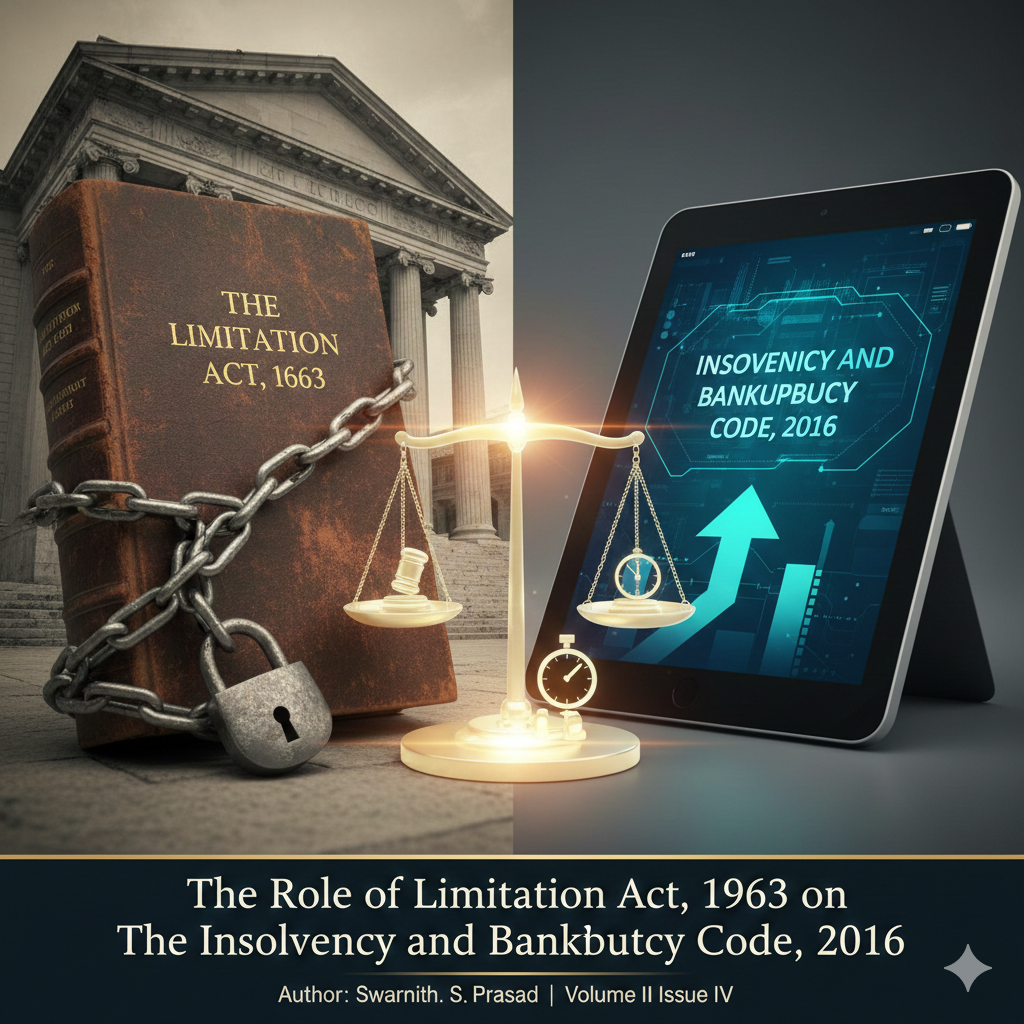
The Research Paper Will Focus On The Role Of The Limitation Act, 1963 On The Insolvency And Bankruptcy Code, 2016 (IBC). It Will Also Deal With Basic Features Of Insolvency Which Are Certain Recommendations Of The Balakrishna Committee.
The Origination Of The Controversy On The Application Of The Limitation Act, Will Be Described Along With The Doctrinal Aspect Of The Limitation Act And Its Governance Over Other Statutes. The Hierarchy Of The Evolution Of Various Advancements With Regard To The Role Of Limitation Act On The Insolvency And Bankruptcy Code Is Discussed By Various Judicial And Quasi-Judicial Decisions. Also, The Advancement After Considering The Lacunae Of The Existing Legislation With Respect To The Limitation Period, Has Been Addressed To With The Help Of Insolvency Laws Committee.
The Role Of The Companies Act, 2013 With Respect To, The Insolvency And Bankruptcy Code, In Dealing With Adjudication Mechanism With The Application Of Limitation Period And Also The Burden Of Following Such Limitation To Be Followed Upon Transfer Of Existing Suits Before The District Court And High Courts To The Respective Company Law Tribunal.
Finally, This Paper Deals With The Role Of The Legislative Body In Addressing The Lacunae With Respect To The Application Of The Limitation Act On The Insolvency And Bankruptcy Code. Also Various Judicial Decisions Are Addressed On The Application Of The Said Provision Of Limitation On The I&B Code.
Also, Certain Suggestions Have Been Made On Whether The Supreme Court Should Have Or Shouldn’t Have Intervened In Order To Take Adequate Action In Addressing The Limitation Application On The Insolvency And Bankruptcy Code.
- LITERATURE REVIEW
India Has Come A Long Way From The Period Where There Were Two Main Pre-Constitutional Legislations To Govern The Insolvency, Namely Presidency Towns Insolvency Act, 1909 And Provisional Insolvency Act, 1920 Which Dealt Ideally With Personal Insolvency. It Was Later Followed By The Companies Act, 1956 Which Dealt With The Winding Up Procedures, Liquidators Etc. Followed By Sick Industrial Companies Act, 1985, Securitization And Reconstruction Of Financial Assets And Enforcement Of Security Interest Act, 2002 And Finally Came The Insolvency And Bankruptcy Code 2016, After A Variety Of Trial And Error Mechanisms Which Were Evolved, This Stood As The Backbone For The Insolvency And Bankruptcy Resolving Mechanism Which Was In Line With That Of The UNCITRAL Model.
According To Section 238 Of IBC , If There Is Any Conflict Between The Provisions Of IBC And Any Other Existing Statutes, Then The Provisions Of Insolvency And Bankruptcy Code Would Prevail. Thus By Looking Into Section 238 It Can Be Understood That Unless And Until The Provisions Of The Limitation Act Is Clearly Against The Provisions Of IBC, The Limitation Act Should Be Prevailing.
In The Case Of Neelkanth Township And Construction Pvt Ltd V. Urban Infrastructure Trustees Ltd[1], NCLAT In Its Order Dated August 11, 2017, Held That The Provisions Of The Limitation Act, 1963 Does Not Apply To The Insolvency And Bankruptcy Process Under IBC. It Stressed On The Fact That The IBC Was Not Entitled For The Purpose Of Recovery Of Money Claims, But Rather For Initiation Of CIRP. NCLAT Allowed A Debt That Was Time Barred Under The Limitation Act To Form The Basis Of An Application For The Initiation Of CIRP. The Supreme Court On 23rd August 2017 Dismissed An Appeal From The Order Of NCLAT And Declined To Interfere With It.
The Paper Concludes That The Introduction Of Section 238A By The Legislative Body Into The I&B Code Has In Fact Been An Effective Measure Which Has Been Adopted By The System In Order To Facilitate More Efficiency And Effectiveness.
III. INTRODUCTION
Insolvency In India Is Categorized Into-
- Personal Insolvency Covering Individual’s And Partnership Firms[2], And
- Corporate Insolvency Dealing With Winding Up Of Companies[3].
Certain Principles Of Corporate Insolvency Are –
- To Ensure That The Creditors Get The Maximum Returns Possible.
- To Avoid Fraud In Transaction, Dissolution.
- To Ensure Fair And Equitable Mechanism Is Adopted Through Redistribution Of Rights So That There Would Be Distribution Of Assets Based On The Claims.
During The Year, 2015, It Was Observed That A Insolvency Resolution In India Almost Consumed 5 Years, While Countries Like USA And UK Approximately Consumed Just 1.5 Years On An Average. By This Data, It Can Be Observed That The Delay Is Mostly Due To The Confusion That Was Existing In The Provisions Of The Bankruptcy Legislations. Also, The Courts Took Their Own Time In Order To Resolve The Cases.
A Committee Headed By Balakrishna Eridi Was Set Up By The Government Of India (Goi), To Look Upon The Existing Insolvency Laws And To Bring Them To International Standards. The Report Was Submitted In 2000. Certain Recommendations Were[4]
- NCLT Needs To Be Vested With Powers With Regard To Winding Up Of Companies Along With Handling Of Sick Companies.
- The Tribunals Must Be Vested With The Power Of The High Court To Hear Insolvency Proceedings.
- Repealing Of SICA
- To Include UNCITRAL Model Into Part VII Of The Companies Act, 1956.
As Per The Preamble[5], The Legislative Intent Is To Remove The Existing Ambiguity In The Previous Legislations, To Prevent Delays That Is Maximum Of 180 Days, To Prevent Laws To Corporate Creditors, To Balance Out The Interests Of Various Stakeholders.
- AIM
The Aim Of The Paper Is To Analyze The Role Of Limitation Act, 1963 On The Insolvency And Bankruptcy Code, 2016.
- OBJECTIVE
The Objective Of This Paper Is To Analyze The Consequence Of Excluding The Insolvency And Bankruptcy Code From The Light Of The Limitation Act.
- SCOPE
The Scope Of This Paper Is Restricted To The Ongoing Scenario About The Role Of Limitation Act On Insolvency And Bankruptcy Code In India. As To How The Judicial, Quasi-Judicial And The Legislature Play A Role In Enhancing The Said Issue.
VII. EFFECT OF LIMITATION ACT ON THE INSOLVENCY AND BANKRUPTCY CODE
The Limitation Act, 1963, States, In The Schedule That, Claims Arising Out Of Money, Can’t Be Raised Beyond A Time Span Of 3 Years From The Date Of The Rise Of The Cause Of Action. In The Case Of, Neelkanth Township And Constructions Pvt Ltd V. Urban Infrastructure Trustee Ltd[6], The NCLAT Discussed With Regard To The Applications To Initiate Corporate Insolvency Under Section 7, 8, 9 & 10 Of The IBC Is Barred By Limitation Or Not.
The NCLAT Held That The Provisions Of IBC Cannot Be Made Vulnerable By The Limitation Act. There Is Nothing On The Record That Limitation Act Is Applicable To IBC. The IBC, 2016 Is Not An Act For Recovery Of Money Claim, It Relates To Initiation Of Corporate Insolvency Resolution Process. If There Is A Debt, Which Includes Interest And There Is Default, Of Debt And Having Continuous Course Of Action, The Argument That The Claim Of Money By Respondent Is Barred By Limitation Cannot Be Accepted.
By Looking Into, The Decision Of The NCLAT, It Can Be Understood That The Limitation Act Does Not Necessarily Extend Its Arms To IBC, 2016. The Main Point Referred By The Hon’ble Tribunal Was That, The IBC, 2016 Does Not Bring Under Its Ambit, The Process Of Recovery Of Money Claim, Whereas, Its Sole Purpose Is To Initiate The Corporate Insolvency Resolution Process.
The Parties Appealed Before The Supreme Court Of India, The Appeal Was Dismissed And The Supreme Court Opted Out With Regard To The View On The Applicability Of The Limitation Act On IBC.
A Very Similar Issue Arose Before The NCLAT In The Case Of Black Pearl Hotels Pvt Ltd V. Planet M Retail Ltd[7], Where The NCLT Bench At Mumbai Had Rejected To Admit An Application By An Operational Creditor To Initiate Insolvency Proceedings On The Ground That The Claim Is Barred By Limitation. Upon An Appeal Before The NCLAT, It Observed That Even If The Limitation Act Is Considered To Apply To IBC, 1st December, 2016 Will Be The Period From Where The Limitation Will Commence, I.E, From The Date The Rights Are Conferred By The Enactment.
Therefore, The Right To Apply, Under IBC, Accrues Only On Or After First Day Of December, 2016 And Not Before That. As The Right To Apply Under Section 9 Of IBC Accrued To Appellant Since 1st December, 2016, The Application Filed Much Prior To 3 Years, The Said Application Cannot Be Held To Be Barred By Limitation.
Thus, By Looking Into The Decision Of The NCLAT It Can Be Observed That Not Bringing IBC Under The Ambit Of Limitation Act, Would Result In Excessive Filing Of Insolvency Cases Before The Tribunal. Thus, Increasing The Case Load And Thereby, Increasing The Work Load Of The Tribunal As Well.
VIII. THE DOCTRINE OF LIMITATION
In The Case Of M/S. Speculum Plast Pvt Ltd V. PTC Techno Pvt Ltd[8], The NCLAT Observed That, A Right Not Exercised For A Long Time, Is Non-Existent. A Renowned Jurist Once Said That In Order Prevent The Error That Accrues With Time Which Might Lead To Wrong Presumptions Of The Facts Of The Matter, It Is Necessary That The Matter Is Disposed Off As Quickly As Possible.
On Observing What Has Been Mentioned, It Can Be Deduced That Holding On To A Particular Fact, Of A Matter Would Only Lead To Loss Of Effectiveness Of Rights Which Are Conferred On The Parties. The Whole Purpose Of Speedy Justice Is Delayed. Also, In The Above Mentioned Case, The Honourable NCLAT Has Recognized The Essence Of Time Without Which It Would Lead Only To Delay In The Mechanism Of Achieving Justice.
The Utility Of A Statute Of Limitation Has Never Been A Matter Of Serious Doubt Or Dispute. It Has Been Said That The Statute Of Limitation Is A Statute Of Repose, Peace, And Justice. It Is One Of Repose Because It Extinguishes Stale Demands And Quiets Title; In The Words Of John Voet, Controversies Are Restricted To A Fixed Period Of Time Lest They Should Become Immortal While Men Are Mortal. It Secures Peace As It Ensures The Security Of Rights, And It Secures Justice, As By Lapse Of Time Evidence In Support Of Rights May Have Been Destroyed. There Can Thus Be No Doubt That It Rests On Sound Policy.
The Operation Of The Law Of Prescription Has Been Explained By Lord Plunket In A Striking Metaphor. He Stated That Time Holds In One Hand A Scythe And In The Other, An Hourglass. The Scythe Mows Down The Evidence Of Our Rights, While The Hour-Glass Measures The Period Which Renders That Evidence Superfluous. Commenting On This, A Learned Author Observes That The Metaphor Could Have Been Contemplated By Adding, So Far As India Is Concerned, That The Frame-Work Of The Hour-Glass Would Certainly Decay, The Glass Be Broken, And The Sand Escape[9].
In The Case Of, Rajinder Singh V. Santa Singh[10] The Supreme Court Held That The Limitation Act Ensures That A Right Acquired By A Person Over Time Due To Long Enjoyment Is Not Disturbed Or Tampered With. In The Case Of N. Balakrishnan V. M.A. Krishnamurthy[11] The Supreme Court Observed That By Implementing The Limitation Act, The Rights Of The Parties Are Thereby Not Destroyed But It Puts A Check On The Dilatory Tactics Resorted To By The Parties.
By This, It Can Observed That The Limitation Act Serves As A Measure Or A Precaution To Those Members Who Are Likely To Be Injured Legally. Thus, It Sets A Life Span For The Injury Suffered And Also It Fixes A Time Limit For Exercising Every Legal Remedy Which Is Conferred Upon The Parties.
- ROLE OF LEGISLATIVE BODY IN ADDRESSING IBC UNDER THE AMBIT OF THE LIMITATION ACT
The Honourable Supreme Court In The Case Of M/S. Innoventive Industries Ltd V. ICICI Bank & Anr[12], Held That The Provisions Of IBC And The Legislative Intent Behind The Incorporation Of The Code Was Such That, The Code Is A Parliamentary Law Which Is Exhaustive In Nature With Regard To The Subject Matter Of Insolvency In Relation To Corporate Entities And Is Made Under Entry 9, List III In The 7th Schedule Which Reads Bankruptcy And Insolvency.
In The Case Of, Hukumdev Narain Yadav V. Lalit Narain Mishra[13], The Supreme Court Has Mentioned That, Even An Implicit Exclusion Evident From The Provisions Of The Enactment Would Be Enough To Free It From The Ambit Of The Limitation Act.
By Looking Into The Above Mentioned Decision, It Is A Settled Principle That, The IBC, In Itself Is A Complete Code And The Remedies Provided By It Envisages All The Matters Provided In The Code.
Section 238A Limitation. –The Provisions Of The Limitation Act, 1963 (36 Of 1963) Shall, As Far As May Be, Apply To The Proceedings Or Appeals Before The Adjudicating Authority, The National Company Law Appellate Tribunal, The Debt Recovery Tribunal Or The Debt Recovery Appellate Tribunal, As The Case May Be[14].
The Above Mentioned Provision, Was Inserted Into The Code By The Second Amendment In The Year 2018 On The Recommendation Of Insolvency Law’s Committee Report Published In March 2018. Prior To This Section, As Discussed Earlier, The NCLAT Held That, The Limitation Act Will Not Be Applicable To The Proceedings Under IBC. Even The Supreme Court Has Remained Silent On This Aspect, However, The Legislative Body With This Amendment Has Brought In About The Importance Of The Limitation Period And The Application Of Limitation Act Upon IBC.
The Supreme Court In The Case Of, B.K. Educational Services Pvt Ltd. V. Parag Gupta & Associates[15] Has Held That The Limitation Act, 1963 Is Applicable To Applications Filed Under Section 7 And 9 Of The IBC From The Inception Of The Code, Article 137 Of The Limitation Act Gets Attracted. The Right To Sue Accrues When A Default Occurs. If The Default Has Occurred Over 3 Years Prior To The Date Of Filing The Application, The Application Would Be Barred Under Article 137 Of The Limitation Act.
The Supreme Court, In The Case Of, Gaurav Hargovindbhai Dave V. Asset Reconstruction Company Ltd[16], Held That, Section 7 Proceedings Of IBC Are An Application And Not Suits, Thus, They Would Fall Within The Article 137 Of The Limitation Act And The Right To Apply Will Arise From The Default Date. Also, In Jignesh Shah V. Union Of India[17], The Supreme Court Held That, The Right To Apply Under IBC Will Be From Date Of Default And Not From The Date Of Enactment Of The Code I.E., 01-12-2016.
By The Above Mentioned Decisions, It Is Crystal Clear That, The Supreme Court, Has Taken A Strict Stand When It Comes To The Application Of The Limitation Act With Respect To IBC. It Has Also Made It Clear That Section 7 Proceedings Are Application Based And Would Thus, Trigger The Residuary Article 137 Of The Limitation Act. In Both The Above Mentioned Decisions, The Right To Apply Given To A Party Begins From The Date Of Default.
RELATION BETWEEN THE COMPANIES ACT AND THE INSOLVENCY AND BANKRUPTCY CODE
Upon Reading The Role Of Applicability Of The Limitation Act, On Looking Into The IBC With A Connected Legislation, That Is The Companies Act, 2013, All The Proceedings With Regard To Winding Up Of Companies Which Are Pending Before The High Court Or District Court, Will Be Transferred To The Tribunal, And The Same Proceeding Will Be Dealt With Such Respective Tribunal. This Stands Under Section 434(1)(C) Of The Companies Act, 2013. As These Were Governed By The Courts, The Limitation Act Stands Applicable. It Cannot Be Taken Away From The Ambit Of The Limitation Act Only For The Matter Of Fact That It Now Stands Transferred To The Tribunal. It Is Thus Clear That Section 433 Of The Companies Act, 2013 Stands Applicable To The Tribunal Even While Dealing The Matters Filed Under Sections 7 And 9 Of The Insolvency And Bankruptcy Code.
However, The Application Of Various Provisions Of The Companies Act To The Code Only Seemed To Be A Light At The Horizon, Hence, Section 238A Of The IBC Was Introduced In, As A Clarification To The Existing Confusion.
In The Matter Of, Sagar Sharma & Anr V. Phoenix Arc Pvt Ltd & Anr[18], The Supreme Court Held That, Article 141 Of The Indian Constitution Mandates That Our Judgments Are Followed In Letter And Spirit. The Date Of Coming Into Force Of The IBC Does Not And Cannot Form A Trigger Point Of Limitation For Applications Filed Under This Code. It Is Article 137 Of The Limitation Act Which Will Apply To Such Applications.
Hence, On Various Occasions, The Supreme Court, Has Mentioned The Need For The Triggering Of The Limitation Act Under Default Payable In Part Or In Full Or In Installments As Per The Code. Previously, Before The Amendment, Supreme Court And The Company Tribunal Have Specifically Mentioned That There Is No Requirement Of The Limitation Act With Regard To The IBC. But, However, Based On Various Judgments, The Insolvency Law’s Committee Decided To Introduce Section 238A Of IBC In Order To Make The Applications Filed Under IBC Time Barred, Without Which It Would Only Lead To Piling Up Of Cases Before The Courts And The Tribunals.
- CONCLUSION
It Stands Clear That The NCLT And NCLAT Will Have To Decide The Case Before It Based On The Application Before It In The Same Manner To That Of The Tribunal Exercising Its Jurisdiction Of The Matters That Fall Under The Ambit Of The Companies Act, 2013. Even Though The Role Of The Supreme Court In This Area Of Legislation Was Very Limited To The Process Of Denial Of The Role Of Applicability Of The Limitation Act On The Insolvency And Bankruptcy Code, The Legislature Took Up The Said Matter To Fill In The Lacunae In The Code By Introducing Section 238A Under The Insolvency & Bankruptcy Code. Thus, By The Introduction Of This Section Into The Code, The Clarity Of The Application Of Limitation Act Stands Solid. This Introduction Only Makes The Process Of Justice To Be Achieved In A Faster Pace By Time Barring, Rather Than Allowing Every Case Before A Judicial Or Quasi-Judicial Body To Proceed Forever. It Stands Clear That For The Applications Filed Under Section 7 And 9 Of The Insolvency And Bankruptcy Code, The Limitation Act Stands Applicable From The Beginning Of The Code, Wherein Article 137 Of The Limitation Act Gets
[1] Neelkanth Township and Construction Pvt ltd v. Urban Infrastructure Trustees Ltd, Civil Appeal No. 10711/2017(India).
[2] Provisional Insolvency Act, 1920 and Presidency town’s Insolvency, 1908
[3] Companies Act, 1956
[4] http;//reports.mca.gov.in/reports/24-eridi
[5] Insolvency and Bankruptcy Code, 2016
[6]Neelkanth Township and Constructions Pvt Ltd v. Urban Infrastructure Trustee Ltd, Civil Appeal No. 10711/2017(India).
[7] Black Pearl Hotels Pvt Ltd v. Planet M Retail Ltd, Company Appeal (AT) (Insolvency) No. 91 of 2017, Date of Order; 17-10-2017(India).
[8] M/s. Speculum Plast Pvt Ltd v. PTC Techno Pvt Ltd, 2017 SCC online NCLAT 319.
[9] Law commission, Limitation Act, 1908 (3rd report, 1956) para 1.
[10] Rajinder Singh v. Santa Singh, AIR 1973 SC 2537 (India).
[11] N. Balakrishnan v. M.A. Krishnamurthy, AIR 1998 SC 3222(India).
[12] M/s. Innoventive Industries Ltd v. ICICI Bank & Anr, AIR 2017 SC 4084(India).
[13] Hukumdev Narain Yadav v. Lalit Narain Mishra, AIR 1974 SC 480(India).
[14] Insolvency and Bankruptcy Code, 2016
[15] B.K. Educational Services Pvt Ltd. v. Parag Gupta & Associates, Civil appeal No. 23988/2017(India).
[16]Gaurav Hargovindbhai Dave v. Asset Reconstruction Company Ltd, Civil appeal No. 4952/2019(India).
[17] Jignesh Shah v. Union of India, Writ petition No. 455/2019(India).
[18] Sagar Sharma & Anr v. Phoenix Arc Pvt Ltd & Anr , Civil appeal No. 7673/2019(India).