
1. Introduction / Statement of Research Problem
The advent of artificial intelligence (AI) has transformed the education sector, with the introduction of AI-powered assessment platforms, personalized learning, adaptive assessment, and predictive analytics.[1] and the scale of the Ed Tech industry growth in India is further driving AI’s application in teaching and evaluation of learning in schools, colleges, and online learning platforms.[2]These technologies are often touted as efficient, objective, and scalable alternatives to traditional assessment methods.
Machine learning algorithms are the foundation of AI-based learning systems which analyse vast quantities of data related to student performance to make predictions, conduct performance analysis and suggest personalised learning opportunities, leading to the use of such systems for automated grading, online exams, behavioural monitoring and performance analytics.Especially in a developing nation such as India, where the amount of learners is huge, the shortage of teachers, and the uneven distribution of educational infrastructure are immense challenges for traditional education systems, the use of AI in education is seen as an advantage.[3]
However, algorithmic bias has emerged as a significant challenge in AI-supported education systems that can lead to discrimination or inequity in the outcomes of these technologies, influenced by biased data in algorithms or training examples or by inaccurate algorithmic assumptions.Inequalities in historical data and behavior might be potentially reproduced and exacerbated in AI decision-making.[4]This means that certain students from underrepresented and marginalized groups may end up being disadvantaged in AI decision-making processes.
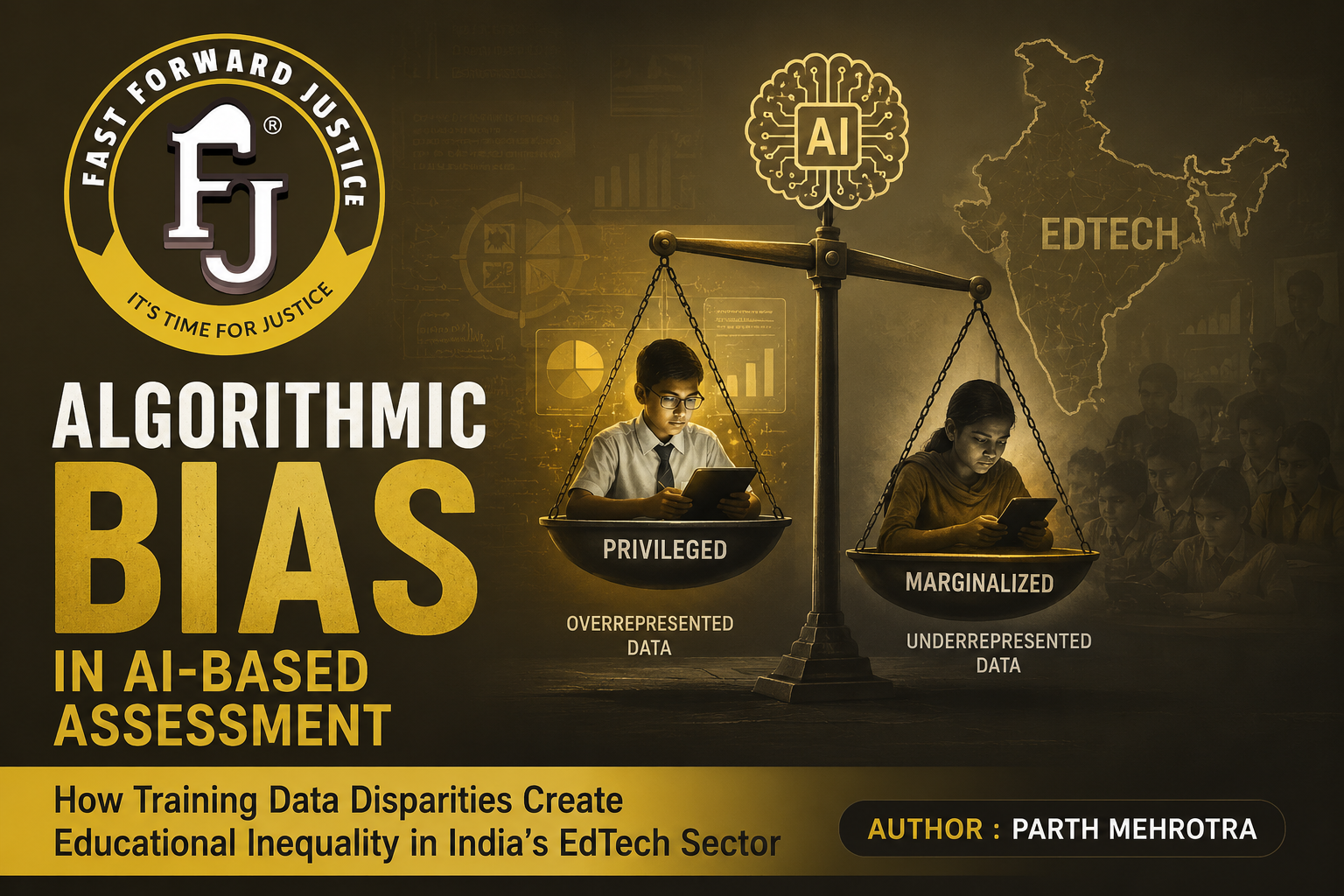
This is more severe in the Indian education landscape where there is a considerable socio-economic divide, linguistic diversity, caste discrimination, gender disparity and a rural-urban digital gap. The vast majority of AI-driven learning and teaching platforms that are active in India are modeled on data sets from digitally connected students, predominantly from urban areas, who speak English. As a result, ver- vernacular-medium,tribal and economically weaker section students, and those from rural areas, continue to be underrepresented in algorithmic training models, impacting fairness and accuracy of AI-generated educational assessments and recommendations.
For example, an AI language assessment system primarily developed using English language datasets might mispoint the performance of language learners in regional languages. Likewise, a predictive learning system can misclassify rural students as low-performing because they do not have access to strong internet connectivity or adequate opportunities to engage in the digital world, and could grant them social disadvantage.[5] This can result in unfair grades, unequal opportunities in education as well as disparities that create social disadvantages for learners who are marginalized by their lack of adequate connection to the internet or opportunities in the digital world.
The educational algorithmic bias is not a purely technological problem but concerns constitutional issues and also ethical and legal issues. AI-powered educational decisions can have a direct impact on scholarships, admissions, and career prospects as well as educational progression. Additionally, the lack of a holistic regulatory framework that oversees AI accountability in India’s education sector poses challenges for concepts like transparency, fairness, and prevention of automated discrimination as safeguards of equality and fairness majorly defined in Article 14 and 21A of the Constitution of India.[6]
Thus, this research paper aims to analyze if such differences in training data of AI-powered assessment systems can be a factor for educational inequality in the Indian EdTech space. It also examines ethical, constitutional and policy considerations that emerging from algorithmic biases, as well as the importance of inclusive and accountable AI governance in education.
2. Review of Literature
In the education field, professions have used the term “Artificial Intelligence” (AI) referring to the phenomenon that is reshaping the work of educators, given that AI algorithms designed for teaching and learning are trained with data from institutions and communities, whose practices and characteristics reflect varying socio-economic status and inequalities.[7]Despite extensive academic discussion, it is evident that AI will not be a ‘neutral technology’ in education, as it will be influenced by the nature of the underlying training datasets, institutional practices, and socio-economic contexts within which it operates.
As the EdTech sector in India continues to grow, scholars and education policymakers have intensified their research into and critical analysis of the dynamics between technology, digital inequality, and education.^4 Indian scholars and policy researchers have noted that digital learning platforms tend to mirror social and economic inequalities, particularly regarding class, caste, gender, language, and access to technology.[8]Digital inequalities become salient when AI systems are largely dependent on data gathered from digital platforms of dominant, urban, and privileged student communities.[9]
Research on AI-educational technologies found that predictive learning systems and adaptive tests conducted by AI tools could exacerbate historical inequalities when AI tools are trained on restrictive or limited data sets. Indian researchers have noted that many AI education technologies present in India are written in English and based on urban contexts of learning and are therefore less effective for students from rural and vernacular-medium educational backgrounds.
Given that several studies conducted in India on the digital divide in education identified insufficient internet connection, poor technology and accessibility support, and limited exposure to digital devices as some of the major factors creating a learning divide for students from rural and tribal communities and those in the economically weaker sections, they can be underrepresented by AI models, which in turn can cause fair grading, inaccurate performance predictions and exclusionary education recommendations through AI.
The Indian context of education also reveals issues around language inequities in AI tools for assessment which are built primarily using English-language data.Owing to the diverse language context of Indian education, it poses a challenge for AI systems that are trained mostly on English language data. Automated systems for assessment have been reported to have some difficulty transcribing responses written in another regional language or produced as native speech in other languages.[10] This presents the opportunity to create adverse consequences for learners on Hindi-medium and other vernacular school systems.[11]
Analyses of the constitutionality of algorithmic decisions and control over technological governance have been undertaken in Indian legal debates, with focus on the collection, surveillance, and profiling of student data in educational technology platforms potentially breach the Constitutional guarantees of equal treatment and arbitrariness.
However, there are dangers linked to the use of AI in education, as even policy-oriented literature has generated by the Institutions in the Indian context like NITI Aayog recognizes that these technologies, without adequate precautions, may exacerbate educational inequalities by potentially creating an advantage for those with greater exposure to digital tools and socioeconomic opportunities.[12]
Additionally, international institutions like UNESCO and OECD have supplemented the literature by identifying ethical government of AI, transparency, explainability and human oversight as central issues for AI tools and technologies in education.They recommend the importance of representative datasets and of fairness auditing as a mechanism to avert algorithmic discrimination in educational systems. Comparative studies on the EU AI regulation also point towards the importance of strict accountability demands for high-risk AI systems like those in educational assessment.[13]
Although substantial work has been carried out on AI ethics and digital education, limited Indian research explicitly explores how training data disparities lead to algorithmic bias and its resultant educational inequality in AI-based assessment.^28 Therefore, this study aims to address this research gap by critically examining the relationship between training data disparities, algorithmic bias, and educational inequality in Indian AI-based assessment.
3. Study Objectives
The aim of this research paper is to:
- To explore the algorithms bias in AI-based learning assessment systems.
- To investigate the issue of training data imbalance and its resultant impact on bias in educational outcomes in India’s Edtech industry.
- To explore the effects of algorithms designed to enrich and disadvantage marginalised and under-represented groups of students.
- To examine the constitutional, legal and ethical consequences of biased AI generated assessments.
4. Research Questions
The following research questions are aimed at by the present study:
- What are the implications of unequal data sets for training on fairness and accuracy across India’s EdTech sector?
- How do biased AI systems create a sense of educational inequity?
- What are algorithmic discrimination in education and its constitutional and legal implications?
- What are the strategies for establishing a transparent and ethical regulatory landscape for AI-based edtech tools in India?
5. Research Methodology
The present study has been conducted through a doctrinal and analytical research methodology to explore the issue of algorithmic bias in AI-based assessment system and its effect on educational inequality in the field of EdTech in India. The study is descriptive in nature where it examines “Artificial Intelligence Technologies for education in India and its aforementioned adoption in different educational systems including online learning platforms and assessment systems”.
The study has primarily used secondary sources of data such as books, journals articles, research papers, government reports, policy documents and internet resources with academic information on Artificial Intelligence, Educational Technology, Constitutional Law and Digital Governance. Other publications like NITI Aayog, UNESCO, OECD, and the Ministry of Education have also been cited to grasp the development of AI policy and moral issues surrounding AI governance.
The doctrinal dimension essays refer to curricular provisions, legal principles and judicial decisions on equality, inviolability of private life and the right to education. The constitutional provisions under articles 14, 19, 21 and 21A have been analysed to consider to whether algorithmic discrimination in educational assessments is a violation of fundamental rights or not.
The research also takes a comparative angle by briefly exploring the international material pertinent to ethical AI governance developments, such as the UNESCO recommendations and the EU’s AI regulatory framework. Qualitative analysis has been employed to study problems of representations in AI training sets, linguistic exclusion, socio-economic inequality, and rural-urban digital disparities.
The aim of the methodology was to examine critically the issue of bias in AI systems in the education sector and to propose legal and policy guidelines for promoting fairness, transparency, and accountability in India’s EdTech sector.
6. Discussion / Analysis
6.1 Algorithmic Bias – What does it mean?
1 Meaning of Algorithmic Bias
Algorithmic bias occurs when Artificial Intelligence (AI) systems repeat patterns in large datasets and make predictions which are unfair, discriminatory or unequal against certain individuals or groups. AI systems operate by extracting patterns from vast amounts of data and algorithmically predicting outcomes. Decisions generated by these systems can thus reflect and reinforce inequalities and exacerbate social disadvantages inherent in the data used in algorithm development, especially where data is incomplete, or under-represented, or reflects social inequalities.[14]
Simply put, algorithmic bias is where AI systems can be unfair towards people or groups of people, through faulty data collection techniques, underrepresentation of certain groups that are marginalized, inaccurate data labelling, or assumptions built into the data models of algorithms.AI systems can be trained to recognize patterns present in the historical data on which they are based, which can perpetuate or even reinforce discriminatory practices that exist in society.
The term algorithmic bias in education is used to describe a discouraging or inaccurate inference derived from the output of AI-powered learning technologies, such as automated grading systems and predictive learning models, automated assessments, and even online proctoring tools.[15] AI algorithms are meant to assess student behaviour, performance, engagement, and capabilities based on an automated analysis of their digital data. But if based on biased datasets or created without sensitivity to varied learning backgrounds, such systems can unfairly impact specific groups of learners.
AI powered grading systems, for instance, which have primarily been developed based on the responses of students in English speaking cities might not accurately categorize students’ answers in rural areas or from disadvantaged and other language or cultural backgrounds, due to knowing how to interact with the system online. No intentional discrimination, but the unequal nature of training data leads to discriminatory outcome of the algorithm.
Algorithmic bias in edtech can manifest in numerous ways, such as: representation bias, measurement bias, historical bias and automation bias. Representation bias is the under-representation of social groups in training data and historical bias is the perpetuation of the caste, gender and socio-economic inequalities in educational data.[16]Automation bias also happens when the educational sector over-automates decisions without accompanying human oversight.
The situation is complicated in India where there is extensive social, economic, linguistic and regional diversity in the educational systems, which can more easily lead to exclusion and educational disadvantage, if AI systems are not designed in consideration of this issue. Hence, the phenomenon of algorithmic bias is a matter of concern in the India EdTech industry which extends beyond technology to a larger issue of equality, fairness and access to education as defined by the Constitution.
6.2 Training Data Disparities in India
(a)Data Disparities in training in India
AI-driven education technologies set up in India typically rely on data derived from students in urban areas, who speak English and are digital natives.[17] However, learners in marginalized cultures and communities are often underrepresented in AI training data, resulting in disproportional and potentially discriminatory effects.
(b) Socio-Economic Inequality
This may lead to certain models producing biases in predicting learning outcomes and learning recommendations from AI systems, potentially disadvantaged students in economically poorer circumstances. Students of private schools in urban areas tend to have access to more digital infrastructure, online learning platforms and technological resources than those of students of government schools in rural areas.
(c) Linguistic Disparities
Given India’s multilingual nature, with significant portions of its students educated in Hindi and regional languages, the lack of linguistic diversity in training datasets can lead to biases in AI assessment systems, affecting students whose answers are not postable in English.[18] This can lead to discriminatory assessment practices and a loss of educational opportunities, particularly for students in non-English-medium schools.
(d) Rural-Urban Digital Divide
Over time, AI-education systems might misinterpret the lower engagement of rural students themselves as less academic ability or lower engagement, due to the reduced availability of engagement data from an under- connected, low-device penetration context, exacerbated by access to promiscuous electricity.
(e) Historical and Social Bias
To the extent that historical education data is shaped by historical inequalities associated with caste, gender-based, class-based and economic background, AI systems risk replicating these inequalities through the automated provision of predictions and recommendations.[19]
6.3 The effect on educational equality
(a) Unfair | Grading and Ranking
Biased AI-powered assessment frameworks can result in inaccurate marking and/or unfair academic rankings for learners in underrepresented groups. The representations of the various linguistic, cultural and socio-economic contexts that AI systems are trained on may not accurately capture the context in which students belong to rural areas, vernacular medium schools or come from a marginalised background may be evaluated differently despite similar academic performance. These flawed estimates can have harmful consequences on educational performance records and future educational opportunities.
(b) Scholarship opportunities decreased
The potential of AI-generated evaluations is increasingly impacting scholarships, admissions, and merit-based educational opportunities. Algorithmic systems can generate biased decisions which could lead to the exclusion of students from disadvantaged groups from scholarships and financial assistance. This can further contribute towards the widening up of education disparity by favouring no access to good education for economically less of society.[20]
(c) discriminatory career guidance recommendations to children
Various learning management systems rely on AI systems for career advice and forecasting student capabilities. But, certain algorithms based on their historic and incomplete patterns in data may give the students specific academic or career trajectory, which could be biased of course. These types of directives can be re-enforcing of social stereotypes and limiting the opportunities for the marginalised learner.[21]
(d) Decrease Confidence/ Psychological Stress
Chronic feedback with negative or incorrect algorithmic assessments could harm student mental health and confidently. Often negative assessments by AI can lead students to low self-esteem, anxiety, and a sense of insecurity in their studies. Discriminatory technological systems could also affect participation and motivation within education contexts due to psychological stress[22]
(e) Reinforcement of Social Exclusion
Learners may be continuously disadvantaged by algorithmic bias and it can continue to perpetuate existing trends in social exclusion. AI-powered tools, when applied repeatedly in a learning environment, can level up—the former privileged learners, and down—the others, thereby resulting institutionalization of educational inequality through technical mechanisms. AI systems that are biased can exacerbate socio-economic and educational inequalities in society, rather than reducing them.
6.4 Ethical Concerns
(a) Transparency lacks.
One of the major ethical concerns relating to AI-based educational systems is the lack of transparency in algorithmic decision-making processes. Many artificial Intelligence technologies are so-called “black box” systems; that is, systems in which any student, teacher, or institution has a difficult time understanding how these decisions are made. Without explainability it is hard to find mistakes, appeal negative results or be able to hold testers to account in education assessments.[23]
(b) Accountability Deficit
An additional significant moral factor is the absence of transparency in the charge for discriminatory algorithmic results. Often there is confusion amongst software developers, educational institutions, data providers, and EdTech companies about who should make a biased assessment. When there are no well-defined regulations and methods, students who are impacted by wrongful AI-generated decisions may not know to whom to ascribe responsibility either legally or ethically.[24] Having privacy problems with data is a critical issue. AI education systems gather and analyse vast quantities of data from students, such as their academic performance, conduct, biometrics and internet usage. There are significant issues with surveillance, profiling, the sharing of personal data on a massive scale and misuse of personal data. In digital learning environments, students’ privacy rights might be violated if necessary measures are not put in place.
6.5 Constitutional Concerns
The use of algorithmic discrimination in educational assessment systems under Indian law is extremely problematic on constitutionality grounds. Article 14 of the Constitution guarantees the Right to Equality and prohibits arbitrary discrimination. There is a risk that AI systems could produce differential results against certain communities of learners, based on language, socioeconomic status, caste, gender and location among others, and thus breach constitutional norms of equality and fairness.[25]
Right to Life and Personal Liberty as guaranteed under article 21 of the Constitution includes the Right to Live in Dignity and protection of Privacy. AI systems that gather too much data about students, or yield unfair outcomes in education, in turn, threaten these constitutional protections. Likewise, Article 21A provides the Right to Education, which is an ongoing commitment of the Constitution towards equal opportunity to education.[26]
The biased AI systems threaten the constitutional values as they lead to unequal access to educational opportunities and promote structural disadvantages for marginalised communities. Thus, its application in education needs to be done in a constitutional manner with respect to constitutional rights, transparency, accountability, and constitutional principles of non-discrimination.
7 Case Laws / Case Analysis
7.1 Justice K.S. Puttaswamy (Retd.) v. Union of India
This is one of India’s landmark decisions as the right to privacy is declared as fundamental right. The Court highlighted what it termed ‘informational privacy, data protection and autonomy of persons in the digital age’. What makes this case so relevant in the context of AI systems in education is that they are so comprehensive, for instance gathering and processing a whole host of student data such as school performance, behavioral dynamics, biometric data, and online learning activities. The judgment holds that educational institutions and EdTech platforms need to implement sound, lawful, and transparent data collection practices, ensuring that they do not involve in unnecessary surveillance of students or in the inappropriate use of their personal information.[27]
7.2 Shreya Singhal v. Union of India
In the present case, the Supreme Court set aside Section 66A of the Information Technology Act, 2000 finding that a vague and arbitrary law infringed on freedom of speech. In the judgment, the emphasis was on transparency, reasonableness and safeguards against arbitrary government action. This might be relevant in the context of AI driven educational assessment systems where opaque and non-explainable algorithms could result in arbitrary and discriminatory educational assessments, excluding students from the chance of challenging such assessment.[28]
7.3 Anuj Garg v. Hotel Association of India
In this instance, the Supreme Court highlighted a focus on substantive equality and determined that any laws or practices grounded on stereotypes and structural discrimination is in contravention of Article 14 of the Constitution. The judgment acknowledged the need to protect people from indirect and systemic forms of discrimination in order to be equal. The latter is essential to understand the potential for algorithmic bias because AI systems based on historically unequal datasets can unwittingly burnish historic social and educational disparities against marginalized learners.[29]
7.4 State of Kerala v. N.M. Thomas
The Supreme Court noted that equality is not merely formal equality but one where the inequalities of weaker sections of society are also considered. The case lends credence to the notion that a technological system like an AI assessment system for education should necessarily include social and economic inequalities.[30]
7.5 Loomis v. Wisconsin
This case has come before the international court in the framework of criminal justice but is still an impactful case in terms of the dangers of automated decision-making. The court discussed the use of algorithmic risk assessment tools and was concerned about the lack of transparency, lack of accountability and the lack of ability of individuals to fully understand the decisions of algorithms that affect their rights. As the case illustrates, the “black box” nature of AI systems raises larger legal issues and points to the need for explainability and human oversight in algorithmic governance.[31]
7.6 Analysis of Case Laws
Judicial rulings, as cited above, collectively illustrate that in the regulation of AI-based educational technologies, the constitutional principles of equality, privacy, transparency, fairness and accountability are extremely pertinent. In the bookshala of constitutional jurisprudence, there will be a strong indication that some systems based on technology cannot function beyond the dimensions of fundamental rights. Educational assessments that rely on AI algorithms and result in unequal outcomes, or those that lack clear and fair decision-making processes, might raise constitutional concerns regarding principles of equality and fair treatment under Articles 14 and 21 of the Constitution of India.
These cases further point to needed explainable, accountable AI systems in the education sector. Determinations of academic opportunities, scholarships, admissions and career opportunities, based on automated decisions, continue to require human scrutiny and oversight. These judgments have led to the formation of judicial principles that serve as crucial constitutional grounding to build AI governance frameworks – based upon ethics and a guaranteed set of rights – within the Indian EdTech landscape.
8. Findings
According to the study, the EdTech space in India is far from completely neutral or objective in its deployment of AI-based assessment systems, which rely, to a large degree, on the quality and representativeness of the training sets. Machine learning systems based on biased and incomplete data can reinforce learning and social inequalities in automated decisions.
The study suggests that the majority of AI-based learning systems in India are based largely on data from urban learners and those who speak English and are digitally connected. This has created a situation where students from vernacular medium, tribal community, rural area and economically weaker sections are still under-represented in AI training models. This underrepresentation has a negative impact on the correctness and equity of automated judging and educational suggestions.
Another key conclusion of the study is that linguistic diversity presents a key challenge to AI-driven education technology platforms in India. Many assessments systems developed using English language data sets are poor at providing a precise evaluation of regional language written or spoken responses. This means that students who study in vernacular-medium schools can be discriminated against or get inaccurate results in the evaluation.
Another significant conclusion is about the rural-urban digital divide, which makes a significant contribution to algorithmic bias. Students who do not have a lot of internet and those who have poor digital infrastructure or do not log in regularly into the internet often give incomplete educational information. Such restrictions can lead to misinterpretations about their academic performance or lack of engagement on an AI system and can thus reinforce educational disadvantage.
The study also reveals the potential broader constitutional and ethical consequences of algorithmic bias for education. AI powered assessments involving academic performance, admission, scholarships and career opportunities can be a breach of equality, fairness and non-discrimination, as enshrined in the Constitution of India. Many AI systems are non-transparent with no explainability making decisions even more arbitrary and unaccountable.
The research also indicates a lack of a holistic legal and policy framework to govern AI’s accountability in the context of edtech in India today. There is limited coverage of such practices at a policy level for the protection of discriminatory practices in algorithmic functioning, with no mandatory measures for fairness audits, transparency guidelines or independent scrutiny of AI systems in education.
In conclusion, the study suggests that while AI technologies have great promise in making education accessible and efficient, their unrestricted use can potentially exacerbate educational inequality unintentionally. Therefore, to guarantee that AI-powered educational systems are executed fairly, responsibly, and socially responsibly, inclusive data collection, human oversight, ethical AI governance and clear regulatory frameworks are crucial.
9. Recommendations / Suggestions
9.1 Inclusive Dataset Development
Student data for training AI systems should consist of students from all socio-economic, regional and linguistic background including Government Schools, Regional Language Schools and tribal society students from rural areas. Increased representation in data sets can lead to better accuracy and fairness in automated tools and assessments and minimize discrimination of marginalized learners.
9.2 Mandatory Bias Audits
There needs to be regular fairness and anti-discrimination audating of AI systems in the educational domain to be done by independent, regulatory bodies. Such audits can be useful in identifying skewed results and ensuring that algorithmic systems are adherent to the constitution’s calls for equality and non-discrimination.
9.3 Transparency Requirements
There is a need for transparency among EdTech providers and education stakeholders regarding AI technologies, including where they have been trained, how they were evaluated, how biases are mitigated, and how they are used to make decisions. Transparent systems will support to establish responsibility while fostering clarity and awareness around automated decision-making.
9.4 Human Oversight
There is a need, therefore, for human oversight to be a crucial element in AI-assisted assessment processes for education. Automated systems should support the teacher and the institution and not substitute human judgment. Student should be provided with avenues for recourse in the event of incorrect or discriminatory AI-created decisions.
9.5 Sector-Specific AI Regulation
A governance framework for AI in education, with specific laws and regulations, should be created in India. These policies ought to center around accountability, fairness, privacy, transparency, and algorithmic discrimination prevention in the EdTech area.
10. Conclusion
Artificial Intelligence has played a transformative role in the field of education, bringing about profound changes in the way assessments are conducted.AI-based assessment systems are changing the face of education by providing automated solutions, adaptive learning, predictive analytics, and personalized experiences. AI technologies have the potential to transform accessibility, efficiency, and scalability in the learning process, particularly in a country like India where the education sector is plagued by challenges like lack of teachers, mainstream access to quality education, and having vast student bases. Educational platforms powered by AI can provide personalized learning approaches, immediate feedback and knowledge, and data-driven support for students’ learning.
The study, however, shows that ascribing absolute objectivity or neutrality to algorithmic or system is misleading. AI systems rely on training sets, and the fairness of algorithmic outcomes has a significant reliance on the quality, diversity, and representativeness of such data. Existing social, economic, linguistic, or regional disparities in datasets can also be replicated and perpetuated by AI systems in automated educational assessments and recommendations.
The study also reveals that, India’s educational landscape poses distinctive challenges for AI governance due to its diversity. Algorithmic fairness is being heavily impacted by the gaps between language, caste and socio-economic, geographical distribution and education. In many cases, students from vernacular medium and tribal schools, from rural and economically weaker and weaker sections stay under-represented in the frame work of AI Training. This can lead to incorrect assessments, discriminatory forecasting, and opportunities.
The study also reveals that the algorithmic bias in education is not just a technical problem; it is a constitutional, ethical and human rights problem too. AI-driven education choices in admissions, scholarships, academic ranking, and career guidance could be an infringement on the equality, fairness, privacy, and freedom from discrimination protected by the Constitution of India. Many AI systems lack transparency and accountability, which can exacerbate the risk of arbitrary and opaque processes.
Summarizing the results, the research postulates that achieving fairness in AI education should involve collective development of education datasets, transparent AI algorithmic systems, periodic auditing, and effective regulations. India needs transparent and responsible frameworks for AI development and management which focuses on equitable education, student rights, and social inclusion. Technological innovations in educational contexts need to be a means or enabler for empowering education and equality, rather than a tool or mechanism that creates and exacerbates social and educational inequalities.
11. References
Books
- Anil K. Gupta, Artificial Intelligence and the Future of Education in India (2021).
- Cathy O’Neil, Weapons of Math Destruction: How Big Data Increases Inequality and Threatens Democracy (2016).
- Frank Pasquale, The Black Box Society (2015).
- Gautam Bhatia, The Transformative Constitution (2019).
- Jean Drèze&Amartya Sen, India: Development and Participation (2d ed. 2002).
- P. Jain, Indian Constitutional Law (8th ed. 2018).
- SafiyaUmoja Noble, Algorithms of Oppression: How Search Engines Reinforce Racism (2018).
- Stuart Russell & Peter Norvig, Artificial Intelligence: A Modern Approach (4th ed. 2021).
- UpendraBaxi, The Future of Human Rights (3d ed. 2008).
- Virginia Eubanks, Automating Inequality: How High-Tech Tools Profile, Police, and Punish the Poor (2018).
Journal Articles
- Joy Buolamwini&TimnitGebru, Gender Shades: Intersectional Accuracy Disparities in Commercial Gender Classification, 81 Proceedings of Machine Learning Research 1 (2018).
- NandiniChami, Artificial Intelligence and Digital Inequality in India’s Education Sector, 57 Economic and Political Weekly 14 (2022).
- Ryan S. Baker & Aaron Hawn, Algorithmic Bias in Education, 1 International Journal of Artificial Intelligence in Education 1 (2021).
- K. Mishra &RuchiVerma, Artificial Intelligence in Indian Education: Opportunities and Challenges, 8 Indian Journal of Law and Technology 45 (2022).
- UshaRamanathan, Technology, Governance and Human Rights in India, 55 Economic and Political Weekly 32 (2020).
Reports and Policy Documents
- Government of India, Ministry of Education, UDISE+ Report 2022–23 (2023).
- NITI Aayog, National Strategy for Artificial Intelligence: #AIForAll (2018).
- OECD, Digital Education Outlook 2023: Towards an Effective Digital Education Ecosystem (2023).
- UNESCO, Recommendation on the Ethics of Artificial Intelligence (2021).
- Wayne Holmes et al., Artificial Intelligence in Education: Promises and Implications for Teaching and Learning (UNESCO 2019).
Case Laws
- Anuj Garg v. Hotel Association of India, (2008) 3 SCC 1.
- Justice K.S. Puttaswamy (Retd.) v. Union of India, (2017) 10 SCC 1.
- Loomis v. Wisconsin, 881 N.W.2d 749 (Wis. 2016).
- Shreya Singhal v. Union of India, (2015) 5 SCC 1.
- State of Kerala v. N.M. Thomas, (1976) 2 SCC 310.
[1] Stuart Russell & Peter Norvig, Artificial Intelligence: A Modern Approach 1–5 (4th ed. 2021).
[2] NITI Aayog, National Strategy for Artificial Intelligence: #AIForAll 34–38 (2018).
[3] OECD, Digital Education Outlook 2023: Towards an Effective Digital Education Ecosystem 95–102 (2023).
[4] Safiya Umoja Noble, Algorithms of Oppression: How Search Engines Reinforce Racism 10–18 (2018).
[5] Ryan S. Baker & Aaron Hawn, Algorithmic Bias in Education, 1 Int’l J. Artificial Intelligence Educ. 1, 14–20 (2021).
[6] Justice K.S. Puttaswamy (Retd.) v. Union of India, (2017) 10 SCC 1.
[7] NITI Aayog, National Strategy for Artificial Intelligence: #AIForAll 34–42 (2018).
[8] Amartya Sen, The Idea of Justice 225–30 (2009).
[9] Jean Drèze & Amartya Sen, India: Development and Participation 95–102 (2d ed. 2002).
[10] Amita Dhanda, Technology and Inclusive Education in India, 14 Indian J. Disability Stud. 20, 24–27 (2021).
[11] Gautam Bhatia, The Transformative Constitution 180–86 (2019).
[12] UNESCO, Recommendation on the Ethics of Artificial Intelligence 20–28 (2021).
[13] European Commission, Artificial Intelligence Act Proposal COM (2021) 206 final.
[14] Stuart Russell & Peter Norvig, Artificial Intelligence: A Modern Approach 25–30 (4th ed. 2021).
[15] Ryan S. Baker & Aaron Hawn, Algorithmic Bias in Education, 1 Int’l J. Artificial Intelligence Educ. 1, 5–10 (2021).
[16] UNESCO, Recommendation on the Ethics of Artificial Intelligence 20–25 (2021).
[17] Virginia Eubanks, Automating Inequality: How High-Tech Tools Profile, Police, and Punish the Poor 20–28 (2018).
[18] Neil Selwyn, Should Robots Replace Teachers? AI and the Future of Education 60–68 (2019).
[19] Nandini Chami, Artificial Intelligence and Digital Inequality in India’s Education Sector, 57 Econ. & Pol. Wkly. 14, 18–24 (2022).
[20] Usha Ramanathan, Technology, Governance and Human Rights in India, 55 Econ. & Pol. Wkly. 32, 35–40 (2020).
[21] Id.
[22] Cathy O’Neil, Weapons of Math Destruction: How Big Data Increases Inequality and Threatens Democracy 3–8 (2016).
[23] Ryan S. Baker & Aaron Hawn, Algorithmic Bias in Education, 1 Int’l J. Artificial Intelligence Educ. 1, 14–18 (2021).
[24] Nandini Chami, Artificial Intelligence and Digital Inequality in India’s Education Sector, 57 Econ. & Pol. Wkly. 14, 18–24 (2022).
[25] Jean Drèze & Amartya Sen, India: Development and Participation 95–102 (2d ed. 2002).
[26] Cathy O’Neil, Weapons of Math Destruction: How Big Data Increases Inequality and Threatens Democracy 21–30 (2016).
[27] Justice K.S. Puttaswamy (Retd.) v. Union of India, (2017) 10 SCC 1.
[28] Shreya Singhal v. Union of India, (2015) 5 SCC 1.
[29] Anuj Garg v. Hotel Association of India, (2008) 3 SCC 1.
[30] State of Kerala v. N.M. Thomas, (1976) 2 SCC 310.
[31] Loomis v. Wisconsin, 881 N.W.2d 749 (Wis. 2016).