
Introduction / Statement of Research Problem
Police discretion is an irreplaceable element of the criminal justice system which is essential for police officers to effectively respond to ever-changing and complicated crime prevention, investigation, arrest, detention and public order maintenance scenarios. In each legal regime, police officers are held to some degree of discretion in their use of force because there simply can’t be a broad and detailed set of legal guidelines that account for all the practical situations in which it’s exercised. But the absence of constitutional restrictions, accountability mechanisms and procedural safeguards when this discretion is put into practice, it produces arbitrary arrest, unlawful detention, custodial torture and abuse of power, infringing on fundamental human rights.[1]
The problem of abuse of police power in India has since long been there since the Colonial era. The infrastructure and working of the police force in India was originally established according to the Police Act of 1861, whose main focus was to ensure imperial control, though since Independence, India has a democratic constitution, many aspects of the colonial police remain pertinent to today’s functioning police system. As a result, the application of police discretion has been seen to entail unnecessary executive power, policing that involves excessive force and less respect for constitutional rights.[2]
The Constitution of India is a detailed measure designed to check the state and to ensure protection of individual liberties. The combination of Article 14, 19, 20, 21 and 22 of the constitution collectively place a check on arbitrary police actions. Under Article 14, no one can be denied equality before the law and nothing can deprive an individual of their personal liberty or their life by arbitrary action of the government; Article 21 affords special protection against deprivation of life and freedom of action in any circumstances, while Article 22 affords special safeguards against arbitrary arrest and deprivation of life and liberty, such as timely access to a lawyer, notice of the reason for arrest, and prompt production before a magistrate.[3]
These constitutional safeguards have been interpreted by the courts and have encompassed many additions. The Supreme Court of India has reiterated several times that exercise of police powers should be an expression of constitutional morality and human dignity in a fair, just and reasonable manner. The landmark judgments – D.K. Basu v. State of West Bengal, Joginder Kumar v. State of Uttar Pradesh, Arnesh Kumar v. State of Bihar – underscore judicial awareness of the dangers arbitrary police powers bring to the rule of law and democracy.[4]
The recently enacted Bharatiya Nagarik Suraksha Sanhita, 2023 aims to modernize criminal procedure and streamline accountability in procedural aspects, including digital documentation of criminals’ cases and reasons for arrests. The question is, however, whether these changes are sufficient to deal with some of police discretion’s institutional and constitutional issues.[5]
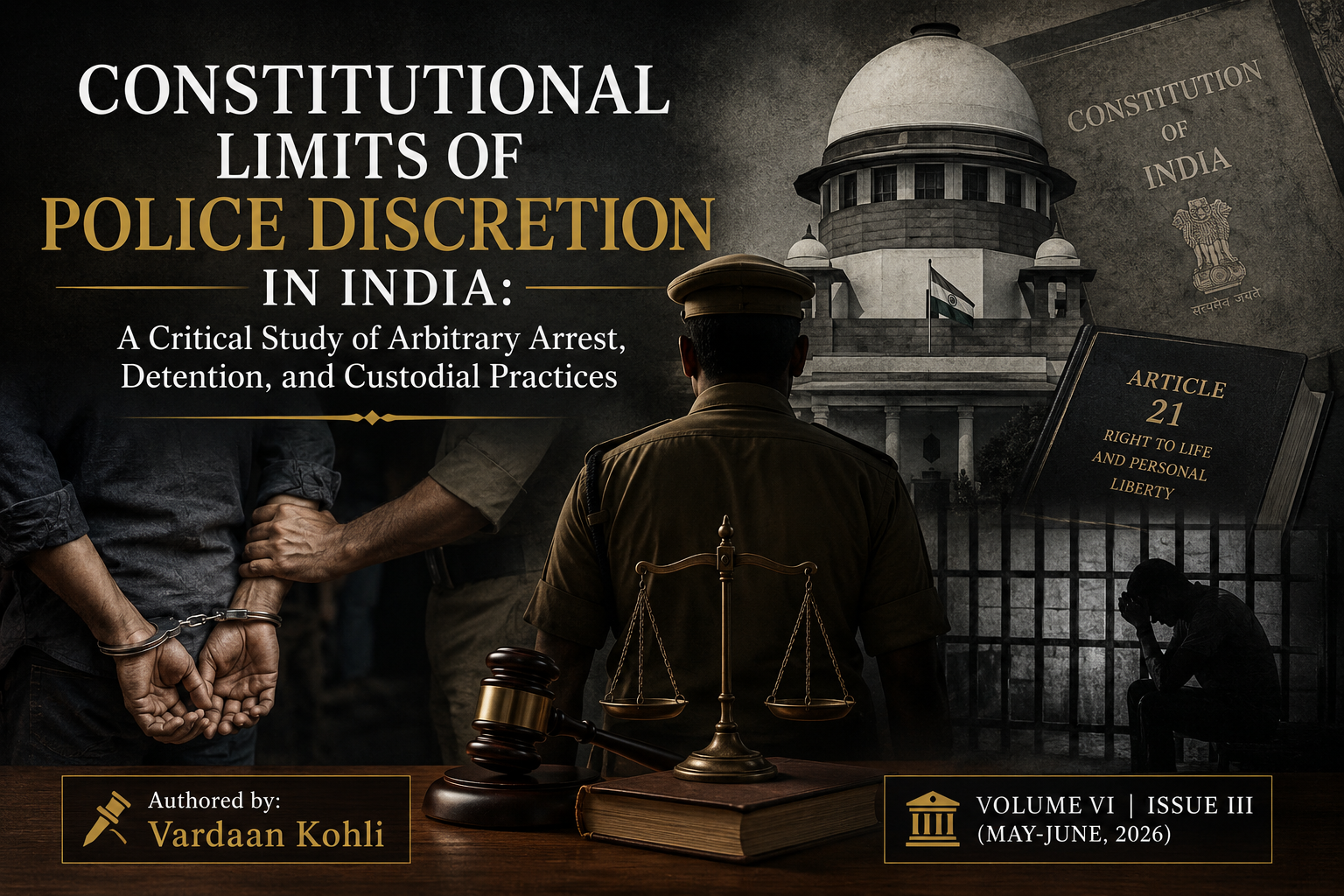
In the present backdrop, the present study looks at the constitutional restrictions placed by various provisions over the police discretion in India, highlighting arbitrary arrest, detention and custodial practices. The study assesses the effectiveness of the constitutional protections, court decisions, laws and institutions, and whether the overall legal framework protects individual liberty and human dignity against the abuse of police power. The paper also examines the need for structural changes to the police force, police accountability, and rights-sensitive policing methods so that the police can work within constitutional bounds with a democratic governmentstyle and the Rule of Law.
Review of Literature
There are significant works on constitutional rights, police powers and criminal, justice administration in India. Personal liberty, equality before law, limitation on power of state have been discussed to the great length by M.P. Jain and V.N. Shukla. However, the constitutional philosophy of the three articles – 14, 21 and 22 – has been explained by the works, which highlights the role of judiciary in protecting civil liberties against arbitrary action by the executive.[6] D.D. Basu has also emphasized the transformative interpretation by the Supreme Court in the case of Article 21 and how it has expanded the concept of procedural fairness, due process and protection against abuse of police authority.[7]
As a critic of the Indian legal structure, Upendra Baxi dissects its structural flaws and how it reinforces inequalities in access to justice, thereby hindering the effective implementation of constitutional rights.[8] An examination of colonial legacy of policing in India was made by K.S. Subramanian, while David H. Bayley and Arvind Verma have studied the policing systems and their importance in getting rid of policing without community service, accountability and professionalization.[9],[10]
Custodial violence and police accountability have been the specific focus of several scholars. Together, these academic pieces illustrate that custodial violence is not an individual act that can simply be identified and rectified, but indeed, a phenomenon that is pervasive in the criminal justice system and part of a broader problem of institutional failure and structural inequalities.
There has also been a considerable amount of discussion about police discretion and custodial rights, as reflected in judicial decisions. Judgements like D.K. Basu v. State of West Bengal, Joginder Kumar v. State of Uttar Pradesh and Arnesh Kumar v. State of Bihar gave importance to the procedural safeguards against arbitrary arrest and custodial abuse.[11]These judgments highlighted the aspects of transparency, accountability, and procedural fairness in criminal justice administration. Yet, from a jurisprudential as well as a commentator’s standpoint, there are continuing debates over the inconsistencies in the implementation of these safeguards in a healthy fashion, an issue of lacking enforcement as well as institutional resistance.[12]
In recent literature, criminal law reforms and the Bharatiya Nagarik Suraksha Sanhita, 2023 and the impact of these reforms have also been explored. These changes focus on digitisation, documentation and procedural modernisation, but the continuation of wide discretionary powers, some practices for ‘preventive arrest’ and poor accountability mechanisms are still of concern in contemporary studies.[13]Some experts go on to state that, alongside institutional change, and the independent oversight and monitoring necessary for this, digitisation, documentation and procedural change are of little value in resolving deep-seated structural issues in policing.[14]
Overall, the literature shows that though India has a robust constitutional and legal regime with the view of curbing police arbitrary powers and ensuring citizens’ personal freedoms, the systemic and institutional frailties continue to hinder the adequate provision of protection against police arbitrary action. The need for comprehensive reforms focusing on strengthening accountability, transparency, judicial oversight and rights-oriented police work is thus strongly underlined by existing scholarship.
Objectives of the Study
- To analyse the concept and scope of Police Discretion in Indian context.
- To evaluate constitutional protections of arrest, detention and custody.
- To examine ‘the arbitrary use of police powers lead to arbitrary arrest and custodial violence’.
- To assess the contribution of judiciary in safeguarding individual liberty and custodial rights.
- To explore the structural and socio-legal aspects that help in lack of discretion in police activities.
Research Questions
- In India, what are the constitutional limitations on Police discretion?
- What is the violation in arbitrary arrest and unlawful detention of one’s fundamental rights?
- Are the actuelante procedures safe-guarded against custodial abuse?
- How the judiciary has curtailed police authority and custodial practices?
- What is said about the structure and socio-legal factors and how is police discretion being misused?
- If the new criminal law regime have met the concerns about police arbitrary powers.
Research Methodology
The present study is mainly doctrinal and analytical in nature. It dwells on the constitutional and legal regime of police discretion in India with reference to arbitrary arrest, detention and custodial practices. The study primarily relies on secondary sources including relevant policy reports, journal articles, books and other secondary literature on police powers and safeguarding fundamental rights as well as the Constitution provision, statutory provisions and judicial pronouncements with the rights to protection.
The doctrinal method has been used to consider the legal principles governing the police power in the Constitution of India and criminal procedural laws. The study examines how Article 14, 19, 20, 21 and 22 of the constitution and certain provisions of once related to arrest, detention, investigation and custodial procedures provide for safeguards. The study also explores the impact of the recently enacted criminal law reforms under the Bharatiya Nagarik Suraksha Sanhita, 2023 and Bharatiya Nyaya Sanhita, 2023.
The primary sources used in the process of research encompass the Constitution of India, statutory enactments, Supreme Court and various High Courts judicial pronouncements, reports of the Law Commission of India, reports of human rights institutions, and governmental documents connected with the administration of policing and criminal justice.
A large number of secondary sources like books, journals, papers and other legal commentaries, reports and databases on internet were also used. Academic studies on constitutional law, criminal law process, human rights, and police reforms have been analysed to derive the meaning of the evolution of the police discretion and the problem of its misuse.
The study has been conducted by using critical and comparative approach. The paper tests the real-life impact of constitutional protections, court remedies and mechanisms of accountability against arbitrary police practices and custodial abuse. Taking into account the comparative references made to international human rights standards and the best practices and intergovernmental experiences in the matter of arrest, detention and custodial rights to evaluate the strengths and weaknesses of the Indian legal framework.
This is a qualitative study that will involve legal interpretation, judicial reasoning and institutional analysis. It aims to identify bridges the Constitution has yet to cross and suggest mechanisms for making it a reality and better, with a particular focus on increasing accountability, transparency and safeguards of individual freedom in the policing system.
Discussion / Analysis
4.1 Constitutional Safeguards Against Arbitrary Police Powers
The Constitution of India provides for a detailed set of rules designed to limit the power of the state, and safeguard citizens from unfair interference by the police. While discretion is essential for the proper functioning of the criminal justice system, it can be governed by constitutional restraints which are meant to place fair, accountable, and human dignity considerations on the use of discretion. Articles 14, 19, 20, 21 and 22, taken together, provide substantive and procedural protections which limit arbitrary arrest, detention, abuse of or mistreatment in police custody, and misuse of investigative powers. These provisions in particular are a reflection of the constitutional determination of the Rule of Law and Democratic Governance.
Article 14 is a guarantee of equality before the law and equal protection of the laws. Accordingly, the Supreme Court has consistently held that this prohibition on arbitrariness of State action applies to police exercise of discretion in arrest, search and investigation and requires reasonableness and nondiscrimination.[15]Politically chosen criteria, such as caste, religion, economic status and personal discourses are some of the grounds upon which police powers are exercised arbitrarily and in violation with the promises of equality and constitutional governance. The judiciary has also noted on many occasions that any action without reason is incompatible with equality and thus, limits discretionary police action in the constitution.
Auto Article 19 guarantees several civil liberties such as freedom of speech, assembly, mobility and association. These freedoms are frequently directly impacted by excessive or unjustified police action, especially in the course of public protests, political demonstrations and during preventive detention. Freedom of expression and assembly can only be restricted based on a legitimate aim and for reasons of public order and security that uphold the test of proportionality and reasonableness; police measures cannot be used to quench legitimate dissent or democratic participation.² Judicial interpretation has ensured that the protection of public order does not turn into an excuse for curbing civil liberties in an indiscriminate manner.[16]
Article 20 guarantees the protection against arbitrary criminal prosecutions and compelled self-incrimination. Clause (3) is of particular safeguard, that is, it prevents a person from being forced to incriminate himself. This protection is all the more significant during custodial interrogations where coercive techniques might be used. The judgment has also expanded the reach of Article 17(21) and 20(3) by stating that the rights to protect personal liberty and privacy in mind (mental privacy) and individual’s right to confidentiality in thought and ideas (cognitive autonomy) are constitutional rights[17].
Article 21 is the keystone of the constitution protection against the arbitrary police action. This was interpreted narrowly at first and then in the landmark Maneka Gandhi v. Union of India, Supreme Court ruled that any process which takes away personal liberty must be fair, just and reasonable and that this liberty encompasses the following elements: dignity, legal aid, fair trial, protection against torture and procedural fairness.[18] The Court then over time decided a series of cases in support of a rights-centric jurisprudence in the realm of Article 21, setting up clear constraints on police powers to operate.
The article 22 is particularly concerned with arrest and detention. These guarantees are designed to prevent secret arrests, illegal arrest or police abuse of authority.⁵ These are meant to be brought before a magistrate within twenty four hours. Preventive detention under it is, however, allowed under certain conditions, setting up an ambulatory situation between state security and personal liberty.
Decisions from the nation’s courts have also enhanced the constitutional protections of police powers. These pertain to requirements of prior arrest memo, medical check-up of arrested persons, record of arrest and communication with relatives in D.K. Basu v. State of West Bengal.[19]In the same manner, in Joginder Kumar v. State of Uttar Pradesh, the Court reiterated the necessity for accountability and procedures for ensuring procedural fairness in criminal justice administration.[20]
Thus the constitutional framework that governs police discretion is sensitive to the legitimate needs of police as well as protection of individual liberty. However, sporadic arrests without solid implementation and accountability in the legal sub-system indicates a need for more than just legal protections. The authorities must continue to pay attention to structural reforms, judicial vigilance and independent oversight, to guarantee that police powers are applied in a manner consistent with the Constitution and democracy.
4.2 Arbitrary arrest and misuse of police discretion
One of such coercive powers enjoyed by the police, which directly impact the means of personal liberty of an individual is arrest. Arrest is an integral part of investigation of crime, prevention of crime and maintenance of public order but the use of arrest powers by the police officers has remained a longstanding problem in the Indian criminal justice system. Arbitrary arrest is defined as the deprivation of liberty without any justified law, adherence to procedures or real necessity. These practices are a denial of Article 14, 21, 22 of the constitution and cast a shadow on the rule of law.
In the past the arrest powers in India have been used extensively and sometimes mechanically. This resulted in overcrowding of prisons, unnecessary extension of sentence for undertrial prisoners and misuse of police authorities.In many cases, arrests were used to harass, instill pressure, collect confessions or to show efficiency as an administrative tool to secure justice.
The Supreme Court has on many occasions commented on the evil of arbitrary arrest. The Court pointed out that it is not enough to be lawful for the police officer to have arrested the accused for the arrest to patisfy any of the conditions in its list to be made.[21]This ruling further curtailed police powers and reiterated the significance of personal liberty in the constitution.
Advocates have noted particular incidents of the inappropriate use of arrest powers with regard to political dissent, arbitrary arrests of vulnerable communities and preventive detention. Preventive detention means laws which enable the executive to detain without trial on wide grounds of maintenance of public order and the national security of the country. However, preventive detention – even constitutionally accepted under Article 22 – provides too much discretionary authority to law enforcement and undermines safeguards of due process.[22] Effective judicial remedies have been unavailable for preventive detainees, and the sweeping nature of the preventive detention statutes makes it more prone to potential misapplication for political or administrative uses.
The arbitrary arrest also disproportionately affects the marginalised and economically weaker section of society. Parents in marginalized and disadvantaged communities are less likely to be aware of their rights in law and to have access to effective legal representation to protect them from unlawful detention, police harassment or longer prison sentences. Researches related to administration of criminal justice in India indicates that there is a huge section of prisoners who remain in jail bars for minor offences, or those that are awaiting trial in the courts.
Judicial involvement is a critical mechanism in keeping in check misuse of arresting powers. The Court pointed out that police officers should give reasons for making or not making arrests in cases of offence punishable for periods less than seven years and magistrates should carefully consider and examine requests for detention.[23] This decision aimed to abolish up mechanical arrests and enhance accountability in police decisions.
Accordingly, in D.K. Basu v. State of West Bengal, the Supreme Court formulated certain safeguards, like preparation of arrest memos, intimation to relatives, keeping records of custody and medical examination of the detainees, to make the process of arrest and detention more transparent.[24]The Court laid stress on the fact that custodial abuse and arbitrary arrest are the violation in direct violation of Article 21.
Although the judicial guidelines have been progressing, there are inconsistencies in implementation. Implementing procedural safeguards often malfunction at police stations due to a lack of culture or training, and weak police accountability mechanisms. Departmental investigations of illegal arrests are regularly ineffective, and opportunities for victims to seek remedies are extremely difficult. The issue is further compounded by political influence within the police, leading to selective enforcement and misuse of power.
The recently enacted Bharatiya Nagarik Suraksha Sanhita, 2023 seeks to bring modernity in the criminal procedure, via digitizing records, reasons for arrest and providing greater visibility during the process. But legislative reform is not enough to eradicate arbitrary arrest in the absence of structural reform and in a system which lacks independent oversight and effective accountability systems.
Thus arbitrary arrest and police discretion misuse still poses a great threat to the constitutional governance and liberty of the public in India. To achieve a meaningful reform, it is essential to consider not only the proper interests of the law enforcement but also the constitutional obligations to respect individual rights and human dignity.
4.3 Custodial Violence and Human Rights Violations
One of the most serious types of use of excessive police force is custodial violence. It encompasses torture, physical attacks, mental harassment, death in police custody, death in judicial custody and sexual abuse. Instead, these practices infringe upon constitutional guarantees of rights (Articles 20 and 21) and the rule of law, human dignity and democratic governance. Although with some constitutional safeguards and judiciary interference, custodial violence remains a grave human rights issue in India.
Custodial violence is a structural and institutional issue. Policing culture in India was initially rooted in the colonial time which was centred on policing rather than protecting civil liberties and this trend remains prevalent.¹ Coercive practices are often tolerance and accepted in the police as tool to investigate and ensure order. Violence and intimidation in interrogation is also a result of insufficient training, the lack of scientific investigation and investigation equipment, pressure for rapid resolution and a lack of accountability of personnel.[25]
Domestic violence against custodial persons is a violation of domestic constitutional provision and international human rights standards. Article 21 provides the person the right to life and personal freedom including protection against torture and inhuman treatment and Article 20(3) protects against forced self-incrimination including forced techniques employed to obtain confessions.³ Worldwide there are laws that ban torture, crueller treatments and arbitrary arrest, including the Universal Declaration of Human Rights and the International Covenant on Civil and Political Rights.[26]
The Supreme Court of India has criticised custodial violence and the responsibility of the State upon custodial violence in many cases and reiterated that dignity to persons in custody has to be protected. The Court in D.K. Basu v State of West Bengal had observed that ‘custodial torture’ is ‘a naked violation of human dignity’ and had laid down various procedures to be observed during arrest and detention.[27] The guidelines included preparing an arrest memo, sending the detainee for medical examination, keeping custody registers and communicating with relatives. The Court underscored the significance of transparency and accountability in the proceedings of the police as an effective public response to police abuse.
In the case of Sunil Batra v. Delhi Administration, the Supreme Court noted that even though a person is jailed, he/she is not deprived of fundamental rights and condemned solitary confinement, degrading and physical torture in prisons.[28]This finding vastly extended the scope of prisoners’ rights law and strengthened the role of the courts in monitoring inmates’ living conditions.
The Supreme Court in Nilabati Behera v. State of Orissa made the State liable for compensation for violation of fundamental rights, asserting that no one can be held responsible for a custodial death other than the State.[29] This decision reiterated accountability and the State’s constitutional duty to protect the safety of people in custody.
Juristrict’s also increased shield on psychological and scientific drives. In Selvi v. State of Karnataka, the Supreme Court contended that involuntary application of narco analysis, polygraph examination and brain mapping infringes upon the personal liberty and protection against self-incrimination.[30]The Supreme Court concluded that mental privacy and cog cognitive autonomy were integral to the human dignity of an individual as guaranteed under Article 21.
Judicial safeguards are not, however, strong enough due to poor implementation and lack of effective systems of accountability, which results in continued custodial violence. Departmental investigations into torture complaints are sometimes delayed or conducted in a biased manner, and prosecutors rarely investigate alleged torture by police officers. Marginalised communities are disproportionately affected as they are economically vulnerable, socially discriminated and less knowledgeable of their legal rights.
Accusations of torture and custodial deaths remain alarming and are confirmed by reports issued by the National Human Rights Commission and the National Crime Records Bureau.[31]Such reports indicate that there continues to be a gap between the spirit and the letter of the Constitution in the criminal justice system.
Under Bharatiya Nagarik Suraksha Sanhita, 2023, the procedural reforms aim at enhancing transparency, incorporating digitization, and documentation of arrest procedures. But without institutional reform, independent monitoring and oversight, human rights training, and accountability regimes, technology alone can do nothing to end custodial violence.
Thus, custodial violence is one of the biggest issues faced by the constitutional governance and protection of human rights in India. Prevention efforts can only be effective, if these are not just supported by legal measures, but also by a change of culture in police work, greater institutional accountability and regular, thorough judicial monitoring of police powers, to ensure that they are used within limits set by the constitution.
Case Laws / Case Analysis
- D.K. Basu v. State of West Bengal
The case of D.K. Basu v. State of West Bengal is considered one of the landmark rulings related to the rights of custody and police accountability in India. This case was driven by a growing number of cases of custodial violence, torture and deaths in police custody. But Supreme Court has carved out a doctrine of custodial torture which is a direct violation of human dignity and liberty guaranteed under Article 21 of the Constitution of India. The Court noted that breach of the police owed duty not only inflicts injury on the person, but also distorts public faith and trust in the criminal justice system and erosion of the rule of law.[32]
The Court formulated strict guidelines to be followed during arrest and detention, to solve the problems of custodial abuse. These rules obligated police officers to write crime memos, keep custody records, notify family members of the arrested person, examine him, and present him to a magistrate within the set time frame. The Court thereby ruled that any such failure would lead to “departmental action and contempt”.
Its importance is that it has revolutionized the field of ‘custodial rights’ in India. It introduced the principle of procedural accountability as a key element of constitutional government and strengthened the constitutional limits on police powers.
- Joginder Kumar v. State of Uttar Pradesh
Joginder Kumar v. State of Uttar Pradesh dealt with the problem of police arrests which were made based on arbitrary and routine considerations. The Court also looked into whether police officers could arrest a person simply because they had the power to arrest them, when there was no true justification for the arrest as was the case with the petitioner, a young advocate.[33]
The Court determined that an arrest cannot be effected in a routine fashion just because it is a lawful arrest for the police officer to undertake. Rather, the officer should then have to show that it was necessary to arrest the person on reasonable grounds; for example, prevent further offences from being committed, for the proper investigation of the offences and complaints, or for securing the presence of an accused person in court for trial. The apex court had emphasized that freedom of person is one of the valuable rights which is given under Article 21 of the Constitution and it could not be curtailed in a capricious way.
The Court also interpreted the liberties of an arrested person to have a friend or family member informed about the arrest. The purpose of this security was for the purpose of diminishing the issue of secret detention while at the same time enhancing transparency in police work. The judgment severely curtailed unfettered police discretion and had strongly reinforced the constitutional safeguards for freedom of movement as a guard against arbitrary arrest.
- Arnesh Kumar v. State of Bihar
In Arnesh Kumar v. State of Bihar, the court has addressed the cases of excessive arrests, especially in cases where the punishment is less than seven years’ imprisonment. In seeing the routine arrests and the population of continually expanding undertrials in India, the Court was worried.[34]
The Supreme Court ruled that it is not mandatory for the police officers to automatically arrest the accused in all cognisable offences. Rather they have to judge for themselves if it is necessary to arrest in a statutory situation and note down why they have or have not arrested. The Court also called on magistrates to consider such requests for detention with utmost prudence and only approve custody.
The decision greatly bolstered procedural protections against arbitrary detention and enhanced police officials’ accountability in their decision-making processes. It pointed out that arrest cannot be an ordinary routine practice and the importance of the liberty of the person espoused in the constitution.
- Sunil Batra v. Delhi Administration
In the case of Sunil Batra v. Delhi Administration, Supreme Court gave a wide interpretation to the rights of prisoners and stated that prisoners were not rendered destitute of constitutional guarantees. The case was about the reports of inhuman, cruel and degrading treatment, torture and solitary confinement in prison facilities.[35]
Court defined the concept of fundamental rights which are valid for prisoners, as well except those which are necessarily curtailed by reason of imprisonment. It denounced physical torture, solitary confinement, and degrading treatment; it noted that human dignity should not be denied even in prison. The Court also reiterated that the state has a duty to ensure human conditions in its prisons, and that judicial review should apply to custodial institutions as well.
This judgment is an important addition to the jurisprudence of rights in this country as it saw the prisoners as persons whose rights need to be protected and not simply some persons over whom the state has control. It also reinforced judicial powers to supervise prison administration and prison conditions.
- Nilabati Behera v. State of Orissa
The Nilabati Behera v. State of Orissa case related to custodial death and the responsibility of the state for the violation of the fundamental rights. The son of the petitioner died in police custody, and the Supreme Court explored whether it could be a constitutional remedy to grant compensation, as part of public law.[36]
It decided that the custodial death was a breach of Article 21 and state vicariously liable for actions of its officers in the course of official actions. The Court ordered compensation to be paid to the family of the victim and confirmed that it could not be subsumed under any specific remedies under the private law or criminal prosecution.
On the aspect of accountability for custodial abuse, this court judgment was important, because it posited compensation as an effective remedy against violation of fundamental rights. It strengthened the concept that the state is responsible for the illegitimate actions of state officials.
- Selvi v. State of Karnataka
Selvi v. State of Karnataka was a Supreme Court case on the constitutionality of the involuntary scientific interrogation technique like Narco Analysis, Polygraph and brain mapping. The question that was before the Court was whether or not it was constitutional to provide such techniques for compulsory use, and to breach such sacred constraints as the freedom from self-incrimination and liberty of the person.[37]
The Court found that forcibly complying with these techniques infringes upon Article 20(3) concerning the right to privacy of the private personal and mental sphere and the freedom to refuse to incriminate oneself; and Article 21, which secures the right to personal liberty. The Court noted that such methods constitute undignifying methods of extracting information and a violation of an individual’s autonomy.
The judgment marked an important contribution to protecting the right to mental privacy and cognitive liberty, as these freedoms were added to the list of constitutional rights to be protected. It also set maintenance limits for the use of investigation techniques by law enforcement agencies.
Findings
Building on this, the study examines and demonstrates that discretionary decision-making by the police is essential for good criminal justice administration yet highly susceptible to misuse with poor accountability mechanisms and oversight. The Constitution of India offers adequate protection from arbitrary acts of the state under Articles of the Constitution 14, 19, 20, 21 and 22, but the protection is not always put into practice.
The research also highlights the fact that arbitrary arrest and unlawful detention still occurs as the provision to arrest is applied routinely with no specific reason or under the supervision of a judicial authority. Judicial guidelines and statutory protections have failed to prevent custodial violence, torture and deaths while in custody from being significant human rights issues.
The study also reveals as major areas contributing to the prevalence of police brutality being structural, and specifically related to political interference, culture of policing in a colonial context, inadequate training, lack of resources, and weak disciplinary mechanisms. Poor or lack of legal awareness and access to justice in the country has resulted in arbitrary police practices affecting the marginalized and economically weaker community disproportionately.
The study further finds that the Bharatiya Nagarik Suraksha Sanhita, 2023, brings in neither procedural changes nor a significant increase in the documentation of police actions, and it does not remove the very concept of broad police powers. Thus, improvement can be effected through greater accountability, institutional transformation as well as right implementation of constitutional protection.
Recommendations / Suggestions
The study calls for boosting independent complaints mechanism in police with required teeth and authority for action so that there can be no room for action for them to take if any member of the force is slapped with any unconstitutional arrests, custodial torture or violation of their duty. The use of CCTV in all police stations to keep records of arrests and interrogation including the mandatory use of digital recording shall be introduced in order to enhance transparency and reduce abuse in police custody.
Police officers should undergo regular training courses on constitutional laws, human rights and procedural safeguards, making it mandatory. Institutional reforms and fixed term of service for policemen should be encouraged and implemented to reduce political interference on impartiality and professionalism.
The study further suggests the need for the separation of functions between investigation and law and order, robust penalisation for custodial torture and violation of procedures and better judicial oversight on arrests and detention. Awareness of the law around arrest and detention, especially in relation to the rights of the people, should be increased, especially within marginalized communities.
Significant reform through changes at a broad policy level, independent oversight, and rights-based policing could be achieved, though the Bharatiya Nagarik Suraksha Sanhita, 2023 brings some procedural modernity.
Conclusion
Whenever it comes to enforcing law and order, police discretion must be pivotal, where its application is subject to the constitutional restraints and democratic accountability. The Constitution of India gives significant protections for arbitrary arrest, unlawful detention and custodial abuse; these are reinforced by judicial standards of procedures and accountability.
But the prevalence of the use of violence by police officers, arbitrary detention and abuse of arrest powers clearly show a difference between theory and practice in the Constitution. Effective regulation of police powers remains compromised by structural weaknesses, political interference, lack of systems for holding police offenders to account and socio-economic inequalities.
While the enactment of the Bharatiya Nagarik Suraksha Sanhita, 2023, is a step towards modernisation of criminal procedure, misuse of police discretion can only be stopped with the help of legislative reform. To ensure that police powers are used in accordance with constitution, institutional reorganization, independent supervision, transparency, and human rights oriented policing is a necessary element.
Finally, respect for the liberty and dignity of the human person should continue to be the core of the administration of justice in a democratic state under the rule of law.
References
- P. Jain, Indian Constitutional Law (8th ed. 2018).
- N. Shukla, Constitution of India (13th ed. 2017).
- D. Basu, Introduction to the Constitution of India (24th ed. 2019).
- Upendra Baxi, The Crisis of the Indian Legal System (1982).
- S. Subramanian, Political Violence and the Police in India (2007).
- V. Kelkar, Criminal Procedure (6th ed. 2018).
- R. Madhava Menon, Criminal Justice System in India (2007).
- David H. Bayley, Police for the Future (1994).
- Arvind Verma & K.S. Subramanian, Understanding the Police in India (2009).
- N. Mishra, Human Rights in India (2018).
- Balagopal, Custodial Violence and the Law, 33 Economic and Political Weekly 2908 (1998).
- Rajeev Dhavan, Police Powers and Civil Liberties, Journal of the Indian Law Institute.
- Pratiksha Baxi, Custodial Justice and Human Rights, Law and Society Review.
- G. Noorani, Preventive Detention and Constitutional Safeguards, Economic and Political Weekly.
- Anup Surendranath, Police Reforms and Human Rights, Indian Law Review.
- K. Basu v. State of West Bengal, (1997) 1 S.C.C. 416 (India).
- Joginder Kumar v. State of Uttar Pradesh, (1994) 4 S.C.C. 260 (India).
- Arnesh Kumar v. State of Bihar, (2014) 8 S.C.C. 273 (India).
- Sunil Batra v. Delhi Administration, (1978) 4 S.C.C. 494 (India).
- Nilabati Behera v. State of Orissa, (1993) 2 S.C.C. 746 (India).
- Selvi v. State of Karnataka, (2010) 7 S.C.C. 263 (India).
- Constitution of India, 1950, available at India Code.
- Bharatiya Nagarik Suraksha Sanhita, 2023, available at India Code BNSS 2023.
- National Human Rights Commission Annual Reports, available at NHRC Official Website.
- National Crime Records Bureau, Crime in India Reports, available at NCRB Official Websit
[1] M.P. Jain, Indian Constitutional Law 1350–75 (8th ed. 2018).
[2] Upendra Baxi, The Crisis of the Indian Legal System 85–110 (1982).
[3] INDIA CONST. arts. 14 & 21.
[4] D.K. Basu v. State of West Bengal, (1997) 1 S.C.C. 416 (India); Joginder Kumar v. State of Uttar Pradesh, (1994) 4 S.C.C. 260 (India); Arnesh Kumar v. State of Bihar, (2014) 8 S.C.C. 273 (India).
[5] Bharatiya Nagarik Suraksha Sanhita, 2023.
[6] M.P. Jain, Indian Constitutional Law 1350–75 (8th ed. 2018); V.N. Shukla, Constitution of India 210–35 (13th ed. 2017).
[7] D.D. Basu, Introduction to the Constitution of India 250–70 (24th ed. 2019).
[8] Upendra Baxi, The Crisis of the Indian Legal System 70–110 (1982).
[9] K.S. Subramanian, Political Violence and the Police in India 50–100 (2007).
[10] David H. Bayley, Police for the Future 45–95 (1994); Arvind Verma & K.S. Subramanian, Understanding the Police in India 90–115 (2009).
[11] D.K. Basu v. State of West Bengal, (1997) 1 S.C.C. 416 (India); Joginder Kumar v. State of Uttar Pradesh, (1994) 4 S.C.C. 260 (India); Arnesh Kumar v. State of Bihar, (2014) 8 S.C.C. 273 (India).
[12]N.R. Madhava Menon, Criminal Justice System in India 120–45 (2007).
[13] Bharatiya Nagarik Suraksha Sanhita, 2023.
[14] S.N. Mishra, Human Rights in India 165–90 (2018).
[15] E.P. Royappa v. State of Tamil Nadu, (1974) 4 S.C.C. 3, 38 (India).
[16] V.N. Shukla, Constitution of India 210–35 (13th ed. 2017).
[17] Selvi v. State of Karnataka, (2010) 7 S.C.C. 263, 362–63 (India).
[18] Maneka Gandhi v. Union of India, (1978) 1 S.C.C. 248, 281 (India).
[19] D.K. Basu v. State of West Bengal, (1997) 1 S.C.C. 416, 435–37 (India).
[20] Joginder Kumar v. State of Uttar Pradesh, (1994) 4 S.C.C. 260, 265–66 (India).
[21] Joginder Kumar v. State of Uttar Pradesh, (1994) 4 S.C.C. 260, 265–66 (India).
[22] A.G. Noorani, Constitutional Questions in India 180–205 (2000).
[23] Arnesh Kumar v. State of Bihar, (2014) 8 S.C.C. 273, 278–80 (India).
[24] D.K. Basu v. State of West Bengal, (1997) 1 S.C.C. 416, 435–37 (India).
[25] David H. Bayley, Police for the Future 70–95 (1994).
[26] International Covenant on Civil and Political Rights arts. 7 & 9, Dec. 16, 1966, 999 U.N.T.S. 171.
[27] D.K. Basu v. State of West Bengal, (1997) 1 S.C.C. 416, 433–37 (India).
[28] Sunil Batra v. Delhi Administration, (1978) 4 S.C.C. 494, 518–19 (India).
[29] Nilabati Behera v. State of Orissa, (1993) 2 S.C.C. 746, 767–69 (India).
[30] Selvi v. State of Karnataka, (2010) 7 S.C.C. 263, 362–63 (India).
[31] National Human Rights Commission Annual Reports; National Crime Records Bureau, Crime in India Reports.
[32] D.K. Basu v. State of West Bengal, (1997) 1 S.C.C. 416, 433 (India).
[33] Joginder Kumar v. State of Uttar Pradesh, (1994) 4 S.C.C. 260, 262 (India).
[34] Arnesh Kumar v. State of Bihar, (2014) 8 S.C.C. 273, 276 (India).
[35] Sunil Batra v. Delhi Administration, (1978) 4 S.C.C. 494, 498 (India
[36] Nilabati Behera v. State of Orissa, (1993) 2 S.C.C. 746, 752 (India).
[37] Selvi v. State of Karnataka, (2010) 7 S.C.C. 263, 281 (India)