Abstract:
Equality before and equal protection of law and justice should not only be done but should be seen to done is what we hear and see at various places of the world. No discrimination should be done while dispensing the justice and everyone is equal in front of law. Law of the land is the supreme authority of a place. Even the kings and first citizen of the country should abide with this law of the land. They can’t make any law or remove any laws according to their whims and wishes. Certain procedure has to be followed before making/ removing any law from the country. All these are the parts of Human Rights and in order to prosper a nation the basic human rights should be adhered. When detaining a person then proper reason should be given to him for his detention arbitrary detention should not be done is what requires under the rule of law. As the UDHR rightly states that all people are born equal irrespective of cast, creed, status, religion, sex, place of birth. If these is followed then the country can flourish and the people have a peace of mind, else the crime rate will increase and one has to take the precautionary measures to prevent the same and chances are there that there will be breach of law.
Key Words: Rule of Law, constitutionalism, Equality, Human Rights, Justice
Abbreviations:
UDHR= United Nation Declaration of Human Rights
PMLA= Prevention of Money Laundering Act
Art= Article
COI= Constitution of India
SC= Supreme Court of India
AIR= All India Report
SCC= Supreme Court Cases
UOI= Union of India
CrPC = Criminal Procedure Code
IPC= Indian Penal Code
Derivation: French word- la Principe de leg alite
Meaning in English– the principle of legality
Concept – rule of law.
Originator of this Doctrine: Chief Justice Edward Coke of England[1]
Definitions of Rule of Law:
Edward Coke: Absence of arbitrary power on the part of Government and no man is punishable or can be made to suffer in body or good except for a distinct breach of law established in the ordinary legal manner before the ordinary courts of land.
Prof. A V Dicey: the absolute supremacy or predominance of the regular law as opposed to the influence of arbitrary power and excludes the existence of arbitrariness or even of wide discretionary authority on the part of the government.
World Jurist Project: The rule of law is a durable system of laws, institutions, norms, and community commitment that delivers four universal principles: accountability, just law, open government, and accessible and impartial justice[2].
John Locke: Established standing laws, promulgated and known to the people- Law Treaties of Government (1689)
Prof. A V Dicey’s concept of rule of law:
Dicey has focused on the following three points in order to establish the rule of law and these are-
Supremacy of law: the first pillar that dicey relied upon the principle of rule of law. This rule rejects all kinds of arbitrary proceedings and a man can be punished only for the breach of law and not for anything else.
Equality before law: the second pillar on which Prof. Dicey stands upon. According to this principle there should be impartiality of law and no distinction between the rich poor, king and slave, officials and non-officials, majority and minority should be made. All are equal in the eye of law.
Predominance of the legal spirit: according to this principle the prevalence of the rule of law should be an enforcing authority and that authority is court. And the court should be free from all types of external influencers. It should be an independent one and should not be dominated by any other body.
Equation[3]:
The rule of law is the foundation for the development of peaceful, equitable and prosperous societies. We believe there are four key areas that form the umbrella protection of the rule of law.
| Equality under Law |
| Transparency under law |
| Independent Judiciary |
| Accessible Legal Remedy |
| The Rule of Law |
Magana Carta:
The term rule of law is evolved from the famous charter the Magna Carta in the year 1215. The then king of England King John Oat Runnymede has singed the charter on 12th June 1215 on the river bank of Themes River. The reason why the king has to sign this charter is because certain groups of barons misused the power of the king and in order to end this, the king singed the Magana carta. Magana carta sets up the limits that a state can do within the purview of law and also sets the boundaries to achieve the equality between the king and his subjects.
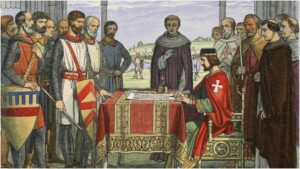 Figure-1 King John Signs the Magana Carta 1215 (Source: https://www.history.com/news/magna-carta-influence-us-constitution-bill-of-rights
Magana carta contains 63 clauses in whole while it originally drafted. This includes the famous ones like clause 39, 40 and other’s wherein the subject can approach to the court for violating their rights irrespective of the wealth background of the subject. Some of the clauses were delated later-wards by the king as it was against them. But to this day many remain intact. The king has followed the principle of law of the land. Clause 39 and 40 read as follows:
Clause 39: No free man shall be seized or imprisoned, or stripped of his rights or possessions, or outlawed or exiled, or deprived of his standing in any way, nor will we proceed with force against him, or send others to do so, except by the lawful judgment of his equals or by the law of the land.[1]
Clause 40: To no one will we sell, to no one will we refuse or delay, right or justice.[2] These are the two important rights that prevail even today though the charter was drafted centuries ago.
Though there are 63 clauses in the Magana carta but only a handful are made applicable in the present era. This is because time has changed and other aspects have also changed like now the society is a welfare society and not a dictatorship society. The will of the people should be prevailed than that of the ruler. Of the few handful which are valid one are the clause 39 and 40 and is highly recommended in the age of AI. This was the initial stage for the development of human rights, which the king John has foreseen during his regime. If the country/ society wants to get develop then some freedom should be given, instead of arbitrary decisions judgement should be delivered with justice and the justice should be given in such a that it can be seen that the Justice has done to the party.
Intermediatorystage of the rule of Law -in apropos to clause 39 and 40 to the present age.
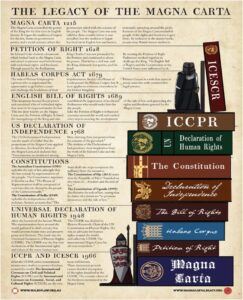
Figure-2II- Development of Magana carta[1].
The image shows us the development of Magana Carta in 1215 to the present stage. How it has reshaped the fundamental rights of the people and how it has taken place in various written constitutions of the world.
Clause 39 and 40 was of more importance than any other clauses as it basically deals with the theme of liberty, equality and fraternity- the founding principles on which the whole human rights is built upon. The first deals with fair trial and the second is justice to all. After the death of king John his successor – King Charles-I has been coronated as the king and found that some of the clauses in the Magana carta was not favorable to him, hence removed those which are not favorable to him and kept the remaining as it is.
The Petition of Right 1628
During his reign as king he forced the subject to give him loan and if any disobeys the command of the king they were subject to imprisonment and hefty amount of tax was imposed on them for their disobedience. He also imposed Tonnage and poundage i.e. levying of taxes without the consent of the parliament. Both these acts were without the consent of the parliament and once the parliament has voted against such custom in 1625, continued to collect by the King during his entire regime. Five knights refused to pay the forced loan as sanctioned by the king and they were sentenced without any trial. The trail is also known as the 5 knight trials. Sir Thomas Darnel, Sir John Corbet, Sir Walter ErIe, Sir John Heveningham and Sir Edmund Hampden who had refused to give the forced loan to the king were arrested and put behind the prison. Of the five knights Sir Thomas Darnel came before the King’s Bench to obtain the writ of habeas corpus in November 1627, but the same was denied by the king’s Bench stating that that they were disloyal to the king. These five knights were arrested were detained without any lawful reason and put a question mark on the freedom of liberty in the UK Parliament. Because of the denial of the right by the kings Bench debate aroused in the parliament in 1628 and the misuse of the power of the king. The major question that rose in this case was the arbitrary imprisonment of the five knights and what should be done in order to avoid such circumstance in the future. The UK Parliament has brought the The Petition of Rights 1628 in order to put a bridle on the powers given to the Kings and its misuse[2].
The Habeas Corpus act 1679
This act was passed during the reign of King Charles- II to strengthen and define the ancient prerogative writ of habeas corpus, where persons unlawfully detained can be ordered to be produced before the court of law. The act prevented unlawful or arbitrary imprisonment of the person and safeguarded the liberty of the citizens.
Bill of Rights 1689
The main purpose of the creation of the bill of rights is that to declare all the illegal practices that the King James II has implemented during his reign. Of the many illegal activities such as royal prerogative of dispensing with law in certain cases, complete suspension of laws without the suspension of laws without the consent of the parliament, levying of taxes and maintenance of standing army in peace times without the authorization of the parliament and all other illegal practices that was practiced during the James II regime. King James II discontinued the parliament and there was no parliament from 1687 to 1689 after the King James II escaped to France,during an invasion and died in exile. In the meantime they leaders of Parliament wrote letter to Dutch Leader William of Orange and husband of Mary for invasion to England in return they will be made as the King and Queen of England. In the year 1689 a new parliament was made known as Convention Parliament and declared that King William and Mary are the King and Queen of UK. But the new coronated King and Queen don’t have the power as the earlier kings had and they have to consult the parliament to make any new laws or promulgations for the citizens. But before the King William and Queen Mary are proclaimed as the King and Queen they had to accept the Bill of rights as made by the parliament. Initially they declined the offer and later-wards they accepted the offer and signed the bill of rights on February 1689. The period from 1688 to 1689 in UK is known as glorious revolution or the Bloodless Revolution.
Universal Declaration of Human Rights 1948
The Universal Declaration of Human Rights (UDHR) is a milestone document in the history of human rights. Drafted by representatives with different legal and cultural backgrounds from all regions of the world, the Declaration was proclaimed by the United Nations General Assembly in Paris on 10 December 1948 (General Assembly resolution 217 A) as a common standard of achievements for all peoples and all nations. It sets out, for the first time, fundamental human rights to be universally protected and it has been translated into over 500 languages. The UDHR is widely recognized as having inspired, and paved the way for, the adoption of more than seventy human rights treaties, applied today on a permanent basis at global and regional levels (all containing references to it in their preambles)[3].
The preamble of the UDHR is read as follows:-
“Whereas recognition of the inherent dignity and of the equal and inalienable rights of all members of the human family is the foundation of freedom, justice and peace in the world;
Whereas disregard and contempt for human rights have resulted in barbarous acts which have outraged the conscience of mankind, and the advent of a world in which human beings shall enjoy freedom of speech and belief and freedom from fear and want has been proclaimed as the highest aspiration of the common people,
Whereas it is essential, if man is not to be compelled to have recourse, as a last resort, to rebellion against tyranny and oppression, that human rights should be protected by the rule of law,
Whereas it is essential to promote the development of friendly relations between nations,
Whereas the peoples of the United Nations have in the Charter reaffirmed their faith in fundamental human rights, in the dignity and worth of the human person and in the equal rights of men and women and have determined to promote social progress and better standards of life in larger freedom,
Whereas Member States have pledged themselves to achieve, in cooperation with the United Nations, the promotion of universal respect for and observance of human rights and fundamental freedoms,
Whereas a common understanding of these rights and freedoms is of the greatest importance for the full realization of this pledge.”[4]
International Convention on Civil And Political Rights:
The preamble of the International convention on civil and political rights states as follows:
“The States Parties to the present Covenant,
Considering that, in accordance with the principles proclaimed in the Charter of the United Nations, recognition of the inherent dignity and of the equal and inalienable rights of all members of the human family is the foundation of freedom, justice and peace in the world,
Recognizing that these rights derive from the inherent dignity of the human person,
Recognizing that, in accordance with the Universal Declaration of Human Rights, the ideal of free human beings enjoying civil and political freedom and freedom from fear and want can only be achieved if conditions are created whereby everyone may enjoy his civil and political rights, as well as his economic, social and cultural rights,
Considering the obligation of States under the Charter of the United Nations to promote universal respect for, and observance of, human rights and freedoms,
Realizing that the individual, having duties to other individuals and to the community to which he belongs, is under a responsibility to strive for the promotion and observance of the rights recognized in the present Covenant.” [5]
Indian Perspective of Rule of Law:
Rule of law in India- History
Rule of law can be traced back form the period of Ramayana and Mahabharata in 8-9th Century BC. The pillars that were laid down were on the principles of Dharma – law and duty which is interchangeable, Rajdharma duty of the king and Dhramaraja for which the slok states in Mahabharata is A King who after having sworn that he shall protect his subjects fails to protect them should be executed like a mad dog,” and also that, “The people should execute a king who does not protect them, but deprives them of their property and assets and who takes no advice or guidance from any one. Such a king is not a king but misfortune.
In Upanishad we can find the rule of law and states that the law is the king of kings. None is above the law nor below it, be it a king or Slave, rich person or poor person. Even the king has to follow the law that is prevailing in his kingdom. He is not getting any special status to this ground norm. There is nothing superior than the law. Those people who are not well educated and weak in society will triumph overt the evil ways of the rich people and the justice will prevail, was the concept in the ancient India.
With the drafting of constitution in India we put the same in our constitution also the concept of rule of law not directly but in an indirect way. Following are the provisions of the constitution where we can find that the principle of rule of law is being applied.
| Sr. No | Article | Description |
| A | Preamble | |
| 1 | Preamble | justice equality and liberty |
| B | Judicial Review | |
| 1 | 13 | Laws inconsistent with or in derogation of the fundamental rights |
| 2 | Art. 32 | Constitutional Remedies- Supreme Court |
| 3 | Art 226 | Constitutional Remedies – High Court |
| 4 | 136 | |
| 5 | 142 | |
| C | Fundamental Rights | |
| 1 | Article 14 | equality before law and equal protection of law |
| 2 | Article 21 | freedom of life |
| D | Prerogative Power of president and governors | |
| 1 | 72 | Pardoning powers – President |
| 2 | 161 | Pardoning powers – Governors |
Case laws which signifies the rule of law in India:
Kesavnanda Bharti case: (Kesvananda Bharti vs Union of India 1973[6])
One of the prominent case and most widely discussed case in Indian History is this case. In this case the core structure of the constitution is being interpreted and that is preamble is the core of the constitution. This case is also known as the basic structure case as this case deals with the basic structure of the constitution. The fundamental principles that are enshrined in the Constitution of India cannot be amended by the parliament according to their whimsical policy. Supreme Court has focused on the concept of rule of law here in this case and said that constitution is the ultimate law of the land and cannot be amended according to one’s desire.
Menka Gandhi Case (Menka Gandhi vs Union of India 1978[7])
This case is also known as the passport case. Here in this case Supreme Court has emphasized the rule of law in an indirect and propounded a new concept for India- due process of law- which is in align with the rule of law. In this case the passport of Menka Gandhi has be impounded by the authorities without proper reason and was not giving back to Menka Gandhi for a foreign trip to attend a business meeting . Supreme Court has categorically emphasized on the concept of personal liberty as enshrined under Art. 21 of the Constitution.
ADM Jabalpur Case (ADM Jabalpur vs Shivkant Shukla 1976[8])
This case is also known as the writ of Habes Corpus Case
“Here, the court had to decide whether Article 21 of India’s constitution is necessary for the rule of law to exist. According to the five-judge bench that consisted of Justices A.N. Ray, Hans Raj Khanna, M. Hameed Ullah, Y.V. Chandrachud, and P.N. Bhagwati, the only rule that exists is Article 21, and no other rule of law may ever exist[9].” The only descending judge who delivered the negative judgement is H R Khanna J, whereas all the other judges give the judgment in favor of government. Although the majority’s decision was negative, Justice H.R. Khanna issued a dissenting opinion by stating that the state has no power to deprive a person of freedom even without the authority of law, even in the absence of Article 21[10].
BachanSingh Case (BachanSingh vs State of Punjab 1980[11])
This case is related to the awarding of capital punishment and shone the light in what circumstance one award the capital punishment. It has bolstered the postulate that death sentence should be given in the rarest of rare case and not in every case which involves section 302 of the then IPC. The doctrine of rarest of rare case was evolved and the death sentence can be given only after thoroughly evaluating all the relevant facts of the case.
Justice P N Bhagwati has observed three cannons for this matter in this case and are as follows-
“Firstly, unlike other forms of punishment, it is irrevocable. Given the inherent fallibility of the Indian criminal justice system (poor investigation, false or misleading testimonies, risk of wrongful prosecution, lack of adequate scientific techniques), the threat of executing an innocent person cannot be ignored.
Secondly, the entire process of being condemned to death, awaiting execution and the final act of execution involves intense mental and physical suffering, which cannot be constitutionally imposed.
Lastly, this punishment does not advance any “permissible penological goal” and defeats the goal of reformation. Justice Bhagwati observed that there was “no way of accurately predicting or knowing” that a person is incapable of reformation. He found that the imposition of a death sentence as a “denunciation [of wrongdoing] by the community or retribution,” is a facade for seeking revenge, which betrays the values of human dignity. Based on a study of research from various jurisdictions, he strongly disputed the claim that the death penalty has greater deterrent value than life imprisonment.”[12]
- R. Coelho case (I.R.Coelho vs. State of Tamil[13] (2007))
Hon’ble Supreme Court has specifically held that Rule of Law is a basic structure of the Constitution and that this basic structure cannot be abolished even by a constitutional amendment. All invalid laws cannot be protected by parking them in ninth schedule of the Constitution is the essence of the decision rendered in Coelho’s case[14].
Yusuf Khan v. Manohar Joshi[15] (2000)
In this case the SC has laid down that it is the duty of the state to preserve and protect the law and the constitution and that it cannot permit any violent act which may negate the rule of law. Hence, it is quite evident that the concept of rule of law is gaining importance and attention and judicial efforts are made to make it stronger.
Emphasizing on Rule of Law -Recent case
- PMLA case
- 197 CrPC Applies To PMLA: Supreme Court Holds Prior Sanction Mandatory To Prosecute Public Servants For Money Laundering Offence[16]. The Supreme Court held today that section 197(1) of CrPC, which provides that prior sanction from the government is required to prosecute public servants and judges for offences alleged while discharge of public duties, will apply to cases under the Prevention of Money Laundering Act[17].
- Bail matters
SC has relied upon its own judgement in a case of Arnesh Kumar v. State of Bihar[18] (2014) and cited as follows –
“In pith and core, the police officer before arrest must put a question to himself, why arrest? Is it really required? What purpose it will serve? What object will it serve? It is only after these questions are addressed that the power of arrest needs to be exercised…Apart from this, the police officer has to be satisfied further that the arrest is necessary for one or more purposes envisaged by sub-clauses (a) to (e) of clause (1) of Section 41 CrPC”. Here also the rule of law was put into effect without harming the right that is available to the person as guaranteed under Art. 21 and 14.
The court in another case of Arnab ManoranjanGoswami v. State of Maharashtra[19]popularly known as the abetment of suicide case;has asserted that the values enshrined in the constitution needs to be protected and the constitutional liberties that available to the citizens should be made available to them the excerpt of this case is as follows:
““Courts must be alive to the need to safeguard the public interest in ensuring that due enforcement of criminal law is not obstructed. The fair investigation of crime is an aid to it. Equally it is the duty of courts across the spectrum- the district judiciary, the High Courts, and the Supreme Court- to ensure that the Criminal Law does not become a weapon for the selective harassment of citizens. Courts should be alive to both ends of the spectrum- the need to ensure the proper enforcement of criminal law on the one hand, on the other, of ensuring that the law does not become a ruse for targeted harassment.”[20]
Exceptions to this rule in India:
Art. 361 of the Constitution of India states about the exception of the doctrine of rule of law which states that-
(1) The President, or the Governor or Rajpramukh of a State, shall not be answerable to any court for the exercise and performance of the powers and duties of his office or for any act done or purporting to be done by him in the exercise and performance of those powers and duties:
(2) No criminal proceedings whatsoever shall be instituted or continued against the President, or the Governor of a State, in any court during his term of office
(3) No process for the arrest or imprisonment of the President, or the Governor of a State, shall issue from any court during his term of office
(4) Any civil proceedings in which relief is claimed against the President, or the Governor of a State, shall be instituted during his term of office in any court in respect of any act done or purporting to be done by him in his personal capacity, whether before or after he entered upon his office as President, or as Governor of such State, until the expiration of two months next after notice in writing has been delivered to the President or Governor, as the case may be, or left at his office stating the nature of the proceedings, the cause of action therefor, the name, description and place of residence of the party by whom such proceedings are to be instituted and the relief which he claims[21].
But this exceptions are only applicable only when they are holding the position and not afterwards. They too become to the rule of law once they step out from the position and are no more the part of the position.
Rule of Law and its effect on various sectors- global effects:
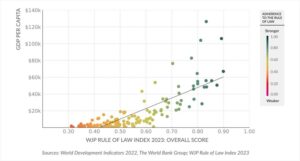
Figure-3 GDP and Rule of Law[22]
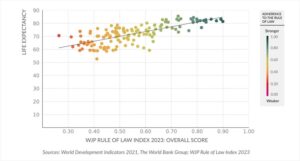
Figure-4 Rule of Law and Life Expectancy[23]
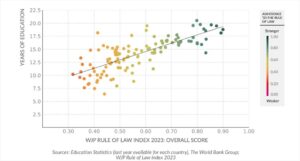
Figure-5 Rule of Law and Education[24]
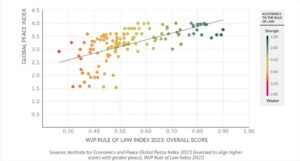
Figure-6 Rule of Law and Peace[1]
According to Global Peace Index (GPI) Societal Safety and Security Index Iceland has got the lowest crime rate followed by Norway and Japan and these countries follow the rule of law.
Safest Countries: Top 20+ India -Countries with Lowest Crime Rates[2]
Rank | Country | Score | Change |
1 | Iceland | 1.107 | – |
2 | New Zealand | 1.269 | – |
3 | Ireland | 1.288 | 3 |
4 | Denmark | 1.296 | -1 |
5 | Austria | 1.3 | 2 |
6 | Switzerland | 1.357 | 1 |
7 | Portugal | 1.301 | -1 |
8 | Slovenia | 1.316 | -3 |
9 | Czech Republic | 1.318 | 1 |
10 | Singapore | 1.326 | 11 |
11 | Japan | 1.336 | 1 |
12 | Canada | 1.389 | -4 |
13 | Hungary | 1.411 | 2 |
14 | Finland | 1.439 | -1 |
15 | Croatia | 1.44 | -1 |
16 | Germany | 1.462 | 3 |
17 | Norway | 1.465 | – |
18 | Malaysia | 1.471 | 4 |
19 | Bhutan | 1.481 | -3 |
20 | Slovakia | 1.499 | 5 |
144 | India | 2.319 | 5 |
Table-1 Safest countries of the word
The full details of Global peace index can be found at https://www.economicsandpeace.org/wp-content/uploads/2024/06/GPI-2024-web.pdfwhere the data related to all the categories are being given. As per the study this shows that were the rule of laws are followed as apropos in above law abiding states has got less crime rates and the happiness level is very high. The number of prisoners where there is zero inmates is Netherlands where there is a drastic decrease in number of crime as the judicial system has developed various other modes for the criminal to be rehabilitated and making them law abiding citizens again.
Conclusion:
From all the points that we have seen from above is that the rule of law or what in India we call as the due process of law should be followed at every step and should not be done in an arbitrary way. If done in an arbitrary way then the people of the country will be not happy with the system of dispensing the justice and will try to breach the law. People will not give importance to law as in their mind the concept is that when the laws are not properly followed and there is a discriminatory way of dealing with the laws then why one should abide the laws. Let not the political parties or any authorities or person who has got authority in any manner do make their own laws and fill their pockets but let the law prevail. Let the principles as enshrined in the constitution more particularly what is mentioned in the preamble be prevail and lets stick to it without any modification.
Impact in Indian Judiciary – Rule of Law:
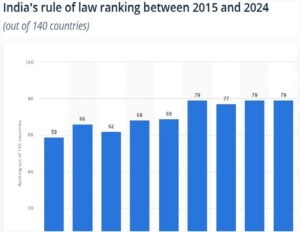
Figure:India’s Ranking- Rule of Law[1]Score: 0.49
Criteria for deciding the rule of Law[1]:
The following nine points are considered for indexing the global rule of law by the World Justice Project which includes the following:
- Limited Power of the Government
- Absence of corruption
- Order and security
- Fundamental rights
- Open government
- Regulatory enforcement
- Access to civil justice
- Effective criminal justice system
Note: The criteria for each sub-heading is being appended as appendix 1 to this article
India stand on all the above 8 factors according to the report are as follows:
No | Factors | Score |
1 | Limited Power of the Government | 0.63 |
2 | Absence of corruption | 0.42 |
3 | Order and security | 0.38 |
4 | Fundamental rights | 0.63 |
5 | Open government | 0.55 |
6 | Regulatory enforcement | 0.45 |
7 | Access to civil justice | 0.50 |
8 | Effective criminal justice system | 0.51 |
India stands at 79th Position while Denmark and Norway are on position 1st and 2nd respectively as per the report or World Justice Project.
Equality before Law:
As per Art. 14 states about the equality before law which is divided into two parts the first part deals with equality before law i.e. irrespective of caste, race, religion, place of birth or sex. This protection is available to all the subject who are residing in India irrespective of which national he/ she belongs. The second part of this article is dealing with equal protection of law. Here when we talk about the equal protection of law is little intricate one as what its says is that if a person is belonging to a specified category then the protection to that category will be same irrespective of the number of person involved in that category. For eg Prime Minister is getting Z type of security, this doesn’t mean that all the people will get Z type security. The Prime Minister belongs to a particular class of person and for that class of person the protection is given in a different manner. The general public can’t say that they too are the citizen of India so they too should be provided with the same type of security. However for the General public the protection ratio by the police is 1,00,000: 144 i.e for every 1 lakh public the police allotted is only 144 police personal, which is very low compared to other countries of the world. But at the same protection is guaranteed to all the subject who are residing in India. The court has punished 7 person for life imprisonment who had allegedly gang raped a Bangladeshi woman. This shows that though one belongs to a different nationals but protection of law is made available to you.
Independent Judiciary:
The judiciary is independent from the other two organs of the constitution the executive and the legislative. When there is breach of constitutional provision the judiciary will come into picture and will protect the citizen. This we can from the case of Shreya Singhal vs Union of India[2] wherein the Supreme Court of India has struck down section 66A of the Information Technology Act 2000 as Unconstitutional one and said that freedom of speech extends even to electronic modes.
Cons to this matter:
When we look into the aftereffect of the case of ADM Jabalpur Case ADM Jabalpur vs Shivkant Shukla 1976[3] we can see that the next chief Justice was in the list of collegium was H R Khanna J but the cost that the Justice has pay in delivering dissenting judgement in the above case is that he lost his Chief Justice Position and made a voluntary retirement after 6 months from the new appointed CJ who is junior to H R Khanna J. [This being mentioned in his autobiography Nether roses nor thrones- H R Khanna, publisher EBC]
Political Interference:
The political pressure imposed upon the judiciary can be seen in recent times and the effect of the judgement delivered by the courts will be to an extent favorable to the government which is an utter violation of the rule of law. We violate the principle of natural justice in an indirect- nemo judex in causa sua” i.e. “ no one can be a judge in his own case”. We sometimes become judge in our own case and decide the case accordingly not in an direct way but in an indirect way.
[1]https://codolc.com/books/Measuring_the_Rule_of_Law.pdf, Juan C. Botero, Alejandro Ponce
[2]AIR 2015 SC 1523
[3] Supra P14
[1]https://www.statista.com/statistics/1356457/india-rule-of-raw-ranking/#statisticContainer last accessed on 11/03/2025
[1] Ibid p27
[2]https://www.economicsandpeace.org/wp-content/uploads/2024/06/GPI-2024-web.pdf
[1]https://www.google.com/imgres?q=magna%20carta%20rule%20of%20law%20and%20its%20development&imgurl=http%3A%2F%2Fwww.magnacarta.org.au%2Fwp-content%2Fuploads%2F2015%2F08%2FMagnaCartaLegacyPosterNew.jpg&imgrefurl=http%3A%2F%2Fwww.magnacarta.org.au%2Fmagna-carta-and-human-rights%2F&docid=5Sf1hgSlyLfdsM&tbnid=gJba0uTujQMyqM&vet=12ahUKEwiUipeAvuOLAxVrTGwGHRBMCMUQM3oECBwQAA..i&w=3508&h=4961&hcb=2&ved=2ahUKEwiUipeAvuOLAxVrTGwGHRBMCMUQM3oECBwQAA last accessed 27/02/2025
[2] The full detail of this case can be read at https://digitalcommons.iwu.edu/cgi/viewcontent.cgi?article=1082&context=constructing#:~:text=King%20Charles%20decided%20to%20imprison,to%20pay%20the%20forced%20loan.
[3]https://www.un.org/en/about-us/universal-declaration-of-human-rights last accessed on 04/03/2025
[4]https://www.un.org/en/udhrbook/pdf/udhr_booklet_en_web.pdf last accessed on 03/03/2025
[5]https://www.ohchr.org/en/instruments-mechanisms/instruments/international-covenant-civil-and-political-rights last accessed on 03/03/2025
[6]4 SCC 225; AIR 1973 SC 1461 6
[7]AIR 1978 SC 597 6
[8]AIR 1976 SC 1207 7
[9]https://www.lawctopus.com/academike/evolution-of-rule-of-law/ last accessed on 02/03/2025
[10]https://vajiramandravi.com/quest-upsc-notes/rule-of-law/ last accessed on 02/03/2025
[11]2 S.C.C.684 7
[12]https://www.scobserver.in/75-years-of-sc/how-justice-bhagwatis-44-year-old-dissent-mirrors-the-state-of-death-penalty-in-india/ last accessed on 04/03/2025
[13]AIR 2007 SC 861
[14]https://kjablr.kar.nic.in/assets/articles/Role_of_Courts_in_Upholding_Rule_of_Law.pdf by Hon’ble Justice A V Chandrashekar
[15] AIR (2000) SCC
[16]https://www.livelaw.in/top-stories/s-197-crpc-applies-to-pmla-supreme-court-holds-prior-sanction-mandatory-to-prosecute-public-servants-for-money-laundering-offence-274362 last accessed on 03/03/2025
[17] Ibid p17
[18](2014) 8 SCC 274 at paragraph 7.3
[19](2021) 2 SCC 427 at paragraph 67
[20]https://corporate.cyrilamarchandblogs.com/2022/08/bail-or-jail-the-supreme-court-clarifies-the-law-and-lays-down-the-guidelines/
[21] Constitution of India 1950, Art 361
[22]https://worldjusticeproject.org/about-us/overview/what-rule-law last accessed 04/03/2025
[23] Ibid p25
[24] Supra P25
[1]https://www.ruleofla.org.au/magna-carta-and-human-rights/#:~:text=By%20sealing%20the%20Magna%20Carta,equally%20ruled%20by%20the%20law. Last accessed on 27/02/2025
[2] Ibid
[1] He was the Chief Justice during the reign of King Charles- II
[2]https://worldjusticeproject.org/about-us/overview/what-rule-law last accessed on 03/038/2025
[3]https://www.lexisnexis.co.uk/about-us/rule-of-law last accessed on 03/03/2025