ABSTRACT
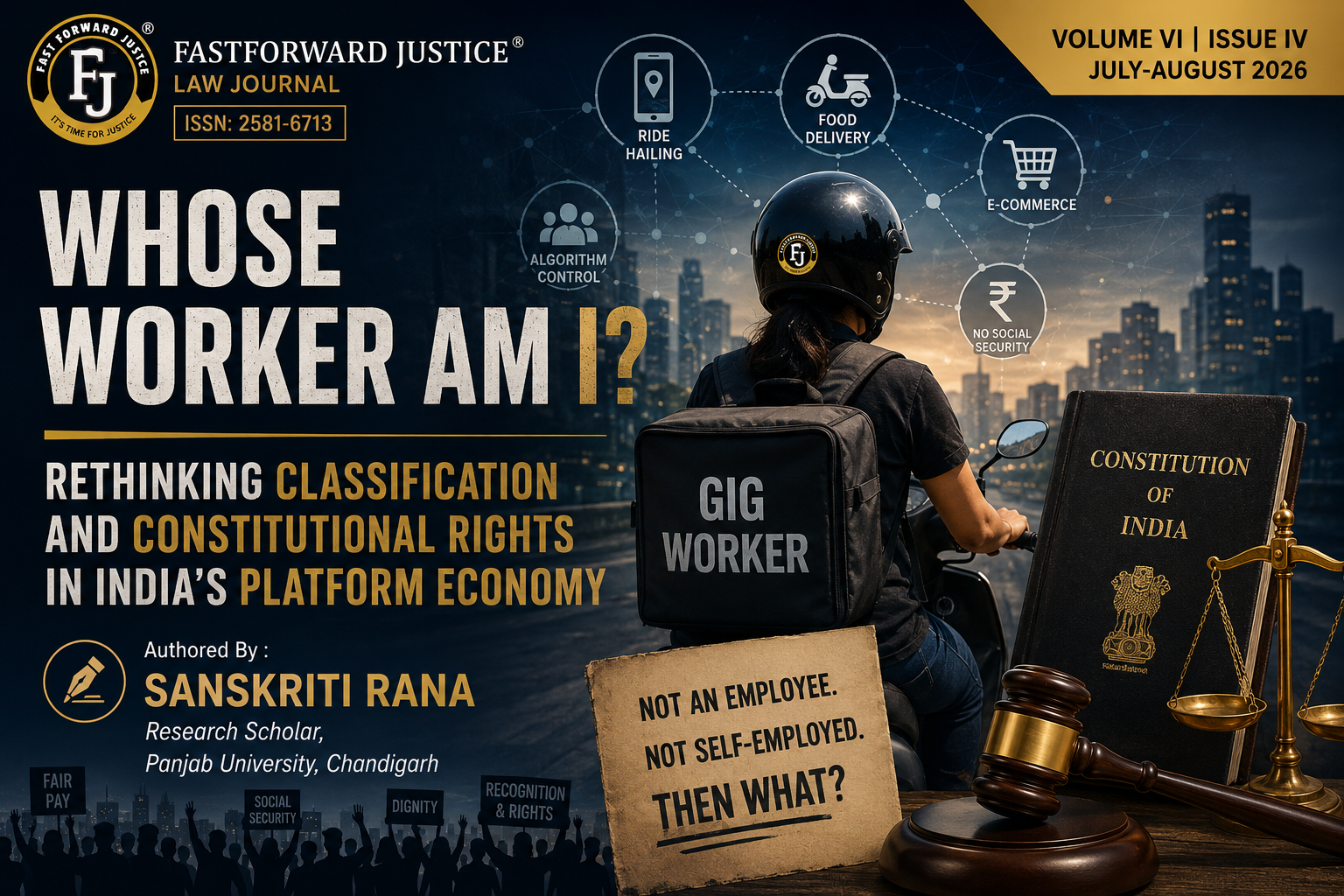
The gig economy has disrupted traditional employment law. Millions of workers on platforms such as Uber, Ola, Swiggy, Zomato and Upwork remain classified as neither employees nor traditional contractors. This paper examines the inadequacy of the binary employee/independent-contractor distinction in the face of algorithmic control and economic dependence, drawing on comparative jurisprudence from India, the United Kingdom, the United States, the European Union and select sui generis jurisdictions. It analyses Uber BV v. Aslam, California’s AB5, the EU Platform Work Directive, the ILO’s 2026 Platform Economy Convention and India’s own labour codes and argues that existing frameworks are structurally unequipped to protect gig workers. It proposes a tripartite classification model and a statutory presumption of platform employment and argues that Articles 21, 19(1)(c) and 14 of the Indian Constitution impose a positive obligation on the State to extend protective legislation to this class of workers.
Keywords: Gig Economy, Worker Classification, Platform Labour, Algorithmic Management, Social Security, Indian Constitution.
I. INTRODUCTION
The gig economy- platform-mediated, task-based work exemplified by ride-hailing, food delivery and freelance marketplaces has reordered the architecture of work while defying the categories built for the factory floor and the formal employment contract. The term derives from the musician’s short-term “gig” and captures the episodic, precarious nature of platform work.[1] Over 150 million workers now participate in the digital platform economy worldwide, with India among the largest markets.[2] The International Labour Organization has repeatedly flagged the sector for income volatility, absent social security, unsafe conditions and denial of collective bargaining.[3]
The central legal problem is classification. Minimum wages, provident fund, gratuity, maternity benefit and the right to organise are all built on the employee/independent-contractor distinction. Platforms characterise gig workers as independent contractors freely choosing flexible work.[4] Courts and legislatures worldwide have increasingly rejected this characterisation, recognising that algorithmic management and economic dependence create a de facto employment relationship the law must honestly confront.
This paper’s argument proceeds in three movements. Parts IV to VI trace the doctrinal history of worker classification and examine how the United Kingdom, the United States, the European Union and India have each grappled with platform work’s challenge to that history. Part VII widens the aperture to jurisdictions that have implemented a working third category in practice, and to the ILO’s own 2026 standard-setting intervention. Parts VIII and IX then turn from description to prescription: Part VIII locates a positive constitutional obligation on the Indian State within Articles 21, 19(1)(c) and 14 and Part IX translates that obligation into a concrete tripartite classification model, a statutory presumption of platform employment and an institutional architecture- a National Gig Worker Rights Commission capable of enforcing it.
II. LITERATURE REVIEW
Three strands of scholarship inform this paper. The descriptive strand documents the structural features of platform work resistant to conventional classification: Jeremias Prassl argues platforms are structured to obscure the identity of the “employer”;[5] Antonio Aloisi’s case-study research documents the near-total absence of the pricing and client-relationship autonomy the independent-contractor label presupposes.[6]
The doctrinal strand asks what legal category should follow. Miriam Cherry and Antonio Aloisi’s account of the “dependent contractor”- an intermediate status between employee and independent contractor, defined by economic dependence rather than control is the closest antecedent to the tripartite model advanced in Part IX.1 below.[7] This paper’s model is best understood as that thesis operationalised for the Indian statutory and constitutional context: it anchors the category to two tested statutory vehicles (the UK “worker” category and the EU Directive’s rebuttable presumption), attaches a specific closed list of protections and grounds the proposal in Articles 21, 19(1)(c) and 14 of the Indian Constitution, none of which Cherry and Aloisi’s comparative, diagnostic account undertakes.
The third, India-specific strand relies principally on NITI Aayog’s quantitative baseline[8] and Sandhya Mahapatra’s comparative doctrinal survey, which pre-dates the labour codes and does not develop the constitutional argument in comparable depth.[9] This paper’s contribution is to synthesise these three strands: using the descriptive literature as the factual predicate for reform, adapting Cherry and Aloisi’s framework into an India-specific statutory model and grounding it in the post-November 2025 constitutional and statutory landscape.
III. METHODOLOGY
This paper adopts a doctrinal, black-letter methodology supplemented by a functional comparative method, which asks how different systems answer the same underlying question- which platform workers get which protections and why, rather than matching formally equivalent categories.[10] The United Kingdom, United States, European Union and India are the primary comparators, selected for doctrinal influence, regulatory innovation and case-study depth respectively. Spain, Australia, Singapore and Global South comparators (South Africa, Kenya, Latin America) are examined separately in Part VII as corroborating rather than primary material, since each has implemented a working sui generis third category. Canada, whose classification jurisprudence remains provincial rather than statutory is excluded for reasons of scope. The analysis states the law as at 31 July 2026 and flags, rather than assumes, matters left pending by subordinate rule-making under India’s Code on Social Security, 2020.
IV. HISTORICAL AND DOCTRINAL DEVELOPMENT
4.1 The Binary Framework and the Control Test
The employee/independent-contractor dichotomy is foundational to common law labour systems, rooted in the Victorian doctrine of respondeat superior.[11] Twentieth-century statutory protections minimum wage, workmen’s compensation, pensions were framed around the “employment relationship,” making the classification decisive. The “control test” from Yewens v. Noakes asked not merely what a worker did, but how they did it.[12]
4.2 Multi-Factor Tests
As franchising, subcontracting and staffing complicated the binary, courts developed multi-factor tests. The US “economic reality” test in United States v. Silk asked whether the worker was, as a matter of economic reality, dependent on the hiring business.[13] California’s “ABC test” created a rebuttable presumption of employment displaceable only if the hirer proved the worker was free from control, performed work outside the hirer’s usual business and was engaged in an independently established trade.[14] The UK developed “mutuality of obligation” alongside control and the Employment Rights Act 1996 introduced “worker” as an intermediate category attracting minimum wage and paid leave.[15]
4.3 Sham Contracts
Labour law has long confronted “sham self-employment,” where employers label workers as contractors to avoid obligations. Autoclenz Ltd v. Belcher held that written contractual terms do not control legal characterisation where they are inconsistent with the reality of the relationship.[16] This principle proved central to gig litigation: platforms’ “independent contractor” clauses have repeatedly been found to bear little relation to the lived reality of algorithmic control and economic dependency.
V. THE GIG ECONOMY’S CHALLENGE TO EXISTING FRAMEWORKS
5.1 The Paradox of Algorithmic Control
Platforms achieve, through algorithms governing task allocation, pricing, ratings and de-activation, precisely the supervisory control the law has always associated with employment, while maintaining the fiction of worker autonomy.[17] The Employment Tribunal in Aslam, Farrar & Others v. Uber BV found Uber’s self-description as a “mosaic of individual small businesses” “faintly ridiculous,” given its control over recruitment, information, contractual terms and de-activation, a finding upheld through to the Supreme Court.[18]
5.2 Economic Dependency and the Illusion of Entrepreneurship
Gig workers typically lack the hallmarks of entrepreneurship: they do not set prices, cannot build client relationships and cannot easily switch platforms.[19] The ILO has termed this “dependent self-employment”, nominal self-employment coupled with dependence on a single platform, echoing the German Arbeitnehmerähnliche Person and French concepts of economic dependence.[20]
5.3 The Deficit of Social Protection
Perhaps the most consequential effect of gig worker misclassification is systematic exclusion from social protection. India’s Code on Social Security, 2020 contains a dedicated Chapter IX on social security for “gig” and “platform” workers,[21] among the earliest such statutory architecture built into a general social security code by any major economy, though France’s narrower 2016 platform-responsibility law, which imposes threshold-based social-responsibility obligations on platforms, pre-dates it.[22] For nearly five years, however, Chapter IX remained dormant: the rules required to operationalise it were not notified, leaving the legislative recognition largely symbolic. This changed materially on 21 November 2025, when all four labour codes came into force, making sections 109–114 binding law rather than a dormant aspiration. This is a genuine reform, but three gaps remain significant as of the date of this paper: the Code obliges the Central and State Governments only to “frame” schemes without fixing benefit quantum or aggregator contribution rates, leaving the substantive content of protection dependent on subordinate rule-making still proceeding in tranches across States; gig workers remain outside the “employee” categories governed by Chapters III–VIII of the same Code (provident fund, state insurance, gratuity), so Chapter IX operates as a parallel, lesser welfare track rather than an extension of mainstream protection; and enforcement infrastructure, aggregator compliance monitoring and an accessible grievance mechanism remain largely untested (Part IX.3 below). India’s gig workforce, estimated at 7.7 million in 2020-21 and projected by NITI Aayog to reach 23.5 million by 2029-30,[23] had by FY 2025 already reached approximately 12 million according to the Economic Survey 2025-26, a 55 per cent increase over the baseline in four years[24] with longer-range academic projections of 61.6 million by 2047.[25] These workers bear the full cost of work-related accidents, illness, old age and unemployment, remaining excluded from the EPFO and ESIC, the twin pillars of formal-sector social security, whose access is conditioned on an “employee-employer relationship.”[26]
VI. COMPARATIVE LEGAL ANALYSIS
6.1 United Kingdom: Uber v. Aslam and the “Worker” Category
The United Kingdom’s approach is arguably the most advanced common law framework and offers lessons for other jurisdictions. The Employment Rights Act 1996 creates three categories- employee, self-employed, and “worker,” the last attracting the national living wage, paid leave and rest breaks.[27] In Uber BV v. Aslam, the Supreme Court unanimously held Uber drivers were “workers,” applying a purposive approach asking what the statute was designed to protect against exploitation of workers lacking bargaining power.[28] Uber’s control over fares, contract terms, service standards and de-activation was found to subordinate drivers accordingly.[29] The Court further held that “working time” ran from the moment a driver logged onto the app and was available to accept trips, not merely while carrying a passenger, substantially expanding minimum-wage liability.[30] Uber subsequently extended UK drivers minimum wage guarantees, pension contributions and paid leave, a direct consequence of the ruling and a data point this paper returns to in Part IX.7 below when assessing the job-destruction argument against reclassification.[31]
6.2 United States: AB5 and Castellanos
US law is fragmented across federal and state tests and the classification landscape is correspondingly complex: the FLSA applies an “economic reality” test,[32] the NLRA a “common law agency” test.[33] California’s AB5 (2019) codified the ABC test from Dynamex Operations West, Inc. v. Superior Court,[34] creating a presumption of employment displaceable only if the hiring entity satisfies all three prongs; “Prong B”- that the work be outside the hirer’s usual business is near-impossible for ride-hailing platforms to satisfy, since transportation is their entire business. Platforms responded with a $200 million campaign for Proposition 22, exempting app-based transportation and delivery companies from AB5 in November 2020.[35] A California Superior Court struck the initiative down as unconstitutional in 2021; the Court of Appeal reversed in relevant part in 2023 and the California Supreme Court unanimously affirmed in Castellanos v. State of California (2024).[36] The holding, however, turned narrowly on whether the state constitution’s “unlimited” legislative power over workers’ compensation excludes the electorate’s own initiative power, not on any considered assessment of whether drivers are properly independent contractors and has little to transfer to India, which has no comparable direct-democracy mechanism by which a popular vote can entrench a labour classification against the ordinary legislature.
6.3 European Union: The Platform Work Directive
The EU Platform Work Directive agreed in 2024 requires Member States to establish an effective rebuttable presumption of employment triggered by facts indicating direction and control, departing from the Commission’s original proposal of a uniform, shared set of indicators in favour of national implementation.[37] Once triggered, the burden shifts to the platform to disprove employment. The Directive is also the first binding instrument to regulate algorithmic management directly requiring disclosure of automated monitoring, human review of significant decisions and a right to contest algorithmic decisions.[38]
6.4 India: An Emerging Jurisprudence
For most of the period surveyed, the operative test was “workman” status under the Industrial Disputes Act, 1947, ill-suited to platform work.[39] Since 21 November 2025, that Act is repealed and subsumed into the Industrial Relations Code, 2020, which re-enacts a substantially similar “worker” definition without creating a distinct gig-worker category, that task remains Chapter IX’s alone. Litigation is active but unsettled: IFAT’s September 2021 Supreme Court writ petition alleging that denial of social security to gig workers violates Articles 14, 21 and 23 has narrowed, following a February 2025 order to compelling notification of Chapter IX rules rather than a claim against aggregators directly.[40] A Delhi High Court petition separately raised whether aggregators exercise sufficient control to qualify drivers as employees,[41] while a June 2026 Karnataka High Court petition challenges the constitutionality of Karnataka’s gig worker Act itself (Part IX.6 below).[42]
Rajasthan’s Platform Based Gig Workers (Registration and Welfare) Act, 2023 was the first Indian state legislation of its kind, funded by a 1–2 per cent welfare cess and a Rs 200 crore corpus.[43] Its implementation, however, stalled after a change of government with rules for the Welfare Board, Fund and transaction-tracking system still unnotified more than two years on[44], an instructive gap between enactment and operation. Karnataka (2025), Bihar and Jharkhand (August 2025) have since enacted comparable statutes.[45]
VII. FURTHER COMPARATORS AND INTERNATIONAL STANDARDS
7.1 Spain, Australia and Singapore
Three jurisdictions have implemented a working sui generis third category rather than merely adapting an existing test. Spain’s Royal Decree-Law 9/2021, following the Supreme Court’s Glovo ruling, created a sector-specific rebuttable presumption of employment for algorithmically managed delivery riders with a right to algorithmic transparency for workers’ representatives.[46] Australia’s Fair Work Legislation Amendment (Closing Loopholes No. 2) Act 2024 creates “employee-like worker” as a genuinely new statutory category, with the Fair Work Commission empowered to set binding minimum standards and resolve unfair de-activation disputes, the closest real-world analogue to Part IX.1’s proposal.[47] Singapore’s Platform Workers Act 2024 attaches a calibrated bundle phased-in Central Provident Fund contributions and work-injury insurance at parity with employees without full employment status.[48] Together these confirm that a distinct third status is administrable across markedly different legal traditions.
7.2 Global South Comparators
South Africa’s proposed National Minimum Wage Act amendment would create a rebuttable presumption of employee status, structurally similar to Part IX.2’s proposal.[49] Kenya regulates e-hailing sectorally, capping commissions at 18 per cent while classifying drivers as service providers with a pending Bill signalling possible reclassification.[50] Latin America spans a spectrum: Chile permits classification under ordinary statutory criteria;[51] Colombia attaches scaled social-security contributions regardless of formal status, closely resembling India’s Chapter IX;[52] Mexico’s 2024–25 reform reclassifies platform workers as employees outright, extending coverage to an estimated 658,000 workers.[53] Together, these confirm that decoupling welfare from classification is a recurring Global South strategy, not a peculiarly Indian invention.
7.3 The ILO Platform Economy Convention, 2026
On 12 June 2026, the ILO’s 114th Session adopted Convention No. 193, the first binding international standard on platform work, applying to all platform workers irrespective of national classification, a classification-agnostic design that sidesteps rather than resolves the employee/contractor debate.[54] It addresses working conditions, algorithmic transparency, occupational safety and collective bargaining.[55] As an ILO member, India must submit the Convention to Parliament within twelve months. Its classification-agnostic design lends international support to this paper’s tripartite model, though the Convention is untested and was criticised by employer representatives as “overly lengthy and prescriptive.”[56]
VIII. CONSTITUTIONAL DIMENSIONS OF GIG WORKER RIGHTS IN INDIA
8.1 A Positive Obligation, Not a Horizontal Claim
Before developing the constitutional argument, a doctrinal difficulty must be confronted. Articles 21 and 14 bind “the State” as defined in Article 12;[57] Ola, Uber, Swiggy and Zomato are ordinary private commercial companies that do not exhibit the “deep and pervasive” governmental control, financial dependence or public-function character the Supreme Court’s state-instrumentality tests require.[58] A writ petition alleging that a platform has itself violated Article 21 or Article 14 would, on existing doctrine, face a serious threshold objection. This paper accordingly advances a positive-obligation claim, not a horizontality claim: that the State’s continued failure to extend protective labour legislation to gig workers is itself a violation of the State’s own constitutional obligations, quite apart from anything platforms do or fail to do.
Three reasons support this choice. First, Indian doctrine recognises only narrow, textually confined horizontal exceptions- Articles 15(2), 17 and 23 apply horizontally by their own express terms and the Supreme Court has held Article 23’s prohibition on forced labour enforceable against private contractors on public projects but these are exceptions tied to specific text, not evidence of a general horizontality doctrine Article 21 or Article 14 could be read to share.[59] Second, the Article 14 argument developed below is, in any event, a conventional vertical claim against the State’s own legislative classification, not against platform conduct. Third, Vishaka v. State of Rajasthan is instructive by analogy: the Court filled a legislative gap through binding guidelines grounded explicitly in the State’s own Article 32 obligation to secure fundamental rights “until Parliament enacts legislation,” not in a finding that employers were themselves bound by Article 21.[60] This paper’s argument follows the same structure: any norm ultimately binding on platforms would be created by the ordinary legislation this paper argues the State is constitutionally obliged to enact, not by direct constitutional litigation against the platforms themselves.
8.2 Directive Principles and the Right to Livelihood
Articles 39, 41 and 42 direct the State toward an adequate livelihood, provision against unemployment and humane conditions of work.[61] The Supreme Court has elevated the right to livelihood into Article 21: in Olga Tellis v. Bombay Municipal Corporation, the Court held the right to life includes the right to livelihood, since no one can live without means of living.[62] This expansive reading bears directly on gig workers’ exclusion from social security.[63]
8.3 Association and Collective Bargaining
Article 19(1)(c), read with the Trade Unions Act, 1926, founds the right to collective bargaining.[64] Gig workers’ capacity to exercise it is constrained by an atomised, geographically dispersed workforce and by algorithmic de-activation risk for organising activity, raising a chilling-effect concern.[65] Nascent organisations such as IFAT (established 2019) illustrate the limits of bargaining power absent legal recognition.[66]
8.4 Equal Protection
Article 14 guarantees equality before the law.[67] A formal-sector driver and an app-based driver performing economically equivalent, comparably controlled work receive starkly different legal protection, a differential grounded solely in the contractor fiction that may lack a rational nexus to the object of labour legislation.[68]
IX. TOWARDS A LEGISLATIVE FRAMEWORK: PROPOSALS FOR REFORM
9.1 A Tripartite Classification Model
The reform proposal at the heart of this paper is a tripartite worker classification model for Indian labour law, drawing on the UK’s statutory experience with the “worker” category. This paper proposes supplementing the employee/independent-contractor binary with a third, intermediate “dependent platform worker” category: a natural person personally performing work through a digital intermediary, economically dependent on one or a small number of platforms and not employing others.[69] This category would attract a defined, closed bundle of protections, a minimum earnings floor, occupational accident insurance, pro-rated paid leave, protection against unfair de-activation and algorithmic transparency rights without extending the full suite of employee rights such as unfair-dismissal protection or trade union recognition that would apply within a traditional employment relationship.[70]
9.2 A Statutory Presumption of Platform Employment
Following the EU Directive,[71] Indian legislation should introduce a rebuttable presumption that persons performing work through digital platforms are “dependent platform workers” entitled to the core protections above, with the burden on the platform to rebut it via a multi-factor test modelled on the ABC test, requiring the platform to demonstrate that the worker genuinely operates an independent business, performs services outside the platform’s ordinary course of business and retains meaningful control over the terms of their own work.[72]
9.3 Completing the Social Security Code’s Promise
Chapter IX is now operative law, but three tasks remain: rule-making must fix a minimum benefit quantum and contribution rate, adopting the transaction-levy design pioneered in Rajasthan;[73] the tripartite classification proposed above remains necessary since gig workers stay outside Chapters III–VIII’s “employee” categories; and enforcement infrastructure, aggregator compliance monitoring and an accessible grievance mechanism must be built. Platform contributions should be calibrated to cover accident and health insurance, reduced-rate provident fund contributions[74] and maternity benefits.
9.4 Algorithmic Transparency and a National Gig Worker Rights Commission
Platforms should be statutorily required to disclose the criteria governing task allocation, pricing and de-activation, to subject significant decisions to human review and to refrain from using algorithmic tools to penalise collective action.[75] Enforcement should sit with a proposed National Gig Worker Rights Commission, tripartite in composition (a retired High Court judge as chairperson, worker and platform-nominated members and independent experts), appointed through a selection committee analogous to that used for other independent regulatory bodies,[76] with civil-court-equivalent powers to summon algorithmic audit trails, adjudicate individual grievances up to a monetary threshold (appealable to the National Industrial Tribunal) and issue binding codes of practice. The Commission would administer Chapter IX schemes and interoperate with EPFO/ESIC on contribution-record portability, without displacing State Labour Commissioners’ existing jurisdiction over the formal-sector workforce.
9.6 Legislative Competence: A Concurrent List Problem
Labour welfare falls under entries 22–24 of the Concurrent List, giving Parliament and the States concurrent competence.[77] Under Article 254, a repugnant State law is void unless reserved for and granted Presidential assent.[78] This is not hypothetical: in June 2026, aggregator platforms and industry bodies challenged the Karnataka Act before the Karnataka High Court on the ground that Parliament has already occupied the field through Chapter IX and the Social Security (Central) Rules, 2026, such that a State cannot layer a parallel welfare-cess regime on top.[79] Whether the Karnataka Act was in fact reserved for Presidential assent is unclear on the material available and the outcome, still pending, will bear directly on the constitutional viability of every other State’s gig worker legislation, including Rajasthan’s own.
A nationally empowered Commission of the kind proposed above risks generating the same field-occupation objection in reverse: a Commission empowered to fix a single national welfare-cess rate could itself extinguish the State-level experimentation that has, to date, driven what regulatory progress India has seen in this area. The more defensible design confines the Commission’s exclusive competence to matters genuinely requiring national uniformity, algorithmic-transparency standards, given that major aggregators operate identical applications across every State and portable worker identifiers, given that gig workers frequently cross State lines while leaving welfare-cess rate-setting and fund administration to the States within a jointly agreed band, consistent with cooperative-federalism practice elsewhere in Indian fiscal law. Absent such a design, a national Commission empowered to override State welfare architecture risks losing in court the very reform this paper proposes to win in Parliament.
9.7 Engaging the Counter-Arguments
Two arguments deserve serious engagement. The flexibility argument holds that gig work’s chief attraction is the absence of fixed schedules and that formal reclassification risks imposing the very scheduling discipline flexible work was meant to avoid the “flexibility paradox.” The job-destruction argument holds that mandatory benefit obligations will raise costs and shrink opportunities; Proposition 22 won 58.6 per cent of the 2020 California vote on substantially these arguments and Castellanos upheld it, though on narrow separation-of-powers grounds specific to California’s initiative process rather than as an endorsement of the underlying policy claim, limiting its transferability to India.
The tripartite model is this paper’s answer to the flexibility argument rather than an evasion of it: unlike AB5’s binary ABC test, it deliberately withholds fixed scheduling and unfair-dismissal protection while still attaching a minimum earnings floor and de-activation protection. On job destruction, the evidence cuts both ways: Uber continued operating in the UK after Aslam rather than exiting the market,[80] but one jurisdiction’s experience is thin evidence for India, where wage levels and margins differ materially. Whether a calibrated intermediate status can deliver protection without triggering platform exit remains, honestly, untested a priority identified in the Conclusion below.
X. CONCLUSION
The gig economy presents labour law’s most fundamental challenge since the industrial revolution: extending protection to workers who are economically dependent and practically subordinate yet formally entrepreneurial. Across the jurisdictions examined, courts and legislatures are increasingly recognising that algorithmic management is still management and that contractual labelling cannot avoid the legal consequences of an employment relationship. Uber v. Aslam, the EU Directive and India’s labour-code reforms all point toward an honest legal reckoning with platform work’s realities.
For India, with a gig workforce already exceeding early projections and heading toward tens of millions of workers, the human costs of continued non-protection, precarious incomes, exclusion from social security, occupational hazard and denial of dignified work are severe. The Code on Social Security, 2020 has opened a legislative door; the task now is to walk through it with the regulations, enforcement and institutional infrastructure genuine protection requires.
Limitations and future research. This analysis is doctrinal rather than empirical. The comparative scope, while including eleven jurisdictions and the ILO, cannot extend to every reforming jurisdiction, notably Canada’s province-led jurisprudence. The Indian analysis remains provisional pending completion of tranche-wise rule notification under Chapter IX. Finally, the tripartite model itself is an untested legislative proposal; future comparative empirical study of the EU Directive’s transposition, and of any Indian legislative response, should assess whether a statutory presumption achieves its protective aim without generating the very classification litigation it seeks to avoid.
The law’s answer to the gig worker’s question- whose worker am I?- will define the social contract of the platform age.
[1] Diane Mulcahy, The Gig Economy: The Complete Guide to Getting Better Work, Taking More Time Off, and Financing the Life You Want 3 (2016).
[2] International Labour Organization, International Labour Conference Ends with Adoption of the First Convention on Decent Work in the Platform Economy, ILO News (June 12, 2026) (estimating more than 150 million platform workers globally); see also McKinsey Global Institute, Independent Work: Choice, Necessity, and the Gig Economy 1 (2016).
[3] Int’l Labour Org., Non-Standard Employment Around the World: Understanding Challenges, Shaping Prospects 43 (2016).
[4] Valerio De Stefano, The Rise of the Just-in-Time Workforce: On-Demand Work, Crowdwork, and Labour Protection in the Gig-Economy, 37 Comp. Lab. L. & Pol’y J. 471, 474 (2016).
[5] Jeremias Prassl, Humans as a Service: The Promise and Perils of Work in the Gig Economy 3–4, 55 (2018).
[6] Antonio Aloisi, Commoditized Workers: Case Study Research on Labour Law Issues Arising from a Set of On-Demand/Gig Economy Platforms, 37 Comp. Lab. L. & Pol’y J. 653, 655–58, 671 (2016).
[7] Miriam A. Cherry & Antonio Aloisi, Dependent Contractors in the Gig Economy: A Comparative Approach, 66 Am. U. L. Rev. 635, 637–40, 645 (2017).
[8] NITI Aayog, India’s Booming Gig and Platform Economy 9–12 (2022).
[9] Sandhya Mahapatra, Labour Rights in the Gig Economy: Indian Perspectives and International Comparisons, 54 J. Ind. L. Inst. 112, 114–18 (2022).
[10] Konrad Zweigert & Hein Kötz, An Introduction to Comparative Law 34 (Tony Weir trans., 3d ed. 1998).
[11] P.S. Atiyah, Vicarious Liability in the Law of Torts 41 (1967); see Reedie v. London & N.W. Ry. Co. (1849) 4 Exch 244.
[12] Yewens v. Noakes (1880) 6 QBD 530, 532–33.
[13] United States v. Silk, 331 U.S. 704, 716 (1947).
[14] Dynamex Operations West, Inc. v. Superior Court, 4 Cal. 5th 903, 916 (2018).
[15] Employment Rights Act 1996, c. 18, § 230(3) (UK); National Minimum Wage Act 1998, c. 39, § 54(3) (UK).
[16] Autoclenz Ltd v. Belcher [2011] UKSC 41, [2011] 4 All ER 745, ¶ 35.
[17] Prassl, supra note 6, at 55.
[18] Aslam, Farrar & Others v. Uber BV [2016] EW Misc B68 (ET), ¶¶ 87–90.
[19] Aloisi, supra note 7, at 671.
[20] Int’l Labour Org., World Employment and Social Outlook: The Role of Digital Labour Platforms in Transforming the World of Work 23 (2021); Cherry & Aloisi, supra note 8, at 645.
[21] Code on Social Security, 2020, ch. IX, §§ 109–114 (India).
[22] Loi no. 2016-1088 du 8 août 2016, Code du travail, arts. L.7342-1 to L.7342-6 (Fr.).
[23] NITI Aayog, supra note 9, at 11–12.
[24] Gov’t of India, Ministry of Finance, Economic Survey 2025–26, cited in Gig Workers Are Exploited Across India; Minimum National Protections Could Ease Their Burden, The Wire (2026).
[25] V.V. Giri Nat’l Labour Inst., projection cited in Vasudevan et al., The Algorithmic-Human Manager: AI, Apps, and Workers in the Indian Gig Economy (2025).
[26] Employees’ Provident Funds and Miscellaneous Provisions Act, 1952 (India); Employees’ State Insurance Act, 1948 (India).
[27] Employment Rights Act 1996, c. 18, § 230(3)(b) (UK); National Minimum Wage Act 1998, c. 39, § 54(3) (UK).
[28] Uber BV v. Aslam [2021] UKSC 5, ¶ 2.
[29] Id. ¶¶ 94–101.
[30] Id. ¶¶ 130–43.
[31] See Aslam progeny discussion, Deakin & Morris, Labour Law 148 (7th ed. 2020).
[32] Fair Labor Standards Act, 29 U.S.C. §§ 201–219.
[33] National Labor Relations Act, 29 U.S.C. §§ 151–169.
[34] California Assembly Bill 5 (2019); Dynamex, supra note 15.
[35] Cal. Prop. 22 (Nov. 2020).
[36] Castellanos v. State of California, 16 Cal. 5th 588 (2024).
[37] Directive (EU) 2024/2831 of the European Parliament and of the Council of 23 October 2024 on Improving Working Conditions in Platform Work, 2024 O.J. (L 2024/2831).
[38] Id. arts. 7–11.
[39] Industrial Disputes Act, 1947, § 2(s) (India) (repealed 2025).
[40] Indian Fed’n of App-based Transp. Workers v. Union of India, W.P.(C) (S.C. India, filed Sept. 2021; order of Feb. 18, 2025).
[41] Petition before the Delhi High Court (India) (on file).
[42] Internet & Mobile Ass’n of India v. State of Karnataka, W.P. (Karnataka H.C., filed June 2026).
[43] Rajasthan Platform Based Gig Workers (Registration and Welfare) Act, 2023 (India), §§ 4–9.
[44] See Part IX.3 discussion; implementation status as reported through mid-2026.
[45] Karnataka Platform-Based Gig Workers (Social Security and Welfare) Act, 2025 (India); Bihar and Jharkhand gig worker welfare statutes (Aug. 2025) (India).
[46] Real Decreto-ley 9/2021 (Spain); Tribunal Supremo (Spain), Glovo judgment (Sept. 2020).
[47] Fair Work Legislation Amendment (Closing Loopholes No. 2) Act 2024 (Cth), inserting pt. 15 into the Fair Work Act 2009 (Cth) (Austl.).
[48] Platform Workers Act 2024 (Act 30 of 2024) (Sing.).
[49] Proposed amendment to National Minimum Wage Act 9 of 2018 (S. Afr.).
[50] Nat’l Transp. & Safety Auth. (Transport Network Cos.) Regs. 2022 (Kenya); Labour Laws Amendment Bill (Kenya, 2025).
[51] Ley No. 21.431 (2022) (Chile), amending Código del Trabajo, tit. X.
[52] Ley 1174 de 2020 (Colom.).
[53] Decree amending the Federal Labor Law (Mex., Dec. 24, 2024, in force June 2025).
[54] Int’l Labour Org., Convention Concerning Decent Work in the Platform Economy (No. 193), adopted June 12, 2026.
[55] Id. arts. 2–3, 8–14.
[56] Int’l Org. of Employers, statement reported in ILO Closes In on Setting Global Ground Rules for Gig Economy, Geneva Solutions (2026).
[57] India Const. art. 12.
[58] Ajay Hasia v. Khalid Mujib Sehravardi, AIR 1981 SC 487; Pradeep Kumar Biswas v. Indian Inst. of Chem. Biology, (2002) 5 SCC 111.
[59] India Const. arts. 15(2), 17, 23; People’s Union for Democratic Rights v. Union of India, AIR 1982 SC 1473.
[60] Vishaka v. State of Rajasthan, AIR 1997 SC 3011.
[61] India Const. arts. 39(a), 39(d), 41, 42.
[62] Olga Tellis v. Bombay Mun. Corp., AIR 1986 SC 180, ¶ 32.
[63] D.K. Yadav v. J.M.A. Indus. Ltd., (1993) 3 SCC 259.
[64] India Const. art. 19(1)(c); Trade Unions Act, 1926, §§ 4–14 (India).
[65] Mahapatra, supra note 10, at 129.
[66] Indian Fed’n of App-based Transp. Workers (IFAT), Annual Report 2022–23, at 8 (2023).
[67] India Const. art. 14.
[68] Air India v. Nargesh Meerza, AIR 1981 SC 1829.
[69] Model draws on Employment Rights Act 1996, c. 18, § 230(3)(b) (UK).
[70] Cf. Directive (EU) 2024/2831, supra note 38, art. 5.
[71] Directive (EU) 2024/2831, supra note 38.
[72] California Labor Code § 2775.5 (codifying the ABC test).
[73] Rajasthan Act, supra note 44, §§ 5–6.
[74] Code on Social Security, 2020, §§ 109, 114 (India).
[75] Cf. Directive (EU) 2024/2831, supra note 38, arts. 8–10.
[76] Cf. Protection of Human Rights Act, 1993, §§ 3–5 (India) (appointment safeguards for the National Human Rights Commission, used here by analogy).
[77] India Const., Seventh Schedule, List III, entries 22–24; art. 246(2).
[78] India Const. art. 254.
[79] Ministry of Labour & Emp’t, Gov’t of India, Social Security (Central) Rules, 2026 (notified May 2026), under Code on Social Security, 2020, § 154 (India).
[80] See Part IX.7 discussion of Uber’s post-Aslam UK operations; Deakin & Morris, supra note 32, at 150.