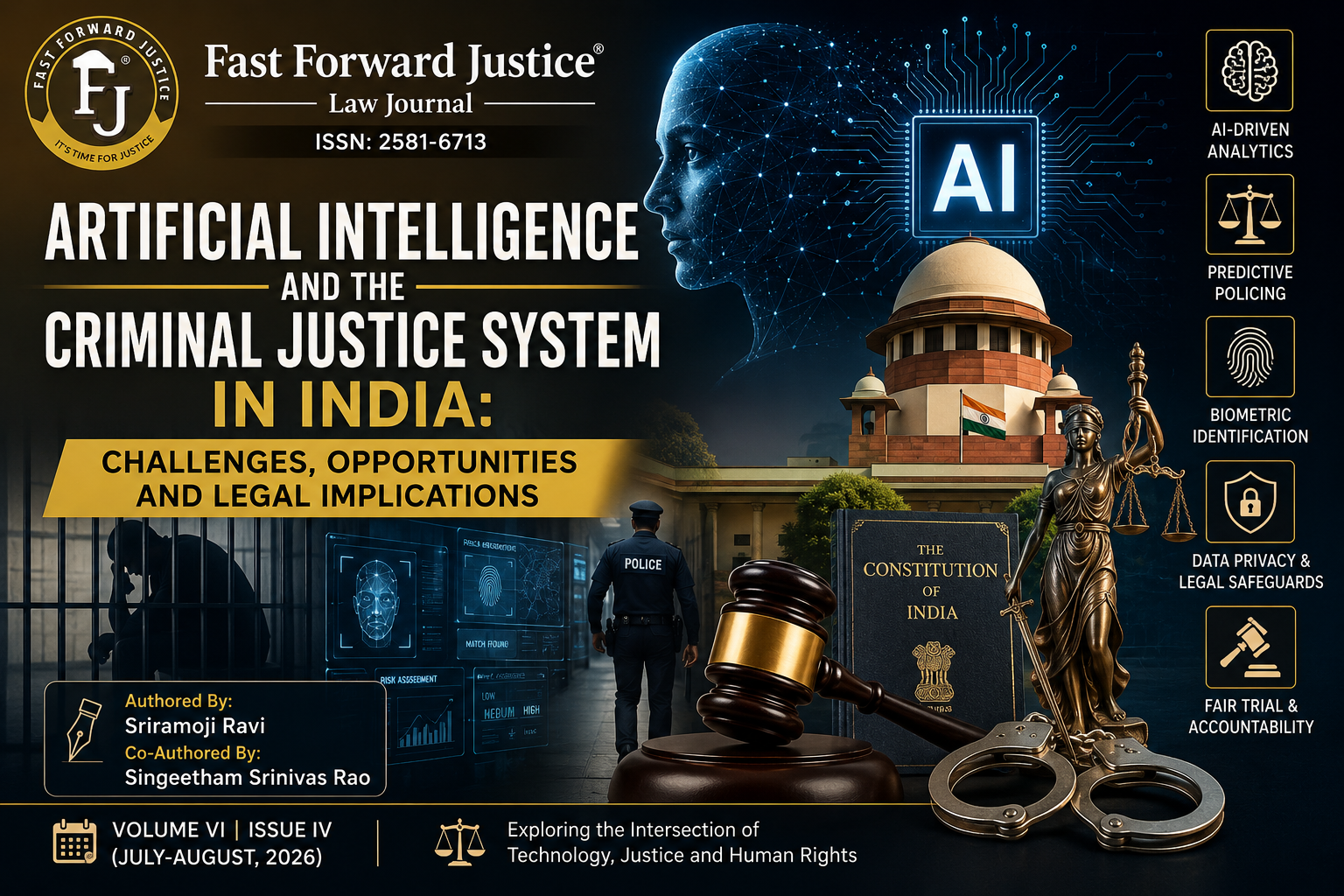
Artificial Intelligence (AI) has emerged as one of the most significant technological developments of the twenty-first century and is increasingly transforming the functioning of modern criminal justice systems. The capacity of AI systems to process vast quantities of information, identify patterns, analyse digital evidence, recognise images and faces, predict trends, and assist in decision-making has created significant opportunities for improving the efficiency and effectiveness of policing, criminal investigation, prosecution, forensic science, judicial administration, and correctional services. At the same time, the increasing integration of AI into criminal justice raises complex constitutional, legal, ethical, procedural, and human-rights concerns. The present dissertation examines the growing relationship between Artificial Intelligence and the criminal justice system in India, with particular emphasis on the opportunities created by AI, the challenges arising from its deployment, the adequacy of the existing Indian legal framework, and the reforms required to ensure responsible and constitutionally compliant use of AI.
The central premise of the study is that Artificial Intelligence possesses substantial potential to strengthen India’s criminal justice system by improving investigative efficiency, assisting in the analysis of digital evidence, supporting cybercrime investigation, facilitating legal research, improving case management, and enabling more effective allocation of law-enforcement resources. AI applications such as predictive policing, facial recognition, digital forensic analysis, automated document review, financial transaction analysis, cybercrime detection, and judicial research assistance can significantly reduce the time and resources required to process increasingly complex criminal cases. The dissertation observes that India’s criminal justice institutions are gradually adopting such technologies, particularly in the areas of digital investigation, surveillance, forensic analysis, cybercrime investigation, and judicial administration. Initiatives such as AI-assisted legal research and digital court management demonstrate the growing role of technology in improving institutional efficiency.
However, the study emphasises that technological efficiency cannot be treated as the sole objective of criminal justice administration. Criminal justice directly affects fundamental rights, liberty, dignity, privacy, equality, and reputation. Consequently, the deployment of AI must remain subject to constitutional principles, statutory safeguards, judicial oversight, and meaningful human supervision. One of the principal findings of the research is that AI should operate primarily as a decision-support mechanism rather than as an autonomous decision-maker. Decisions involving arrest, prosecution, assessment of guilt, sentencing, judicial interpretation, parole, or other matters directly affecting individual liberty should not be delegated entirely to automated systems. Human judgment and judicial discretion remain indispensable in ensuring fairness and due process.
The dissertation adopts a doctrinal legal research methodology. The study is based primarily on qualitative analysis of constitutional provisions, legislation, judicial decisions, government policies, academic literature, research papers, reports, and comparative legal materials. The principal primary sources examined include the Constitution of India, the Bharatiya Nyaya Sanhita, 2023, the Bharatiya Nagarik Suraksha Sanhita, 2023, the Bharatiya Sakshya Adhiniyam, 2023, the Information Technology Act, 2000, the Digital Personal Data Protection Act, 2023, relevant Supreme Court and High Court judgments, Law Commission reports, and Parliamentary Committee materials. Secondary sources include books, peer-reviewed journals, legal commentaries, research papers, government publications,
NITI Aayog reports, international reports, and scholarly literature. The research adopts descriptive, analytical, comparative, and critical legal approaches.
The study examines the application of AI across different stages of criminal justice administration. In policing, AI can assist in crime hotspot identification, CCTV analysis, facial recognition, automated number plate recognition, missing-person identification, cyber patrol, social-media intelligence, and emergency response. Predictive policing can help law-enforcement agencies allocate resources and identify patterns of criminal activity. Nevertheless, the research identifies significant concerns where historical crime data contain institutional or social biases. Algorithms trained on such data may reproduce or amplify existing patterns of discriminatory policing. Predictive policing may consequently result in disproportionate attention being directed towards particular communities or geographical areas. Such outcomes raise concerns relating to equality, arbitrary state action, explainability, and procedural fairness. The dissertation therefore considers predictive policing appropriate only as an advisory mechanism subject to human judgment and legal safeguards.
AI also has considerable applications in criminal investigation and digital forensics. Modern investigations increasingly involve large quantities of electronic information originating from mobile phones, computers, cloud storage, CCTV systems, GPS devices, financial records, social media, email, encrypted communications, and Internet-connected devices. AI can assist investigators in organising and analysing such information, detecting suspicious financial transactions, identifying relationships among suspects, linking multiple cases, analysing communication patterns, recovering digital information, detecting cyber fraud, and identifying manipulated or forged material. In cybercrime investigation, AI can assist in malware detection, phishing identification, cryptocurrency transaction analysis, dark-web investigations, ransomware detection, and financial-fraud investigation. The study therefore recognises AI-assisted investigation as particularly valuable in responding to the increasing complexity and volume of digital crime.
Digital forensics represents another important area in which AI may substantially improve criminal justice administration. AI-enabled forensic tools can assist in mobile-phone analysis, hard-disk recovery, cloud-forensic investigation, image enhancement, voice recognition, video authentication, deepfake detection, and document examination. Such technologies may reduce delays in forensic laboratories and enable investigators to analyse large volumes of electronic material more efficiently. Nevertheless, the dissertation stresses that AI-generated forensic conclusions should not automatically be treated as conclusive. Independent verification by qualified forensic experts remains necessary before AI-assisted conclusions are relied upon in criminal proceedings.
Facial Recognition Technology is examined as a particularly sensitive application of AI. Facial recognition can assist in identifying suspects and missing persons, detecting repeat offenders, supporting counter-terrorism operations, and improving security. However, inaccurate identification, biased datasets, poor image quality, and large-scale surveillance create significant constitutional concerns. The use of facial recognition can directly affect informational privacy and personal liberty, particularly where individuals are subjected to surveillance without adequate safeguards. The dissertation therefore supports the introduction of clear statutory controls, judicial oversight, independent auditing, and appropriate data-protection safeguards for the deployment of facial-recognition technologies.
The study further analyses AI applications in prosecution and judicial administration. Prosecutors may use AI to organise evidence, review large volumes of documents, identify inconsistencies, prepare chronological timelines, locate relevant legal provisions and precedents, and manage prosecution databases. Similarly, AI may support courts through legal research, case summarisation, precedent identification, translation, scheduling, document classification, transcription, and case-flow management. The dissertation refers to the Supreme Court’s SUPACE initiative as an example of AI-
assisted judicial research. Importantly, such technology is intended to assist judges rather than replace their independent reasoning. The research concludes that AI must never determine guilt, innocence, sentencing, or constitutional questions because these functions require judicial appreciation of evidence, legal reasoning, and consideration of individual circumstances.
A central component of the dissertation is the examination of constitutional and legal issues arising from AI deployment. Article 14 of the Constitution provides an important safeguard against discriminatory algorithmic decision-making, while Article 21 protects life and personal liberty and incorporates the constitutional protection of privacy recognised by the Supreme Court in Justice K.S. Puttaswamy (Retd.) v. Union of India. AI-powered surveillance, facial recognition, behavioural monitoring, and predictive analytics must therefore satisfy requirements of legality, necessity, proportionality, and procedural safeguards. Principles of natural justice, including the right to be heard, reasoned decision-making, transparency, and judicial review, must remain central to AI-assisted criminal justice.
The dissertation also evaluates India’s statutory framework. The Bharatiya Nyaya Sanhita, 2023, Bharatiya Nagarik Suraksha Sanhita, 2023, Bharatiya Sakshya Adhiniyam, 2023, Information Technology Act, 2000, and Digital Personal Data Protection Act, 2023 provide an important legal foundation for addressing aspects of criminal conduct, criminal procedure, electronic evidence, information technology, and personal-data protection. However, the study finds that these statutes regulate AI only indirectly. India does not presently have comprehensive legislation specifically governing Artificial Intelligence in criminal justice. Consequently, important questions concerning algorithmic accountability, transparency, explainability, liability for AI errors, independent auditing, and automated decision-making remain insufficiently addressed.
The literature review identifies an important research gap. Existing Indian scholarship has increasingly examined AI, digital governance, privacy, and technological development, but comparatively limited research integrates constitutional law, criminal procedure, evidence law, data protection, and AI governance within a single legal analysis of criminal justice. In particular, the interaction between AI technologies and India’s newly enacted criminal laws remains under-explored. The dissertation seeks to address this gap through an integrated doctrinal analysis supported by judicial precedents and comparative legal perspectives.
The comparative study examines regulatory approaches in the European Union, United States, United Kingdom, and Singapore. The European Union follows a risk-based regulatory approach, under which high-risk AI systems used in areas such as law enforcement are subjected to requirements relating to transparency, human oversight, documentation, and conformity assessment. The United States follows a more fragmented regulatory model involving federal and state laws, judicial decisions, and administrative guidance, while continuing to face concerns regarding algorithmic bias and discrimination. The United Kingdom emphasises human-centred governance, transparency, accountability, and explainability. Singapore provides a governance-oriented model emphasising transparency, human oversight, risk management, accountability, and public trust. The comparative analysis identifies common principles that may be adapted to India’s constitutional and socio-legal context, particularly human oversight, transparency, accountability, privacy protection, independent audits, ethical governance, and risk-based regulation.
The major findings of the dissertation demonstrate that AI can significantly enhance criminal investigation, digital forensics, judicial administration, and the overall efficiency of criminal justice institutions. At the same time, AI creates substantial risks relating to privacy, discrimination, algorithmic bias, transparency, accountability, surveillance, cybersecurity, and procedural fairness. The study finds that existing Indian laws provide important safeguards but do not constitute a comprehensive AI
governance framework. Constitutional protections therefore remain particularly important in controlling the use of AI by state authorities.
Based on these findings, the dissertation recommends the enactment of comprehensive legislation specifically addressing AI in criminal justice. Such legislation should establish clear requirements relating to transparency, accountability, explainability, human oversight, data protection, risk assessment, and independent supervision. AI systems used by criminal justice authorities should be explainable and auditable, and regular independent audits should assess their accuracy, bias, security, and constitutional compliance. Human review should remain mandatory for decisions affecting individual rights and liberty. Police officers, prosecutors, judges, and forensic professionals should receive specialised training concerning AI technologies and their legal implications. National ethical guidelines should promote fairness, proportionality, accountability, transparency, and respect for human rights. The study also recommends greater public awareness concerning governmental use of AI and the safeguards available to individuals.
The hypothesis of the study is substantially supported by the analysis. Artificial Intelligence has considerable potential to improve the efficiency and effectiveness of India’s criminal justice system; however, its widespread adoption without a comprehensive legal and regulatory framework may adversely affect privacy, equality, procedural fairness, accountability, and public confidence in the administration of justice. The dissertation therefore advocates a balanced approach in which technological innovation is encouraged but remains firmly subject to constitutional values, statutory safeguards, judicial oversight, independent accountability mechanisms, and meaningful human control.
In conclusion, the dissertation establishes that Artificial Intelligence should complement, rather than replace, human intelligence in India’s criminal justice system. Its potential to improve crime detection, investigation, digital forensics, cybercrime response, prosecution, judicial administration, and public safety is substantial. Nevertheless, efficiency cannot come at the cost of liberty, dignity, equality, privacy, or the rule of law. India’s existing constitutional and statutory framework provides an important foundation, but the rapid development of AI necessitates a dedicated and comprehensive regulatory approach. The future of AI in Indian criminal justice should therefore be based on responsible innovation, human oversight, transparency, accountability, privacy protection, independent auditing, ethical governance, and judicial review. Such an approach can enable India to harness the benefits of Artificial Intelligence while ensuring that technological advancement strengthens rather than undermines the principles of justice and constitutional governance.
Keywords: Artificial Intelligence, Criminal Justice, AI Governance, Predictive Policing, Facial Recognition, Digital Forensics, Cybercrime, Algorithmic Bias, Privacy, Constitutional Rights, Human Oversight, Digital Evidence, Judicial Administration, AI Regulation, India.