
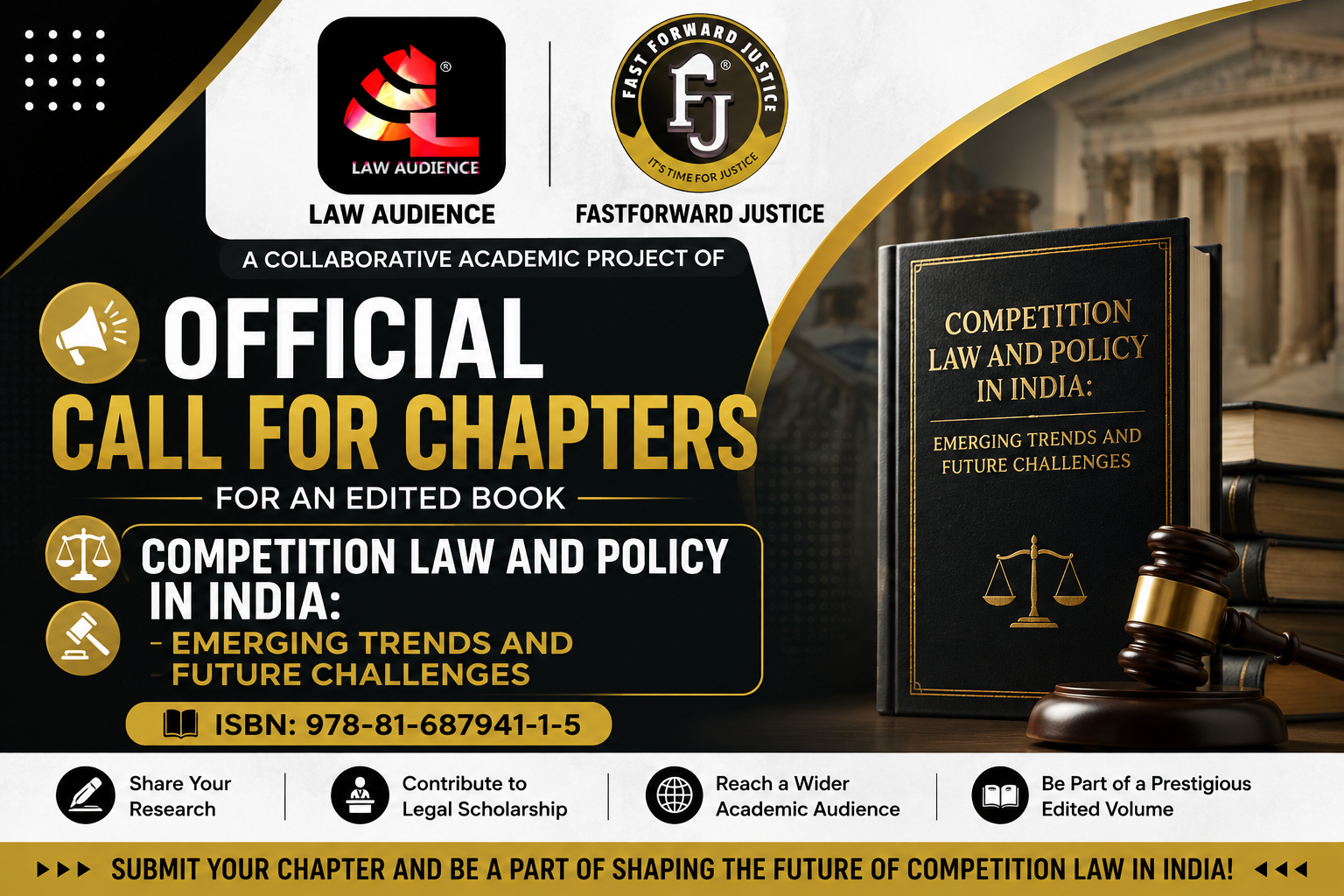
CALL FOR CHAPTERS| AN EDITED BOOK| COMPETITION LAW AND POLICY IN INDIA: EMERGING TRENDS AND FUTURE CHALLENGES |ISBN: 978-81-687941-1-5|
A Collaborative Academic Project of LAW AUDIENCE AND FASTFORWARD JUSTICE
- CALL FOR CHAPTERS
Law Audience and FastForward Justice are pleased to invite original, unpublished and research-oriented chapters for their forthcoming edited book titled:
Competition Law and Policy in India: Emerging Trends and Future Challenges
ISBN: 978-81-687941-1-5
The edited volume seeks to bring together diverse academic, professional and research perspectives on the evolving framework of competition law and policy in India. The book is intended to examine both the established principles of Indian competition law and the rapidly emerging issues arising from digital markets, artificial intelligence, data, platform economies, merger control, sectoral regulation, new enforcement mechanisms, sustainability, innovation and changing market structures.
The proposed volume is designed as a comprehensive contribution to contemporary scholarship on Indian competition law and is expected to be useful for students, researchers, academicians, advocates, legal professionals, policymakers, corporate professionals and others interested in the field of legal studies.
Submissions are open to all persons interested in legal studies.
Individual as well as co-authored submissions are permitted.
- ABOUT THE BOOK
Competition law in India has undergone a significant transformation from the earlier regime concerned primarily with the regulation of monopolies and restrictive trade practices to a modern framework focused on maintaining competitive markets, protecting the competitive process, promoting consumer welfare and facilitating innovation.
The enactment of the Competition Act, 2002, the establishment and evolution of the Competition Commission of India, subsequent legislative amendments, developments in merger control and the emergence of new mechanisms such as settlement and commitment have considerably expanded the scope of Indian competition regulation.
At the same time, the contemporary economy is increasingly shaped by:
- digital platforms;
- artificial intelligence;
- data-driven business models;
- algorithmic pricing;
- online marketplaces;
- Big Tech;
- network effects;
- platform ecosystems;
- start-up acquisitions;
- private equity and venture capital transactions;
- digital payments;
- FinTech;
- new forms of labour-market coordination;
- sustainability considerations; and
- cross-border commercial activity.
These developments have created complex questions regarding market power, dominance, anti-competitive coordination, access to data, digital gatekeepers, innovation, merger review, algorithmic conduct, consumer welfare and regulatory overlap.
The edited book, therefore, aims to provide a structured and forward-looking analysis of the foundations, present developments and future challenges of Competition Law and Policy in India.
The volume seeks to encourage both doctrinal and interdisciplinary research and welcomes contributions that combine legal analysis with developments in economics, technology, business, public policy, corporate governance, innovation and regulatory studies.
- OBJECTIVES OF THE EDITED BOOK
The principal objectives of the book are to:
- Examine the historical and contemporary development of competition law in India.
- Analyse the statutory and institutional architecture of the Competition Act, 2002.
- Evaluate the impact of recent legislative and regulatory reforms.
- Study emerging forms of anti-competitive conduct.
- Examine competition concerns arising from digital markets and platform economies.
- Analyse the impact of artificial intelligence, algorithms and data on competition.
- Study India’s evolving merger-control framework.
- Examine new enforcement mechanisms, including settlement and commitment.
- Analyse competition-law issues in specific sectors.
- Examine important judicial and institutional developments.
- Explore the relationship between competition law and innovation, sustainability and technology.
- Identify future challenges and possible directions for Indian competition policy.
- EDITORIAL BOARD
Senior Chief Editor
Dr. Amit Yadav
Associate Professor (Law)
Department of Law
Manipal University Jaipur
Senior Editor
Dr. Bhupender Kumar Jodhta
Professor & Principal, Awasthi College of Law,
Nalagarh, Solan
Sabrina Bath
Assistant Professor
University Institute of Legal Studies (UILS)
Chandigarh University
Assistant Chief Editors
Adv. Gaganpreet Kaur Gill
Pursuing Ph.D. in IPR
University Institute of Legal Studies (UILS)
Chandigarh University
Advocate Amit Verma
Founder, FastForward Justice
Adv. Varun Kumar
Founder, Law Audience
Adv. Rahul Tiwari
High Court of Delhi
Other Members of the Editorial Board
The edited volume will also have several other well-known academicians, legal practitioners, researchers and professionals serving in different editorial capacities, including as Assistant Chief Editors and Assistant Editors.
The complete editorial board may be announced separately by the Organizers.
- NATURE OF THE CHAPTERISATION
The chapterisation above is proposed and indicative.
Depending upon the submissions received, the Organizers and Editorial Board reserve the right to:
- modify chapter titles;
- merge closely related submissions;
- create additional chapters;
- reorganise Parts;
- allocate an accepted submission to a more appropriate chapter;
- request authors to modify the focus of a manuscript; and
- make other editorial changes necessary for the coherence and academic quality of the book.
Authors may also propose a relevant topic not expressly mentioned above, provided it falls within the broader theme of Competition Law and Policy in India: Emerging Trends and Future Challenges.
- ELIGIBILITY
Submissions are open to all persons interested in the field of legal studies, including:
- Students;
- LL.B. and integrated law students;
- LL.M. students;
- Ph.D. scholars;
- Research scholars;
- Academicians;
- Professors;
- Assistant Professors;
- Advocates;
- Legal practitioners;
- Corporate professionals;
- Researchers;
- Policy professionals;
- Compliance professionals;
- Competition-law practitioners; and
- Other interested contributors.
There is no restriction limiting submissions only to persons associated with any particular institution.
- CO-AUTHORSHIP
Co-authorship is permitted.
Where a chapter is co-authored:
- Details of all authors must be provided on the cover page.
- The processing fee will be charged per article, not separately for each author.
- Each author whose name appears on the published chapter may receive the applicable soft-copy Certificate of Author, subject to the publication policy of the Organizers.
- If the co-authors wish to purchase hard copies of the edited book, they may purchase the required number of copies separately through the official channels/websites of the Organizers, subject to availability and applicable charges.
No complimentary hard copy of the book is included in the processing fee unless specifically announced otherwise by the Organizers.
- SUBMISSION GUIDELINES
Authors are requested to carefully follow the following guidelines.
- Manuscript Format
Requirement | Specification |
File Format | MS Word (.doc/.docx) |
Page Size | A4 |
Orientation | Portrait |
Font | Times New Roman |
Main Text Size | 12 pt |
Heading Size | 14 pt |
Line Spacing | 1.5 |
Text Alignment | Justified |
Font Colour | Black |
Margins | Standard/A4 appropriate margins |
Language | English |
Note on heading size
For purposes of this official notification, the heading size has been stated as 14 pt, while the main body text shall be 12 pt.
- COVER PAGE — MANDATORY
Every submission must contain a separate cover page providing complete details of the author(s).
The cover page must contain:
- Title of the Chapter
- Full Name of Author
- Full Name of Co-author, if any
- Mobile Number(s)
- Email Address(es)
- Degree/Qualification Details
- Current Course/Programme, if applicable
- Designation, if applicable
- Institution/University/Organisation
- Professional details, where applicable
- Any other relevant information that the author wishes to provide for editorial correspondence.
For a co-authored submission, complete details of each co-author must be provided.
- SUGGESTED STRUCTURE OF THE CHAPTER
Authors may structure their chapters as follows:
Title of Chapter
Author Details
Abstract
A concise overview of the purpose, scope, principal arguments and findings of the chapter.
Keywords
Relevant keywords identifying the principal subject matter of the contribution.
Introduction
Conceptual/Legal Framework
Main Analysis
Judicial/Regulatory Developments, where relevant
Critical Analysis
Suggestions/Recommendations, where appropriate
Conclusion
References/Bibliography
Authors may adapt the structure according to the nature of their topic.
- CITATIONS AND REFERENCES
Authors are required to provide appropriate citations for all sources relied upon.
Submissions should properly acknowledge:
- statutes;
- rules;
- regulations;
- judicial decisions;
- CCI orders;
- NCLAT decisions;
- Supreme Court and High Court decisions;
- government publications;
- books;
- journal articles;
- reports;
- policy papers;
- working papers;
- websites;
- databases;
- international instruments; and
- other sources relied upon.
Authors should maintain consistency in citation style throughout the chapter.
- ORIGINALITY AND ACADEMIC INTEGRITY
Every chapter must be:
- original;
- unpublished;
- research-oriented;
- properly referenced; and
- free from plagiarism.
The manuscript should not be simultaneously under consideration for publication elsewhere.
Authors shall remain responsible for ensuring that:
- The manuscript is their original work.
- All third-party material has been appropriately acknowledged.
- Necessary permissions have been obtained where required.
- The submission does not infringe the copyright, intellectual property rights or other legal rights of any third party.
- All factual and legal claims have been appropriately supported.
The Editorial Board reserves the right to reject any submission that does not satisfy the required standards of originality, academic integrity or research quality.
- EDITORIAL REVIEW
Submission of a chapter does not automatically guarantee publication.
Every manuscript may be subjected to editorial review.
The Editorial Board/Organizers reserve the right to:
- accept the manuscript;
- reject the manuscript;
- seek revisions;
- seek clarifications;
- recommend restructuring;
- suggest changes in title;
- correct grammatical and typographical errors;
- standardise formatting;
- make reasonable editorial changes; and
- determine whether the submission is suitable for inclusion in the edited volume.
The decision of the Editorial Board/Organizers concerning publication shall be final.
- PROCESSING FEE
Plan A
₹700 PER ARTICLE
A processing fee of: ₹700 per article
Plan B
1499/- which Includes Hard Copy of the book and laminated certificate (in case of co-authored articles, each needs to purchase the hardcopy of the book and certificate separately).
For co-authored articles:
The processing fee shall remain ₹700 for the article and shall not be charged separately at ₹700 for each author, unless otherwise notified by the Organizers.
Authors may be informed about the payment procedure following the applicable editorial/selection process.
- LAST DATE FOR SUBMISSION
7 OCTOBER 2026
Authors are strongly encouraged to submit their manuscripts well before the deadline to facilitate editorial scrutiny, correspondence and publication planning.
- CERTIFICATE OF AUTHOR
Authors of successfully published chapters shall be provided with:
SOFT COPY OF THE CERTIFICATE OF AUTHOR ONLY
No hard copy of the Certificate of Author shall be provided.
Authors are requested to carefully note this condition before making their submission.
- PURCHASE OF THE BOOK
Authors and interested readers will be able to purchase the:
Soft Copy of the Book
and/or
Hard Copy of the Book
through the official websites/official channels of Law Audience and FastForward Justice, subject to availability and applicable purchase terms.
The processing fee for the chapter and the price of the book are separate.
For Co-Authors
Where a published chapter has two or more authors and each author wishes to obtain a separate hard copy, the required copies may be purchased separately through the official purchase mechanism of the Organizers.
No hard copy should be presumed to be included merely on account of payment of the chapter processing fee.
- COPYRIGHT POLICY
COPYRIGHT SHALL BE RESERVED WITH THE ORGANIZERS
Authors whose chapters are accepted for publication shall be required to sign a Copyright Agreement with the Organizers.
Publication of the chapter shall be subject to execution of the required Copyright Agreement.
The agreement may regulate matters concerning:
- publication rights;
- reproduction;
- distribution;
- electronic publication;
- printing;
- dissemination;
- archival use;
- authorised promotional use; and
- other rights relating to publication of the accepted work.
Authors must ensure before submission that they possess the necessary rights in all material forming part of their contribution.
- AUTHOR DECLARATION
By submitting a manuscript, the author(s) shall be deemed to represent that:
- the work is original;
- the author(s) are entitled to submit it;
- all sources have been appropriately acknowledged;
- the manuscript does not knowingly violate third-party rights;
- the information furnished on the cover page is accurate; and
- the author(s) agree to comply with the publication and copyright requirements of the Organizers if the manuscript is accepted.
- SUBMISSION PROCEDUREABOUT LAW AUDIENCE
LAW AUDIENCE
Law Audience is a legal education and academic platform committed to promoting opportunities for students, researchers, academicians and legal professionals.
Its academic and educational initiatives seek to facilitate:
- legal research;
- academic writing;
- knowledge dissemination;
- professional development;
- contemporary legal discussions; and
- engagement between members of the legal community.
Law Audience undertakes academic and professional initiatives including legal competitions, seminars, conferences, webinars, workshops, publications and research-oriented activities.
- ABOUT FASTFORWARD JUSTICE
FASTFORWARD JUSTICE
FastForward Justice is a legal education and professional-development initiative focused on encouraging legal learning, research, writing, practical skills and meaningful academic engagement.
Its activities seek to create opportunities for law students, researchers, academicians, advocates and members of the legal profession to improve their legal knowledge and professional capabilities.
Through educational and research-oriented activities, FastForward Justice seeks to contribute towards a stronger culture of legal scholarship and professional skill development.