
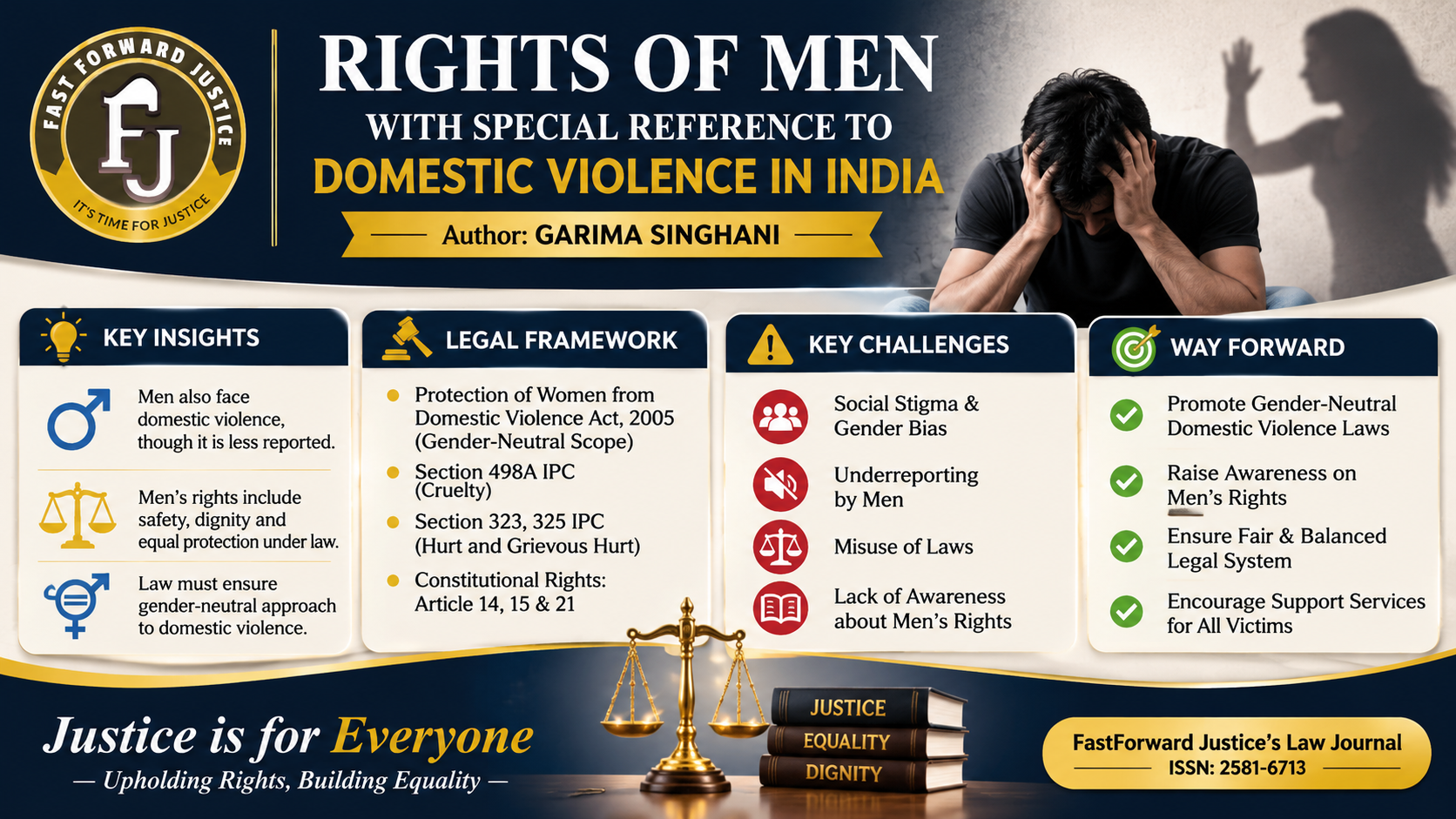
Abstract
Domestic violence is conventionally understood as violence against women, and Indian law is built on that premise. This paper examines the position of men who experience violence within marriage and intimate relationships in India. Using a doctrinal and comparative method, it asks why such violence is under-reported, how India’s framework compares with those of the United States, the United Kingdom and Australia, and whether the remedies, safeguards and defences available to Indian men are adequate.
The paper highlights that men cannot be protected under the act or the act is not gender-neutral “Protection of Women from Domestic Violence Act, 2005 (PWDVA)” and must rely on general criminal law and matrimonial statutes, which do not address emotional, economic and coercive abuse in a gender-neutral way. Reliable national data on male victimisation is scarce, and much of the available evidence comes from small or advocacy-led surveys. The paper argues that recognising male victims need not dilute protection for women, and recommends better data, gender-neutral civil protection, institutional support and continued safeguards against misuse of cruelty provisions.
Keywords: domestic violence; male victims; PWDVA 2005; Section 85 BNS; gender neutrality; under-reporting; Article 14.
Domestic violence is usually imagined as violence by a man against a woman, and the evidence supports the view that women are the majority of reported victims. As per the National Family Health Survey (NFHS-5, 2019–21), almost 30% married Indian women aged 18–49 disclosed abuse by a spouse. That reality, however, hardens into an assumption that men cannot be victims, and the assumption shapes law, policing and public attitudes. In a society that discourages men from expressing vulnerability, a man who reports abuse by his wife or her relatives risks ridicule rather than assistance.
This paper does not claim that violence against men equals violence against women in scale or severity. Its claim is narrower: a man who is abused is entitled to the equal protection of the law guaranteed by Article 14 and to life with dignity under Article 21, and the present framework gives him only a thin and indirect remedy. Whether women’s growing economic independence is shifting patterns of intimate conflict is debated; Indian evidence is limited, so this paper treats it as a hypothesis, not a finding.
The paper also recognises a competing concern. Courts have repeatedly warned that section 498A of the Indian Penal Code, 1860 (IPC), now section 85 of the Bharatiya Nyaya Sanhita, 2023 (BNS), is sometimes misused in matrimonial disputes. False accusation by a spouse is a procedural problem; violence suffered by a man is a substantive one. The two issues are related but must not be conflated.
1.1 Research Objectives-
- To examine the extent and causes of under-reporting by men regarding the domestic violence against them in India.
- To examine and compare the legal provisions covering domestic violence against men within India and selected foreign jurisdictions.
- To evaluate the adequacy and effectiveness of the legal remedies, safeguards, and defences available to men under Indian law.
This study examines domestic abuse against men within India and the remedies, safeguards and defences available to them under the Indian law. The protection of Women from Domestic Violence Act, 2005 (PWDVA) explains domestic violence widely under Section 3, but limits the status of “aggrieved person” under section 2(a) to women, so its remedies under Section 18 to 22 are unavailable to men. Although Hiral P. Harsora v. Kusum Narottamdas Harsora (2016) 10 SCC 165 recognized that women may be respondents, it did not extend relief to male victims. While this exclusion is constitutionally defensible under Article 15(3), the study asks whether other laws, including the BNS, 2023 and general civil and procedural remedies, adequately fill the gap. It also examines the safeguard available to men against false or misused allegations and compares the Indian position with selected foreign jurisdiction. The study is confined to the Indian legal framework, with comparative references used only to assess its adequacy and suggest reforms.
The study is doctrinal in nature and relies entirely on secondary sources, (statutes and Supreme Court judgments) and secondary sources (peer-reviewed studies, government and survey reports), no primary data was collected. Its main limitations are the scarcity of nationally representative data on male victims, the reliance on small regional and advocacy-led surveys. Since the three new criminal codes(BNS, BNSS and BSA) 2023 took effect on 1st July 2024, most judicial decisions of court still rely on the repealed codes.
Gender is widely understood as a social construct shaped by factors such as class, caste and religion (Lorber and Farrell, 1991). Asian societies, including India, gender roles are strictly enforced, which give rise to social stereotypes about who can be a victim of abuse and who cannot. Indian law reflect a view under (PWDVA) and limits the definition of an “aggrieved person” to women as per section 2 (a), so men can’t seek its civil remedies directly. A male victim must instead rely on general criminal provisions, such as hurt, wrongful confinement under BNS which are not a help for domestic abuse. Courts have also at the same time, accepted that women can be perpetrators, as Hiral P. Harsora v. Kusum Narottamdas Harsora (2016) in this Supreme Court held that female relatives may be respondents under the Act.
- Whoever is held to have committed hurt as defined in section 319 IPC under now BNS SECTION 114, 116 if they cause the bodily discomfort, sickness, or incapacity of another person, serious wounds including fractures, the gradual loss of function in a limb or body part, or wounds that endanger a person’s life. The Sections 321 and 322 of the Code now Section 115(1), 116 define voluntarily causing harm people. If someone is intentionally harmed, they might spend up to a year in jail, pay a fine of up to Rs. 1,000, or both (BNS Section 115(2)). For serious injury, a fine and up to three years in jail are possible penalties (BNS Section 118(1)).
- Unlawful imprisonment and confinement are likewise covered under Sections 339 to 348, BNS Section 126-127 with a three-year maximum term. An individual who has been the victim of any of the aforementioned behaviors may seek protection under these Sections as domestic abuse frequently involves aspects of suffering, constraint, and imprisonment.
- Sections 349 through 352, 355 & 357 BNS Section 128-135 concern assault and crimes involving the use of illegal force. They offer redress for individuals who want to physically hurt another person or who use unlawful force to do so. Maximum penalties include a fine of Rs. 5,000, two years in jail, or both.
- As per Section 24 of The Hindu Marriage Act, 1955, both men and women are entitled to maintenance while the case is still being considered. In these cases, the court considers the couple’s total income for determining support. However, a male does not get the same right under the Special Marriage Act. Under the exemption stipulated by Section 125 of the Criminal Procedure Code, and section 144 of BNSS the husband may decide not to pay support if the wife left the marital home without a valid reason. Any male who has been the victim of violence of any kind is always qualified to register a FIR under any applicable Sections or submit a Constitutional Petition to safeguard his right to life and personal liberty. In India, legislation pertaining to men’s rights is being established, and the courts have started providing harmed men with adequate legal recourse in cases of domestic abuse. Although it’s likely that separate legislation won’t be ready anytime soon, precedents and revisions will help to paint a clear picture of a system for defending rights. There is no denying that violence affects everyone, regardless of gender, even though it occurs at different rates. This only deals with the issue that is truly doing irreparable harm; it does not lessen the challenges that either gender faces. Legislation that is gender-neutral shouldn’t be enforced until social equality has been attained. Men might seek reparation in a number of ways. There will always be a solution as long as there is a procedure in place to safeguard men’s rights.
5. Extent and Under-reporting of Violence against Men
5.1 What the evidence shows
There is no national survey of male victimisation in India, and the available studies must be read with caution. The most frequently cited is a cross-sectional study by Malik and Nadda (2019) in rural Haryana, which interviewed 1,000 married men aged 21–49 using a modified Conflict Tactics Scale. It reported that 52.4% of men had experienced some form of spousal violence in their lifetime, 51.5% in the preceding twelve months, with emotional violence the most common (51.6%) and physical violence far less so (6%). The study is regional, relies on self-report and uses a broad definition of violence; its figures cannot be generalised to India.
Advocacy surveys, such as the Save Family Foundation survey cited by Sarkar and others (2007), likewise report emotional and economic abuse more often than physical violence, but they are not probability samples. Claims that a fixed share of domestic violence victims in India, such as “40 in 100”, are men have no reliable national source and should not be repeated as fact.
Media-reported suicides add a troubling but anecdotal dimension. Reports from Pune (April 2019), Ahmedabad (May 2019) and Delhi (January 2019) record men whose notes or recordings alleged harassment by wives or in-laws,. These allegations are untested, and National Crime Records Bureau (NCRB) data show that men account for roughly 70% or more of suicides generally, without attributing causes to spousal abuse. They justify further research, not firm conclusions.
5.2 Why men do not report
The literature and available studies suggest several overlapping causes:
- Fear of counter-allegations. Men fear that complaining may provoke a cross-complaint under section 85 BNS or the PWDVA, prolonged litigation, arrest, or loss of access to their children.
- Gender stereotypes. Men are expected to be physically strong, emotionally resilient and protective. A man who admits abuse may be mocked, disbelieved or seen as having failed in his role, so shame silences him.
- Social and family pressure. Family reputation carries great weight in India. Men may stay silent to avoid embarrassment, protect children, or preserve the marriage, and some blame themselves.
- Denial and institutional disbelief. Because domestic violence is widely assumed to affect only women, police may refuse to register complaints, and there are almost no helplines, shelters or counselling services designed for men.
- Absence of a tailored legal route. With no civil protection regime, a man who wants protection must file a criminal complaint, which demands proof of a specific offence and does not capture emotional and economic abuse.
Emotional abuse deserves emphasis: insults, threats of false cases, isolation, interference with employment and public humiliation can be as damaging as physical force, yet are hardest to prove.
One in every nine men in the United States faces domestic abuse by their current or ex-partner or spouse or someone else. One in every seven men has been physically abused by his wife or intimate partner.
6.1 United States
In the United States the Violence Against Women Act (VAWA) addresses physical and sexual and coercive behavior. There are State Laws which are gender-neutral regardless of victim is male or female and assistance is available to all victims of domestic violence.
6.2 United Kingdom
In the United Kingdom, men account for around two in every five who are the victims of domestic violence. This contradicts the common assumption that domestic violence affects only women. The Domestic Abuse Act, 2021(section-1) provides a statutory definition of domestic abuse including sexual, economic or emotional abuse. It covers both men and boys and have a gender- neutral definition.
As stated by men’s rights Organization, abuse suffered by men at home goes unrecognized, and their attackers are rarely prosecuted. From 2004-2005 to 2008-2009, 40% of domestic violence sufferer were male, as noted by British crime survey. It has recently dropped to 37.7%. The most frequent abusers of domestic violence against men are unknown people and in open places.
6.3 Australia
One in every Sixteen Australian men has experienced domestic violence in the form of physical or sexual abuse by the partners or people they live with since the age of 15. In Australia The Family Law Act, 1975 (section 4AB) defines family violence and the provision identifies such as assault, sexual abuse, it focuses on behavior rather than being limited to one gender.
Each month between 2012-13 and 2013-14, one man died because of domestic violence by his present or ex-partner. Based on research across different nations, abuse in the home suffered by men done to them by their wives or intimate partners is more widespread than assumed. Suitable legal measures must be enacted to address domestic violence in a more gender- neutral way.
6.4 Comparative Position of India
The primary difference between these countries and India is the scope of their legal frameworks; while UK AND Australia includes gender inclusive definitions India’s primary civil framework is explicitly restricted to female victims, leaving male victims with limited alternative remedies.
The new Indian Criminal Laws such as BNS section 85 defines ‘Cruelty’ but is still limited to women and under BNSS the procedure has changed but, doesn’t recognize men right as a victim.
7. Remedies, Safeguards and Defences under Indian Law
7.1 Legal Position on Cruelty Provisions
Earlier, section 498A of the IPC penalized cruelty against married woman by her husband or in-laws with upto three years of imprisonment and a fine. Under the new legal framework, this provision is governed by section 85 (read with section 86) of the BNS, 2023 “Cruelty” includes:
- Physical or mental harm that endangers a woman’s life, health, or safety, or drives her towards suicide.
- Harassment aimed at coercing her or her family to meet unlawful demands for dowry or property.
But, over time courts have noticed that this provision is sometimes misused by making a fake complaint, women utilize Section 498A or section 85 BNS. In order to satisfy their unlawful demands, a husband, his parents, and other family members may be charged with cruelty to a wife under Section 498A IPC or Section 85 BNS. The spouse, his parents, and other family members are frequently detained for a long time without being given a full inquiry. Even if the complaint is untrue, the accused is assumed guilty unless proven innocent in court. These presumptions do not automatically apply to standalone charge of cruelty under section 498A IPC or section 85 BNS, The burden lies on prosecution to prove the case beyond reasonable doubt. In case of Sushil Kumar Sharma VS Arnesh Kumar.
7.2 Safeguards against misuse of Cruelty Provisions
- Protection against Arbitrary Arrest- police cannot automatically arrest an accused under section 85 BNS (formerly section 498A IPC) they must issue a notice and record valid reasons for arrest under section 35 BNSS as mandated by guidelines in Arensh Kumar v. State of Bihar.
- Civil Matrimonial Relief- filing false and baseless criminal complaints against a spouse constitutes legal cruelty, which serves as a valid ground to seek divorce under section 13(1) (ia) of the Hindu Marriage Act, 1955 or seek restitution of conjugal rights under Section 9.
Section 85 BNS penalizes a husband or his relative who is cruel to a woman, as set out in section 86, with a sentence extending to three years along with a fine. The offence is cognizable and bail cannot be claimed as a right (court’s discretion). Courts have repeatedly noted its misuse in some cases, and the following safeguards now apply.
- Restrictions on arrest. In Arnesh Kumar v. State of Bihar (2014) 8 SCC 273, the Supreme Court directed that police must not arrest automatically in crimes that attract punishment for imprisonment upto a term of seven years, must apply the statutory checklist, and must record reasons, while magistrates must scrutinise any request for remand. The same discipline is carried into section 35 BNSS, including the notice of appearance under section 35(3).
- Pre-arrest and pre-trial relief. Anticipatory bail (section 438 CrPC, now section 482 BNSS), discharge where the material discloses no grave suspicion (section 227 CrPC, now section 250 BNSS), and quashing of proceedings by the High Court (section 482 CrPC, now section 528 BNSS).
- Burden of proof. There is no presumption of guilt in a standalone prosecution under section 498A IPC or or section 85 BNS; the prosecution must prove cruelty beyond reasonable doubt. (Presumptions in dowry-death cases under section 113B of the Evidence Act, now section 118 of the Bharatiya Sakshya Adhiniyam, 2023, apply only in that distinct context.)
- Counter-remedies for false complaints. Proceedings for false information to a public servant (section 182 IPC, now section 217 BNS), false charge (section 211 IPC, now section 248 BNS), criminal conspiracy (section 120B IPC, now section 61(2) BNS) and defamation (section 356 BNS) are available, subject to proof of intent and to the procedural requirements for private complaints. Routine retaliatory use is discouraged and may deter genuine complainants.
Evidence. An accused husband should preserve messages, call records and witness details early; electronic evidence needs the certificate under section 63 of the Bharatiya Sakshya Adhiniyam, 2023 (formerly section 65B of the Evidence Act).
1.Arnesh Kumar Vs. State of Bihar
- Background of the case
The woman said that she was compelled to pay dowry and that when she refused; she was kicked out of the marital home. The partner’s anticipated bail was not authorized. Because of this, the spouse moved a special leave petition (SLP) before the Supreme Court.
- Ruling
The court in the present case highlighted that resentful spouses usually use Section 498A as a tool of attack rather than a safeguard because it is a cognizable and non- bailable violation.. The husband and his family suffer torture as a result of their incarceration in accordance with this Section. The Court found that a police officer must comply with specific rules while making an arrest according to Section 4 of the Dowry Prohibition Act of 1961, this arrest should be justified by a reasonable ground in the validity of the charge. Furthermore, even judicial Magistrates need to exercise caution when granting routine or arbitrary detention.
- Manju Ram Kalita Vs. State of Assam
- Background of the case
According to Section 498A of the Indian Penal Code, the woman filed a complaint alleging that her husband had physically and psychologically abused her. On the other hand, the spouse has refuted every accusation.
- Ruling
The court found that although Section 498-A of the Indian Penal Code may be different in contrast to other legal regulations, “cruelty” for such causes must be taken into consideration in Section 498-A’s context.
Among other things, it should be evaluated by examining the man’s activities, evaluating their significance or seriousness, and figuring out whether there was an extreme mental or physical distress put up on the woman. It must be demonstrated that the lady has been continuously ill- treated, or at the very least, that this has been the case since the complaint was submitted. The Court continued by stating that while routine marital discords can’t be considered as “cruelty,” Section 498-A of the Indian Penal Code does not apply to them.
- Bibi Parwana Khatoon Vs. State of Bihar
- Background of the case
The wife died of burn injuries by the husband and family members, which was a repeating theme in earlier incidents. The Supreme Court heard an appeal of the conviction from the deceased wife’s, husband’s sister and brother.
- Ruling
The appellants in the present case did not live in the area where the alleged offence took place, the court remarked. There was insufficient evidence to prove their claim to be true. The Court exonerated them as a consequence and decided that it should not falsely implicating family members.
4. Rajesh Kumar & Ors. Vs. State of Uttar Pradesh
- Background of the case
- Since no dowry was required in this case, the husband and numerous other relatives faced allegations of harassing the woman. However, some relatives requested that rules be established to avoid false implication. Therefore, the husband’s relatives may occasionally take part in Section 498A proceedings as well. However, it is not essential for them to have taken part in the crime. The appeal raised the issue of whether regulations were necessary to stop the abuse of Section 498A of the Indian Penal Code.
- Ruling
To avoid the potential misuse of Section 498A of the Indian Penal Code, the Supreme Court gave thorough instructions in the mentioned below fields:
- Family Welfare Committees: According to the Supreme Court, each district must have a Family Welfare Committee that investigates complaints submitted in accordance with Section 498A.
- To investigate the complaint, an Investigating Officer should be tasked. The problem is resolved when a settlement has been achieved.
- Impounding of passport after receiving a Red Corner Notice.
- Bail regulations have also altered.
- Cases involving the same parties may be grouped together.
- All family members are exempted from personal appearances. Offenses causing actual physical harm or deaths, according to the Court, are excluded from these rules. The National Legal Services Authority was also given instructions by the Supreme Court, with the addition that it may submit a report for any modifications to the previously issued instructions or additional instructions following a six-month trial run, not beyond March 31, 2018.
- Generate reliable data. The NFHS and the NCRB should systematically collect data on spousal violence experienced by men, using validated instruments that capture context, severity and injury, so that policy rests on evidence and not on advocacy estimates.
- Create gender-neutral civil protection. Parliament should consider either extending protection orders and residence relief to all victims of domestic violence or enacting a parallel civil remedy for men. Such a provision would be consistent with Article 14 and would not affect the PWDVA, whose validity rests on Article 15(3).
- Provide institutional support. Helplines, counselling services and emergency housing should be open to male victims, and police should be trained to register and investigate complaints regardless of the victim’s sex.
- Strengthen procedural safeguards. Courts should continue to enforce Arnesh Kumar and to scrutinise omnibus allegations; the Law Commission’s recommendation on compoundability merits legislative consideration; and mediation should be encouraged where no serious injury has occurred.
- Deter proven falsehood. Where a complaint is found after trial to be knowingly false, existing provisions (sections 217 and 248 BNS) should be applied firmly but on proof of intent, so as not to discourage genuine complainants of either sex.
- Raise awareness. Public campaigns should counter the stereotypes that silence men and challenge the belief that abuse is only physical.
Indian law treats domestic violence as a women’s issue, for understandable reasons: women are the majority of reported victims, and the PWDVA answers a real history of abuse. But it leaves a man who is abused by a spouse or her relatives with no civil protection, no tailored institutional support, and only the general criminal law, which fits emotional and economic abuse poorly. Under-reporting is driven by stigma, fear of counter-allegations and institutional disbelief, and its true scale cannot yet be measured.
The Supreme Court has meaningfully strengthened protections for men as accused persons, but this is a different matter from recognising them as victims. A mature response would collect reliable data, extend neutral civil protection, build support services, and retain safeguards against misuse, while preserving the protections that women need. Recognising that men can be victims does not diminish women’s claims; it completes the principle of equal protection of the law.
References
Arnesh Kumar v. State of Bihar (2014) 8 SCC 273.
Australian Bureau of Statistics (2017). Personal Safety, Australia, 2016.
Black MC, and others, The National Intimate Partner and Sexual Violence Survey: 2010 Summary Report. (CDC 2011).
Dara Lakshmi Narayana v. State of Telangana (2024), (Supreme Court of India, December 19, 2024).
Hiral P. Harsora v. Kusum Narottamdas Harsora (2016) 10 SCC 165.
India Today. (2019, April 22) ‘Pune man kills self after being harassed by wife, her lover’.
International Institute for Population Sciences. (2022). National Family Health Survey (NFHS-5), 2019–21: India Report (2022).
Kahkashan Kausar v. State of Bihar (2022) 6 SCC 599.
- Srinivas Rao v. D.A. Deepa (2013) 5 SCC 226.
Kumar, A. (2012) “Domestic Violence Against Men in India: A Perspective”, Journal of Human Behaviour in the social Enviornment, 22(3), 290-296.
Law Commission of India. (2012). Report No. 243:Section 498A of the Indian Penal Code.
Lorber, J., and Farrell SA (Eds). (1991). The Social Construction of Gender. Sage.
Malik, JS., and Nadda, A.(2019). ‘A cross-sectional study of gender-based Vvolence against men in the rural area of Haryana, India’. 44 Indian Journal of Community Medicine, 44, 35.
Manju Ram Kalita v. State of Assam, (2009) 13 SCC 330.
Office for National Statistics. (2024). Domestic Abuse Victim Characteristics, England and Wales: Year Ending March 2024.
Preeti Gupta v. State of Jharkhand (2010) 7 SCC 667.
Rajesh Sharma v. State of U.P. (2017) 9 SCC 1.
Sarkar, M., Dsouza, and Dasgupta.(2007). Study on Domestic Violence against Men, Save Family Foundation. (As cited in secondary literature.)
Social Action Forum for Manav Adhikar v. Union of India (2018) 10 SCC 443.
Straus, M.A., and Gelles, R.J. (1990). Physical Violence in American Families (Transaction Publishers).
Sushil Kumar Sharma v. Union of India (2005) 6 SCC 281.
Times of India. (2019, May 17). ‘Man commits suicide alleging harassment by wife’.