ABSTRACT
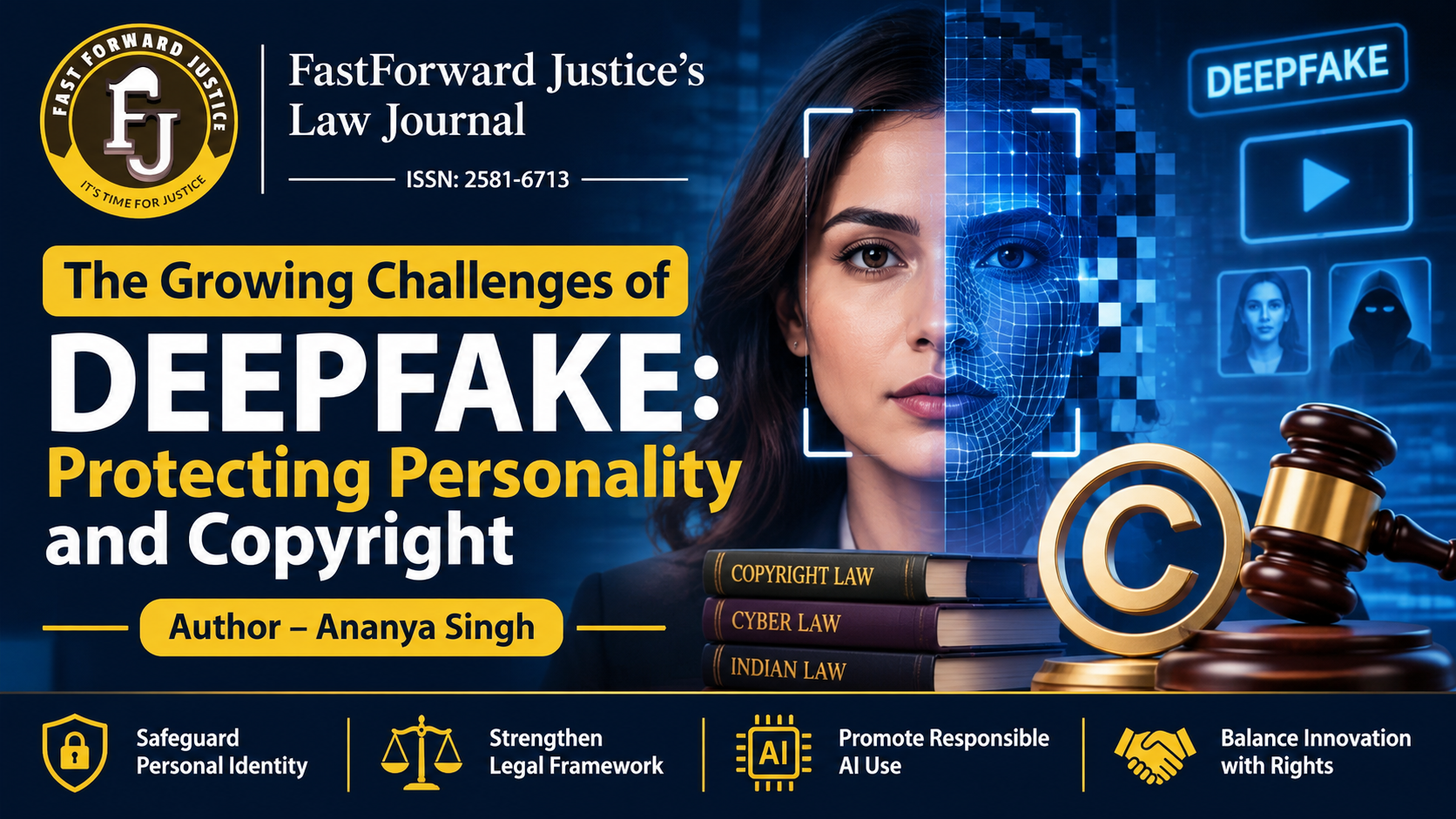
The boom in artificial intelligence, machine learning, and generative media has completely transformed how people make, tweak, and share things online. One tool driving much of that shift is deepfake technology, which makes it remarkably easy to manipulate or generate a person’s face, voice, and mannerisms in video and audio. There is no shortage of genuine, creative uses for this in film production, classrooms, and research labs. Still, when someone uses it without permission, it triggers massive legal and ethical headaches—threatening privacy, wrecking reputations, complicating copyright, and misleading the public.
Things get especially messy when someone’s likeness is lifted and circulated without their say-so. Beyond the immediate hit to personal dignity, assembling these fakes usually means scraping existing photos, film clips, and sound recordings without the creator’s sign-off. As it stands, India doesn’t have a single, clean-cut statute dedicated to deepfakes. Instead, lawyers and judges have to pull from a patchwork of older rules: the Copyright Act of 1957, the Information Technology Act of 2000 alongside its 2021 Intermediary Guidelines, constitutional guarantees around privacy, and judge-made case law on personality rights.
Indian courts, for their part, have begun taking these digital rip-offs seriously. A standout moment came when the Delhi High Court weighed in on Anil Kapoor v. Simply Life India & Ors. The dispute directly targeted AI-generated imagery, face-swapping, and voice clones. Recognizing the harm, the court stepped in to block vendors and platforms from profiting off the actor’s face, voice, catchphrases, and overall public persona without his consent.
This paper looks closely at where deepfake tech, personality rights, and Indian copyright law collide. It walks through what the statutes say, how the courts are handling real-world disputes, and where the current legal playbook falls short. The goal is to show that any workable fix has to walk a fine line: clamping down on identity theft and copyright infringement without choking off satire, fair criticism, artistic freedom, or everyday free speech.
{Keywords: Deepfake, Artificial Intelligence, Personality Rights, Right of Publicity, Copyright, Privacy, Cyber Law, Generative AI, India.}
Introduction
The digital age has fundamentally altered the way in which information, entertainment and creative works are produced and consumed. By enabling the generation of realistic text, images, voices and videos with only a small amount of human involvement, artificial intelligence has speeded up this process. One of the most controversial uses of this technology is the production of deepfakes.
The word “deepfake” usually describes audio-visual material that has been digitally altered or artificially produced by means of artificial intelligence and machine-learning methods. It is capable of making a person appear to have said or done something that they in fact never did. Today’s systems are able to replicate facial expressions, voice features, gestures and mannerisms with ever-increasing realism. While this offers great possibilities for the entertainment and creative industries, it also leads to new kinds of legal harm. The situation is especially serious in cases where a real person’s identity is used without their consent. For example, a celebrity’s face could be superimposed onto another person’s body, someone’s voice could be cloned in order to promote a product, or an actor could be digitally recreated making statements which damage their reputation. Moreover, deepfakes can be employed to produce sexually explicit material, fraudulent advertisements, political misinformation or false endorsements.
The problem from a legal point of view is that there can at the same time be a number of different interests in the same digital item. The person whose identity has been reproduced can make use of their privacy and personality rights. The owner of the original photograph, film, sound recording or artistic work can rely on copyright law. The platform which is hosting the material may have responsibilities under the rules relating to intermediaries. And in some cases the person who created the content may be able to claim artistic freedom or fair dealing.
Traditionally, Indian law has dealt with these matters by means of separate legal principles rather than through a specific deepfake statute. The rights relating to personality have mainly been shaped by judicial rulings, whereas copyright is mainly regulated by the Copyright Act, 1957. Privacy is protected by the Constitution under Article 21, especially following the Hon’ble Supreme Court’s decision in K.S. Puttaswamy v. Union of India to regard privacy as a fundamental right. Furthermore, issues relating to data are also covered by the Digital Personal Data Protection Act, 2023, which aims at protecting individuals’ digital personal data while at the same time permitting lawful processing.
Deepfakes therefore pose an important legal question as to whether the current principles are adequate for dealing with a technology which can reproduce a person’s identity in a way that is almost indistinguishable from reality.
The problem doesn’t only affect celebrities since ordinary people can also be victims of synthetic media; nevertheless, cases involving celebrities are especially useful as judicial examples because their names, images, and voices have considerable commercial value.
The fact that the Hon’ble Delhi High Court’s ruling in Anil Kapoor v. Simply Life India & Ors. shows just how serious this new issue is should be noted. The plaintiff claimed that his name, photographs, voice, dialogues, likeness and AIgenerated images and videos had been used without authorisation. The Court clearly acknowledged that technological tools including artificial intelligence, machine learning, deepfakes and face morphing can be employed to misuse personal attributes.
The study therefore looks into whether Indian law offers adequate protection against such practices and examines how copyright and personality rights can function together in the context of deepfake technology.
Research Problem
Deepfake technology has advanced more rapidly than the traditional legal frameworks. There is not at the moment in Indian law a single, overall legal definition and regulatory framework which is specifically designed for deepfakes.
This creates several problems;
- Firstly, Identity does not always fit perfectly within the framework of traditional copyright law; although a person’s face, voice, or mannerisms may have great commercial value, they are not automatically granted copyright just because they belong to that person.
- Second, a deepfake can involve several copyrighted works at the same time. For instance, in order to produce a manipulated video it may be necessary to copy a photograph, extract frames from a cinematograph film, reproduce a sound recording and alter the audiovisual material.
- Thirdly, it becomes difficult to determine liability when deepfake content is created anonymously and then uploaded outside of India before being distributed on a number of platforms.
- Fourth, too much regulation might affect legitimate activities such as parody, satire, criticism, artistic experimentation, film production and education.
The key legal issue is thus about striking a balance between conflicting interests, namely, the protection of individual identity and dignity, the protection of creative works, technological innovation, and freedom of expression.
Research Questions
This paper will address the following research questions:
- What are deepfakes and how do they pose challenges to personality rights and copyright laws?
- To what extent are personality rights protected by Indian law?
- Can unauthorized use of deepfake content violate copyright laws?
- How have Indian courts reacted to unauthorized usage of celebrities’ properties such as names, images, voices, and personas?
- Are Indian cyber and intellectual property laws sufficient to tackle the challenges posed by deepfakes?
- What legal and technological measures can offer protection to the subject matter of deepfake videos while allowing freedom of speech and expression and enabling legitimate use of the content?
Literature Review
The literature that is currently appearing on deepfakes shows that the technology presents problems which extend beyond those of traditional cybercrime. Researchers have looked at deepfakes from the points of view of privacy, misinformation, intellectual property, reputation and platform governance.
A major topic in the literature concerns the difficulty of regulating deepfakes since the technology by itself is not illegal. AIgenerated material can be put to good use in the fields of creativity and education. It follows that legal rules should focus on harmful or unauthorised applications rather than making all forms of synthetic media illegal. Another key area covered in the literature is personality rights. Originally, traditional publicity rights were mainly linked to celebrities because their names and images had commercial value. Nowadays, however, AI technology has increased the possibility of identity exploitation since voice cloning and digital avatars can replicate aspects of personality that used to be hard to copy.
Indian judicial developments have in recent years begun to address these concerns. TheHon’ble Delhi High Court’s ruling in the case of Anil Kapoor shows how principles relating to personality rights can be applied to content generated by AI. The Court stated that the plaintiff’s name, voice, image, likeness and other characteristics could be protected against being exploited by technology. Similarly, the Bombay High Court’s decision regarding singer Arijit Singh highlights the significance of the voice as a component of personality. The Court looked at AI tools which are capable of converting speech into a celebrity’s voice and treated unauthorised commercial exploitation of such traits as falling within the scope of personality-right protection at the interim stage.
The literature shows that the problem concerning the regulation of deepfakes is not merely technological but also one that relates to intellectual property, privacy law, personality rights, cyber law and the regulation of intermediaries.
Research Methodology
The study makes use of the methodology associated with doctrinal legal research and will mainly depend on primary legal sources, for example statutes, judicial decisions and government publications. It is possible to use secondary sources such as legal scholarship and commentary in order to provide context.
The research will mainly concentrate on Indian law, referring to comparable developments when these help in understanding possible regulatory approaches.
The principal legislation examined comprises of the Copyright Act, 1957, the Information Technology Act, 2000, Information Technology (Intermediary Guidelines and Digital Media Ethics Code) Rules, 2021 and the Digital Personal Data Protection Act, 2023.
Understanding Deepfake Technology
Deepfake technology is generally associated with artificial intelligence systems capable of generating or manipulating audio-visual material. The technology may utilise machinelearning models trained on large amounts of visual or audio data to reproduce characteristics of a real individual.
There are several forms of deepfake manipulation.
- Face Swapping
Face swapping involves replacing one person’s face with another person’s face in a photograph or video. The resulting content can make it appear that the second individual participated in an event when they did not.
- Voice Cloning
AI systems can reproduce characteristics of a person’s voice. A sufficiently advanced voice-cloning system may generate speech that appears to have been spoken by the person whose voice was utilised as training material.
- Facial Re-enactment
Facial re-enactment involves transferring facial movements or expressions from one person to another digital representation.
- Synthetic Video Generation
Generative AI systems are now able to create completely synthetic audiovisual content, so that in those instances the resulting material is not merely a modified version of an existing video but instead a brand new representation of a real person.
This situation leads to a basic problem when it comes to evidence: the long-standing idea that photographic or audiovisual evidence shows something which actually took place is not so reliable
Personality Rights: Meaning and Scope
Personality rights are broadly legal interests associated with an individual’s identity and persona. These may comprise of a person’s name, image, likeness, voice, signature and other distinctive characteristics.
This concept originated in the USA as the “Right of Publicity,” which has since been adopted and adapted by Indian courts.The very moment one hears “Thappad se darrnahilagtasahab, Pyaar se lagtahai,” it transports us in the movie Dabangg and we can see Sonakshi Sinha in a sari and hear her voice . This is not just a scene from a movie but a “brand” or “personality.” However, due to the rise of AI and the emergence of Deepfakes, this personality is threatened. Anybody can use your name, face, and voice to create a fake and synthetic narrative you never signed up for. Just because someone is in the public eye doesn’t mean their persona is public property.[1]
In India, personality rights are derived from the Right to Privacy under Article 21 and supported by intellectual property laws and judicial decisions. They help safeguard an individual’s privacy, reputation, dignity, and commercial value.[2]
Personality rights are particularly important for celebrities because their identities have commercial value. An actor’s face or voice may be utilised to sell products, endorse services or attract audiences.In India, personality rights are not contained in a single comprehensive statute but have developed through judicial decisions involving privacy, publicity, passing off, unfair competition and intellectual property principles.
The Hon’ble Delhi High Court in Titan Industries Ltd. v. Ramkumar Jewellers[3]recognised the commercial dimension of personality rights. The case comprised of the unauthorised use of Amitabh Bachchan and Jaya Bachchan in advertising. The Court explained that the right of publicity comprises of the right to control commercial use of a famous person’s identity.
The Court identified two important elements: validity of the enforceable interest in the identity or persona and identifiability of the individual from the defendant’s use.This principle becomes highly relevant to deepfakes. AI may not reproduce a person’s photograph exactly. Instead, it may create a new synthetic image which nevertheless makes the person identifiable.
Therefore, a narrow requirement that the defendant must reproduce an original photograph would be insufficient to address many deepfake cases.
Right to Privacy and Personality Rights
Personality rights are closely linked to the constitutional right to privacy.
In the case of K.S. Puttaswamy v. Union of India[4], the Supreme Court deemed privacy to be a fundamental right as provided for in Article 21. This right includes elements of individual autonomy, dignity and the ability to control personal information. Deepfakes can in various ways affect this autonomy. For instance, a person might be willing to appear in an ordinary photograph but may still object to that photograph being altered into sexually explicit material. Likewise, an actor might agree to take part in a certain advertisement but will not agree to having his or her face digitally inserted into another advertisement.
It is important to make this distinction since agreeing to one use of identity should not mean that you are giving your consent to all future uses.
The Digital Personal Data Protection Act of 2023 is also applicable to the wider aspect of data protection; the Act specifically deals with the processing of digital personal data and acknowledges the need to protect individuals’ personal data while at the same time allowing lawful processing.
It is not possible simply to equate personality rights with data protection.Personality rights protect identity and persona, including commercial interests whilst data protection primarily regulates processing of digital personal data. The two legal frameworks may therefore overlap without becoming identical.
Deepfakes and the Copyright Act, 1957
The Copyright Act, 1957 provides the principal statutory framework of copyright protection in India.
- Section 13 provides copyright protection for original literary, dramatic, musical and artistic works, cinematograph films and sound recordings.
- Section 14 provides that copyright is the exclusive right to undertake or authorise specified acts in relation to a protected work.
This is relevant when a deepfake uses copyrighted material as its source
Suppose the AI-generated video uses:
- a copyrighted photograph of an actor;
- footage from a copyrighted film;
- a copyrighted sound recording;
- a copyrighted musical composition; or
- copyrighted promotional material.
The creation or spreading of the deepfake could possibly involve actions which fall within the exclusive rights of the copyright owner.
The provision in section 51 states that copyright is regarded as having been infringed in the case where a person performs an act for which the copyright owner has an exclusive right without having the necessary licence or authority. However, copyright law does not offer automatic protection for the identity of a person.
This is a crucial distinction.
A photograph of a celebrity may be protected by copyright. The celebrity’s face itself is not a copyrighted work. A sound recording may be protected by copyright, but the person’s natural voice cannot simply be treated as a copyrighted object in every situation.
Personality rights may provide the legal basis where copyright protection does not.
Copyright Infringement Through Deepfake Creation
Deepfakes can give rise to copyright problems at various stages.
- Use of Original Photographs : If the AI system uses a copyrighted photograph to produce a manipulated image there may be questions about reproduction and adaptation
- The use of film footage involves inserting a person’s face into an existing film scene, this being achieved by reproducing or adapting cinematograph material.
- Deepfakes that are based on voice may include parts of previously recorded material; copyright infringement could take place if recordings that are protected are copied or used.
- Transformation and adaptation: The deepfake technology is capable of making substantial changes to existing works; nevertheless, the fact that the AI system alters the original material does not remove the copyright issues.
The legal analysis will have to take into account the nature and extent of the copying, the rights in question, the purpose of the use and whether or not a statutory exception applies.
The Landmark Decision: Anil Kapoor v. Simply Life India
The 2023 Hon’ble Delhi High Court ruling in the case of Anil Kapoor v. Simply Life India & Ors.[5] represents one of the most significant Indian cases dealing with the unlawful use of AI to recreate personalities.
In this case, the plaintiff’s name, image, likeness, and voice were misused for generating morphed images, AI images and videos, unauthorized use of voice and dialogues, counterfeit goods, endorsements, and pornographic deepfake content.The Court held that the case “raises issues regarding the use of technological tools for morphing images, AI, and other tools for the unauthorized use of the plaintiff’s persona.” Furthermore, the Court stated that “free speech on matters of public interest involving the use of the plaintiff’s image, news, satire, and criticism would be protected as a legitimate use of the plaintiff’s persona.”
However, the Court ruled that “the use, publication, or reproduction of the plaintiff’s image and personality for the purpose of tarnishing and damaging his commercial and personal reputation has crossed the threshold of legitimate use of the plaintiff’s image and personality.”
As a result, the Court granted an injunction prohibiting the defendants from using the plaintiff’s name, likeness, image, voice, personality, and other attributes in any manner through AI, machine learning, deepfakes, face morphing, GIFs, or any other technology or means to falsely portray him.The case is significant because, in its ruling, the Court did not exempt AIgenerated content from copyright or privacy law protection simply because it was generated by innovative technology.
The proceedings continued after interim order. In April 2024, Hon’ble Delhi High Court granted the permanent injunction against the defendants based on the prior ad interim findings about the unauthorized use of the plaintiff’s name, likeness, image, persona and other attributes. The case demonstrates the flexibility of a court to respond to emerging technologies and to apply legal principles to the novel sets of facts in order to achieve justice.
At the same time, the judicial protection on a case by casebasis may not be efficient as it should be if there is a general legislative framework to combat the unauthorized use of the name, likeness, image, persona and other attributes. The victims may face challenges in proving the anonymity of the creators in order to request any court to issue orders against foreign sources to deliver the evidence.
Other Indian Judicial Developments
The evolution of personality rights in India was not restricted to deepfake cases.The Hon’ble Delhi High Court in D.M. Entertainment Pvt. Ltd. v. Baby Gift House[6]was called upon to consider unauthorised commercial use of an individual’s identity and held that the value of publicity around an individual’s persona was indeed important.
Titan Industries Ltd. v. Ramkumar Jewellers also dealt with unauthorised commercial use of a celebrity’s identity and laid down important principles regarding the commercial exploitation of the persona of celebrities. The Court held that unauthorised commercial use of an identifiable celebrity persona may indeed amount to infringement of publicity rights.
In Mr. Shivaji Rao Gaikwad v. M/s Varsha Productions[7], (pertaining to actor Rajinikanth) the Madras High Court dealt with personality and publicity rights and laid down that the right of publicity vested with the individual, along with certain other indicia of the individual’s identity.
More recently, it may be noted that various courts have continued to apply these principles, with the Delhi High Court in Jaikishan Kakubhai Saraf alias Jackie Shroff v. The Peppy Store[8]relying on the earlier decisions of Titan Industries, Anil Kapoor, and D.M. Entertainment, in dealing with the rights in the name, image, voice and distinctive attributes of the celebrity.
In conclusion, it may be said that these decisions reflect a continuing trend in the Indian judiciary to accord protection to commercially valuable elements of an individual’s identity, against unauthorised exploitation.
Personality Rights Versus Copyright: The Conceptual Difference
An important question in personality right disputes, especially in the context of deepfake controversies, pertains to the conceptual difference between personality rights and copyright law.
Copyright protects original, creative expression, while personality rights protect interests in an individual’s identity and persona. For example, A photographer creates a photo of a famous actor. The photographer may own copyright in the photograph, while the actor may have personality interests in the commercial use of their image. Just because someone owns a photograph does not mean that the photographer can use the actor’s identity for any purpose.
Personality rights safeguard the individual underlying the identity, while copyright safeguards the creative work or expression; a controversy arises when the same digital content at the same time involves both a human identity and creative expression.
Intermediary Liability in Relation with Deepfake Content
A major legal issue is the question of the liability of online intermediaries; a deepfake can be made by one person, uploaded by another account, amplified by algorithms and then viewed by millions of users within a short time.
The main framework for intermediary due diligence is provided by the Information Technology Act, 2000 and the Information Technology (Intermediary Guidelines and Digital Media Ethics Code) Rules, 2021. The regulatory approach has developed as a result of the Government’s response to concerns regarding synthetic media. Reflecting the growing regulatory focus on deepfakes and other synthetic media, MeitY has issued materials concerning proposed amendments that are specifically aimed at synthetically generated information.
Under the current regulatory situation, the main problem is to assign substantial duties to the platforms without making it unreasonable for them to have to monitor all user-generated content.
Problems in the Existing Indian Legal Framework
- Deepfake Statute does not exist :There is no single law to address deepfakes in India; each victim is therefore forced to assert a different cause of action.
- Unclear what Synthetic Identity means : Traditional laws deal with photographs or images of individuals, whereas AI may generate a totally fake but recognisable image of an individual
- Hard to identify the creator : AI can work behind screens via multiple accounts, foreign sites or decentralised systems.
- Cross borders :If a perpetrator or platform is located outside of India, it may be challenging to enforce a court order.
- Proof : The victim may not be able to prove who created or shared the material. Furthermore, digital content may be ephemeral.
Deepfakes, Freedom of Speech and the Constitution
The regulation of deepfakes has to be reconciled with Article 19(1)(a) of the Constitution, which guarantees freedom of speech and expression, subject to restrictions permitted by the Constitution.
Not all deepfakes should per se be prohibited, since:
- political satire often involves manipulation of images;
- comedians imitate people;
- filmmakers recreate characters;
- artists enjoy AI; and
- teachers use AI to teach;
The above examples illustrate the dangers of a general prohibition. A reasonable restriction would apply when the material is designed to deceive, exploit, defame, sexually abuse or give a false impression of endorsement.The Anil Kapoor ruling is notable in this regard because it recognised that legitimate news, satire, parody and criticism should not be restricted but unlawful use and tarnishment should be punished.
A future regulation should therefore distinguish between harmful impersonation and legitimate transformation of identity or expression.
Suggested Legal Reforms
- Statutory recognition of personality rights
The Parliament can consider expressly recognising personality and publicity rights, and clarify their scope, ownership, transferability and applicability after the demise of a person
- Deepfake definition
The statute should define AIgenerated or AImanipulated audiovisual material falsely representing a person, event or statement
- Obligation to disclose or label
The statute could impose an obligation on platforms and creators to disclose or label AIgenerated or AImanipulated audiovisual material if it could mislead a reasonable person.
The Meity guidelines show the Government’s growing interest in issues relating to synthetically generated information and obligations of intermediaries.
- Quick takedown
Victims of impersonation, deepfake pornography, fraud and damage to reputation should be able to utilise expedited complaint and takedown procedures.
- Preservation of evidence
In the context of lawful complaints or litigation, platforms should keep relevant information for a reasonable period.
- Online Platforms
Large platforms ought to have policies and procedures to address harmful deepfake content.
CROSS-BORDER COMPARATIVE ANALYSIS
- India;
India does not currently have one specific statute that entirely governs deepfakes or digital replicas. Copyright, information-technology, privacy, personality/publicity, and judicial law combine to provide a measure of protection for individuals.
When the Delhi High Court stepped in on Anil Kapoor v. Simply Life India[9], it marked a genuine turning point for personal privacy in India. The court made it crystal clear that an individual’s name, face, voice, and overall persona belong entirely to them. By handing down an injunction in 2024, the bench didn’t just target basic copyright infringements—it tackled modern tech head-on, shutting down unauthorized deepfakes, AI cloning, and digital face-morphing. It’s a refreshing sign that our legal system is ready to adapt and defend human identity against rapidly evolving technology.Nevertheless, the lack of a specific statute means that questions about the scope of personality rights, and how they interact with other areas of law, still remain.
US(United States Of America);
The US has publicity rights, but these have been determined at the state level, rather than federal.Some states offer protection for commercial aspects of an individual’s identity, including their name, voice, photograph, or likeness. The US Copyright Office, having reviewed the rise of AI-generated digital replicas, noted in 2024 that current law did not provide sufficient protection against their unauthorized use and recommended that Congress enact a federal law that would offer such protection.[10]
The proposed NO FAKES Act and its variations would make it illegal to distribute digital replicas of an individual’s voice or visual image without consent and would also address issues of platform liability and the First Amendment. As of June 2026, the bill had passed the Senate Judiciary Committee and should therefore be considered proposed legislation, rather than enacted law.[11]The US Copyright Office has also addressed copyrightability of AIgenerated outputs and AI training data separately, which shows that the topic was considered distinct from the issues of digital replicas and publicity.[12]
UK;
The UK has a robust set of online-safety regulations and legislation that governs deepfake content and other digital replicas. The Online Safety Act 2023 includes provisions on intimate visual content and requires relevant service providers to take action when such content is reported to them.[13]The UK further strengthened its online-safety legislation with the Crime and Policing Act 2026, which criminalized the creation, adaptation, supply, or offer to supply of tools that facilitate the creation of visual content of an intimate nature, where this applies to specific conditions and with specific defenses. The 2026 Act also supplemented the Online Safety Act to require stronger takedown procedures in relation to reported intimate visual content.[14]
The UK’s approach to deepfakes and digital replicas is therefore especially pertinent in the context of non-consensual, intimate visual content, where it directly addresses the issues of both creation and distribution of such content.
The cross-border comparison shows that the regulation of deepfakes is taking shape in different jurisdictions in distinct ways. India, for its part, has seen a number of high-profile cases such as that of Anil Kapoor whose image was manipulated with AI technology in a manner that purported to depict him saying things he never actually said, and which was directly taken up by the Delhi High Court.
Relying on personality rights gives Indian regulators a solid foot in the door, but it can’t carry the entire load on its own. To really get a grip on deepfakes, lawmakers need a broader, more cohesive playbook: formal statutory protections for identity, smarter copyright rules, tighter platform accountability, and clear digital provenance so people actually know where media came from. Speed matters just as much, meaning victims need fast-track legal remedies before harmful content goes viral.
A framework like this doesn’t just patch up the damage after a fake drops, it actively disincentivizes bad actors and chokes off distribution channels before things spiral. Crucially, it strikes that tricky balance between shutting down malicious impersonation and preserving breathing room for satire, art, and legitimate journalism.
Conclusion
Deepfake technology presents one of the most difficult legal problems arising from AI and digital communication; although it is extremely powerful and complex, its capacity to imitate a person’s identity poses serious dangers to privacy, dignity, reputation, economic interests and intellectual property.
The Indian legal system meets these challenges by making use of constitutional rights, copyright laws, cyber laws, data protection principles and rights in personality which have been established by the courts. The Indian courts have played a fruitful role in the development of personality rights, as shown by important decisions such as Titan Industries Ltd. v. Ramkumar Jewellers, Mr. Shivaji Rao Gaikwad v. Varsha Productions, Anil Kapoor v. Simply Life India and the later rulings on personality rights, all of which demonstrate that the Indian courts acknowledge the need to protect a person’s name, image, voice, likeness and other features.
The Anil Kapoor case is particularly remarkable in the digital age since the Court took note of the potential of AI, deepfakes and face morphers to cause injury and recognised the rights of the plaintiff despite the novelty of the technology.A holistic approach is required to regulate deepfake technology, taking into account constitutional principles, personality rights, copyright laws, data protection principles, cyber laws and technological solutions. Although a total ban would hinder creativity and free speech, the harmful use of technology should still be subject to strict regulation.
The regulation should include:
- a definition of AI-generated or AI-manipulated audiovisual material, which falsely represents an individual;
- expedited procedures for addressing deepfakes in cases of impersonation, fraud, pornography and damage to reputation;
- the liability of platforms hosting or distributing deepfake content;
- transparency and labelling of deepfake content;
- technological solutions to establish provenance of AI generated or AI manipulated audiovisual material;
- protection of minors against the use of their identity in deepfakes and
- a ban on the use of deepfake technology to commit crimes.
The Indian legal system must carefully strike a balance between the need to protect personal rights and property and the danger of suppressing creativity and free speech. In order to deal effectively with deepfake technology it is necessary to have a thorough understanding of the complex interactions between personality rights, copyright and data protection laws. The connection between deepfake technology, personality rights and copyright law shows a major change in intellectual property law. Intellectual property laws have in the past developed on the basis of the ideas of the work, the author and the medium of communication. Artificial intelligence reverses each of these concepts. A photograph can be used as an input to produce a completely new image; a person’s voice can be artificially copied; and an audiovisual fictional performance can be made using the identity of a real person.
It therefore follows that intellectual property laws have to develop. While copyright law can still be applied in cases where protected material is used without permission, personality rights could provide a remedy when an individual’s identity is used without their consent. In instances of the unlawful processing of personal data, the data protection principles might be applied. Furthermore, cyber and civil laws could also be relevant when the use of AI results in demonstrable harm. In the end, the issue is to achieve a balance that allows for innovation while at the same time preventing the abuse of technology.
REFERENCES
- Statutes and Government Materials
- The Constitution of India, 1950.
- The Copyright Act, 1957.
- The Information Technology Act, 2000.
- The Information Technology (Intermediary Guidelines and Digital Media Ethics Code) Rules, 2021.
- Ministry of Electronics and Information Technology, Government of India, materials concerning amendments to the IT Rules relating to synthetically generated information.
- Cases
- D.M. Entertainment Pvt. Ltd. v. Baby Gift House & Ors., Delhi High Court.
- Titan Industries Ltd. v. M/s Ramkumar Jewellers, 2012, Delhi High Court.
- Mr. Shivaji Rao Gaikwad v. M/s Varsha Productions, 2015, Madras High Court.
- Anil Kapoor v. Simply Life India & Ors., 2023, Delhi High Court.
- Anil Kapoor v. Simply Life India & Ors., 2024, Delhi High Court.
- Jaikishan Kakubhai Saraf alias Jackie Shroff v. The Peppy Store & Ors., 2024, Delhi High Court.
- K.S. Puttaswamy (Retd.) v. Union of India, Supreme Court of India
[1]https://www.khuranaandkhurana.com/
[2]https://vajiramandravi.com/
[3]https://indiankanoon.org/
[4]https://indiankanoon.org/
[5]https://indiankanoon.org/
[6]https://indiancaselaw.in/
[7]https://indiancaselaw.in/
[8]https://www.khuranaandkhurana.com/
[9]https://indiankanoon.org/
[10]https://copyright.gov/
[11]https://www.blackburn.senate.gov/
[12]https://www.copyright.gov/ai/
[13]https://www.legislation.gov.uk/
[14]https://www.legislation.gov.uk/