ABSTRACT
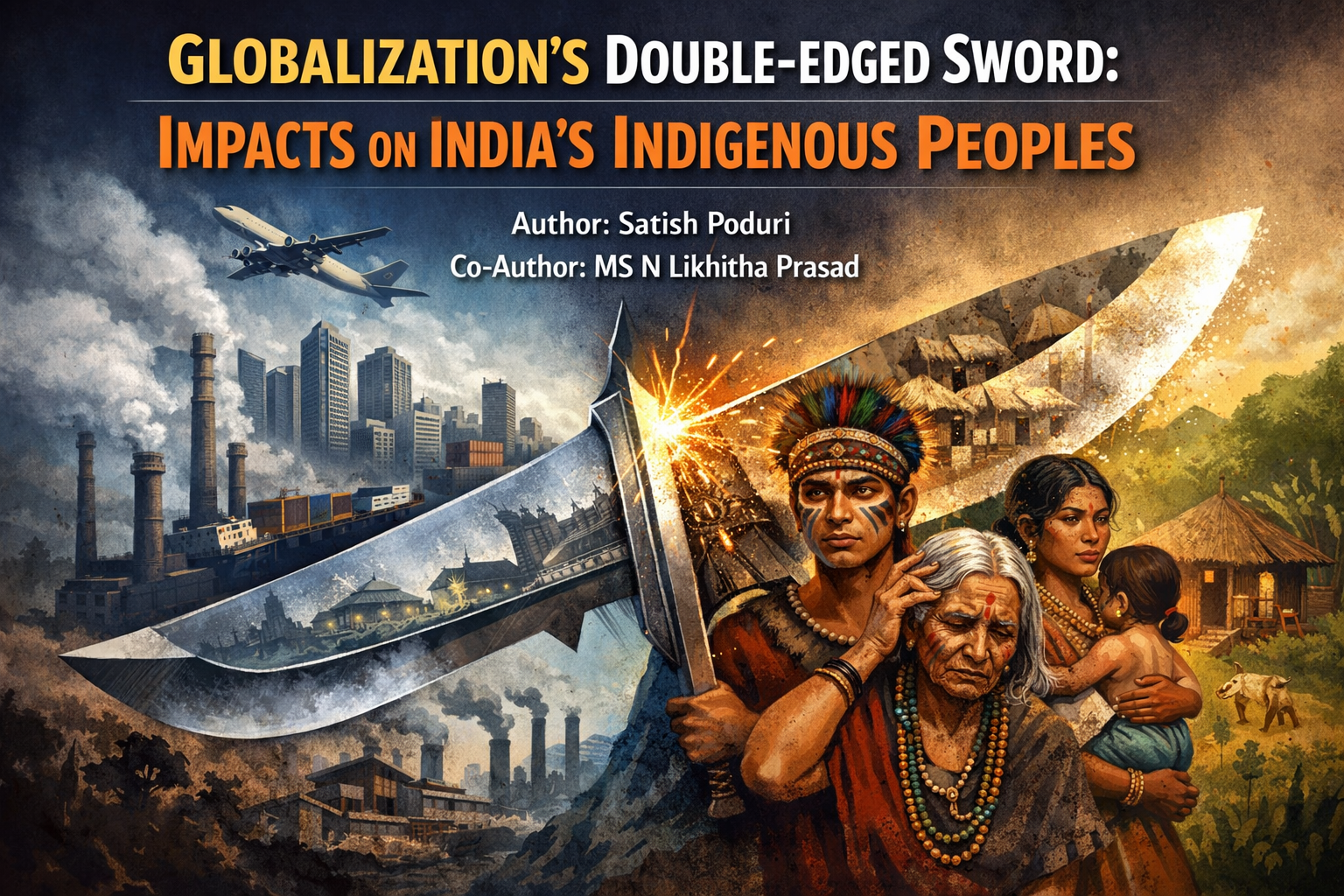
Globalisation has been a boon to the urban society but has proved to be a tool of exploitation to the tribals. It had a tremendous impact on their cultural and ethnic lives. Globalisation only widened the gap between the urban society and the tribal community in the sense, with global giants’market-oriented development philosophy, the traditional knowledge the tribals possessed was strangulated to push for the western knowledge. Tribals or Adivasi’s are an intrinsic part of the forests of India. They are the original settlers and they mostly live in forests, hills and other naturally isolated regions. There are different tribes who live in the forests right from their birth until their death. Many tribals earn their livelihood on the products the forest provides them. The constitution provides the required protection of the forests and the tribal community on the whole. Despite this constitutional protection a large population of this ethnic community is still very backward. Forest area has decreased due to development, leading the tribal people to look for alternative sources of income. This paper illustrates how globalisation affected their way of life and explains why the government must create unique regulations and initiatives to prevent traditional knowledge from becoming biopiated and mislabelled as Western expertise.
KEYWORDS
Globalization, Traditional Knowledge, Tribals, Adivasis’,Development
INTRODUCTION
Globalisation in the larger picture means world shrinking due to improvement of trade and commerce wherein in increases interconnection and interdependences of the citizens of the globe. It affects every single person on the planet, either directly or indirectly. Globalisation is the modernising of the world as a result of scientific and technological advancements that affect people’s daily lives. As a result, some nations exploit their advantageous location, and individuals from less developed or impoverished nations relocate to wealthy nations in search of better opportunities, causing a cultural divide between the original residents and the newcomers. Although the Indian constitution has given tribal populations a number of protections, they are still the country’s most marginalised and discriminated-against groups.
MEANING OF GLOBALIZATION
Globalization means the increasing interconnectedness and interdependence of countries through the exchange of goods, services, information, ideas, people, and culture across borders.
It involves the integration of world economies, made easier by advances in communication, technology, and transportation. In simpler terms, it’s the process by which the world is becoming more linked and unified — like one global community.[1]
Economically, it means trade and investment flow more freely between nations. Culturally, it spreads ideas, languages, and lifestyles. But it can also bring challenges, such as inequality or cultural homogenization.
A way to picture it: globalization is like the world “shrinking” — not physically, but in how quickly and easily things can move from one place to another.
DEFINITIONS OF GLOBALIZATION
The World Health Organization (WHO) defines it as “the increased interconnectedness and interdependence of peoples and countries,” involving open borders for flows of goods, services, finance, people, and ideas, alongside supportive policy changes.[2]
Sociologists Martin Albrow and Elizabeth King describe it as “all those processes by which the people of the world are incorporated into a single world society.”[3]
Anthony Giddens calls it “the intensification of worldwide social relations which link distant localities.”[4]
The IMF views economic globalisation as the growing integration of economies through trade in goods, services, capital, labor, and technology.[5]
THE GLOBAL IMPACT
Globalisation had a tremendous impact of the original inhabitants of the land. Their dwellings diminished by rapid industrialisation and increase in trade and commerce due the demand from across the world over. People wanted goods that were manufactured half way across the globe which created a demand for the goods. Due to this spike in demand the manufacturers increased their production units for which forest lands and natural resources were compromised. Multinational companies with deep pockets started dumping their goods in poorer countries thereby impacting local industries which shut down due to consumer base shifting to the newer products. This created a void in the local entrepreneurs to take risk in their businesses.
THE INDIAN SCENARIO
Globalisation in fact is not a new process as far as India is concerned. Trade and commerce existed between the Indian Kingdoms and their counterparts in Africa. The sculptor of a giraffe in a boat on the walls of Konark Temple is an example that maritime trade existed even before the Europeans came with a sea route. Traveling for trade always existed with merchants taking their goods, ideas, knowledge and customs to lands as far as Mexico. However, displacement and migration of the Indian population was minimal as India was a flourishing civilisation and traveling from across the world visited India and have documented it.
The decline in trade and commerce started with the fall of Constantinople and the decline in the kingdoms in India. This forced the Europeans to find a sea route to continue the trade which started the colonialisation of India.
The British colonialisation was the first incident of regressive impact of globalisation. British products were dumped and India products were taxed forcing Indian to go for Swadeshi movement. The British carried India people as poor labourers to all their other colonies to work in the tea estates or in mining. The migration was mainly to the Caribbeans and Africa. This migration created a melting pot to customs and cultural practices of the indigenous people as well as migrants. New customs formed due to the amalgamation of different cultures and customs due to migration.
British imperialists started impacting the tribals and other original inhabitants by displacing them of their original habitats and fiddling with their customs and practices. This was the turning point of the indigenous knowledge getting diminished in a phased manner. The medicinal herbs and the practices that were part of their lifestyle was snatched from them and in that place western practices were forced on them. The tribals follow the natural law theory and the intrusion of alien culture and practices created a disturbance to the tribal way of life and a fewtribes extincted due to this effect.New diseases which were unheard by the tribals impacted them due to the change in their life style.
The word “tribe” has administrative and legal meanings in India. Tribes are defined by the Indian government’s Ministry of Tribal Affairs as: “such tribes or tribal communities or parts of or groups within such tribes or tribal communities as are deemed under article 342 to be schedule tribes for the purpose of this constitution”.[6]
India is home to a wide variety of ethnic groups, each with its own language, economy, and sociocultural system. According to the 2011 census, 8.6% of the country’s population is tribal. Different tribal practices were developed over time, and have been adapted since time immemorial. These people developed environmental management, Bio diversity, traditional medicine, art and architecture. India has a strong and vibrant population with different cultural practices. Through oral traditions, each group or society has created its own knowledge systems over many centuries. It also entails not sticking to conventional medical procedures and remedies like herbs and spices. As global pharmaceutical firms gained traction in India, traditional medical methods such as Ayurveda, Yoga, Unani, Siddha, and Naturopathy were affected.
Globalisation as a policy was undertaken by the government of India in 1991. The Liberalisation, Privatisation and Globalisation created positive impacts like employment, improvement of life style and urbanisation wherein it had tremendous negative impact of the tribals by depriving their land, resources and inequality in opportunities.[7] While the Urban population reaped the benefits, the rural and tribal population bore the brunt of globalisation. In India, globalisation has resulted in a troubling situation where a huge vulnerable rural and tribal population has been denied access to the benefits of progress while a privileged elite group enjoys them. Following the government’s 1991 policy, the processes of liberalisation, privatisation, and globalisation resulted in an ambiguity of obvious and expanding equality. Tribal people have been denied the advantages of economic expansion while a select few have benefited from growth and progress.
When globalisation as a policy started in 1991, it was implemented as a Liberalisation Privatisation and Globalisation hampering income distribution. Public limited companies were sold in the name of disinvestment. The new policy shift moved from a workman centric to market centric. This paradigm shift hit a fatal blow on the tribals as they lost employment in the name of modernisation wherein machines replaced humans. The tribals were restricted from entering their own lands due to forest degradation.
One negative consequence of globalisation in India is the marginalisation of tribal people. Globalisation took away their way of life, means of subsistence, culture, and habitat in the name of progress. Since the beginning of globalisation as a policy, the number of tribal migrants in India has risen. Under the pretence of economic progress and development, commercial operations introduced foreign forces, cultures, and influences into indigenous groups’ traditional ways of life, which had the greatest impact on traditional medicine. In order to build opulent resorts that would draw tourists from all over the world, the wealthy elite political class, eager to profit from globalisation, uprooted the indigenous people from their ancestral lands and disregarded their environmental management. Increased foot traffic disrupted the flora and fauna of the remote areas and hills, resulting in an ecological disturbance or environmental imbalance. The National Bio-Diversity Strategy and Action Plan, the Bio-Diversity Act of 2002, the National Environmental Policy of 2006, and other national and state tourism policies have emerged in recent years as successive governments have explored the potential for eco-tourism development in biodiversity areas. Indigenous people have experienced anxiety and psychological trauma as a result of these advancements since they were causing an ecological imbalance, and the heartless bureaucracy was more interested in carrying out the projects than considering the negative consequences. Instead of taking a comprehensive approach to the situation, they just considered revenue. Many forest regions, including as national parks, wildlife sanctuaries, and reserved forests, were targeted for ecotourism based more on drawing foreign visitors and generating income than on a few eco-friendly practices. Important factors including the involvement and advantages of tribal people whose livelihoods depend on woods in such tourism, as well as the detrimental effects of tourism on biodiversity and eco-systems, were disregarded by the government and authorities. In a fragile ecosystem, unplanned tourism initiatives are harmful to the interests of the tribes, particularly indigenous women.
Despite the fact that these projects/initiatives have increased government revenue, indigenous women are nevertheless forced to spend twice as much for basic requirements due to the increased difficulty in obtaining drinking water. However, large-scale development projects, especially thermal plants, mining industries, and extractive mineral industries, were directed towards the tribal areas. These projects have provided these tribes with minimal benefits, such as cheap labour and land compensation, but they have also deprived them of their habitats, resources, means of subsistence, and identity. As a result of globalisation, a large number of tribal people were uprooted, and their way of life was deconstructed and denigrated for the purpose of development initiatives.Living and lifestyle displacement has additional traumatic, psychological, and sociocultural effects in addition to the loss of land. Their lives became more unpleasant and destitute as a result of these kinds of involuntary displacement.
Globalisation has brought trans organisational crimes to the door steps of the tribalswith the negative socio-cultural impactslike prostitution, trafficking on women and drug trafficking as the government has not done anything to improve the lives of these women and with it the callous nature of the authorities the tribal women were exposed to the harsh realities of globalisation.Women were allured into the negative socio-cultural impacts when globalisation impacted their food security. This raised due to the fact that women relied on agriculture and collecting of forest products and selling them which were deprived due forest land given to companies in the name of globalisation. Tribal women lost land, revenue and employment in this process which ended in their losing food security. Food is the basic need for human survival more so to a woman because she has to take care of the family. Losing food security indirectly forced the tribal woman into the negative way.In India, the trend of globalisation has enormous cultural potential. The country’s first people, the Adivasis, had their culture and identity deliberately and methodically destroyed as a result of developmental tactics implemented under the new economic policies.[8]
THE AFTER AFFECTS
India is predominantly an agrarian economy with about 70% of rural and tribal population generates revenue through agriculture. Most of the land is occupied by rural and tribal population who are mainly small land holding farmers, subsistence cultivators, herbalists, hunters, gatherers. These people depend on forests and other auxiliary produces of the forests. There are many opportunities to protect forests and biodiversity through traditional knowledge. For instance, one way to preserve biodiversity is through sacred groves or forest temples. It is appropriate to take into account how Western perspectives and the influence of non-Indian religions have contributed to the erosion of traditional knowledge by undermining the idea of sacred groves and sacred forests, which has its origins in animistic and traditional nature worship religions.
The Maldhari tribe of Gujarat and the Bishnois of Rajasthan are two examples of tribal people whose traditional techniques have helped conserve biodiversity. distinct processes that are used in the states of India are the Panikheti system, Apatani, Dafla in Andhra, Boro,dimasa techniquesinAssam, Kanaja techniquein Karnataka, Bidd cultivation in Rajasthan, etc.These are rebranded and pushed as western knowledge. This is only due to Biopiracy of the dominant nations which are controlled by seed companies. Many legal battles are fought at high costs for rights of the traditional knowledge.[9]
INITIATIVES OF GOVERNMENT OF INDIA
The Indian government created a number of laws to safeguard the indigenous people’s traditional knowledge. The most notable of these was the Biological Diversity Act of 2002, which requires grassroots Biological Management Committees (BMC) to play a major role in biodiversity conservation. The BMC creates a public biodiversity register that includes information about locally accessible biological resources, their therapeutic applications, and any customs related to them within their jurisdiction. However, as long as Indian biological resources are exchanged as commodities and not for any other purpose, this statute does not apply to them.The government established the Ministry of AYUSH to safeguard traditional medical knowledge, advance traditional medical practices, and ensure that the indigenous health care system is promoted as much as possible.
Furthermore, the National IPR Policy of 2016 recognises that monetisation of knowledge is not a part of Indian culture and further states that this non-monetization of knowledge is incompatible with the global scenario, which is why it calls for the transfer of knowledge into intellectual property assets. It also takes into account the traditional knowledge and interests of less viable intellectual property generators and holders. By this the indigenous people would get value and revenue through commercialisation of the assets.
The goal of the 2020 National Education Policy is to promote traditional knowledge. The development of traditional knowledge in education is another priority for the Ministry of Education.
CONCLUSION
Traditional knowledge is easily vulnerable to the misappropriation and misuse by modern science and technological lobbies with deep pockets. This is due to the low cost easy accessibility and efficiency of the traditional methods particularly in curing aliments. These systems were fragile from the inception and due to the colonialisation and urbanisation these traditional practices were shunned as superstitions and dangerous.
Today after few setbacks in terms of the efficiency of modern science and medicine in treatment of some diseases, the west recognises the significance of the traditional knowledge possessed by the tribals of India. At this juncture it is pertinent for the people of India and the government to acknowledge the traditional knowledge and should embrace the techniques and should in corporate them. It is also necessary that the benefits whatsoever should be passed down to the tribals, the original owners of the indigenous knowledge.
[1]Shashwata Sahu &Bidyutprabha Thakur, Law and Justice in a Globalizing World, First Edition, [Asia Law House – 2024.]
[2]https://youmatter.world/en/definition/definitions-globalization-definition-benefits-effects-examples/, accessed on 18 March 2026.
[3]https://en.wikipedia.org/wiki/Globalization, accessed on 18 March 2026.
[4] Ibid.
[5]https://www.imf.org/external/np/exr/ib/2008/053008.htm, accessed on 18 March 2026.
[6]http://tribal.nic.in/, accessed on 20 March 2026.
[7] Raja Mohan Rao K., Sabesh Manikandan M & Walter Leal Filho, An Overview of the impacts of changes in common property resources management in the context of globalization: A case study of India, The International Journal of Sustainable Development & World Ecology, 2009.
[8]https://niti.gov.in/, accessed on 20 March 2026.
[9] Rahul Kabiraj, Globalization and its impact on Tribal Society in India, Vol. 2, Issue 1, Asian Journal of Humanities and Social Studies, 2015.