- ABSTRACT:
This is the 21st century and people’s ideologies, thoughts and general perception towards trivial items have changed significantly. People have moved away from orthodox thinking and practices and embraced different cultures from all across the globe. India, in particular, is becoming more and more accepting of these changes, as long as it does not interfere with culture, tradition or religion. But with a population of a billion (and counting), the views on what’s acceptable and not in contravention with the culture is different for different communities. But there are a few practices which are still largely unacceptable, and one such practice is Public Display of Affection or “PDA”. In a country with population of more than a billion,and where Kama Sutra had originated, it is safe to say that there is no lack of intimacy or affection. But whenever two people try to show their appreciation towards each other in public, most of the times it leads to physical violence or being chastised and humiliated publicly, even though when there is no legislation which outrightly makes PDA illegal. In fact, the judiciary through several suits/petitions/cases has interpreted that, two people consensually kissing or hugging is not illegal and is no ground for filling petitions. But even after such clarifications time and again, many people have been blissfully ignorant of this, especially the country’s moral police. Moral policing has arisen,based on the idea that western culture corrupts Indian morals and values. There have been several incidents where people have bashed young couples on the ground of indulging in PDA which is apparently,against Indian culture. But who is it to decide whether PDA is a part of the Indian culture or not? India has often termed itself as developing and modern, but issues such as PDA are often met with regressive and orthodox view. In this article, I analyze the legal provisions and judicial interpretations with respect to Public Display of Affection in India.
INTRODUCTION:
In European or North American Countries, “Public Display of Affection” or PDA is a rather common and perfectly normal practice. Several people consider it as a form of expression of their love and affection towards their loved ones. People hold hands with their partners, hug them, kissthem at airports, but in a country like India, which is still profoundly connected to its rich culture and history, PDA is highly opposed and balked. But what exactly is PDA? It can be defined as “an act that displays a person’s affection for another person in public”.
In India, any couple engaging in PDA is subjected to physical violence and it usually does not matter if the couple is married or not, but in most of the scenarios unmarried couples are more prone to degrading and debasing. Many times, the country’s “moral police” take it up as their job to discipline such people, and the activity of disciplining largely involves beating them with sticks. And all this is done in the name of upholding the cultural integrity and morals of the Indian society. Many a times, the moral police have also taken the defense of religion and hence justified their violent actions as being against the religious ideologies and practices. On 24thOctober 2014, a group of activists belonging to the youth wing of the nation’s ruling party, Bhartiya Janta Party (BJP) erupted into a café, which was located in Kozhikode, Kerala. Once inside the café, they smashed windows, broke chairs and other items. Later it was found that the reasoning behind such an activity was that they believed that café was encouraging “immoral values” which included couples holding hands and kissing. This incident was followed by demonstrations and protests dubbed, “Kiss of Love”. Demonstrators held hands, hugged and kissed to show affection and love in public sphere.
While activities such as holding hands or hugging is not considered PDA, kissing, the act of “making out” or other sexual activities are considered PDA and are highly castigated. It is important to know that, sometimes couples might be criticized for no apparent reason and activities like giving a peck on your partners lips might not be obscene but other activities like kissing passionately or sensually touching your partner can be considered obscene as it has the tendency of making people present around highly uncomfortable. The most vulnerable people with respect to PDA are the women and those who belong to the LGTBQ community. Women in our society are expected to be “pure” and the whole family’s reputation is decided by what the woman of that family chooses to do. Women are shamed and humiliated, much more than a man is. In the same way, the LGBTQ community has always been crucified not just by the public but also by police and other authorities. This was until the landmark judgement of Navtej Singh Johar v. Union of India[1] where the court read out s.377[2] of the Indian Penal Code and made it plenty clear that consensual sexual intercourse between people of the LGBTQ community is not a crime. But the truth remains that even after this, they are subjected to physical and mental violence.We live in a country where people don’t shy away from showing their affection and this is plenty clear by the sheer number and size of the country’s population.
- LEGISLATION AND JUDICIAL INTERPRETATION WITH RESPECT TO PDA IN INDIA:
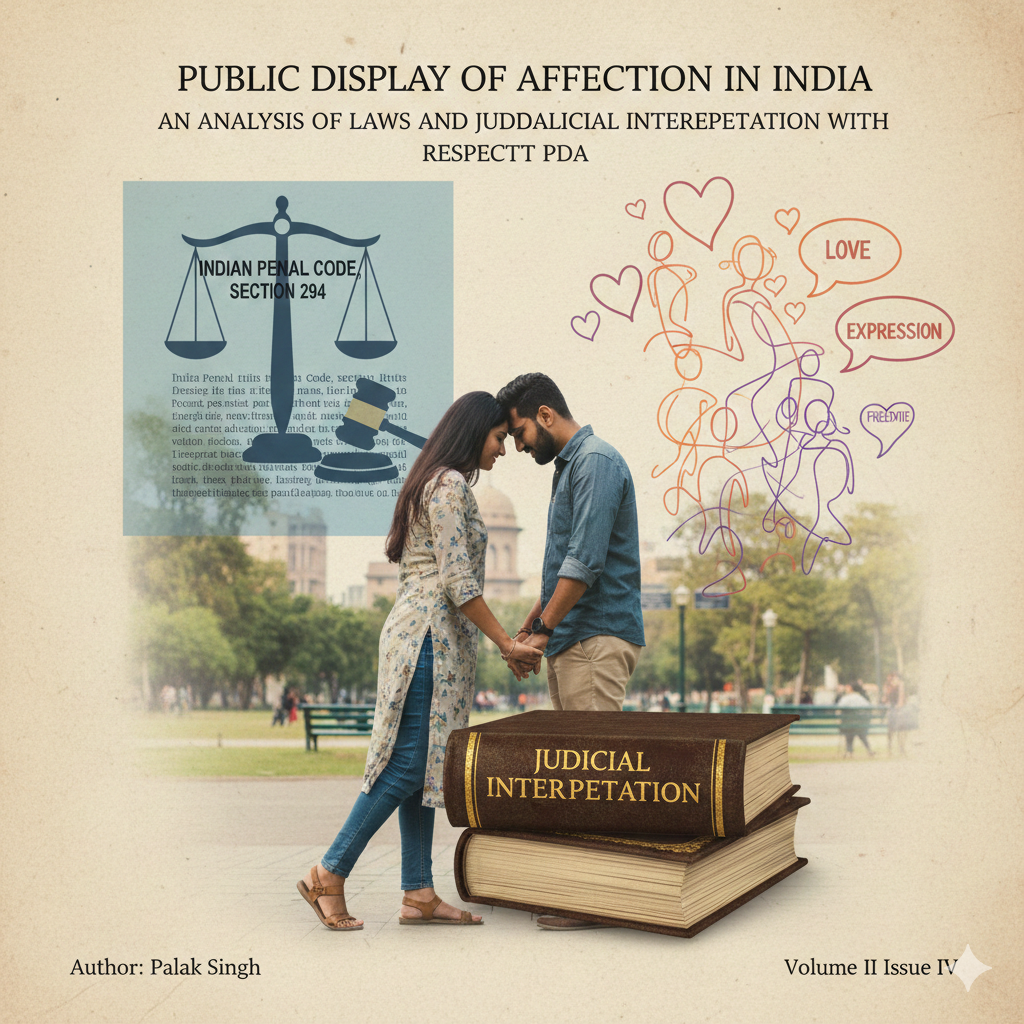
While there is no particular lawwhich particularly focuses on PDA in India, s.294 of IPC talks about obscene acts and songs.
Section 294 of the Indian Penal Code (hereinafter referred to as IPC) states:
“Whoever, to the annoyance of others,
(a) does any obscene act in any public place, or
(b) sings, recites or utters any obscene songs, ballad or word, in or near any public place,
shall be punished with imprisonment of either description for a term which may extend to three months, or with fine, or with both.”
IPC does not give the definition of what qualifies as “Obscene”. Definition of obscene cannot possibly be narrowed down, as what may or may not qualify as obscene,depends on the situations and circumstances. The interpretation of the word obscene in its truest sense can only be ascertained by the judges in the Court of Law as there is no definition provided by the legislation, and therefore it mostly remains arbitrary.
In the landmark judgement of Ranjit Udeshi v. State of Maharashtra[3] the Apex court has stated that “IPC does not define the word obscene and this delicate task has to be performed by courts” If the highest judicial authority of the country finds it rather tough to define obscenity, then we can’t expect the public or police authorities to understand and implement the same. Nevertheless, the Supreme Court along with other High Courts across the nation has never held activities such as kissing or hugging as illegal.
While there are actions such as sexual activities, which if performed out in the public can be labeled as highly obscene, other activities like simply hugging or holding hands cannot possibly be categorized as obscene. Still, couples are beaten and called out if they do any such activity. Being married or not being married is also a very significant factor in PDA. A very infamous example of such moral policing is when groups of men wearing red or orange clothes get out on streets and parks on Valentine’s Day, search for couples and beat them up for allegedly tainting the image of the Indian heritage and culture. Many a times, the western culture is blamed for the changes associated with the coming of new generation. They have termed this as “Americanization of India”.[4]
But, the most controversial question that still remains is whether “kissing” is allowed in public or not? The Indian Constitution under Article 19(1)(a) states that freedom of speech and expression is a fundamental right, and no one can be deprived of the same. Although, this right has certain restrictions as stated under Article 19(2),[5] but it cannot be deduced whether the law of obscenity would come under the restriction. The Apex court has gone on to say that no action can be brought against the act of consensual kissing, and s.294(a) of the IPC clearly states that the act must be of such an extent that it could cause annoyance to others. Supreme Court in the case of S.Khushboo v. Kanniammal&Anr[6] held that “obscenity should be gauged with respect to contemporary community standards that reflect the sensibilities as well as the tolerance level of an average reasonable person.” Court has also stated that the “fundamental freedom under Art. 19(1)(a) can be reasonably restricted only for the purposes mentioned in Art.19(2) and the restriction must be justified on the anvil of necessity and not the quicksand of convenience or expediency…intolerance is as much dangerous to democracy as to the person himself.” Hence, by keeping this principle in mind, it can be deduced that while a couple kissing in a metropolitan city such as that of Mumbai won’t be a big deal, but the same couple kissing in a small town of Bihar or Uttar Pradesh would probably be beaten and cursed for the very same activity. An example of this is when a swiss couple was attacked by a group of people in Fatehpur Sikri for kissing in public.[7]
The Supreme Court has stated that “no case can be made out of two people consensually hugging and/or kissing.” This verdict was in response to a petition filed by Richard Gere to quash the arrest warrant issued by a Jaipur court after the actor had embraced Bollywood actress Shilpa Shetty in a kiss at an AIDS awareness program.
In several cases, various courts have taken a collective view stating that “Indian judiciary at the higher levels has not universally treated kissing in public as illegal. In appropriate context, spelt out variously by the relevant judgments, it has been seen as an expression of love, expression of compassion, and its artistic representation as defensible. Absent in all these cases is the tendency to presume that every kiss is an act of sexual expression and that indulging in this act in public is always obscene.”[8]
Now that it is established that kissing or hugging has never been illegal in our country, we need to understand that the ubiquitous presence of the practice of moral policing has put lives of many people, especially youngsters, at risk. There are large number of people who think of kissing or any other practice of showing one’s affection towards their partners as immoral and against “cultural” or “religion” and hence even after clear indication from the top Judicial authority of the country, people refuse to accept PDA.
CONCLUSION:
Showing affection towards your loved ones should never be objected to and people should have the freedom to showcase their appreciation for their partner. But it should be kept in mind that displaying affection in front of a public towards your significant other can be twisted and taken in a different way as, there is a fine line between PDA and obscenity. People should keep in mind that while engaging in such display of affection, it does not make any other person uncomfortable. However, it is to be remembered that the Constitution of India guarantees to its citizens that they have the freedom to express their feelings and therefore, anything which does not make the third person uncomfortable, shall not be objected to. Indian Society is deeply attached to its roots and hence can have certain orthodox opinions. But the youth today is making sure that this changes and that the country becomes a more accepting place for the future generations to come.
[1]Navtej Singh Johar v. Union of India, (2018)AIR 2018 SC 4321 (India).
[2]The Indian Penal Code, 1860, No. 45, Acts of Parliament, 1860 (India).
[3]Ranjit D. Udeshi v. State of Maharashtra, (1964) 1965 AIR 881 (India).
[4]Akash Kapur, How India Became America, The New York Times (March 4th, 2012), https://www.nytimes.com/2012/03/11/opinion/sunday/how-india-became-america.html .
[5]INDIA CONST. art. 19, cl. 2.
[6]S. Khushboo v. Kanniammal&Anr, (2010) AIR 2005 SC 9 (India).
[7]Karl Rock, Is PDA (Public Display of Affection) Safe in India?, Karl Rock’s Blog (October 30th, 2017), https://blog.karlrock.com/pda-public-display-affection-safe-india/.
[8]A & B vs State The. N.C.T. of Delhi,(2009) CRL.M.C 283/2009 (India).