I Abstract
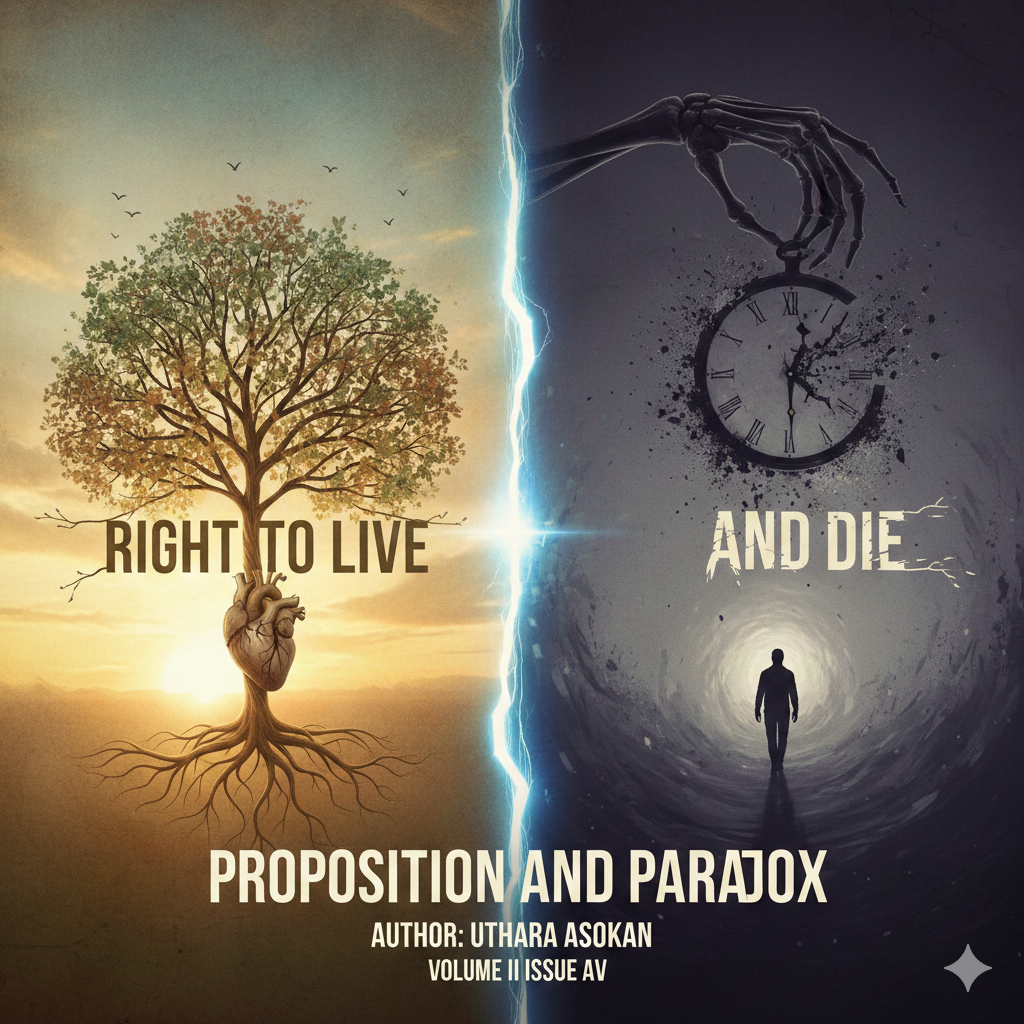
Right to life is always considered to be a natural right. It is a right that every human poses. Before a person is born, right to life is conferred on that person. Hence its relevance is inevitable. The scope of right to life as enshrined in Article 21 of the constitution is still a moot issue. Article 21 by its phraseology is not absolute and always subject to the procedure established by law. This article is to be tested in the backdrops of article 25 also as this paper is confined to the scope of article 21 with reference to religious practices. Right to die is not so common as constitution does not reflect the same through any articles under it. Hence there is always an ambiguity with regard to whether right to life includes in it the right to die. In this paper both the views are suggested for further deliberation. The first view is that Right to life does not include right to die and the second view is that the right to life include right to die also. Reliance on Article 25 is more emphasized by the supporters of view 2. The question whether right to life includes right to die on a religious considerations has not attained finality. The issue agitated ended up in conflicting views by the courts. In this paper I have therefore included both the views through case laws to have a final conclusion on the issue, particularly the scope of Article 21 of the constitution with the touch stones of religious practices.
II Introduction
Under the Indian Constitution, Right to life is considered as one of the most important fundamental right. Article 21 guarantees the right to life. The words and phraseology used in the article itself demonstrate the scope of the right visualized in this article. The right to life shall not be deprived to citizen subject to the procedure that is established under the law. The issues cropped up as to the extent of limitations contemplated by this article – Article 21.In legal parlance also, this right always became a debatable issue and by now the contours of this right is almost crystallized. But in some areas referable to this right, issue still remains unsettled. One such aspect is demonstrated in this article i.e. whether right life includes right to die or not. Scope of article 25 is clubbed along with this issue under article 21 gives a wide range of opportunities to develop a systematic development with regard to the question posed above. Right to die always arose in the context of one’s religious beliefs with uncertainty. Death is considered as attaining salvation in many religions under its practices. But whether it can be exercised as of right and unoffended by other statutory provisions also led to controversial issues before court in the touchstones of Articles 21 and 25 of the Constitution of India. To commit suicide is an offence under the Indian Penal Code. Whether practicing death as a religious belief is to be considered as suicide or not is still a moot issue before the courts.
III Right to life does not include right to die
Right to Life does not include right to die or right to self-destruction. Right to life is a basic natural right of the human beings. It is a fundamental right guaranteed under Part-III of the Constitution. Article 21[1]of the Constitution statesno person shall be deprived of his life or personal liberty. It confers an obligation on the state to ensure good quality of life and also a dignified life to the people, which is the positive aspect of the article. Hence state has a definite role to interfere if it affects the moral value that has to be followed. Religious practice whereby which death is being practiced have to be considered morally incorrect as it destroys the human ethics and the social message that gets spread becomes very much disturbing.
In the case of Kharak Singh v. State of Uttar Pradesh[2], Hon’ble Supreme Court held that, the term life as here used something more is meant than mere animal existence. The deprivation of which shallextend to all those limbs and faculties by which life is enjoyed. The provision prohibits the mutilation of the body by amputation or pulling out an eye and so on. No person has the right to destruct himself, and state has a responsibility also. Such religious practices should never be encouraged as it becomes a gross violation of Article 21 enshrined in the Constitution. In the case ofNikhil Soni v UOI[3], declared this practice as illegal considers it to be equivalent to suicide and thereby attracts section 306[4] and section 309[5] of the Indian penal code. The court declared this practice method of attempting suicide that is illegal and against the laws of the land because Article 21 of the constitution grants the citizens of India Right to lead a proper life under article 21 but not the Right to die. [6] If any sound person tries to commit the same it shall be constituted as attempt to suicide and shall be punishable. In GianKaur v. State of Punjab[7],Right to life’ is considered to be a natural right which is embodied in Article 21 and is considered to be in total non-compliance with right to die. Article25 of the Constitution -.Freedom to practice and propagate religion and is subject to public order, morality and health. In,Durgah Committee v. Hussain Ali[8], MahantJagannathRamanuj Das vs The State of Orissa[9] and Sri VenkatamonaDevaruvs The State of Mysore[10], the Court held that Articles 25 and 26 provides only vital and important parts of religion immunity from state intervention. It also held that the immunity is given to not just the matters of doctrines or belief; but it also extended to acts done in furtherance of religion which includes rituals, ceremonies, modes of worship and so on which are considered to be very basic parts of the religious practices. The Court also made apoint as to no immunity can be used to protect mere superstitions and unnecessary religious practices. Hence what has to be taken note is that such practices of death as a religious practice are mere superstition and an unnecessary religious practice without a strong customary backing. In the case of Saifuddin v State of Bombay[11], Freedom of religion does not allow a man to commit human sacrifice, in the case of Arver v US[12], position in the case of Saiffudinis maintained. The same position is reflected even in Cf.RamjiLal v State of UP[13]
The doctrine of “essentiality” was invented by a seven-judge Bench of the Supreme Court in the ‘Shirur Mutt’ case[14] -The court held that the term religion will encompass all rituals and practices that are vital and very much integral to a religion, and took upon itself the responsibility of determining the essential and non-essential practices of a religion. Essential religious practice is an important doctrine evolved by the court to protect only such religious practices which were essential and integral to the religion. Dr M Ismail Faruqui and Orsvs Union Of India and Ors[15]’which upheld the law under which the Centre acquired the disputed land in Ayodhya on which the Babri Masjid had stood, the Constitution Bench had ruled that , a mosque is not considered as an essential part of the practice of the religion of Islam and namaz by Muslims can be offered at any place, even in the open. In the case of Commissioner Of Police &OrsvsAcharya J. AvadhutaAndAnr[16], the court prohibited carrying and dancing with human skulls with weapons in public road in Kolkata against the morality and can cause fear in the minds of people. Held that not essential part of the Anand Margi faith.Essential part of a religion is from the beliefs from which the religion originated. Death is also something that creates fear in the minds of people, hence such practice should notbe given consent to practice freely.InAdithayan v Travancore Dewaswom Board[17], any custom or usage irrespective of any proof of their existence in pre constitutional days cannot be countenanced as a source of law to claim any right when it is found to be violative of human rights, dignity, social equality and the specific mandate of the constitution and the law made by the parliament. The practice of giving up life as a religious practice is violation of law and is against the social decency. Such practices can even be persuasive for people to follow the same. Article 18 (3) of ICCPR[18]states as follows- Freedom to manifest one’s religion or their beliefs may be subject to certain limitations as are prescribed by law and are necessary to protect public safety, health, morality and so on or the fundamental rights and freedoms of others. Hence what is to be noted is that Right to die does not fall under Right to life as it is constitutionally unacceptable.
IV Right to life includes right to die
Right to Life includes Right to die. Article 21 of the Constitution of India, 1950 provides that, a person should not be deprived of his life and personal liberty. Right to life is one of the crucial fundamental rights that is guaranteed under the constitution and which helps a man to meaningfully complete his life. There are various religions across India that believes in Right to life includes right to death and have death as a religious practice among them. As the constitution have laid down Article 21 in such a manner that it deems to include right to death in right to life as it is an individual’s decision whether to carry forward a life which he/she feels meaningless and to meaningfully end it as per his /her discretion. In Sunil Batra v. Delhi Administration[19], the Supreme Court held that the “right to life” includes the right to lead a healthy lifein order to enjoy all faculties of the human body in their prime conditions. It also encompasses right to protect ones tradition, culture and whatsoever that gives a proper meaning to that person’s life.Correlating the position in this case of the Hon’ble Supreme Court, if any of the communities aretrying to preserve their traditional religious practice which is an essential component then that should be held valid.
Death by slow starvation is a practice that is embraced by the Jain community, it is an act of embracing death which is being practiced by such communities.A similar practice is reflected in Hinduism also, suicide by fasting by a person, a person who has no desire left, and no responsibilities remaining in life. Various instances in which religious practice have been followed are quoted under – In the year 1982, Acharya VinobaBhave (spiritual successor of Mahatma Gandhi) died by prayopavesa[20]. In November 2001, SatguruSivayaSubramuniyaswami also gave up his life through prayopavesa. Pipel and Amsel “Contemporary proponents of ‘rational suicide’ or the ‘right to die’ usually demand by ‘rationality’ that the decision to kill oneself be both the autonomous choice of the agent desired by liberals, and ‘a best option under the circumstances’ choice desired by the stoics or utilitarian, as well as other natural conditions such as the choice being stable, not an impulsive decision, not due to mental illness, achieved after due deliberation, etc.[21]
The Jain religious practice of starving to death known as the Santhara/ Sallekhanais seen as a self-purification. Here the person does not take food or water if he is aiming to end his life.Article25(1)[22] of the Indian Constitution states the freedom to practice and profess ones religion which is subject to public order, morality and health. Article 26[23] of the Constitution states the Freedom to manage religious affairs which is also subject to public order, morality and health. This article gives right to every religious denomination to manage its own affairs in matters of religion, stated under clause b of section 26.
Under the Hindu religion, 4 important objectives are Dharma, Artha, Karma and Moksha. One believes that his body attains purity and satisfaction through moksha. It is to be considered as a moral right, article 26 of the constitution provides for taking forward the religious belief without any inhibition and also in no way this act leads to affecting the moral principles of a community, as this is a religious practice it should be respected in all terms. India is a country that is secular, it does not have a religion but it protects and safeguards all the religions. In that scenario, religious practices should be free and there should not be any constitutional restrictions.
The apex court in ‘RatilalPanachand Gandhi vs The State of Bombay and Ors’[24] acknowledged that “every person has a fundamental right to entertain such religious beliefs as may be approved by his judgment or conscience”. Durgah Committee v. Hussain Ali[25], MahantJagannathRamanuj Das vs The State of Orissa[26] and Sri VenkatamonaDevaruvs The State of Mysore[27], the Court held that Articles 25 and 26 provides only the essential and the vital parts of religious immunity from state intervention. It also held that immunity is not just given to matters of doctrines, it also extends to acts that is done in furtherance of the religion such as the rituals, ceremonies, modes of worship etc which are very much fundamental for that religion. With these positions, Right to death needs to be considered as an essential religious practice if such community so believes.No outside authority has any right to say that these are secular activities.[28]In Commissioner of Police v AcharyaJagadisharanandaAvadhuta[29], what constitutes an essential part of religions primarily to be ascertained with reference to the doctrine of that religion itself and the court cannot say that belief is not part of religion. In Jesse Cantwell v State of Connecticut[30], US v Ballard[31], SC judgments – Commissioner HRE v Sri LakshmindraThirthaSwamiar of Sri Shirur Mutt[32],in all these cases reliance was placed on JamshedjiCurseetjeeTarachand v Soonabhai[33], where it was held- If there is a belief that exist in the community, secular judge is bound to accept such a belief. In Bijoe Emmanuel v State of Kerala[34], Personal views and reactions are irrelevant. If the belief is genuinely and conscientiously held, gets the protection under article 25. The only constituent that determines whether right to die can be allowed or not is the concept of essential religious practice. A religion when it solely believes that right to death is an inevitable practice, then such practice should fall under right to life. Purpose of attaining salvation might be an important criterion for certain religious group and such beliefs might be embodied in it since time immemorial, which thereby becomes a custom and it should be well accepted. Constitution cannot interfere in such matters, for those people who believe this life is materialistic can very well make it more meaningful and divine by taking up death as an option to attain salvation. If any court tries to stop people from carrying out such religious practice, it might end up as an instigation to commit suicide. Hence, right to die has to be seen as a embodied element in right to life.
V. Conclusion
This paper have covered both the views of whether right to life includes right to die or not touching the religious aspects as this is a current standing issue which does not have attained finality. I believe that in order to reach a finality both the pros and cons and the arguments in support of either views have to be known, keeping that as a prime focus I have prepared this article. I believe, right to life should not include right to die as life is of utmost importance that from the time of birth till death, state has a responsibility over its citizens and any day, religious superstitions have to be brought down by not allowing any religious groups to continue such superstitious beliefs and not harming ones religion.
[1]INDIA CONST.Chapter III, art. 21.
[2]Kharak Singh v. State of Uttar Pradesh,1963 AIR 1295, 1964 SCR (1) 332
[3] Nikhil Soni v UOI,2015 Cri LJ 4951
[4]Indian Penal Code, S306, 1850.
[5]Indian Penal Code, S 309, 1850.
[6]The wire, Feeding Life into the Santhara Debate,( Nov.19 2015),https://thewire.in/law/feeding-life-into-the-santhara-debate.
[7]GianKaur v. State of Punjab,1982 AIR 1473, 1983 SCR (1) 456.
[8]Durgah Committee v. Hussain Ali,1961 AIR 1402, 1962 SCR (1) 383.
[9]MahantJagannathRamanuj Das vs The State of Orissa,1962 2 Suppl. S.C.R. 496.
[10]Sri VenkatamonaDevaruvsThe State of Mysore, 1954 1 S.C.R. 1005.
[11]Saifuddin v State of Bombay, 1962 AIR SC 853.
[12]Arver v US, 245 US 366 (1918).
[13]Cf.RamjiLal v State of UP, 1957 AIR SC 620.
[14]Commissioner HRE v Sri LakshmindraThirthaSwamiar,1954 AIR 282, 1954 SCR 1005.
[15]Dr M Ismail Faruqui and Orsvs Union Of India and Ors, 1995 AIR SC 605 A.
[16]Commissioner Of Police &OrsvsAcharya J. Avadhuta And Anr,1983Cril.J. 1872.
[17]Adithayan v Travancore DewaswomBoard, 2002 AIR SC 3538.
[18]United Nations General Assembly, International Covenant on Civil And Political Rights, Art 18 (3), 23 March 1976.
[19]Sunil Batra v. Delhi Administration, 1978 AIR SC 1675.
[20]Robert D. Mcfadden, VinobaBhave, a gandhi disciple and social reformer dies at 87, (Nov.16, 1982),
[21]Pipel and Amsel, Whatis Wrong with Rational Suicide, (Jul.22, 2011), https://www.researchgate.net/publication/225662355_What_is_Wrong_with_Rational_Suicide.
[22] INDIA CONST. Chapter IV, art 25.
[23] INDIA CONST. Chapter IV, art 26.
[24]RatilalPanachand Gandhi vs The State of Bombay and Ors,1954 AIR 388, 1954 SCR 1035
[25]Durgah Committee v. Hussain Ali,1961 AIR 1402, 1962 SCR (1) 383
[26]MahantJagannathRamanuj Das vs The State of Orissa, 1962 2 Suppl. S.C.R. 496.
[27]Sri VenkatamonaDevaruvsThe State of Mysore, 1954 1 S.C.R. 1005.
[28]Durga Das Basu, Commentary on the Constitution of India,pg 3486, (8th ed., Justice YV Chandrachud, Justice S.S Subramai and Justice BP Banerjee, 2008).
[29] Commissioner of Police v AcharyaJagadisharanandaAvadhuta ,2004 AIR SC 2984
[30]Jesse Cantwell v State of Connecticut, 310 US 296(1940)
[31] US v Ballard ,322 US 78 (1944)
[32] Commissioner HRE v Sri LakshmindraThirthaSwamiar, 1954 AIR SC 282
[33]JamshedjiCurseetjeeTarachand v Soonabhai ,1909 ILR 33 Bom 122
[34]Bijoe Emmanuel v State of Kerala, 1987 AIR SC 748