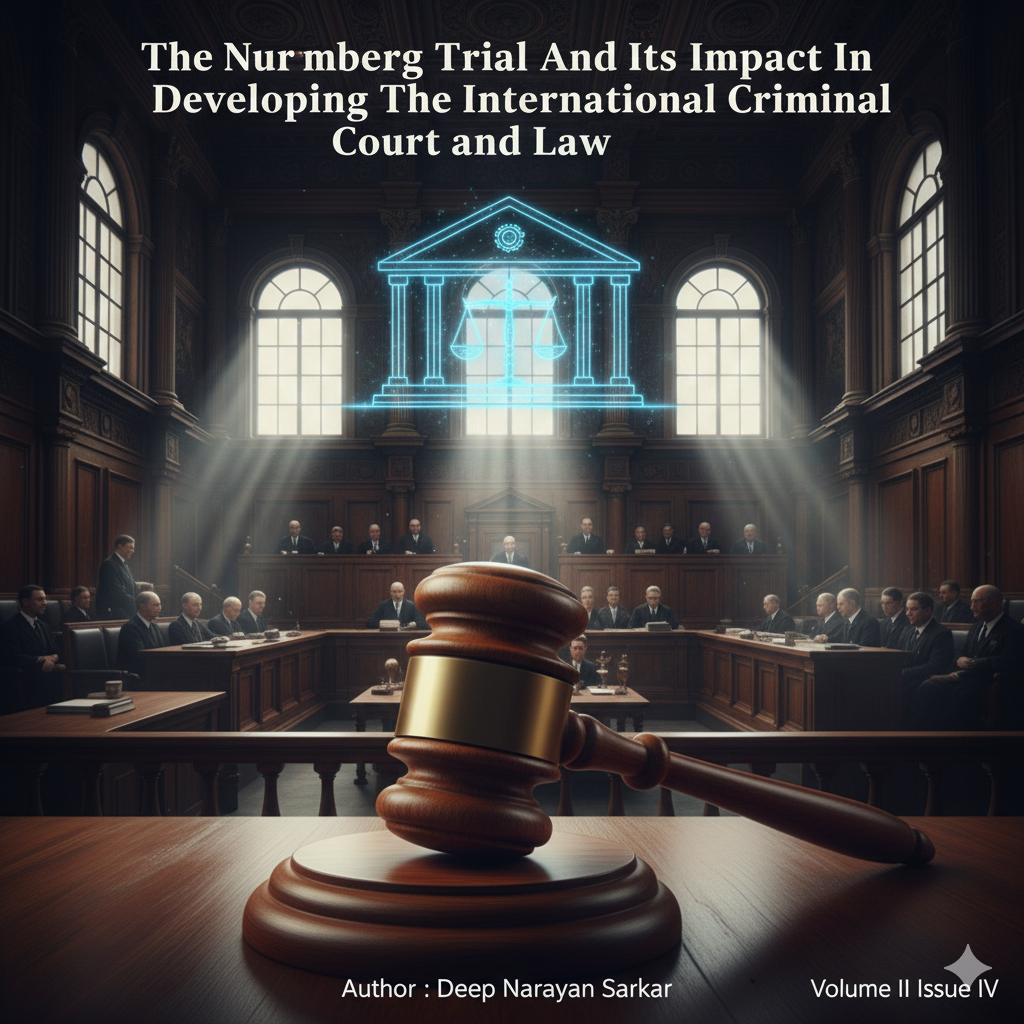
Abstract: The paper aims to show the establishment of the judicial system that came into place in order to try the criminals of the World War II through the Nuremberg Trial. Additionally, the paper aims to reflect and showcase how such trial was the first of its kind that the world witnessed which had an impetus impact on shaping the International Criminal Law in the present day. The first part will give a brief overview of the circumstances which led to the Nuremberg Trials and change in the mind-set of the Allied leaders who understood the importance to develop international law to try the war criminals of the World War II. Further, it highlights on the War Criminals’ Trial that occurred in Nuremberg. The third part will highlight on the development of the International Criminal Court and the law keeping in mind the Nuremberg Trials which was the first of its kind. The paper meticulously highlighted how the big powers have swayed international law in their favour to take control of all the countries in the world under the garb of lawful provisions. Needless to say, the international community was under the grasp of the powerful nations who had immunity from such international forums. They hardly paid attention to any adverse orders from such forum. The paper ends with a few examples of adjudication by the international criminal court in the 21st century to give a brief understanding of its working.
INTRODUCTION
The Nazi party came to power with Adolf Hitler as its leader and chancellor of Germany in 1933. He and his party began to implement barbaric policies to eliminate the German-Jewish people from the nation. Hitler’s regime used the ‘biological fascism and pseudo-social Darwinism as their dogma in order to create a pure Aryan race’[1]by eliminating the Jews, homosexuals and other groups that they thought to be inferior to the superior German race and destroy the sanctity of Germany. Over the years, such policies were popularized in Germany which resulted in inhuman treatment received by the so-called inferior classes that resided in Germany during his regime. As a result, by the end of the World War II, there were ‘state sponsored murder of some 6 million’[2] European Jews. Once the horrific World War II was over and the Nazi Party was overthrown from Germany, the Allied Leaders of France, Great Britain, the United States and the Soviet Union realised the dire need to hold a trial for the war criminals that were involved in the barbaric acts of mass killings and other crimes that violated the basic human rights of the citizens. It was difficult for the four big powers to reach to a conclusion as it was the first time such an attempt was undertaken in order to try war criminals by unifying the laws of different countries with ‘different legal traditions and practices’[3]into one. As a result, there were a lot of disagreement among the leaders of the Allied Forces with Winston Churchill opting for a summary trial of the offenders while Americans proposing for a fair criminal trial in order to give a chance to the offenders to level the allegations. After a considerable time spent on negotiations and incorporating everyone’s views into account, the Allied Leaders were successful to establish the laws and procedures for the Nuremberg Trials. This led to the formation of the London Charter of International Military Tribunal.The charter defined inter alia three defined categories of crimes:crimes against peace, war crimes and crimes against humanity[4].It was decided that both civilians as well as the officials could be tried in those categories. Nuremberg was decided as the place of the trial as it was the place where Nazi leaders held their annual rallies and meetings. Such a trial clearly marked the end of Hitler’s regime, the Third Reich. Further, it aimed to set an example to the global community by honouring the basic human rights of the citizens of every nationwho stood in the trial.
THE NUREMBERG TRIAL OF WAR CRIMINALS
The Nuremberg Trials was embedded in two major principles. Firstly, individuals who were responsible for committing serious international crimes should be duly punished for their actions.[5]The judgment of the Nuremberg Tribunal famously stated,“Crimes against international law are committed by men, not by abstract entities, and only by punishing individuals who commit such crimes can the provisions of International law be enforced.”[6].If such horrific acts of the individuals were overlooked then it could have rampant consequences on international peace and set a dangerous precedent. Secondly, the individual should only be punished by a fair trial to ‘safeguard the rights of the accused’[7] and respect their rights.This section will highlight the major War Criminal Trials and the subsequent trials that had taken place in Nuremberg. The format of the Trials of Major War Criminals was a ‘mix of legal traditions’[8]of the all the four Allied powers with each nation supplying two judges each i.e. one main judge and an alternate judge. The trial took place in the presence of the prosecutions and the defence attorneys and was much similar to that of the British and American Legal system. However, the decisions and sentences in such trial were rendered out by a Tribunal. Twenty-four people were accused and brought to the trial of the war crimes. This included major leaders of the Nazi organization. However, the main accused, Adolf Hitler and few of his close associates had committed suicide at the end of the war and hence could not be brought tothe trial. The trial went on for a year with each indicted man getting a chance to present their case through a lawyer of their own choice. The most common defence that each one of them took was that the crimes that were defined in the London Charter were ‘ex post facto law’[9]i.e. a law that made an act illegal but was legal when the act was committed. Thus, the accused termed the trial to be ‘victor’s justice’[10]because the trial indicated that the Allies were lenient towards their own men and harsh on the others. Hence, the charter was heavily criticized by the defence attorneys for its one-sidedness. According to them, justice was not met due to such an attitude and hence they too should be relieved of the crimes. However, their views were not considered and the tribunal punished them all. The punishments ranged from death penalty to years of imprisonment. This famous trial also saw the introduction of a new system in place. Such an integrated trial was required to maintain a synchronisation among all the people present at the trial. Since, there were people of various nationality who spoke in different languages, it was important to introduce a technology so that everything could be understood by everyone. Hence, it was the first time IBM introduced the instantaneous translator to bring a uniformity among everyone present there. They hired people from international ‘telephone exchanges to provide on-the-spot translations through headphones’ in French, English, German and Russian.[11]
In addition to the major trial, there were twelve minor trials where lawyers, doctors, businessmen and other professionals were tried for their involvement in the plans the Nazi organization. However, such trials differed from the main trial. This is because with each passing year, differences arose among the Allied powers and they drifted apart. Hence, joint trials were made impossible to hold. Thus, the other defendants which majorly included lawyers, doctors, businessmen were tried by the American Tribunal. The Tribunal found most of them guilty of ‘crimes against humanity’[12]and imprisoned them. The Major Trial of the Criminals and other subsequent trials were the stepping stone towards the development of a well-defined International Court and law. Such centralised court of international colour was requiredto put the crimes of global dispute under trial.
- DEVELOPMENT OF INTERNATIONAL COURT AND LAW
This section will primarily concentrate on the Nuremberg Trial along with other subsequent trials of the past which contributed in shaping the International criminal law. It is important to mention that the Nuremberg trials formed an integral part in development of the International law. They helped in giving rise to a new system of International criminal legal system. The national courts, ad-hoc international and mixed courts and the ICC were all incorporated in the system.[13]It is important to mention that the Nuremberg Trial was never intended to be a ‘mere historical event’[14]. Instead, it was believed that such a trial laid the foundation of the beginning of a new era of organised international criminal law. John Parker, one of the alternate judges’ in the Tribunal went to the extent of saying “It is not too much to hope that what we have done may have laid the foundation for the building of a permanent court with a code defining crimes of an international character and providing for their punishment.”[15]Such a quote from the wise man clearly proved that the Allies foresighted the Nuremberg trial as a stepping stone for the establishment of international law. Further, the findings at Nuremberg led to the direct formation of the United Nations Genocide Convention and the Geneva Convention on Laws and Customs and War. Also, the International Military Tribunal contributed greatly towards the trials of the Japanese Criminals in Tokyo.[16]
Though the Nuremberg Trial has shown a big step forward and a great vision, it was difficult to develop a definite international legal system for all. It was difficult to bring all the nations in conformity due to the onset of the Cold War that started between the two major powers of the world. The war hampered the growth of the new proposed legal system which was still at its infancy. While there was no development in the law, international crime flourished with the war criminals walking away freely without being punished. Hundreds and thousands of innocents were subjected to ‘war crimes, crimes against humanity and genocide’[17]in the past century. The world stood silence while horrific crimes occurred in Russia, Cambodia, Vietnam, Bangladesh, Philippines and many more. The leaders of the world were only alarmed when barbaric acts of ethnic cleansing took place in Yugoslavia and Rwanda. This led the UN Security Council to create an ad-hoc criminal tribunal to try the criminals of such barbaric acts and set an example for the future. Also, with the end of the cold war then, made it possible to initiate the formation of a permanent, international body to deter such horrific crimes from occurring in the future which was hampered in the past because of the tensions that existed among nations.[18]This led to the development of the permanent, international body of International Criminal Court.
INTERNATIONAL CRIMINAL COURT
The International Criminal Court (ICC) came into force in 1998 when it received the ratifications of 120 nations who gathered in a conference. The statute which was long awaited finally came into being. It was the first ever permanent, treaty based, international organization which aimed at establishing the rule of law and made sure that the most horrific crimes did not go unnoticed. The charter of the ICC was prepared by the International Law Commission (ILC) which included distinguished legal experts on an invitation from the General Assembly of the UN. The body submitted its draft statute in 1994. Finally, in 1996 the body submitted the ‘draft code of crimes against peace and security of mankind’.[19]This marked the era of a new world with international criminal law in place to conduct a fair trial for the accused to maintain a just world order under the law. Finally, the long-awaited statute came into effect with a jurisdiction to try genocide, war crimes and crime against humanity. The charter was duly signed by most of the member nation in the United Nation. Needless to say, the ICC has its roots from Nuremberg and was built on two core principles of it: ‘the need for accountability of serious crimes’ and the ‘importance of fair trial’.The maintenance of accountability is rooted in number of provisions that is embedded in Nuremberg. It is important to mention the two most important provisions. Firstly, at Nuremberg, an individual’s position as a Government official could not ‘absolve him of his duties’. Secondly, it was made clear in the Nuremberg trials that ‘acting under superior orders’ could not be considered as a defence. Such affirmation was also taken in the ICC’s statute which made crystal clear that everyone who is accused of international crime will be punished irrespective of their position.[20]Hence, the formation of such a permanent body clearly gave a much more stability to the world to regulate future atrocities, barbaric crimes and maintain world peace.
ICC’S WORKING IN THE 21st CENTURY
The last part of this paper will give a highlight of ICC’s work in the international forum and the working of the courts in recent times. The ICC has been very effective recently. They were efficient to revive justice in the Democratic Republic of Congo by sentencing prime war crime suspect of the Congolese region, Thomas Lubanga. They successfully tried the Congolese war lords, Germain Katanga and Mathieu Ngudjolo. The war lords accused of committing crimes of attacking civilians ‘using child soldiers’ and the ‘rape committed by subordinates’. Such horrifying crimes against humanity were dealt seriously by the ICC whose primarily goal was to revive peace in the affected area and create an environment of safety there. They were also effective in reviving peace in Ivory Coast by charging Lauren Gbagbo with ‘individual criminal responsibility on counts of crimes against humanity’. Few other activities where the body has been very effective is their intervention in African countries of Libya, Uganda, Kenya and Sudan.[21] They were quick to react at those affected areas and ensured at reviving peace in the countries.
CONCLUSION
This brings us to the end of the paper. It is my firm believe that the academic paper maintains a great coherence with the course of events in the past that led to the establishment of the international legal system. Also, I am hopeful that the paper has clarity of thought and will be successful in conveying its ideas to the readers. Further, I would like to make some comments on the topic. Yes, it is true that the Nuremberg Trial laid the foundation of developing an International legal system. Though, the idea saturated for a long-time due to the tensions of the Cold War yet the Leaders of the World buckled up and successfully established the ICC. Yes, it is true that the ICC has brought a change in the world and has been instrumental in maintaining world peace but it is important to put out that the ICC’s work is exclusively effective for the poorer and the weaker nations. The ICC is majorly controlled by the Big Powers like the US, Russia and as a result has no effect on these nations. Hence, the crime committed by these nations go unnoticed and justice is not served. Hence, it is time that we ponder upon the concept of a more neutral international court where countries will be treated equally. Such unbiased international forum will ensure that justice is served to the aggrieved party irrespective of their status while ensuring the core principles of international law. Such setting will ensure world peace which has been the prolonged desire of the international community.
[1]Tori Misrok, Implications of the Nuremberg Trials on the Trajectory of International Law, and the Reunification of German-Jewish Cultures(2014), https://www.binghamton.edu/philosophy-politics-and-law/pdfs/misrok-international-law-and-the-nuremberg-trials-research-paper.pdf.
[2]Nuremberg Trials, HISTORY (2010), https://www.history.com/topics/world-war-ii/nuremberg-trials.
[3]Id.
[4] History, supra Note 2.
[5] Philippe Kirsch, Applying the Principles of Nuremberg in the International Criminal Court, 3Washington University Global Studies Law Review 501-502 (2007), https://openscholarship.wustl.edu/cgi/viewcontent.cgi?article=1146&context=law_globalstudies.
[6]William A. Schabas, International criminal law Encyclopædia Britannica (2020), https://www.britannica.com/topic/international-criminal-law.
[7]Kirsch, supra Note 5, at 502.
[8]History, supra Note 2.
[9]Id.
[10] Misrok, supra Note 1, at 7.
[11]History, supra note 2.
[12]Id.
[13] Kirsch, supra note 5, at 501.
[14]Id.
[15]John J. Parker, The International Trial at Nuremberg: Giving Vitality to International Law, 37 A.B.A. J. 493 (1951).
[16] History, supra note 2.
[17] The Influence of the Nuremberg Trial on International Criminal Law, https://www.roberthjackson.org/speech-and-writing/the-influence-of-the-nuremberg-trial-on-international-criminal-law/.
[18]Id.
[19]Id.
[20] Kirsch, supra note, at 502-505.
[21]High-profile ICC cases, ABC News (2012), https://www.abc.net.au/news/2012-03-14/cases-before-the-icc/3888680.